The
precise date in which chopsticks were first used has been lost in time.
Archaeological evidence found in burial plots indicates they are at
least 3,200 years old though some scholars believe they've been around
even longer than that.
Even the evolution of
chopsticks is in debate. Some surmise that chopsticks evolved from
the practice of using wooden sticks to stir food as it cooked on large
pots over an open fire. Others believe that hasty eaters broke
twigs from trees to retrieve food as it cooked.
Whenever their origin
and whatever its genesis, chopsticks have, for thousands of years, been
the main tableware of the Chinese. By the Fifth Century A.D., the
use of chopsticks had even spread from China to present day Japan, Korea
and Vietnam.
The dualistic
philosophies of Yin Yang that seek universal balance and harmony even
posit a correct way to use chopsticks so that the user forges a correct
ration of sauce to meat. Their fundamental use remains unchanged
over time.
While many Americans
have mastered the etiquette and techniques for using chopsticks
properly, in the hands of others (including me), chopsticks become a
lethal weapon, the attempted use of which might result in someone's eye
being gouged out.
Ironically, the only
chopsticks you'll see when you walk into Chopstix Chinese Cuisine are in
the hands of deft users. On unoccupied tables, the place settings
are spoons, forks, knives and a napkin. What makes this doubly
ironic is that Chopstix, despite the Westernization of the name, is the
most authentically Chinese restaurant we've found in Albuquerque.
Since
its launch in 2005, I've received more e-mail about Chopstix than any
other restaurant I had not already reviewed. None of the e-mail
was more passionate or compelling than one from Tom Donelan who
described Chopstix as having "really excellent food with amazing and not
familiar flavors." Tom should know, having sampled 50 to 60 menu
items.
Chopstix is ensconced
in a nondescript shopping center on the northwest corner of Lomas and
San Pedro. It occupies the space which once held
Taeja, a Korean restaurant which closed
in 2004.
On its signage, the "x" at the end of the name Chopstix
resembles a pair of chopsticks. The bottom end of the chopsticks
(the end used for picking up food) is tapered to a blunt end.
That, we quickly found out, is where the "Westernization" ends.
The
menu at Chopstix is very similar to what you might find in the Chinatown
district of a large Cosmopolitan city such as San Francisco. Every
item on the menu is spelled out in English and in Chinese and is
accompanied
by a photograph. A plethora of healthful options, very
unlike the fried and candied entrees in almost every Chinese restaurant
in Albuquerque, makes this menu unique.
The menu includes
several of the "usual suspects" (Kung Pao Chicken, Sweet and Sour
Chicken, Orange Beef) which are served at every Chinese restaurant in
town though I suspect Chopstix' version is far better and less
Westernized.
Additional dishes
(specials) are posted in plastic sleeves on the east-facing wall.
Many of these dishes are not to be found anywhere else in Albuquerque
and rotate in and out seasonally and as customers request. To my
surprise, there were several menu items I hadn't seen since my days in
Boston.
The cuisine is
Beijing-style which focuses on poultry and vegetables and relies heavily
on spices (though not as extensively as Szechwan style cooking) and
breads. This style of cuisine is surprisingly not that common,
even in Cosmopolitan cities throughout America.
Most of the dishes are
truly authentic, prepared as they would be in Beijing itself, without
modification for American tastes. These dishes are prepared from
scratch and take meticulous preparation time before they reach your
table. When the restaurant is busy, it can mean long waits.
While that may tax the patience of some Americans, many of Chopstix'
customers are Chinese who don't seem to mind the wait. It's
certainly worth it.
The appetizer section
of the menu lists twelve appetizers including the ubiquitous egg rolls.
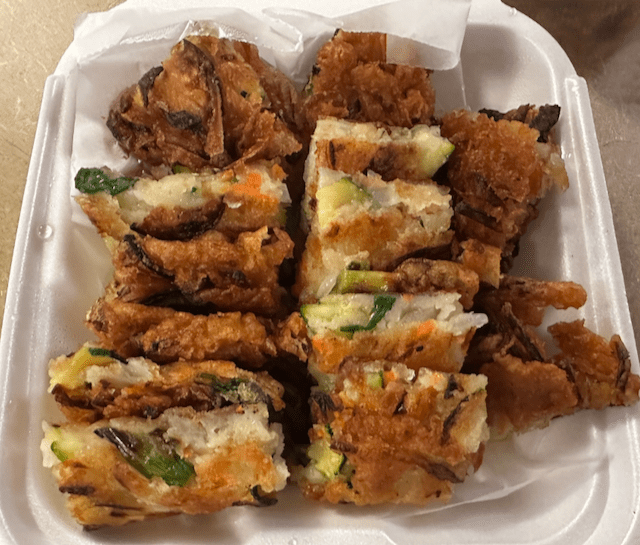
Appetizers also include sesame shaobing, a layered flatbread with
sesame on top. In taste and texture, shaobing bears some semblance
to naan, the wonderful Indian flatbread.
The shaobing is
accompanied by a standard "pot sticker sauce" for dipping, but I would
recommend ordering the shaobing with your meal instead of as an
appetizer. Dredging up the sauce on some of the entrees with
shaobing would certainly be an improved use of a very tasty, very
utilitarian bread that you just don't find in many Albuquerque Chinese
restaurants.
Another
appetizer unique in Albuquerque to Chopstix is Szechwan Sausage.
While Szechwan cooking is characterized by spicy and piquant food,
the Sausage barely registers on the piquant scale, but is redolent with
spices, making it a very flavorable appetizer.
There's
a lot of truth in labeling when an asterisk (*) prefaces a dish. That
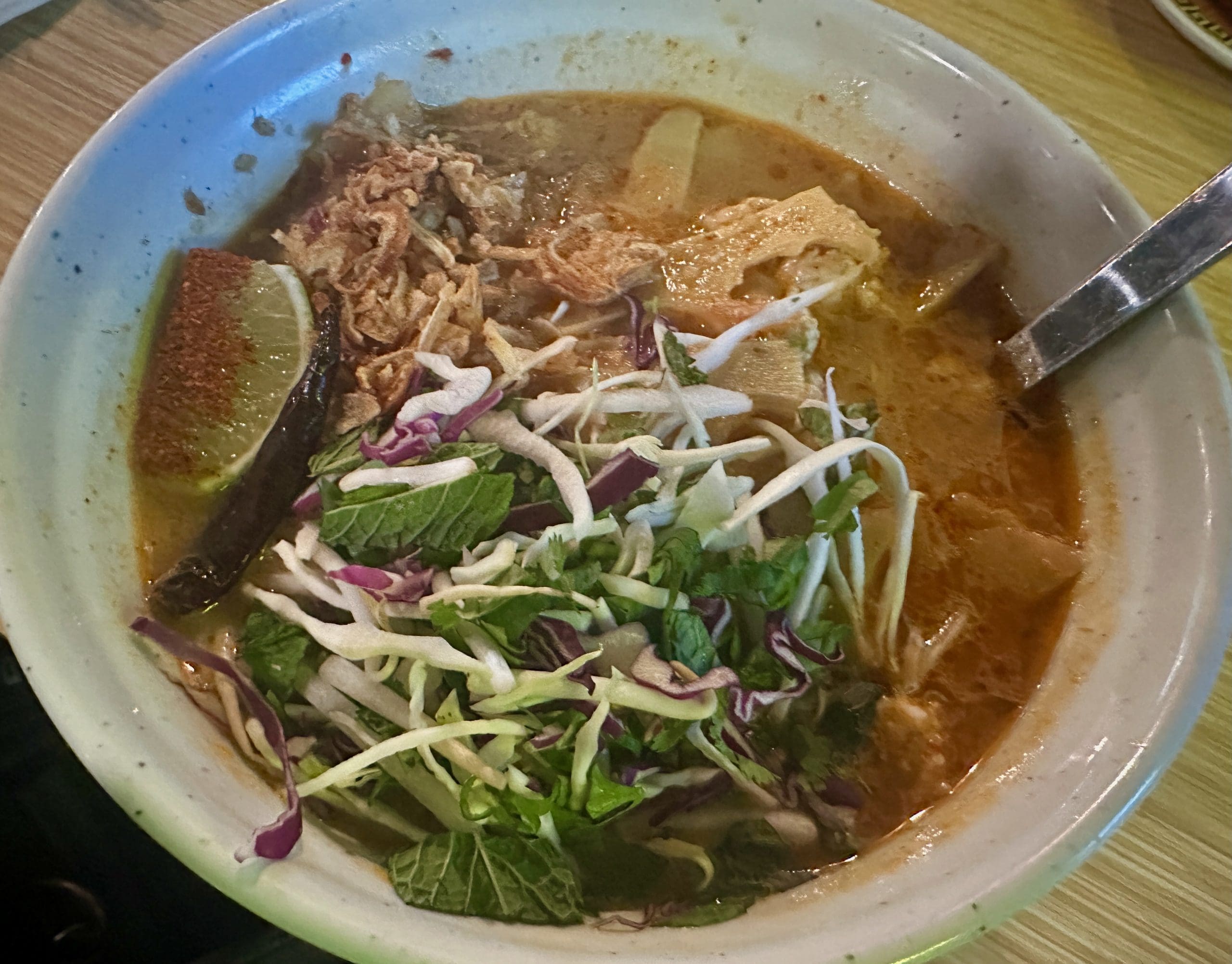
means the dish is hot and spicy. Even the hot and sour
soup (one of three soups on the menu) is gunpowder incendiary.
It's also as delicious and comforting as any soup we've had, with throat
and stomach warming properties that move it near the top of my favorite
soup list.
At the very top of my
list of outstanding garlic shrimp entrees I've ever had is the
Chopstix version. Laden with minced garlic and populated with
barbed hot peppers, it is intensively flavored and preternaturally
delicious. Prepared to absolute perfection were the dish's
vegetables: sweet snow peas, julienne carrots, green peppers, white
onions and more. The sauce is incredibly flavorful, a perfect
accompaniment to the aforementioned shaobing.
Having read recently of
the healthful properties of mustard seed (which contain lots of
protective substances called phytochemicals, which may inhibit the
growth of existing cancer cells and help prevent normal cells from
turning into cancerous ones), I just had to order the mustard with
dried bean curd.
Somewhat
resembling, in both taste and appearance, the mustard greens so popular
in Southern cooking, this dish doesn't have the intense flavoring of the
garlic shrimp, but it may be the best version of "greens" I've ever had.
Several entrees are
accompanied by steamed white rice, but for a pittance you can also have
fried rice, with or without pork. Chopstix' version of
fried rice isn't as soy sauce salty as most fried rice you'll find in
Americanized Chinese restaurants. It lets other flavors speak out
for themselves.
Pork entrees include
Vinegar and Sugar Ribs in which pork ribs are stewed with soy sauce,
Chinese vinegar, various seasonings and what is likely brown sugar.
Not everyone appreciates a sweet and savory combination, and even if you
do, this may be too much of a good thing--as in not enough taste
contrasts for you to continue enjoying it with the same gusto as you had
when gnawing the meat off the first few bones.
That, in fact,
synopsizes my only complaint (and it's a very small one) with Chopstix.
This is a restaurant to be shared with friends--the closer the friends
the better, particularly if many menu items are ordered and shared
family style.
You should never visit
Chopstix alone because while every item might be good, you miss out on
the fun and adventure of sharing and even a good thing (like the Vinegar
and Sugar Ribs) might be too much of a good thing.
There is much to like
and much to be explored at Chopstix, a restaurant which may have a
Westernized spelling, but which serves some of the best, most authentic
dishes of any Chinese restaurant in New Mexico. This one will move
up on my rating list quickly!