During
a 1997 episode of Seinfeld, the "show about nothing," George Costanza
and his girlfriend du jour discussed the possibility of incorporating
food into their lovemaking--not as a post-coital meal, but in flagrante
delicto.
George listed as
potential candidates: strawberries, chocolate sauce, pastrami on rye
with mustard and honey. His girlfriend, unfortunately, failed to
appreciate the erotic qualities of pastrami and thus, their relationship
terminated.
Ultimately George met
up with a woman who declared pastrami to be "the most sensual of all the
salted cured meats." With that proclamation, their lustful appetites
took over and they succumbed to the pastrami inspired throes of passion.
I don't know about
pastrami being the most sensual of all salted cured meats (sounds like a
bit of double entendre here), but do know there are few sandwiches quite
as wonderful as a pastrami sandwich.
Alas, not all pastrami
is created equal. The perfect pastrami finds its genesis as brisket
given a salt, sugar and spice rub, dry cured, smoked, and cooked.
Having
grown up in bucolic Northern New Mexico, I had no idea pastrami existed
until the Air Force sent me to Massachusetts. It was love at first
bite. For two years I visited delis throughout New England and New York
City in search of the best pastrami.
Since returning to New
Mexico in 1995, I've lamented being short-changed insofar as Duke City
restaurants or delis offering a world-class pastrami product.
Fortunately frequent trips to Chicago have proven to be fulfilling
pastrami pilgrimages.
Most meat distributors
serving New Mexico sell a processed pretender, pastrami "loaf." I
wanted the real thing--whole beef brisket with lots of marbling and
heavy, briny seasoning. Real pastrami is also what Joseph
Rodriguez wanted to bring to New Mexico.
A California native now
living in Pojoaque, Rodriguez was raised on hot pastrami sandwiches and
like dozens of us pastrami paramours, he couldn't find good pastrami in
New Mexico.
The rest of us are thrilled that he took it a step
further and begin selling it at the New Mexico state fair during the
fall of 2006.
Rodriguez doesn't sell
his pastrami at some fancy storefront. He built a concession
trailer and parked it on the corner of St. Francis Drive just as you
turn into Alameda. The trailer is furnished with all he needs to
prepare his product and it's portable so he can take it to the state
fair and balloon fiesta.
Having lived in the
East Coast and traveled extensively in the Golden State, the term "California pastrami" gave me nightmarish visions
of pesto packed pastrami desecrated with sushi grade sashimi, artichoke
and the designer vegetable de jour. Fortunately, as it turns out
California (or West Coast) pastrami is served on a hoagie bun with
yellow mustard and dill pickles (just as some grinder shops in
Massachusetts sold it). Even better, this is an outstanding
sandwich.
Rodriguez buys his
pastrami from a supplier who furnishes it to The Hat, a Los Angeles area
pastrami sandwich shop chain. It's the real stuff--well marbled,
briny, highly seasoned and absolutely delicious. It's comparable
to pastrami I remember fondly in New York City, but not quite as good as
my favorite pastrami in Chicago.
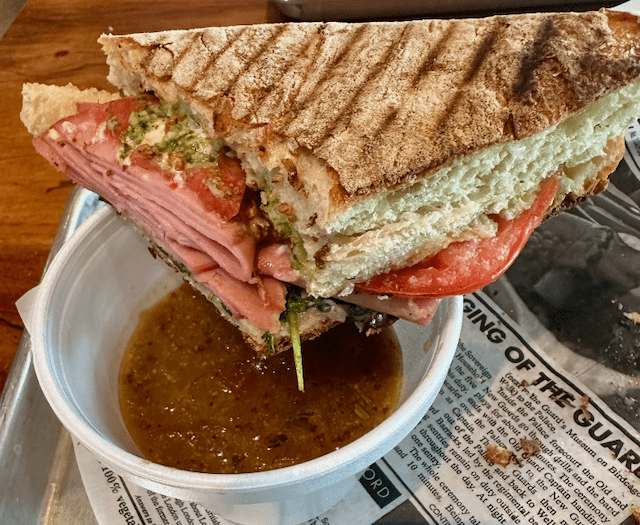
Speaking of New York,
you can also get your pastrami sandwich New York style--on light rye
sandwich bread with grainy mustard. Having tried both California
and New York style pastrami, I'm not ready to declare a preference.
Both are terrific!
If you can't make
frequent trips to Santa Fe to assuage your pastrami fix, you can buy
pastrami by the pound. Rodriguez will even tell you how to prepare
it and that isn't on a microwave. The trick to pastrami retaining
its flavor and moistness is steaming it, a technique he will aptly
describe.
As for the "More"
portion of the restaurant's name, "more" includes burgers, fish tacos
and burritos, none of which I may never try courtesy of pastrami George
Costanza would have loved in the Biblical sense. It also includes
corned beef.
If you've ever wondered
what the difference is between pastrami and corned beef, it's in the
preparation. Both usually begin with a brisket--same meat prepared
differently for different results. Where pastrami is given a salt
and spice rub, dry cured, smoked then cooked, corned beef is cured in
brine. To me, the main difference is that pastrami is much better,
but then, like George Costanza, I consider pastrami the most sensual of
all salted, cured meats.