“Careful Father, this stuff will melt your beads.”
~Lt Colonel Henry Blake, MASH 4077
Just as Hogan’s Heroes helped establish the perception many Americans (at least of my generation) had about German food, the television show MASH was the first introduction many of us had to Korean food. Set in South Korea during the Korean War, the series centered around a group of resilient doctors, nurses and support staff in an isolated hospital compound which saw more than its share of wounded. Not only did each half hour episode depict–sometimes rather graphically–the horrors of war, it painted a rather poignant and entirely accurate picture of sacrifice and hardship.
Some of the sacrifice and hardship came at the hands of the kitchen staff which concocted some of the most unsavory fare conceivable (imagine a restaurant today serving creamed turnips, spam lamb and cream of weenie soup). Indigenous cuisine was apparently even worse because no matter how bad chow hall food was, the MASH team didn’t walk down to the nearby village for a meal of Korean food. And, as the quote above illustrates, when they did partake of Korean food, the impression given was that it was almost lethally piquant.
Compared to the cuisines of other East Asian nations, the rise in the popularity of Korean food across the fruited plain was painfully slow. In fact, only in recent years have Korean restaurants become a thriving part of the American culinary mainstream. According to seriouseats.com, much of this is attributable to the insular nature of Korean restaurants which, by design, initially catered to other Koreans, not to the teeming masses. The unwillingness of Koreans to compromise on authenticity can be contrasted to the pandering to American tastes by other East Asian cultures who have dumbed down their dishes to appeal to the masses. Can you say Pad Thai or General Tso’s chicken or even sushi?
Korean food may be the least Americanized of East Asian cuisines meaning that within Korean restaurants you won’t find any one dish that you won’t recognize as being dumbed down for American tastes (as Pad Thai has been at Thai restaurants across the fruited plain). That means purists curious about traditional Korean cuisine can still find it easily and as relatively unspoiled as if served in Seoul. Indisputably the most popular Korean dish among American diners is bulgogi, the marinated and grilled beef dish to which diners often refer as Korean barbecue. Today it’s possible to find bulgogi served at non-Korean restaurants where it is discernibly more Americanized (almost cloying in some instances).
Albuquerque has been blessed with the presence of at least one Korean restaurant for nearly four decades. Chris and Kye Lovato started it all with the long defunct Fu Shou House which they operated in the Kirtland Air Force Base area until 1993. That year the Lovatos moved to the Scottsdale Village Shopping Center where they reopened as Fu Yuang. Over the past four decades, there have been (and still are) other Korean restaurants operating in the Duke City, but in terms of sheer numbers, Korean restaurants in Albuquerque pale compared to restaurants from other East Asian nations.
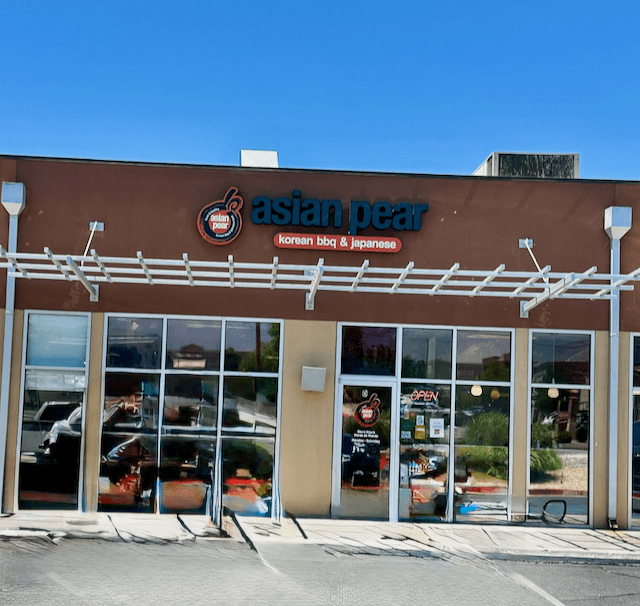
The January 12th, 2015, launch of Asian Pear, did little to impact the disparity in the number of Korean restaurants compared to the surprisingly high number of Vietnamese and Thai restaurants in the Duke City. Unlike many of them, however, but the Asian Pear concept appears a promising candidate for expansion (wishful thinking here). The restaurant’s marquee is underscored by “fresh and healthy Korean BBQ and Japanese food,” but it would not be inaccurate to add “inexpensive” and “delicious.” Asian Pear’s first home was located in the bustling downtown area right next to the long-established Skip Maisel’s on Central Avenue. In 2018, Asian Pear moved relocated to a strip mall on San Pedro just north of Paseo Del Norte.
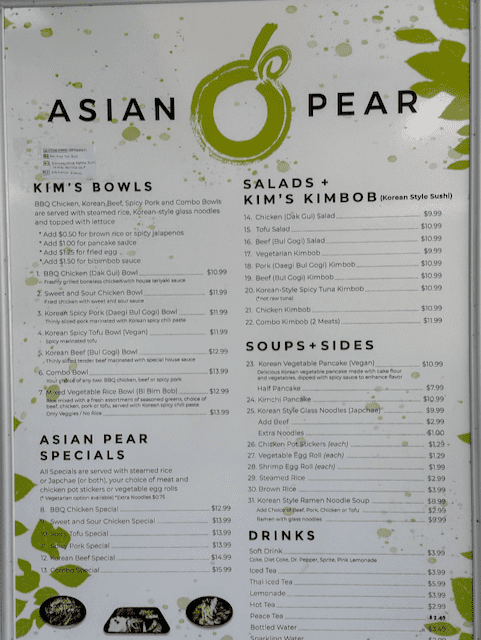
Despite its relatively small digs and just a few tables (mostly two tops), Asian Pear has a warm, homey look and feel to it. A large-print menu is positioned to the right of the counter where you place your order. Just in front of you is a rather open kitchen where you can see dishes being prepared. The menu is segmented into Kim’s bowls (BBQ chicken, Korean beef, spicy pork and combo bowls served with steamed rice, Korean-style glass noodles and topped with lettuce), Asian Pear Specials, Salads and Kim’s Kimbob (Korean style sushi) and Soup and Sides . The low, low prices will have you doing a double-take though several items have climbed well north of ten dollars as of this writing.
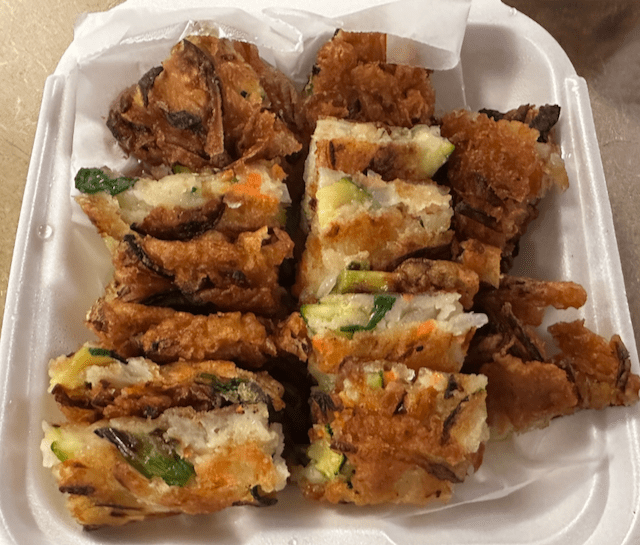
10 May 2026: If you frequent Chinese restaurants, chances are you’ve enjoyed scallion pancakes. In restaurants they’re generally served as an appetizer, though in China and American China Towns, scallion pancakes are a popular street food, often considered a “poor man’s dish. Scallion pancakes have evolved into a popular, crispy-chewy savory “bread” enjoyed throughout China, Taiwan, and abroad. Vegetable pancakes do not have a single point of origin but rather developed independently across many cultures as a way to use leftovers. Key historic variations include Korean yachaejeon (on Asian Pear’s menu as “Korean vegetable pancakes (vegan).” These delicious vegetarian pancakes are made with cake flour and vegetables with a side of spicy sauce. A crispy, crunchy exterior gives way to soft, delicate middle where you’ll enjoy fresh vegetables. In its annual Food & Wine issue for 2017, Albuquerque The Magazine awarded Asian Pear a Hot Plate Award signifying the selection of its Vegetable Pancake as one of the “dishes…that’s lighting a fire under the city’s culinary scene.” Considering the thousands of potential selections, to be singled out is quite an honor.
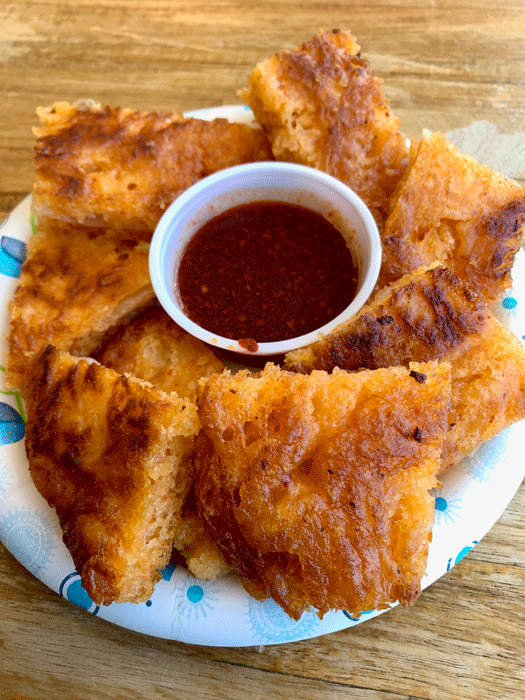
8 October 2019: At first browse, Asian Pear’s vegetable and kimchi pancakes are simplicity itself, but there’s much more to these crispy, chewy, salty, spice orbs than all-purpose flour and vegetables or kimchi. Shards of pungent-piquant kimchi are embedded in the orange-rust colored kimchi pancake which is served with a spicy sauce you probably won’t even touch. Instead, you might want to hold on to some of the complementary kimchi and use it as a topping for the pancakes. Either way, these are a must-have.
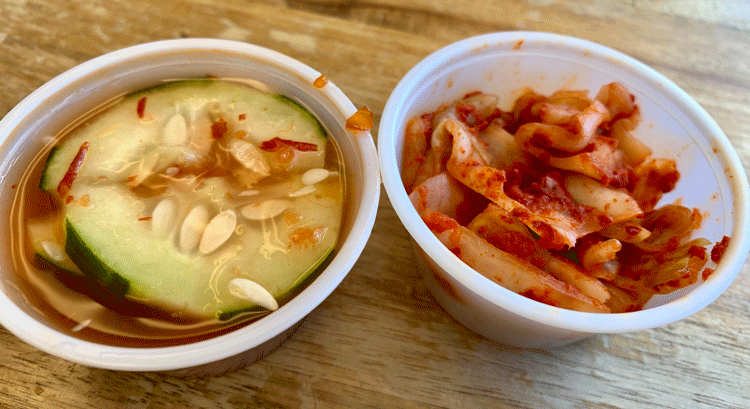
10 May 2026: One of my very favorite Korean culinary traditions is “banchan.” small, shareable side dishes served alongside cooked rice and a main dish in Korean cuisine. Banchan is an essential part of every Korean meal, ranging from simple home cooking to formal, elaborate spreads. Translated from Korean to “side dishes,” the number of banchan dishes is numerous (Thrillist jokes that there are a quarter-million kinds of banchan. At Asian Pear, we’ve had kimchi and The kimchi, a dish of fermented cabbage, pungent garlic and other vegetables, doesn’t have the eye-watering piquancy of kimchi w’ve had elsewhere, but it’ll tantalize your taste buds with its spiciness and personality. With its light, crunchy and refreshing qualities, the Korean cucumber salad is sure to please, too.
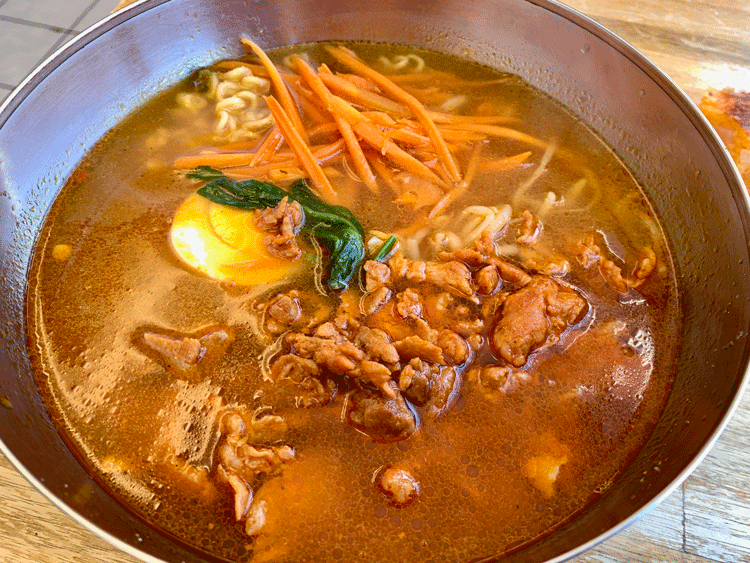
8 October 2019: With temperatures hovering around 30 degrees on the day of my inaugural visit with my friend Bruce “Sr. Plata” Silver, only a steaming bowl of soup could take the chill out. At the time Asian Pear offered some of the very best wonton noodle soup in town, a piping hot elixir brimming with plump wontons. Wonton noodle soup is no longer on the menu, but an even better option is. That would be Korean Style Ramen Noodle Soup with your choice of tofu, pork, chicken or beef. Julienne carrots lend a crispy contrast to the silky smooth, slide-down-your-throat noodles. Tiny strips of pork swim in a lavish, well-seasoned broth with just a hint of heat where you’ll also find a perfectly prepared half a hard-boiled egg.
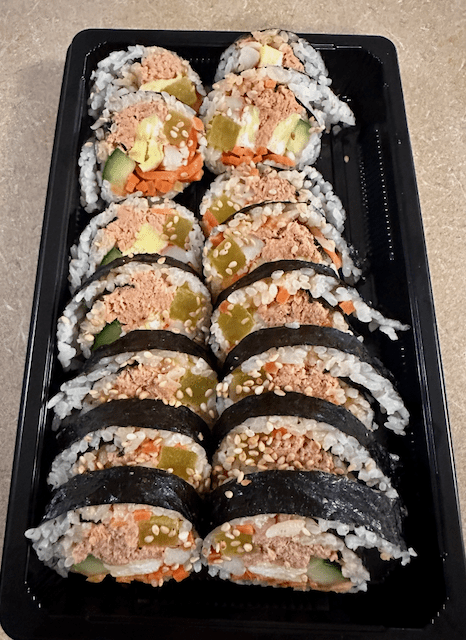
10 May 2026: Kimbap (spelled as “kimbob” on Asian Pear’s menu) literally translates from Korean to English as “seaweed rice,” though it’s more accurately described as a rice roll—a piece of kim (seaweed) covered with well-seasoned bap (rice) and rolled around fillings. Some Korean chefs get irritated when it’s referred to as “Korean sushi” because of its visual similarity to futomaki, Japanese sushi rolls. That’s not a problem for Asian Pear where the “Kim’s Kimbob” menu is subtitled “Korean-style sushi.” Aside from emanating from different culinary cultures, there are significant differences betwen kimbap and sushi. Kimbap rice is seasoned with sesame oil and is more savory, where sushi rice is vinegar-based. The most important difference is the filling.” Maki rolls (sushi) tends to be filled with raw seafood and feels almost like a palate cleanser, while kimbap is more balanced and has more heft.
Asian Pear’s Kimbob menu lists eight items, only one of which features fish. That would be the Korean-style spicy tuna kimbob (not made with raw tuna). Because the menu posted on Asian Pear’s website is so tiny it can only be read by the James Webb telescope, I didn’t see the spicy tuna kimbob and was a bit rushed by a growing queue so I ordered the beef kimbob (seaweed rice roll filled with seasoned bulgogi beef, pickled radish, carrots, spinach, and egg, seasoned with sesame oil). Though it may resemble sushi, it certainly doesn’t taste like sushi. Nor was wasabi provided, only soy sauce in a packet. To refer to kimbob as “Korean sushi” is entirely inaccurate, but to call it “delicious” is a truism.
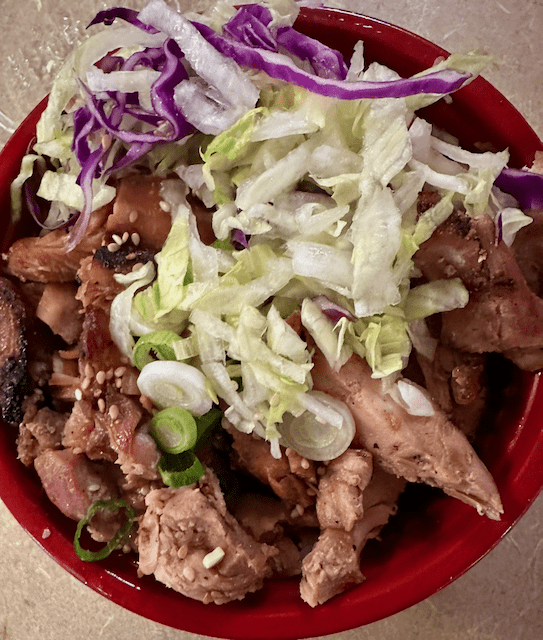
10 May 2026: One of my Kim’s guilty pleasures is terriyaki beef from (gasp) Panda Express. Yeah, I don’t understand it either. Ordering Asian Pear’s BBQ chicken bowl (freshly grilled boneless chicken with house teriyaki sauce) seemed a no-brainer. She immediately poo-pooed the lettuce and rice then proclaimed the teriyaki sauce inferior to the version at Panda Express. Luckily she has a horde of teriyaki sauce from Panda at home with which she doctored the chicken to her liking. The Dude is also a huge fan of Panda’s teriyaki chicken. It’s only this naysayer who’s dismissive of that chain’s fare.
In 2016, a USA Today feature called “50 States: 50 Best Restaurants” used Yelp algorithms to determine that the very best restaurant in the Land of Enchantment was Asian Pear.
Asian Pear
8101 San Pedro Drive, N.E.
Albuquerque, New Mexico
(505) 766-9405
Web Site | Facebook Page
LATEST VISIT: 8 October 2019
1st VISIT: 15 December 2015
# OF VISITS: 2
RATING: Very Good– Good to very good food; generally solid; delivers consistent quality, strong technique, and a comfortable, enjoyable dining experience
COST: $$
BEST BET: Kimchee, Vegetable Pancake, Fried Rice, Beef Kimbob,
REVIEW #900
The Asian Pear lady came over with little cups of kimchi and offered them, but asked cautiously if we knew what kimchi was. We cracked up (politely I hope), being fans of various shadowy K-town eateries in L.A. I’d say Korean is the cuisine I miss most, living out here now.
I do like Asian Pear and the price is indeed right. Agree that the veggie pancake is special … the rest we’ve tried there is OK/pretty good.
Would really like to see someone open a tabletop grill place for all-you-can-eat Korean barbecue. One of those where you come home smelling like a forest fire. And they start you off with like nine little plates of Korean fermented magic. Can’t imagine that missing.
Hi Glenn A,
I too am a member of the Koreatown diaspora having live two blocks off Mid-Wilshire in the late 80s. It’s been said that Koreatown was Pulitzer Prize-winning food critic Jonathan Gold’s favorite culinary L.A. neighborhood. I haven’t found good Korean here in New Mexico but I have found good everything else. Is good kimchi to a Korean what good green chile is to a New Mexican? I’ll let you decide.
We have not found any really good Korean restaurants in NM. To get the good stuff you almost have to go up to Denver thus we do that for about a week every year. The Korean places downtown are not wonderful but there are bunch out on Havana Street, especially Seoul BBQ, Shin Myung Gwan BBQ, & Dae Bak Korean Bar & Grill. There are many others we have yet to try.
One of the highlights of extended business trips to San Jose and Santa Clara back in the mid 90s was visiting Korean restaurants and creating my own delicious masterpieces on tabletop grills. One of my colleagues told me Sushi and Sake on Central has tabletop grills, but it’s the server who prepares your meal and it’s (unfortunately) not all-you-can eat.
There are a number of Korean restaurants clustered throughout the city. If you’ve visited any of these, would you mind sharing your experiences and what you’d recommend:
Arirang Oriental Market on Eubank.
Bon Chon on Unser
Fu Yuang on Eubank
Soo Bak Seoul Bowl on Central
New Address:
8101 San Pedro Dr NE
Albuquerque, NM 87113
I’m not sure if the downtown location is still open.
Sadly, no.
The Asian Pear really is a wonderful little treasure downtown. It’s one of a handful of restaurants in town that gets me excited about eating lunch. The food is simple, satisfying and so flavorful. The meats are mouth wateringly flavorful, the vegetables crisp and fresh… I just can’t get enough of this place.
1st: Sandy, this restaurant you would like! Although not like Korean Food found in Gardena but comes close. As being originally from 90924, I can vouch for it.
2nd: I joined Sensei at this wonderful this little restaurant. They were wonderfully kind to us, and kept bringing us samples of their different kind of foods. They brought the vegetable pancakes, the kimchi, and other things as you see in deals pictures. As many in know,I love beef ribs and to have them here at the price we had it was amazing quality. I also had the chicken wonton soup, it was a very cold day and having soup made me warm. I recommend this restaurant to all of Gil’s friends, let’s keep this one going strong. We need something like this in the Rancho / Corrales area !!!
Gil – As you know, since I live in LA and only get to NM once a year, I have limited experience with your wonderful cuisine. But I did want to send big congratulations on your 900th review!! That’s truly incredible!!! And thanks, too, for all of your food recommendations over the years. Every one has been a winner!!
Thank you, Sandy. Every time you grace New Mexico with a visit, the Land of Enchantment becomes even more enchanted. I look forward to your next visit, hopefully in warmer weather.