At the heart of Thai cuisine is the harmony of five fundamental flavor pillars: sweet, sour, salty, spicy, and savory (umami), often with a subtle touch of bitter to ground rich dishes. This doesn’t mean individual dishes require every single flavor profile. Most Thai dishes combine at least two or three of the five flavor profiles to create harmony (like a musical chord), rather than forcing all five into every single recipe. Instead of every single plate containing all five tastes, Thai meals are built to encompass a collective. A full table will typically feature a contrast of dishes—such as a fiery, sour soup balanced out by a mild, sweet-savory stir-fry, a bitter or herbal dish, and plain rice—so that the balance is achieved across the entire meal rather than inside every individual bowl.
As a pedantic food snob, I analyze Thai dishes for their balance of flavors. It pains me to admit many Thai restaurants across the Land of Enchantment overemphasize sweet flavors. Even at a “Thai hot” level of piquancy, some Thai curries are dessert sweet. Other dishes (such as pad Thai) may as well be desserts. Thai friends assure me that westernized recipes and national taste preferences are the culprits for certain dishes tasting sweeter than they would in Thailand. Alas, it’s not possible to drive to Thailand where my desired authenticity and balance would be easier to find. Thankfully, Thai restaurants in Las Vegas, Nevada do offer the authenticity and balance I crave.
For years, we’ve been devotees of Lotus of Siam, once declared “the single best Thai restaurant in North America” by legendary Pulitzer Prize award-winning food writer Jonathan Gold. We’ve rarely visited Sin City without dining at least once in Lotus of Siam. At the risk of sounding like an unfaithful cur, I’ve been contemplating “cheating” on my Thai mistress for years. Not because Lotus has lost a step (it hasn’t) but because I’m the least monogamous diner in the world. Would I regret it? Could any Thai restaurant possibly be as good as Lotus of Siam? Those were my considerations even as I learned that the only Las Vegas Thai restaurant to earn Michelin honors was not Lotus of Siam. It was relative newcomer Lamaii Modern Thai.
Lamaii officially launched on 31 January 2019 on Spring Mountain Road in Chinatown. It was founded by Bank Atcharawan, the former sommelier at Lotus of Siam. Under Atcharawan, Lotus became renowned for its stellar list of Rieslings that ostensibly paired well with spicy Thai food. Lamaii’s beverages focus on wine with a large portion of the list dedicated to Riesling, Champagne, and Chablis. In Michelin’s first instantiation of its Southwest (Nevada, Arizona, New Mexico and Utah) list, Lamaii landed under the “Michelin recommended” list. Only seven Vegas restaurants earned Michelin stars.
Although I despised the hypocrisy of mission, vision and operational statements in the corporate world, I nonetheless like to read such statements on restaurant websites. There are two very appealing statements on Lamaii’s website that enticed me: “We cook Thai food the way it’s meant to be tasted — loud, layered, unafraid” and “Dishes built on contrast — sour against smoke, chili against char.” Those two assertions gave me hope that Lamaii is the real deal and not another Thai restaurant trying to appeal to Western tastes for sweet and sour foods. Like the serpent at Eden, it tempted me to stray from the garden that is Lotus of Siam.
It’s not enough to say that Lamaii is located on Spring Mountain Road without emphasizing that Spring Mountain Road is THE literal economic, cultural, and geographic backbone of Las Vegas Chinatown. It functions as the primary strip that anchors the entire pan-Asian culinary and retail district. Translation: this street has lots of great restaurants. Though tagged “Chinatown,” the area serves as a dense clustering ground for Vietnamese banh mi, Japanese ramen, Korean BBQ, Taiwanese bubble tea, Sichuan hot pot, and other emerging multi-cultural fusion concepts. If you love Asian food, there’s no need to traverse further than Spring Mountain Road.
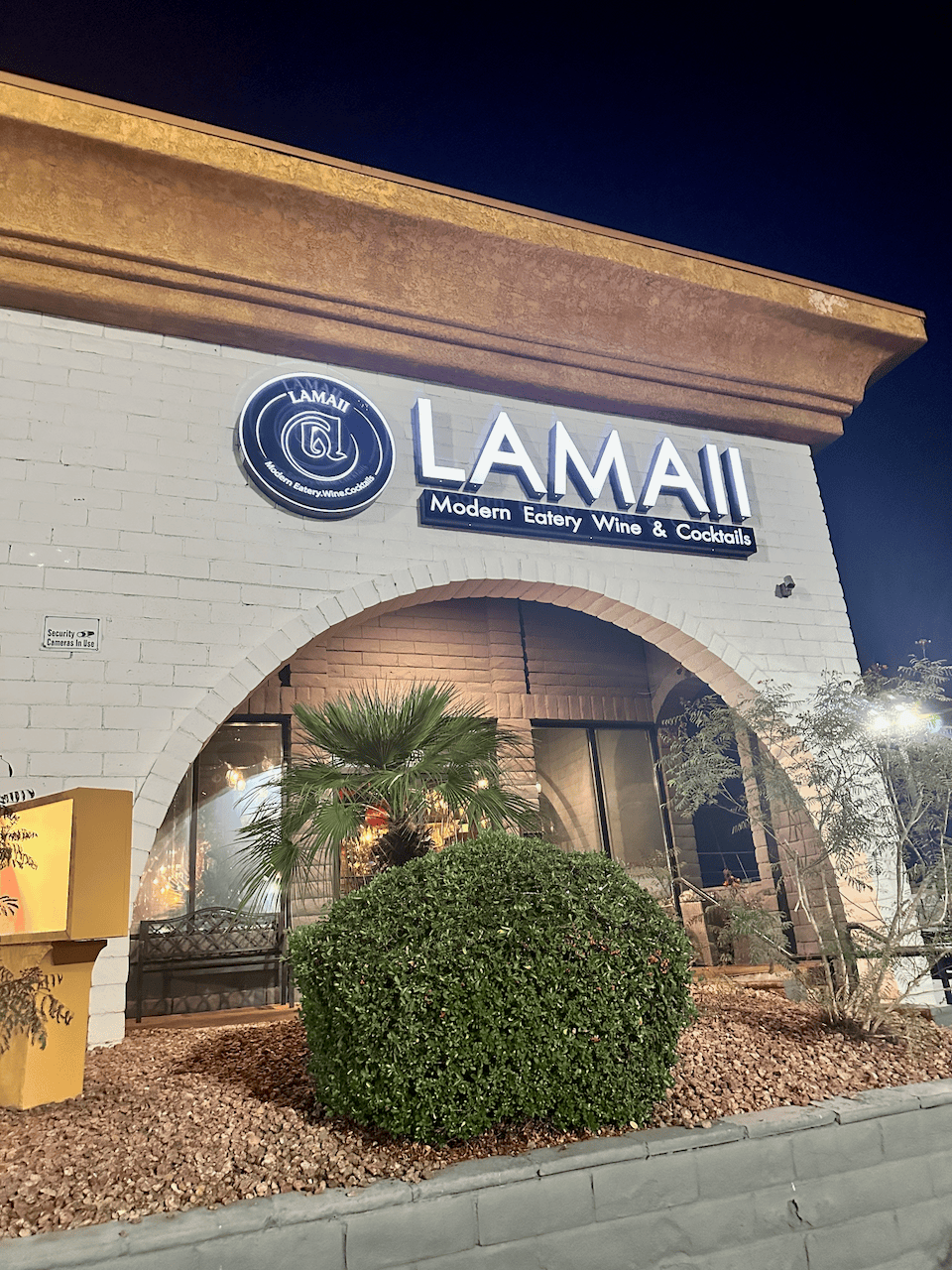
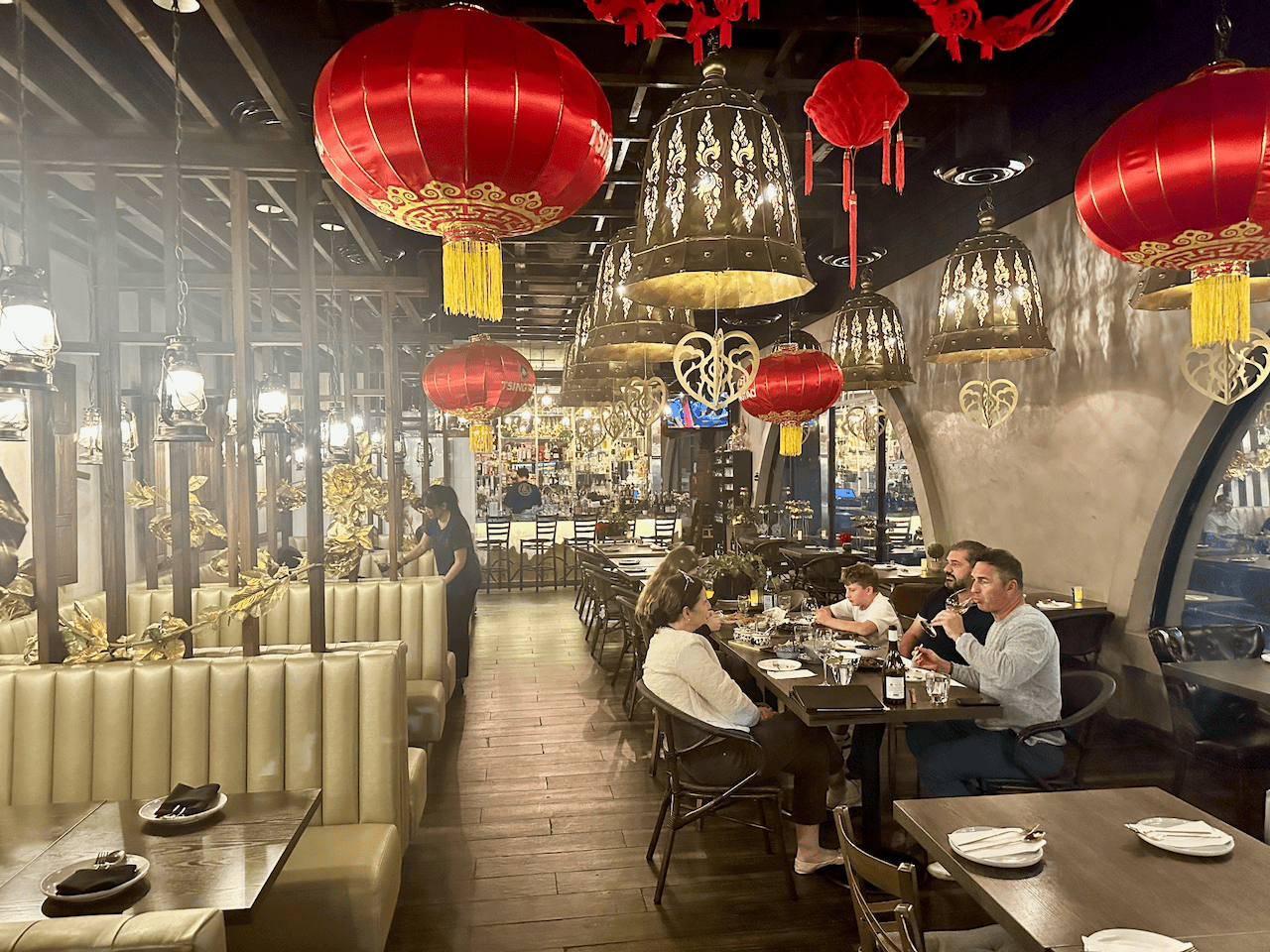
For our inaugural visit, we made reservations for 5:45. The restaurant was virtually empty when we walked in. An hour and a half later, you wouldn’t have been able to find a seat without a reservation. Though not much to look at from the outside, step inside and you’re greeted by a beautiful setting showcasing a contemporary, upscale design. Large arched windows and dim, romantic lighting create an intimate ambiance (though intimate doesn’t necessarily mean quiet). With raucous crowds celebrating what happens in Vegas stays in Vegas, the restaurant can get rather noisy. Outstanding service is a hallmark of Lamaii. We didn’t have the same server throughout our visit, interacting with several polite and attentive servers all bowing politely.
Our servers didn’t just hand us one menu. A binded menu listed the standard dinner options, including beer and wine. A separate paper menu featured several items from Bangkok. Yet a third menu listed two items we’ve never even heard of, much less tried. Had I been dining alone, this is the menu from which I would have ordered. The main menu has only four sections: small plates (appetizers), soups, mains and desserts. Unlike some Thai restaurants we’ve visited, the menu wasn’t a compendium of virtually every Thai dish ever created. It’s rather sparse in comparison.
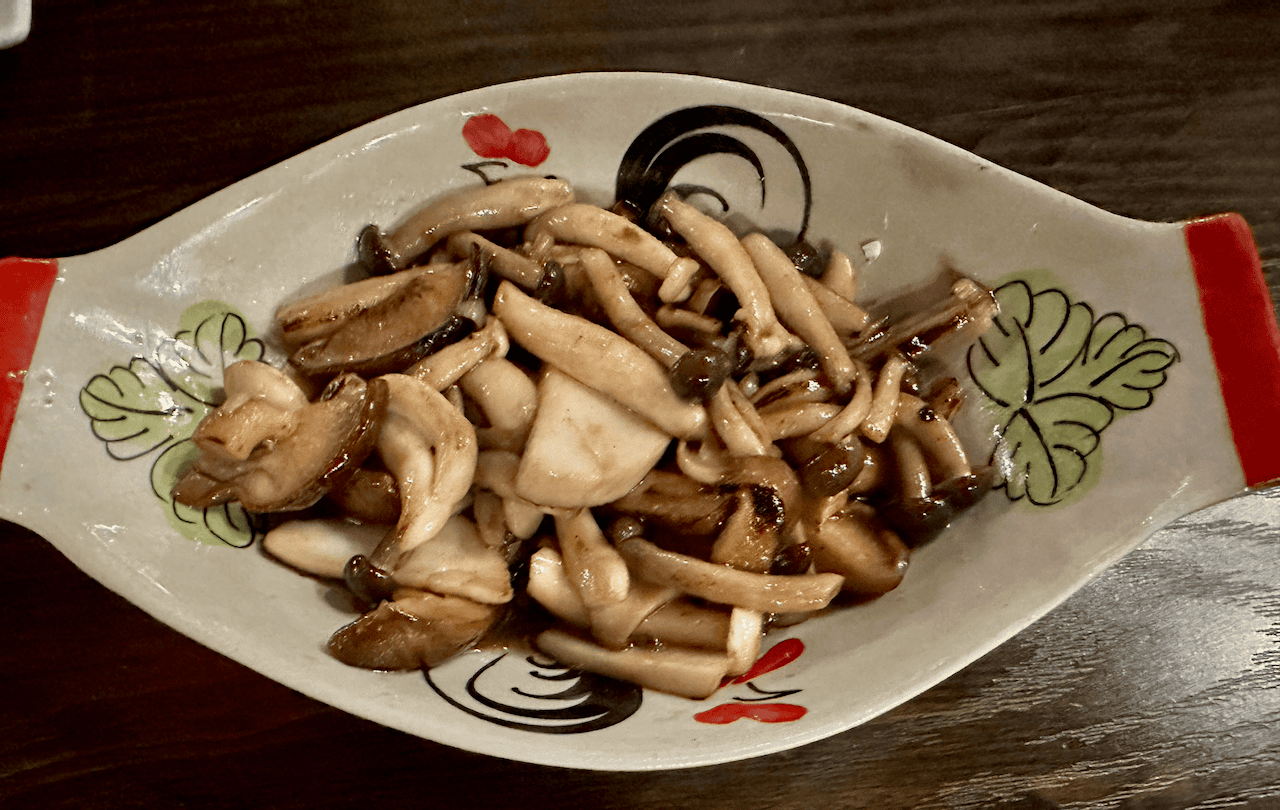
What a joy it was to peruse the “small plates” menu, especially since it wasn’t a list of the “usual suspects” we’ve experienced at most Thai restaurants. There were several items we hadn’t seen at any Thai restaurant (not even at Lotus of Siam). Our first small plate was Hed Sarm Yang (Stir-fried shimeji, shiitake, and king oyster mushroom). Translating roughly to “Three Types of Mushrooms,” this dish is a flavorful, savory wok-tossed plate of perfection. The mushrooms are tossed in a savory, garlic-forward sauce that emphasizes their natural earthy profiles while delivering a classic Thai umami depth. This dish offers a satisfying contrast of textures—ranging from the tender caps of the shiitake to the meaty, robust chew of the king oyster mushrooms (my favorite).
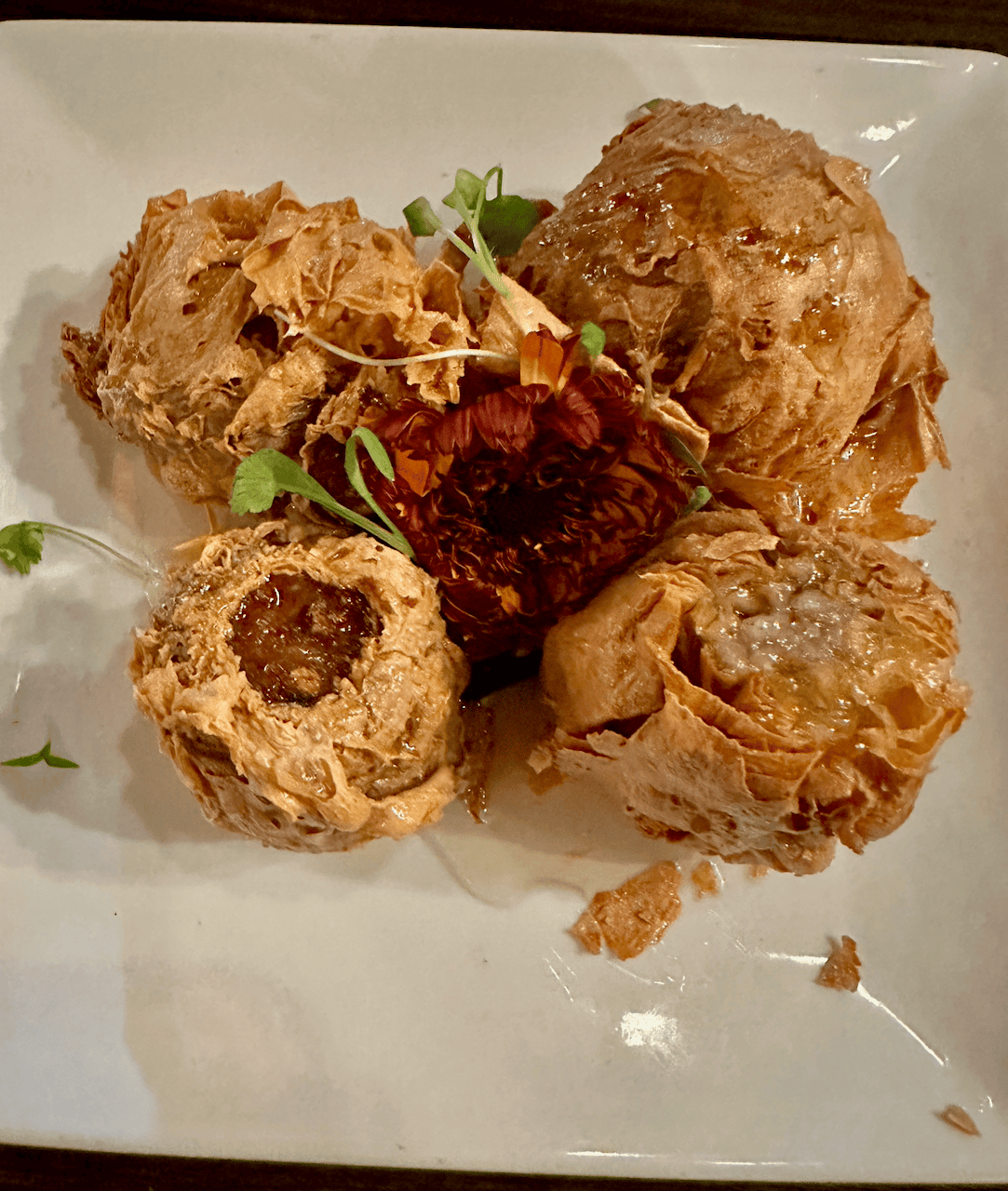
Our second small plate, Hoi Jor (Golden Crab Rolls) came from the third menu. Golden crab rolls are a traditional Thai-Chinese appetizer featuring jumbo lump crab meat (alongside pork and shrimp or a rich savory filling) wrapped tightly in a crispy tofu skin-bean curd wrap. I’m always trepidacious about ordering any Chinese egg roll, finding them to be the most mediocre of all Asian rolls. The Hoi Jor was as delicious and special as Chinese egg rolls are boring. The jumbo lump crab meat was tender and moist, a nice offset from the crisp, dry tofu skin wrap. Four per order are served Served alongside a sweet and tangy plum sauce for dipping. Ordinarily I don’t like plum sauce which tends to be cloying, but Lamaii’s version was quite good.
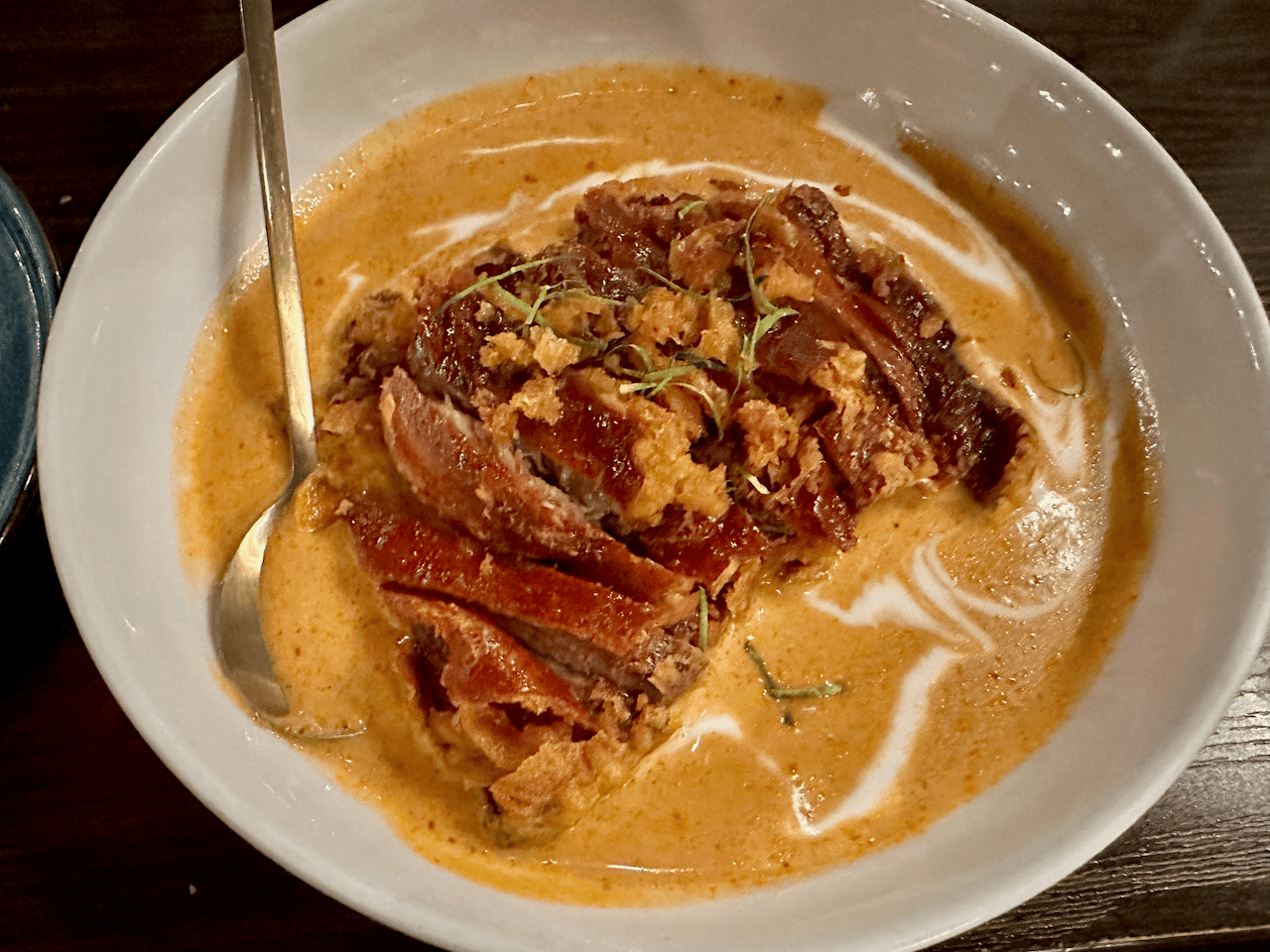
Regular visitors to Gil’s Thrilling… are probably tired of my ad-nauseam proclamations of love for Thai curry. Curry ranks up there with red chile for me. Lamaii’s menu doesn’t list the same types of curry dishes (typically red, yellow, green, masuman, Panang) most Thai restaurants do. Instead, the four curry-based items were Tumeric curry on a dish with cook braised beef, Panang curry on crispy roasted duck, Southern curry paste with stir-fried pork, spicy crab curry with vermicelli noodle, spicy Northern curry on egg noodles and curry paste with crispy stir-fried catfish. How refreshingly wonderful is that? My choice was the Panang curry (crispy roasted duck or crispy prawns with Panang curry sauce. Because duck is such a delicate protein, I actually requested a “medium” degree of heat. I’ve had similar dishes at Lotus of Siam, finding the rich, velvety curry a wonderful complement to the crispy, unctuous duck. Some of the duck was slightly fatty, but so deeply satisfying I had to ward off a swoon or two.
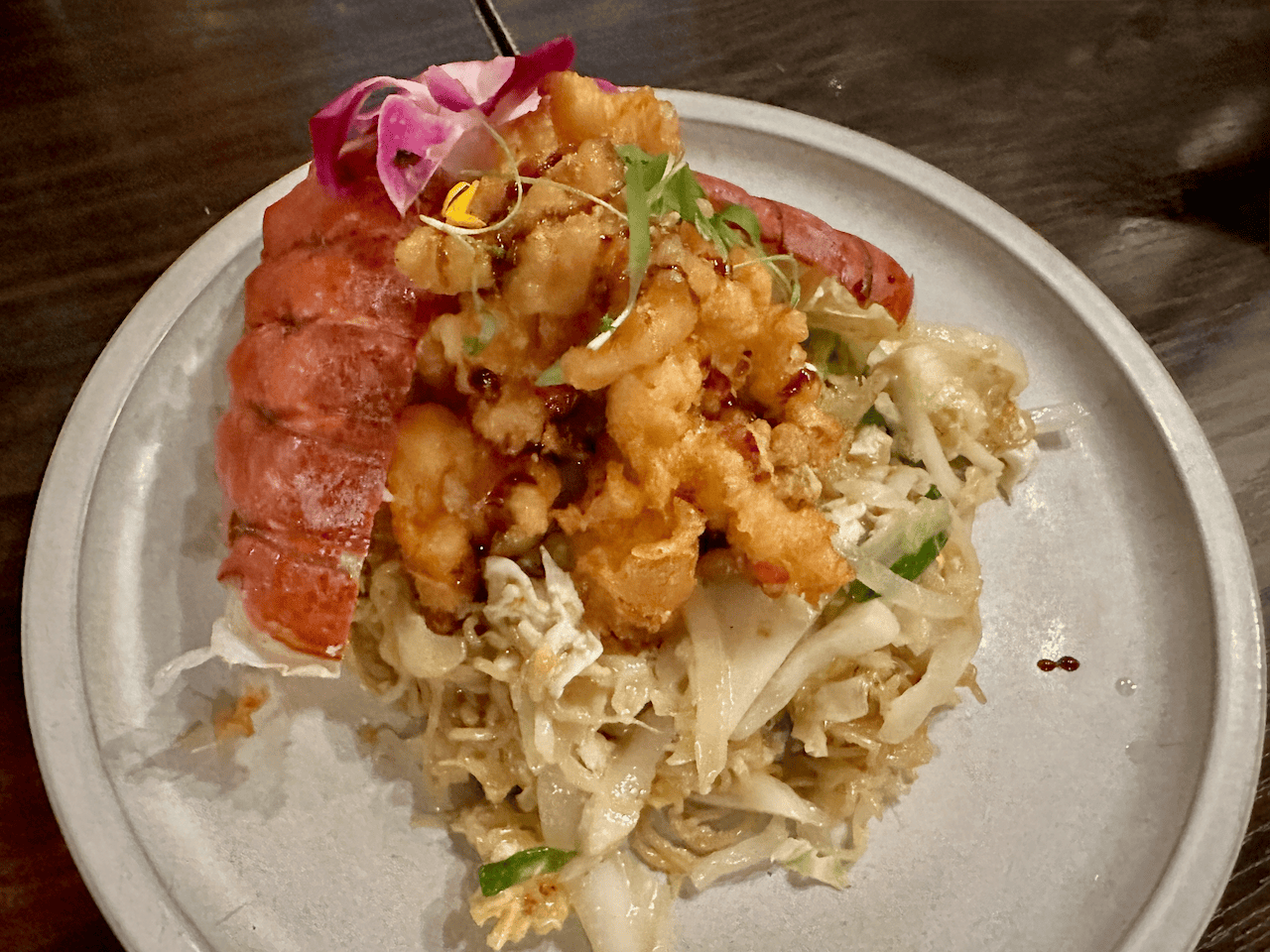
Recalling how much she loved deep-fried lobster at Woodman’s of Essex in Massachusetts, my Kim ordered Lamaii’s Pad Sen Lobster (stir-fried soba noodles in garlic sauce topped with crispy lobster). This signature dish features a generous portion of lobster (an entire whole lobster tail that has been diced, breaded, and deep-fried to a crisp popcorn style). The lobster was lightly breaded, just enough to be crispy. The tender soba noodles were coated in a rich, savory garlic sauce that was a nice counterbalance to the sweet lobster meat.
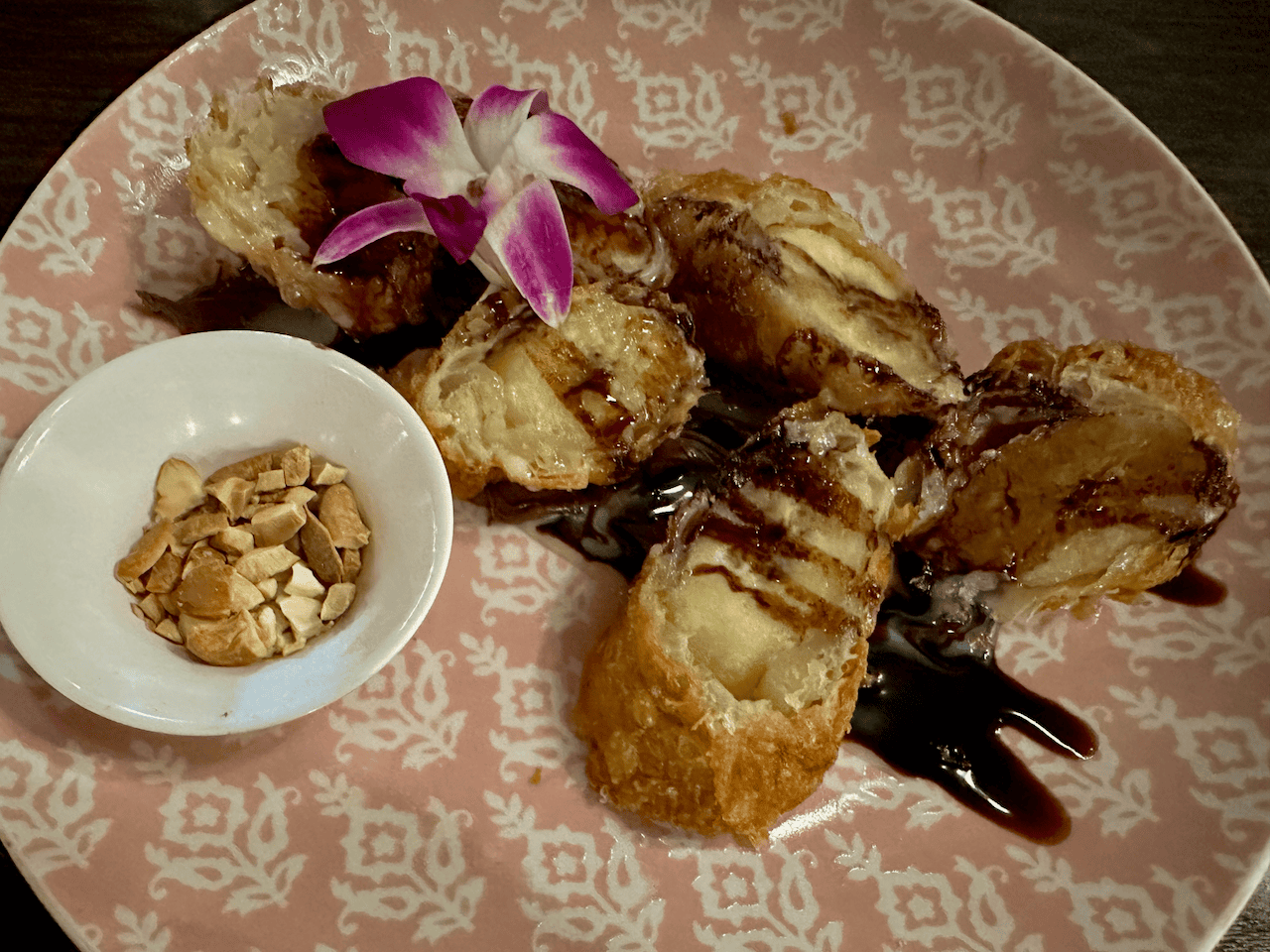
Mangoes and sticky rice, the ubiquitous dessert most Thai restaurants tend to serve was not among the three dessert options. We were very happy with the unique paratha puff (Fresh bananas encased inside a shatteringly crisp, golden-fried roti puff pastry then heavily drizzled with Nutella and chocolate sauce, and sprinkled with toasted cashew nuts for an added crunch). This decadent dessert combines classic Southeast Asian street food textures with rich, sweet toppings. By the way, paratha is a traditional, layered, unleavened flatbread native to the Indian subcontinent (including India, Pakistan, Nepal, Bangladesh, and Sri Lanka) so yes, you’ve probably seen it at your favorite Indian restaurant.
I’m not quite ready to proclaim Lamaii as my favorite Thai restaurant in the world, but it certainly ranks near the top.
Lamaii Modern Thai
4480 Spring Mountain Rd. #700
Las Vegas, Nevada
702-238-0567
Website |
LATEST VISIT: 6 November 2026
# OF VISITS: 1
RATING: N/R
COST: $$$$
BEST BET: Hed Sarm Yang (Stir-Fried Mushrooms), Crab Rolls, Panang Curry with Crispy Roasted Duck, Pad Sen Lobster, Paratha Puff
REVIEW #1560