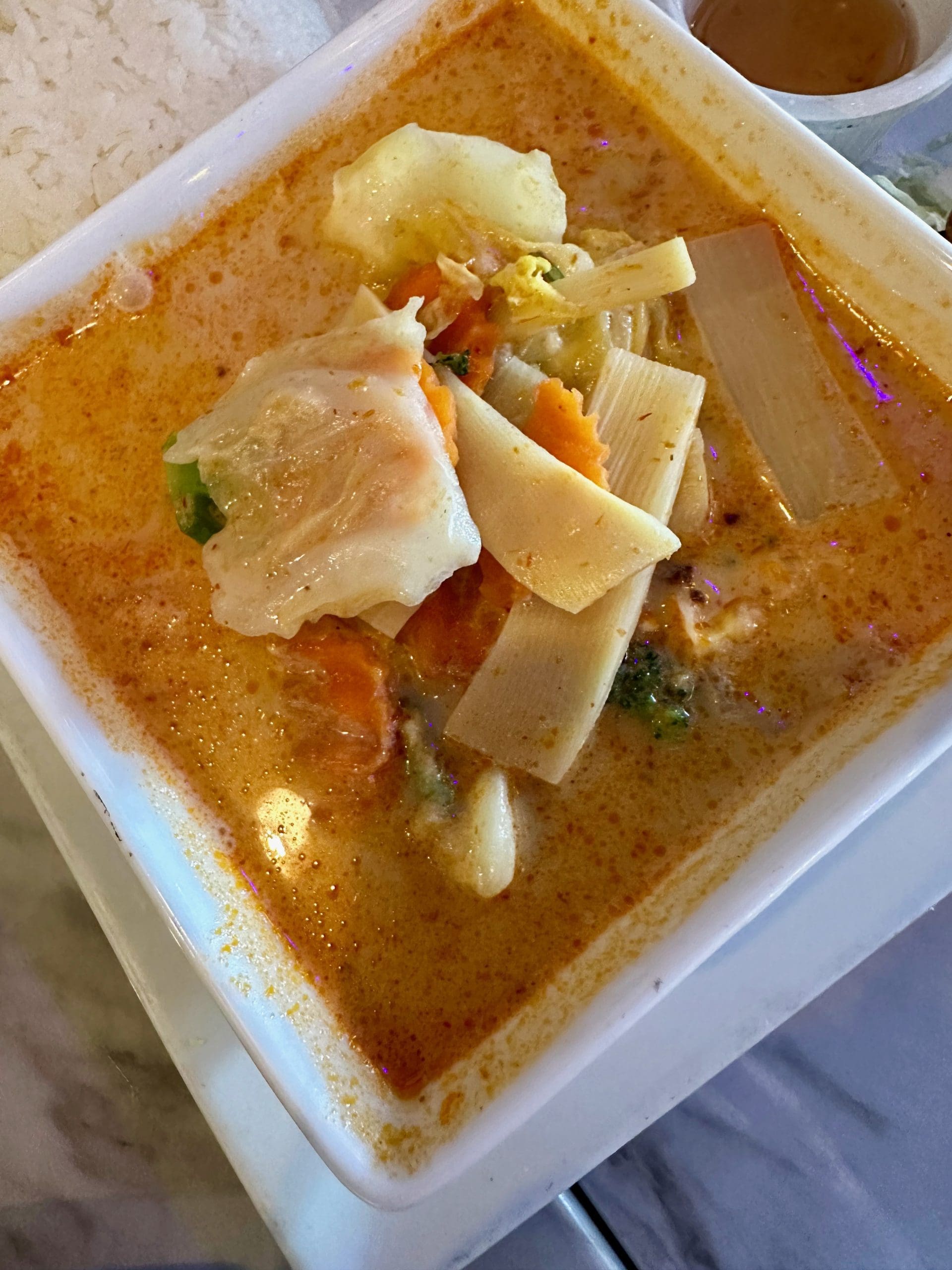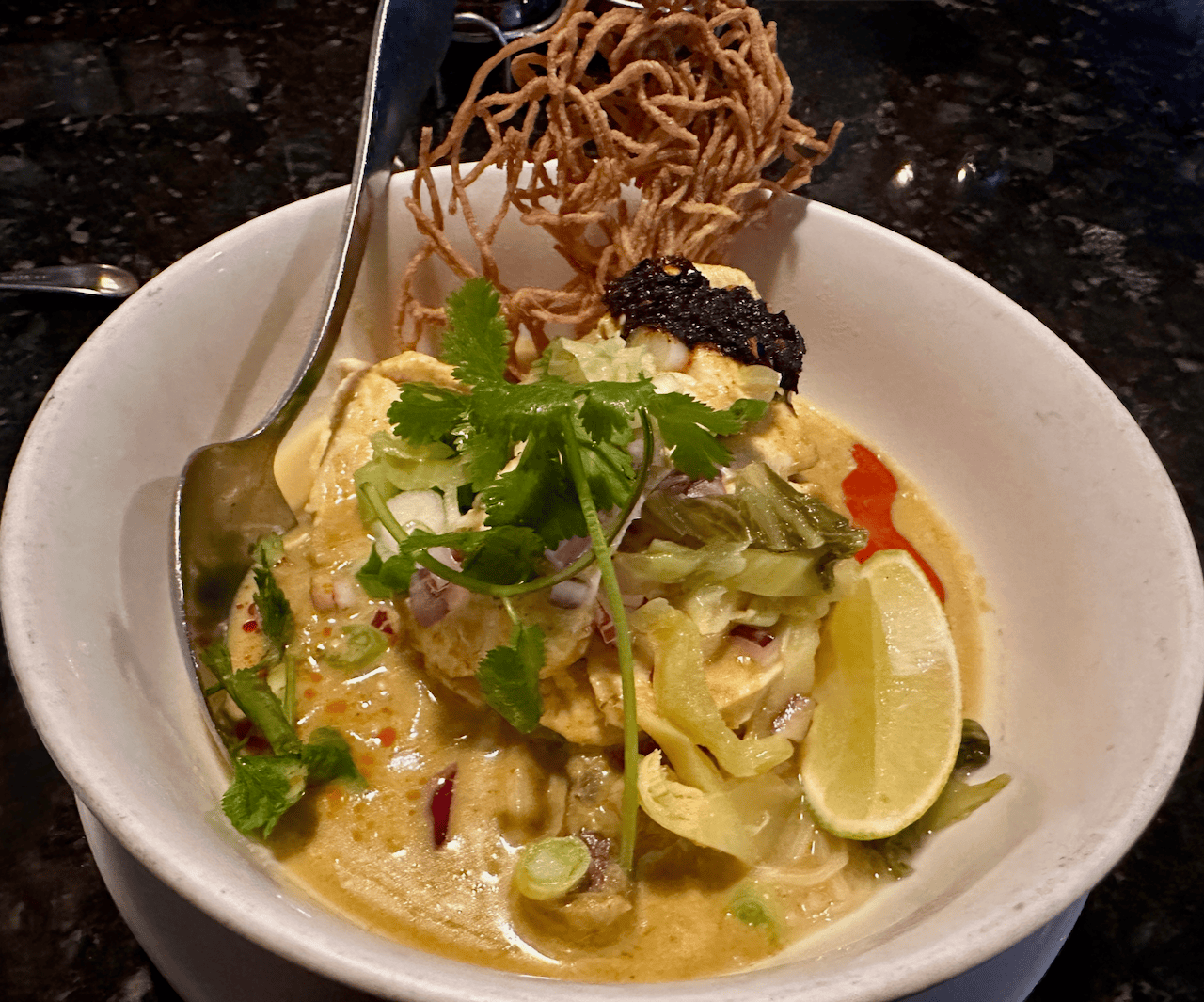
Vong Sushi Thai & Laos Cuisine – Rio Rancho, New Mexico

Grammatically any of the following is correct:  Laotian cuisine, Lao cuisine or the cuisine of Laos.  Just don’t ever call it “Laosy cuisine.”  That would not only be a malapropism, it would be wholly inaccurate.  The cuisine of Laos is among the most dynamic and delicious in Southeast Asia, if not the world.  One of the reasons Laotian cuisine doesn’t receive the accolades it deserves is because of its neighbors.  The Lao People’s Democratic Republic is a landlocked country in Southeast Asia bordered by Myanmar (formerly Burma), China, Vietnam, Cambodia and Thailand.  To some extent, these neighbors (at least China, Vietnam and Thailand) have surpassed Laos on the world’s culinary stage–not necessarily because their cuisine is superior, but because it’s…

LOTUS OF SIAM – Las Vegas, Nevada

In the August, 2000 issue of Gourmet Magazine, Jonathan Gold,  the only food critic to ever earn a Pulitzer Prize, called the Lotus of Siam restaurant in Las Vegas, Nevada “the single best Thai restaurant in North America.”  Not a disparaging word was heard or a dissenting opinion offered among the cognoscenti save for those who argued that the word “Thai” should be removed from from Gold’s audacious proclamation.  Lotus of Siam is THAT good! In the decade plus since Gold’s assertion, every reputable critic from every credible publication has jumped on the bandwagon, essentially echoing or adding to to the validation of the greatness that is the Lotus of Siam.  The superlatives are similar on every review you’ll read…

Eat My Thai – Albuquerque, New Mexico

In his inimitable style Anthony Bourdain described the first time he tasted Thai food: “It was like discovering a color I never knew existed before. A whole new crayon box full of colors.”  His words resonate true for those of us who don’t live in a monochromatic world of homogeneous meals lacking diversity, personality and flavor.  Similarly resonant is his characterization of Thailand’s spicy food: “That perfect balance of pain, and pleasure, and more pain. Brain flooding with endorphins and all is well with the world. Until tomorrow morning.”  Would that my words would flow with the profundity, veracity and ease with which Bourdain laced his every utterance. When my Kim and I find a Thai restaurant with a menu…

Thai Cuisine – Rio Rancho, New Mexico

New Mexican men can be so haughty.  (I don’t include New Mexican women in this categorization because they’re generally smarter.)  We laugh at what Californians, Arizonans and especially Texans call “chili.”  We pride ourselves on machismo, some of which is on display even when we eat out.  We never ask if the chile is hot.  We assume (and hope) it is so we can prove how tough we are.  We question the manhood of any New Mexican who prefers his chile “mild.”  Mild chile is for children and law enforcement officials in Uvalde, Texas.  Give us chile with the piquancy of napalm or volcanic lava.  Give us chile even Satan can’t eat. Yeah, right!  I’ve seen New Mexican men wheeze…

Sa! Thai Restaurant – Albuquerque, New Mexico

In 2023, TasteAtlas, an “encyclopedia of flavors, a world atlas of traditional dishes, local ingredients, and authentic restaurants” compiled a ranking of the 100 best cuisines in the world.  The highest rated cuisine in the world (to no surprise) was Italian followed by Japanese then Greek.  Thai cuisine was ranked 17th in the pantheon of great cuisines, just one slot ahead of American cuisine (whatever that is).  TasteAtlas also named Phat Kaphrao (also known as Pad Grapao or “holy basil stir-fry”), a dish made from meat, chili and basil, as the “best stir-fried dish in the world.”  Among the highest rated dishes, Phat Kaphrao ranked third overall.  Considering 395,205 dishes were rated, Phat Kaphrao’s place in the standings signifies it…

Glai Baan – Phoenix, Arizona

“We are a “Very Thai” kitchen, focusing on street food and snacks that you would commonly find while visiting Thailand. Most of our dishes are best shared and many dishes are from the Isan region (northeastern), where they like their food spicy. We source our produce and meat locally when possible, and we do not use MSG.”  When I read that introductory statement on Glai Bann’s website and menu, I nearly danced with joy.  Over the years I’ve become increasingly frustrated with Thai restaurants in that the balance of flavors–sweet, sour, salty, bitter, spicy–has skewed overwhelmingly toward sweet.  The culinary journey at many Thai restaurants is incomplete for those of us who don’t particularly like entrees as sweet as desserts.…

Thai Spice – Albuquerque, New Mexico

“Thai food ain’t about simplicity. It’s about the juggling of disparate elements to create a harmonious finish. Like a complex musical chord it’s got to have a smooth surface but it doesn’t matter what’s happening underneath. Simplicity isn’t the dictum here, at all. Some westerners think it’s a jumble of flavors, but to a Thai what’s important, it’s the complexity they delight in.” ~Chef David Thompson Complexity of flavors, disparate elements, a jumble of flavors…these are the expectations diners have come to expect from Thai restaurants. The underlying foundation of Thai cuisine, going back to Chinese influences as early as the 10th century, is to achieve a satisfying and exciting taste experience through the relationship between five fundamental tastes: sweet,…

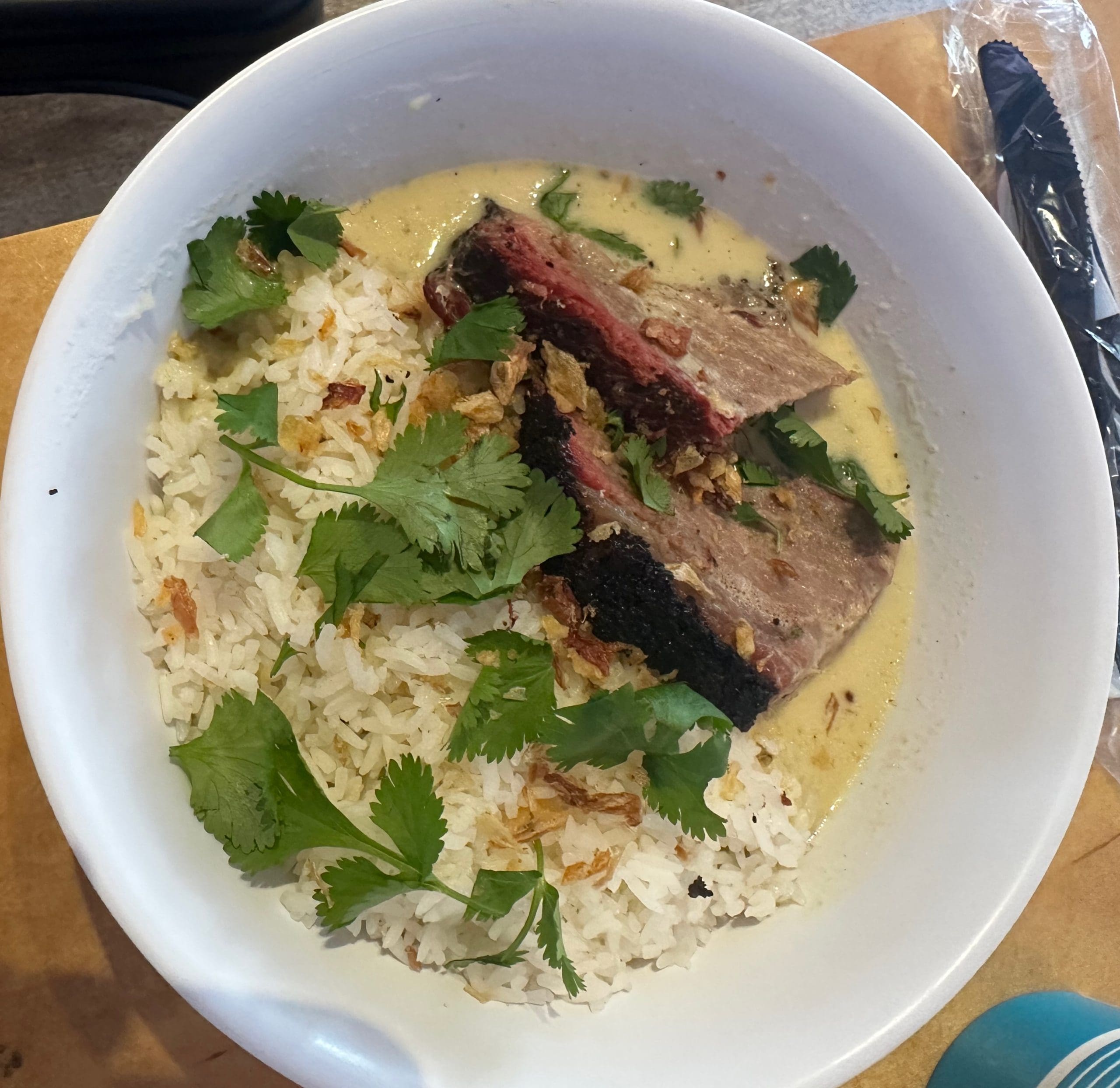
Curry Boys BBQ – San Antonio, Texas

The 1970s were characterized by writer Tom Wolfe as the “Me Decade” and derided by cynics as the “Disco Era.” It was an era of contrasts: the national crisis of confidence described by President Jimmy Carter as a “malaise” and the ubiquitous yellow smiley face; the melodic, velvety stylings of the Carpenters and the edgy, funky beat of disco; an explosion of copycat fast food chain restaurants and the introduction of innovative fusion cuisine in many contemporary restaurants. Fusion cuisine is the inventive combination of diverse, sometimes disparate culinary traditions, elements and ingredients to form an entirely new genre. In large metropolitan areas, particularly in California, the fusion of different cuisines became commonplace. Restaurants featuring the melding of French and…

Thai Heritage & Vegan – Albuquerque, New Mexico

Who among us hasn’t learned at least one thing about Thai culinary heritage from The Big Bang Theory? In a 2011 episode, for example, we learned that according to Thai tradition the last morsel of food, the greng jie, goes to the most important person in the room. At least that’s what Sheldon tells Penny when she reaches for the last remaining dumpling. Thanking everyone for the honor, she devours the dumpling. Sheldon’s retort: “I’ve seen pictures of your mother. Keep eating.” Some of us learned that Thai food is meant to be eaten with forks not chop sticks though in Thailand, they don’t put the fork in their mouth. It’s simply a tool to put the food on a…

Jasmine Thai Cuisine – Twin Falls, Idaho

My sister and I joke that our hometown of Peñasco is the only place in the entire country that doesn’t have a McDonald’s or a Thai restaurant.  Thanks to our neighbors in the Picuris Pueblo, there’s a Subway just a few miles west of our home.  The McDonald’s closest to Peñasco is 25 miles away in Taos which also boasts of three Thai restaurants.  Driving twenty-five miles in the high mountain country is very different from driving 25 miles in Albuquerque where you might still be in the Duke City when driving that distance.  Driving from Peñasco to Taos involves precipitous curves, steep climbs and sometimes weather conditions that render the streets unsafe. Just how pervasive are Thai restaurants? There…

Thai Street – Albuquerque, New Mexico

By chronological standards, Thai cuisine–especially as we know it today–is relatively new to the world culinary stage.  Culinary historians believe Thai cuisine may be as young as 1,400 years, coinciding with a mass migration of people from regions of China.  These settlers dined mostly on seafood, herbs and plants prepared mostly by stewing, baking and grilling (over time, stir-frying and deep-frying also became popular).  Large domestic animals such as water buffalo and oxen were too valuable to slaughter for food.  As such, meat was used very sparingly though considering the settlers’ propensity for seasoning, a small amount of meat went a long way.   While Chinese–particularly Szechuan–dietary practices were the most significant early influences, the introduction of other ingredients and…