Fancies Bakery and Modern Market

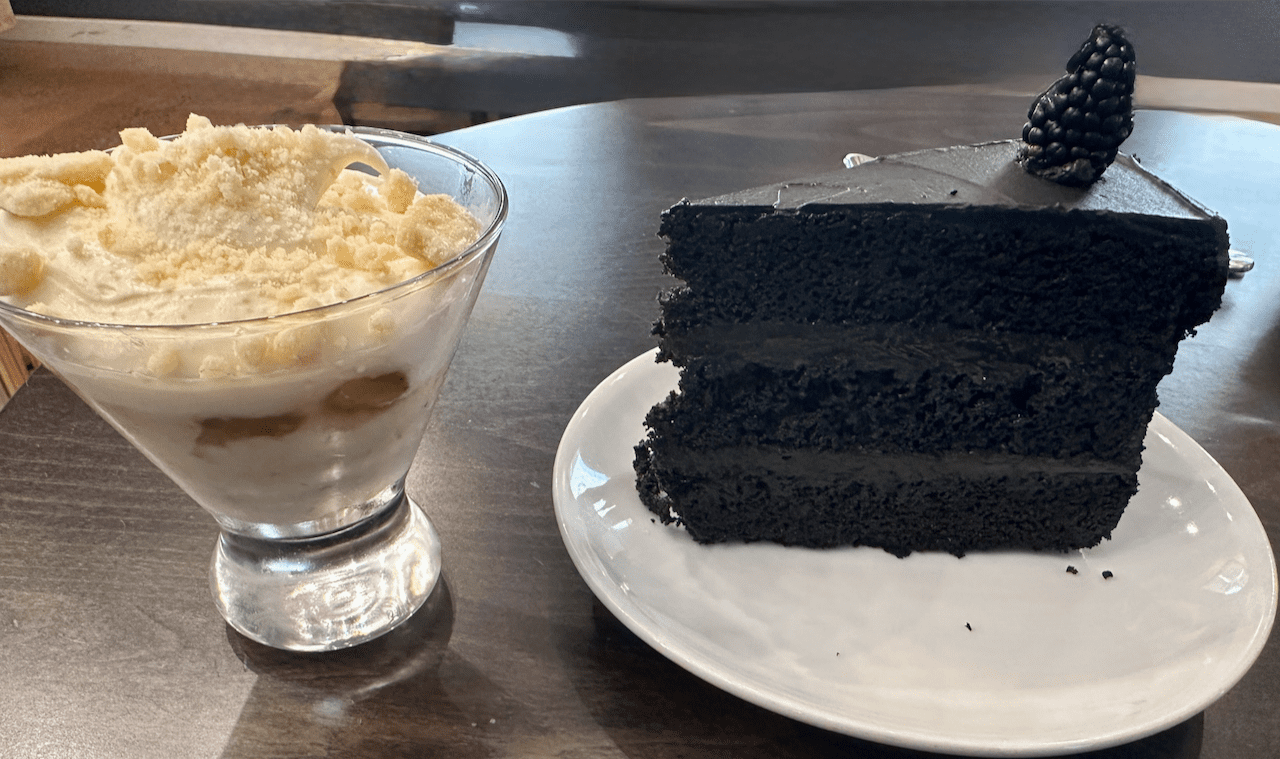
“Light and airy, reminiscent of European markets.”  That’s how the Corrales Comment described Fancies Bakery and Modern Market.   New Mexico Magazine waxed: “Fancies Bakery, Market & Cafe is a hive of activity. People pop into the airy Corrales café for a fresh-baked pain au chocolat, Cubano sandwich, or other delectable fare. Others browse the European-style market, picking up tinned sardines from Portugal, French jams, and ceramics made in Latvia.”  Perhaps only if you’ve lived in Europe is clarification helpful.  For my Kim and I, “fancies” had come to represent French Fancies, iconic, bite-sized sponge cakes topped with a dome of buttercream and covered in colorful, glossy fondant icing.  We must have devoured a truckload of fancies during our time in England. Recent restaurant visits have been akin to returning to our English home from 1984 through 1987.   During those three years, my Kim and I celebrated our cotton, paper and leather anniversaries (and we’re still going strong some 37 years later).  As much as possible, we lived “on the economy,” a military term for integrating into the local commercial and housing market instead of relying solely on the military bubble.  It meant buying food at local markets because it was…

Thicc Pizza Co. – Albuquerque & Rio Rancho, New Mexico

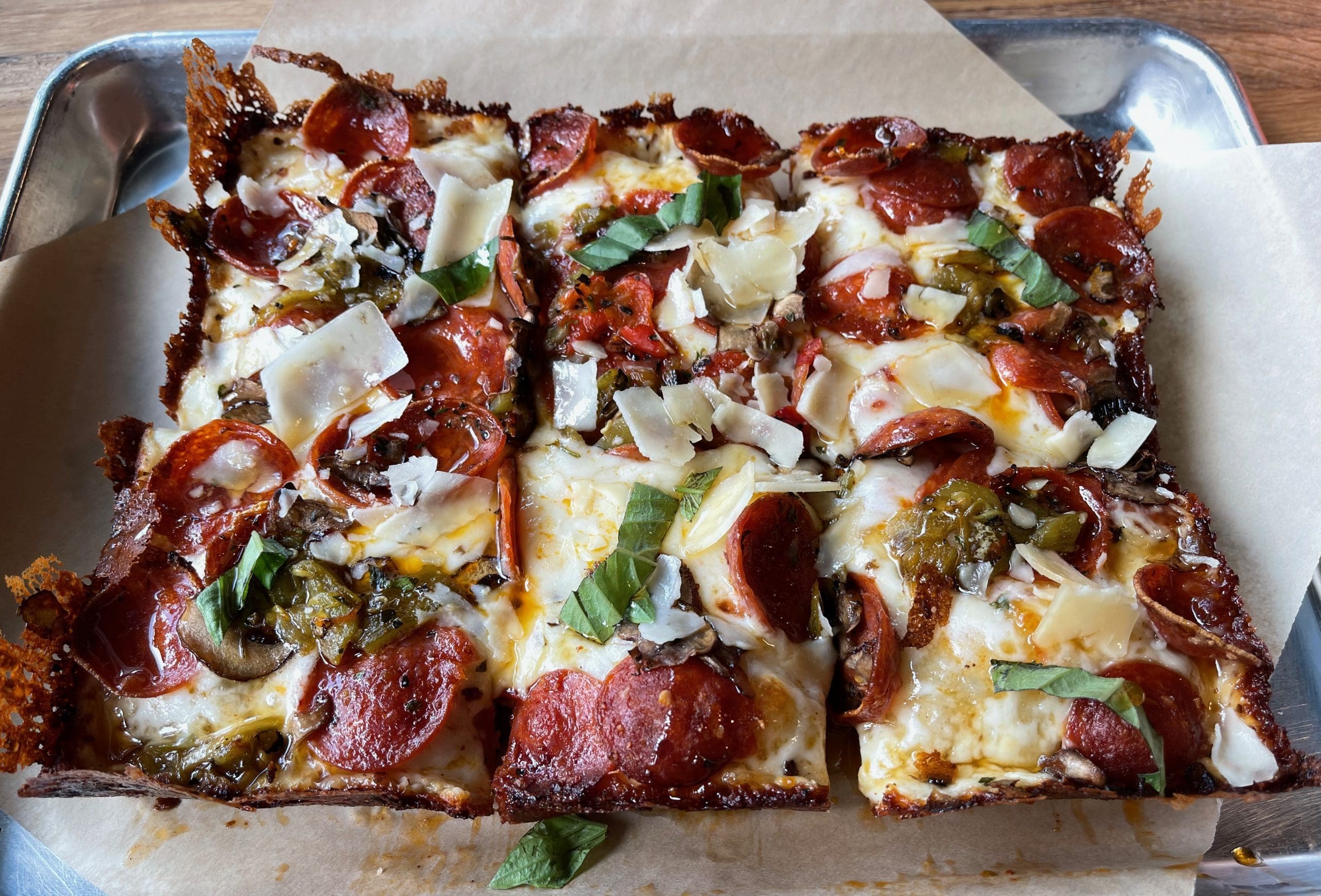
As you’ve read on the tagline for Gil’s Thrilling (And Filling) Blog, your humble blogger fancies himself somewhat of a sesquipedalian (a person who tends to use big words).  My logophilia (the love of vocabulary) is a lifelong affliction, both in English and in Spanish.  Despite my “affair” with words, one word-related term which just doesn’t always describe me is neologist (someone who uses new words). This is especially true about slang terms in fashion among the pop-culture-oriented youth.  When it comes to such terms, I’m not far removed from groovy, bread and copacetic.  It’s certainly not that I’m not interested in such words.  It’s just that I don’t seem to know anyone young and cool enough to use such terms (sorry BOTVOLR). Upon espying the name “Thicc Pizza Co.,” my initial inclination was “why would anyone spell “thick” so incorrectly.”  It then dawned on me that “thicc” could be one of those neologisms (a newly coined word or expression) no one in my inner circle seems to use.  A little research on the Sydney Morning Herald confirmed my suspicions: “Appearing in hip-hop circles during the early 2000s, the term “thicc” (originally “thick”) developed in African-American culture as a synonym for…

Turtle Mountain Brewing Company – Rio Rancho, New Mexico

The Tewa name “Oku Pin” which translates in English to “Turtle Mountain” has three meanings of significance to the people of Okay Owingeh, one of New Mexico’s great Tewa speaking Northern New Mexico Pueblos. “Oku Pin” was the the Indian name given to Dr. Alfonso Ortiz who obtained worldwide prominence as an anthropologist and ethnologist until his death in 1998. Ortiz was born and raised in San Juan Pueblo which in 2006 officially changed its name to Okay Owingeh. “Oku Pin” is also the Tewa name for Sandia Peak, the 10,678-feet high mountain which provides a spectacular backdrop for Albuquerque, Bernalillo and Rio Rancho. When Nico Ortiz, son of the famous anthropologist launched his inaugural restaurant and microbrewery in 1997, it just made sense that it should be called Turtle Mountain, a name which pays homage to his father and to the magnificent peaks under whose shadow his enterprise would flourish. Today, Turtle Mountain has also become synonymous with good food and (ostensibly) very good beer. Nico Ortiz has dedicated his life to the pursuit and production of good beer and has garnered tremendous recognition for his efforts, including a multi-page spread on the November, 2005 edition of New Mexico…

Il Vicino – Albuquerque, New Mexico

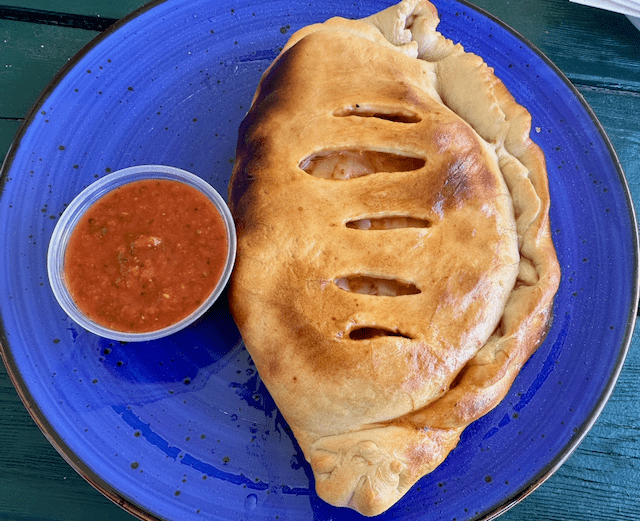
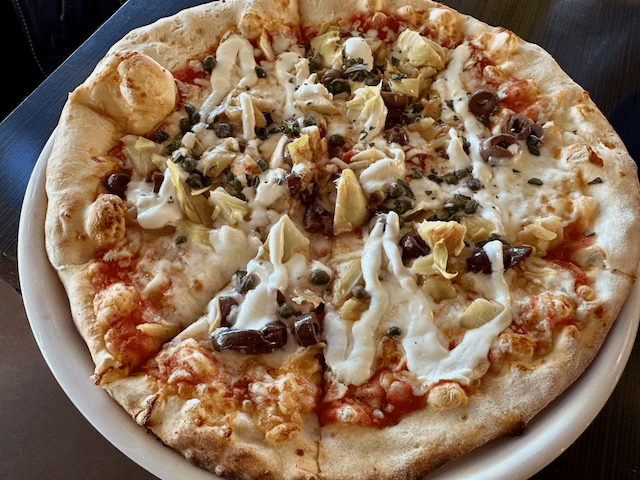
Undoubtedly the most oft-quoted line on Robert Frost’s poem “Mending Wall” is “good fences make good neighbors.” Frost, a four-time Pulitzer Prize award winning American poet certainly didn’t have Il Vicino (“the neighbor”) in mind when he penned his prose. Fortunately fences are no obstacle to patrons of this popular contemporary Italian trattoria. A well-regarded neighborhood eatery with three Albuquerque locations, Il Vicino is probably best known for its wood-oven pizza and award-winning brewery with popular micro-brewed ales but it offers much more than that. Known in some circles for prized beers, Il Vicino has a private wine label designed to complement its menu. Victuals include salads, panini and piadine-style sandwiches and baked lasagna, too. Il Vicino has long been a fixture in Albuquerque’s Nob Hill area (3403 Central Avenue, S.E.) with a second location in the far Northeast Heights (11225 Montgomery Boulevard, N.E.). In November, 2009, a third Il Vicino was launched in the burgeoning Northwest side (10701 Coors Blvd, N.W.). You’re never too far away from Il Vicino.  Every year, Pizza Monthly, a highly respected trade publication, mails out surveys to independent pizzerias across the nation. Using their responses, they compile a “Hot 100 list” — a ranking…

Calavida Cantina – Albuquerque, New Mexico

At Calavida Cantina, you’re invited to “party like the dead.”  If you haven’t partied like the dead, you’re probably not well acquainted with the Mexican tradition of “El Dia De Los Muertos,” the Day of the Dead.  During this Mexican holiday, the profusion of skeletons of all sizes performing day-to-day activities signifies the return to this world of the dead who remain who they were when they lived, doing what they did.  For example, skeletal figures depicted on the artwork at Calavida Continue would have been party animals when they graced this earthly plane.  Therefore in death, they remain party animals–eating, drinking and being merry.   At Calavida, the party animals of a past life mingle with party animals of today in a milieu that’s the antithesis of a morgue or mortuary. When we first espied the Calavida Cantina, I worried my Spanish vocabulary was diminishing with age (I’m 39) and lack of practice.  It was a relief to learn that Calavida isn’t an actual word, but a portmanteau blending calavera (skull) with vida (life), “a nod to the Día de los Muertos belief that joy and remembrance can—and should—coexist.” Calavida “toasts to the past, celebrates the present, and crafts liquid stories for the…

Fuego 505 Rotisserie & Bar – Albuquerque, New Mexico

“I have become obsessed with cooking meat over fire. I get prepared for it. I make sure I’m hungry before I cook it. The smell of the smoke and the aroma of the crackling meat ignites some ancient genetic memories. It makes cooking and eating significantly better.” ~Joe Rogan, Podcast Host Those of us with a carnivorous bent can relate to Joe Rogan’s ode to cooking meat over fire.  There’s absolutely nothing as mouth-watering as the heady aroma and melodious sound of meat searing on the grill or sizzling in a pan.  An argument can easily be made that nothing evokes a wanton lust more than smoke perfumed by meat as it wafts toward our anxiously awaiting nostrils.  The sounds and aromas of luscious meats licking flames on a roaring fire trigger something completely primal in all of us, especially when the pangs of hunger are at their most powerful.  It was that way from the first time a bolt of lightning struck a mastodon and rendered it delicious. Undoubtedly inspired by the aroma and flavor of that mastodon, homo erectus began throwing slabs of meat into the fire between one- and two-million years ago.  As a a direct benefit…

Perea’s Tijuana Bar & Restaurant – Corrales, New Mexico

The curious appellation “Tijuana Bar” dates back to the 1920s when the 18th amendment to the Constitution established Prohibition in the United States during the period 1920 to 1933. Because Prohibition forbade the sale of alcoholic beverages, many Americans got their alcohol illegally or they went to Mexico. Tijuana was a popular vacation and honeymoon destination and it happens to be where Teofilo C. Perea, Sr. and his bride honeymooned in the 1920s. The newlyweds visited a bar called the “Tijuana Bar” and decided then and there to use that name should they ever open a bar. Bureaucracy being what it is, once a license to dispense alcohol is issued, it’s very difficult to change the name on the license–hence Tijuana Bar. It fits. Housed in one of the oldest buildings in Corrales, a 200 year plus old structure constructed of “terrones” or thick slabs of earth rather than adobes, Perea’s Tijuana bar & Restaurant doesn’t subscribe to the notion that all food served in Corrales has to be of high-brow fru-fru variety. In fact, for outstanding home-cooked New Mexican food, Perea’s is one of a handful of restaurants vying for “best restaurant” in the Duke City area. In my…

Rudy’s Country Store & Barbecue – Albuquerque, New Mexico

In 1983, country crooner Ed Bruce released a song titled “My First Taste of Texas,” the first line of which was “My first taste of Texas was her blue eyes and golden hair.” Some ten years later, I experienced my first taste of great Texas barbecue when visiting Rudy’s Country Store & Barbecue in Leon Springs, Texas, a San Antonio suburb on the fringes of the magnificent Texas Hill Country. At the time Rudy’s was just beginning to make inroads toward becoming a significant barbecue presence in Texas where beef and brisket are king. Back then Leon Springs appeared to be a test ground for new restaurant concepts–and in fact, it is the site of the first Romano’s Macaroni Grill and the first Rudy’s Country Store & Bar-B-Q (as well as a concept called Nacho Mama’s which might have been the best of the lot.) Before it was Rudy’s Country Store & Bar-B-Q, however, it was just Rudy’s Country Store. The country store was opened in 1929 by Rudolph “Rudy” Aue, the son of the founder of Leon Springs. The country store included a gas station, garage and grocery store. In 1989, Rudy’s added Bar-B-Q to its country store’s name.…

El Guero Canelo – Tucson, Arizona

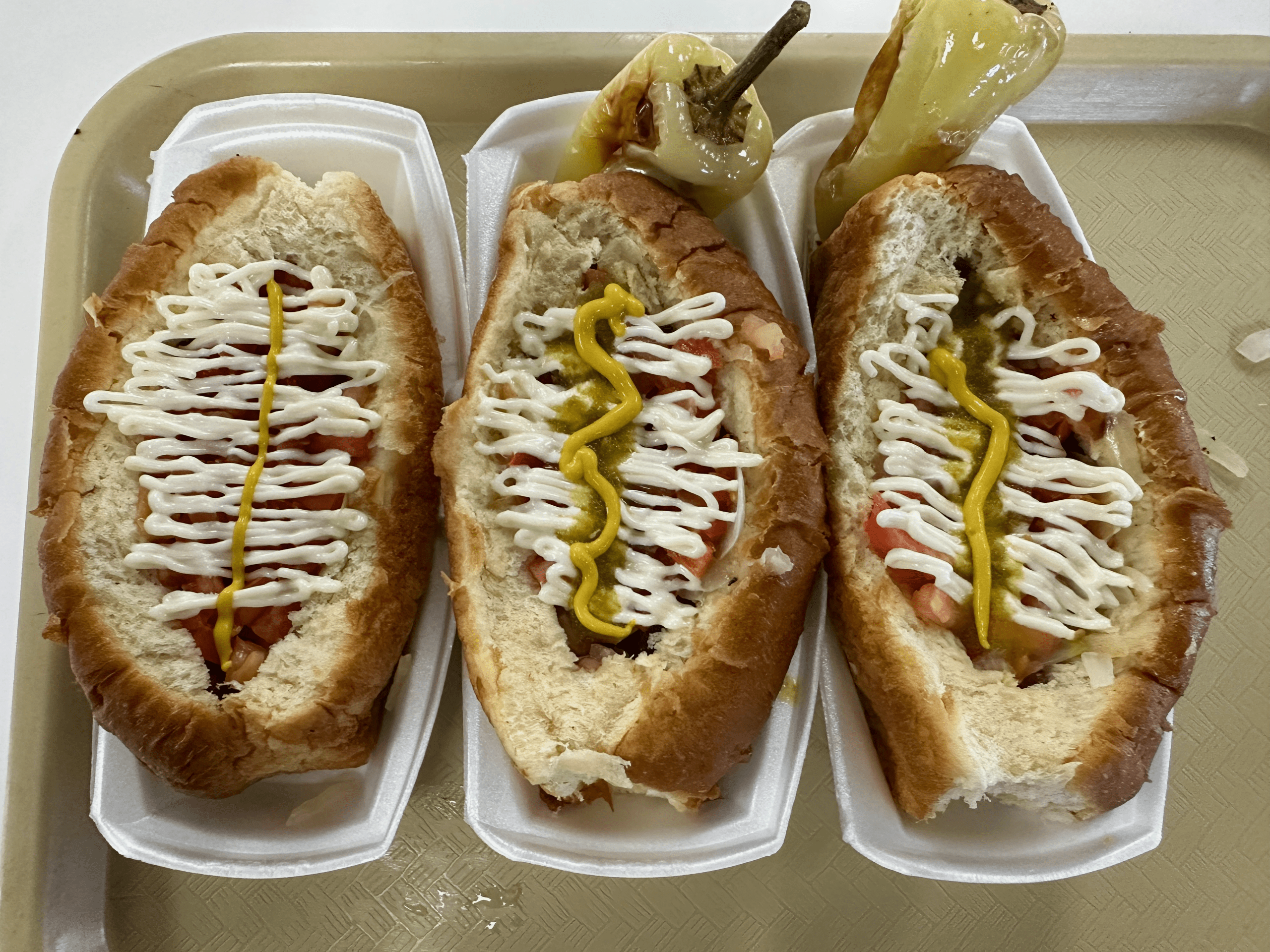
If asked to participate in a word association exercise, any well-traveled foodie undergoing psychoanalysis would find it easy to name the first food that comes to mind when a city is mentioned: Philadelphia – the Philly cheesesteak sandwich; Boston – baked beans; Chicago – Italian beef sandwiches; San Francisco – sourdough bread; Milwaukee – butter burgers; San Antonio, New Mexico – green chile cheeseburgers.  You get the point.  Some foodies might not know that Philadelphia is the birthplace of liberty, but they know about Geno’s and Pat’s King of Steaks and their decades-long battle for Philly cheesesteak supremacy. You might find it strange that seemingly pedestrian foods would be the defining cuisine of burgeoning cosmopolitan cities, historically significant metropolises and tiny hamlets in the desert, but it’s not solely foodies who associate foods with places. Anthropologist Maribel Alvarez of the University of Arizona says the “quintessential food of Tucson” is the Sonoran hot dog, explaining that instead of taking guests to high-end restaurants, locals will bring their out-of-towners to one of the city’s purveyors of Sonoran hot dogs. Hot dogs, like baseball and barbecue, aren’t exclusively the domain of Americans any more.  In fact, they never were. Before you call…

Guido’s Chicago Meat & Deli – Scottsdale, Arizona

For years now, my Kim and I have largely eschewed American television, especially its sophomoric, lowbrow and “meant for voyeurs” reality shows.  We’ve been increasingly gravitating to an almost exclusive viewership of British television which we’ve found to be meant for grown-ups rather than children.  British television programs offer a sophistication direly absent in American programming.  British programs tend to be more substantive, refined and of much higher quality than their American counterparts.  That assessment applies to mysteries, comedies, dramas and even commercials. The final nail in the coffin for American television were two absolutely unwatchable reality shows:  The Kardashians and Jersey Shore.  Both showcase obnoxious, self-aggrandizing and vacuous characters with no redeeming characteristics.  The Jersey Show, for example, made celebrities of four loud, foul-mouthed, hypersexual Italian Americans who self-style as “guidos” and “guidettes.”  Never mind that “guido” (slang for a working-class urban Italian-American) is widely perceived by Italian-Americans as a pejorative word, like “spic” or “wop.” It’s a very unflattering stereotype. Lest you think we lowered ourselves to watch such detritus, we caught a promotion for the series which bragged about gathering the “hottest, tannest, craziest guidos” and assembling them at a beach resort where all would be laid…

Cinnamon Sugar and Spice Cafe – Albuquerque, New Mexico

Back in the dark ages when I grew up–long before America became the kinder, gentler Utopia it is today (seething with cynicism)–it would have been inconceivable that boys and girls would receive trophies just for “participating.” Back then, we were expected to be competitive about everything. The battle of the genders was waged at home every night with my brothers and I pitting our brawn and bulk against the brains and gumption of our sisters, two of whom would go on to graduate as valedictorians and all of them much smarter than the recalcitrant Garduño boys. It rankled us to no end when our sisters reminded us constantly that “boys are made of snips and snails and puppy dog tails‘” while they were made of “sugar and spice and everything nice” even as they smashed our toy machine guns (undoubtedly in retaliation for us having drawn mustaches on their Barbie dolls before decapitating them). We sure made it challenging for our parents to be as generous with their affection as Dr. Benjamin Spock (the pediatrician, not the Vulcan) had advocated. Espying the curiously named Cinnamon Sugar & Spice Cafe on Juan Tabo rekindled memories of the “What Are Little Boys…