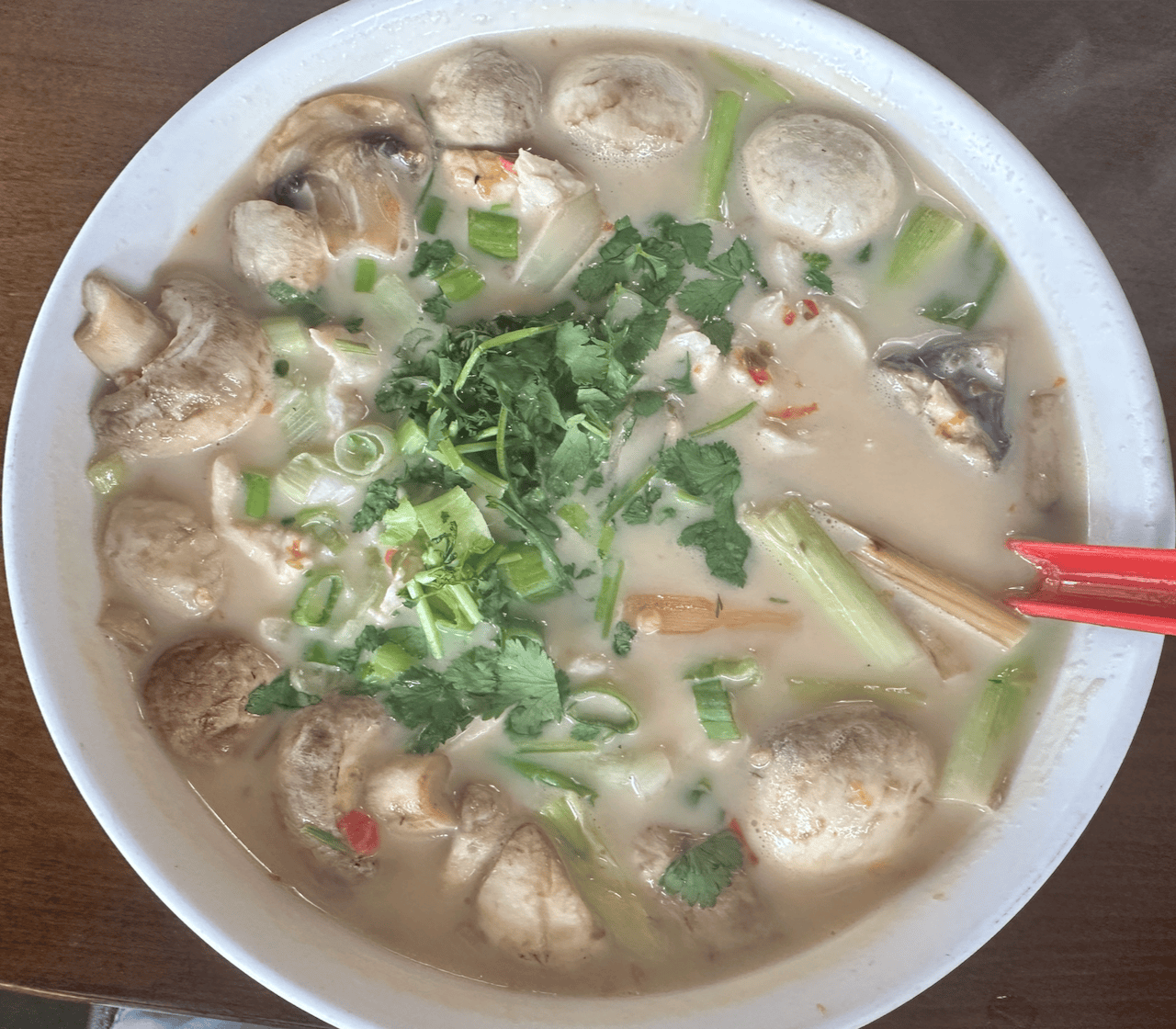
Vong Sushi Thai and Laos Cuisine – Rio Rancho, New Mexico

Grammatically any of the following is correct:  Laotian cuisine, Lao cuisine or the cuisine of Laos.  Just don’t ever call it “Laosy cuisine.”  That would not only be a malapropism, it would be wholly inaccurate.  The cuisine of Laos is among the most dynamic and delicious in Southeast Asia, if not the world.  One of the reasons Laotian cuisine doesn’t receive the accolades it deserves is because of its neighbors.  The Lao People’s Democratic Republic is a landlocked country in Southeast Asia bordered by Myanmar (formerly Burma), China, Vietnam, Cambodia and Thailand.  To some extent, these neighbors (at least China, Vietnam and Thailand) have surpassed Laos on the world’s culinary stage–not necessarily because their cuisine is superior, but because it’s got a much larger platform. It’s no surprise that Lao cusine has been greatly influenced by neighboring nations, but a French influence is also in evidence. From 1893 to 1954 when it gained full independence, Laos was part of the Protectorate of French Indonesia.  So what’s the Cuisine of Lao like? It might help to understand that its closest “relative” is the cuisine of the Issan region of northern Thailand. New Mexicans who love their food a bit on the…

East Asian Kitchen – Albuquerque, New Mexico

Perhaps more than anyone I’ve ever met, my Singaporean friend Ming Lee (God rest his beautiful soul) regarded people by the content of their character, not by physical characteristics.  So, it surprised me to hear him joke “we all look alike.”  It was an unsolicited admission that even he couldn’t always discern the cultural genesis of Asian people he met.  He also joked “at least I can always tell where an Asian restaurant’s food comes from.”  Ming was a bona fide gastronome who introduced me to the cuisine of Singapore and Malaysia.  Like me, he disliked restaurants in which overt homogenization of Asian food was apparent.  Sure, different culinary cultures across Southeast Asia have borrowed from one another over the millenia, but most adapt to cultural tastes rather than copy exactly. Ming was wary of Asian restaurants that purported to serve the cuisine of more than one Southeast Asian nation.  To him, the concepts of global cuisine and multicultural restaurants “dumbed down” what is best about each culinary culture.  We disagreed on the concept of fusion cuisine, the blending of elements from different cultures, creating new dishes that offer several cultures on a plate.  I like the concept when executed…

Ichiban – Albuquerque, New Mexico

In an episode of Friends, Joey Tribbiani starred in a commercial released only in Japan for Ichiban men’s lipstick. His friend Chandler’s response upon viewing the commercial: “he really is a chameleon.” In Japanese, the word “ichiban” means “number one” or “the best” and can be used either as a superlative (as in the highest of quality or the very best choice) or to denote precedence or numerical order. The fictional Chinese-American detective Charlie Chan, for example, called his eldest son “number one son.” Whether meaning to denote the highest quality or precedence (ranking) among other restaurants, any dining establishment calling itself “number one” is making a pretty audacious claim.  That may be especially true if that claim is made about a sushi restaurant. Even in a landlocked market like Albuquerque where fresh seafood isn’t walked off the dock and onto a restaurant’s kitchen, there are enough “passable” or better sushi restaurants that it is disputable as to which is really number one. After several visits to Ichiban Japanese Restaurant since its launch in the millennium year (2000), it became increasingly clear that the “number one” designation is business name.  In our experience Ichiban has suffered from inconsistency over the…

Aji Ramen – Albuquerque, New Mexico

If a television show was to be created about ramen (some pronounce it ray-men), it would probably be called “Everybody loves ramen.”  According to the World Noodles Association (yes, there is such an entity), Americans consume 5.15 billion servings of instant ramen every year.  If you think that’s a lot, the United States ranks as only the sixth-largest consumer globally, significantly far behind such Asian nations as China and Indonesia.  Still, the land of spacious skies and fruited plains ranks as the top ramen consumer outside of Asia.   The per person consumption rate among Americans is 15 servings of ramen per year.  Would you believe South Korea is ranked the world’s number one per capita in instant noodle consumption (72.8 servings of instant noodles per annum)? Perhaps because of my non-traditional route (night school and testing out of courses) to higher education, I’ve never had instant ramen.  That’s right.  In my 39 years on planet Earth, my lips have never partaken of the food most commonly associated with college students.  Maybe it’s a good thing.  The high-calorie content and the high concentration of refined carbohydrates, fats, and sodium  in instant noodles, contribute to an increased risk of metabolic disease.  Though…

Sushi Gen – Albuquerque, New Mexico

Years ago while at Intel I co-managed an enterprise project with Nora, a diminutive Vietnamese lady who later left the company and moved to San Diego.  I expected her to say she her move was prompted by a desire to be closer to family or to her childhod home.  Instead what she most looked forward  to about relocating to San Diego was the availability of all-you-can-eat (AYCE) sushi bars.  Her answer validated why she and I worked so well.  We had a very symbiotic relationship and were able to land our project not only successfully, but better than any other Intel site had done.  We both loved Asian food of all types. Nora left Albuquerque a couple of years before the Duke City saw the launch of its first AYCE sushi restaurant.  In 2024, Sushi Gen celebrates twenty years of creating and serving sushi.  Its $29.99 per person price point isn’t significantly more than it was in 2004.  When Nora first told me about AYCE sushi restaurants, I was skeptical. “How good can AYCE sushi be?” I opined.  We found out during a 2001 visit to Makino in Las Vegas, Nevada that AYCE sushi can be pretty good indeed, especially…

Sushi Freak – Albuquerque, New Mexico

Somewhere in Japan generations of traditional sushi chefs are rolling in their graves…and they’re not rolling sushi.  What set them off?  No one knows for sure, but it could have been a 2014 article in the San Diego Reader in which Jennifer Duarte, the co-owner of a San Diego based sushi restaurant named Sushi Freak boasted “I can teach any kid to become a sushi roller.  I could train you in five minutes.”  Sushi masters (itamaes) trained in Japan would argue that it takes years to learn and master the delicate art of making great sushi, that it’s significantly more complex and subtle a specialty than could possibly be mastered in five minutes by a kid.   The painstaking process of earning the exceptionally prestigious and revered title of itamae can take as long as ten years of rigorous training.  Itamae, which translates from Japanese to “in front of the board” literally means “this is the person in charge of all that happens on the (cutting) board where sushi preparation takes place.”  All that happens on the board includes being entrusted with the time-honored responsibility of artfully preparing sushi, guiding the sushi kitchen, pleasing the guests and even calculating the final bill…

Tokyo Bangkok – Albuquerque, New Mexico

In 2019, Mastercard published its Global Destination Cities Index which ranked 200 cities around the world with the most international visitors.  Topping the list for the fourth consecutive year was Bangkok, Thailand which boasted of 22-million overnight visitors.  Next on the list with around 19-million international overnight visitors were Paris and London respectively.  With 13.6-million visitors, New York City was the only United States destination to make the top ten, ranking seventh.  Tokyo (12.93-visitors) was ninth on the list. Many years ago when I was a fledgling airman in the world’s greatest Air Force I had the privilege of serving with grizzled veterans who had been stationed in Southeast Asia during the long and drawn-out Vietnam War.  Almost invariably they spoke about the camaraderie and esprit de corps they shared with their brothers-in-arms.  Though they bemoaned having arrived as boys and forever losing their youth during the ravages of war, they lit up when talking about  Thailand with its exotic aura, welcoming lifestyle and (maybe especially) women they found mesmirizing.  They regaled me with tales of nightlife in Bangkok where they lost themselves momentarily in revelry. During my Air Force career (especially as a single man) my “dream sheet” (what…

Ikigai ABQ – Albuquerque, New Mexico (CLOSED)

While ikigai (pronounced ee-key-guy) may sound like what grade school girls called me many years ago, in Japanese the term ikigai is a Japanese concept combining the terms “iki,” meaning “alive” or “life,” and “gai,” meaning “benefit” or “worth.”  Though there is no direct English translation, when combined these terms embody “that which gives your life worth, meaning, or purpose.”  Essentially, ikigai is the reason why you get up in the morning. It makes a lot of sense therefore that the signage for Ikigai, a sushi restaurant ensconced in a Lilliputian pod within the El Vado Motel complex, would be subtitled “a sushi shop with purpose.”  For some of us, sushi gives life worth, meaning and purpose.  Sushi was the reason we got up early on the Sunday morning of our inaugural visit, an indulgence that came very highly recommended by my friend  Howie “the Duke of the Duke City” Kaibel, Community Director for Yelp. Leave it to that fiendishly clever Howie to contemplate the existential in his Yelp review of Ikigai: “I’m pretty sure I’ll spend the better part of eternity seeking out so-called Balance, and failing miserably. There’s food I consider Healthy and all the rest that doesn’t…

Pacific Paradise Tropical Grill & Sushi Bar – Albuquerque, New Mexico (CLOSED)

Shangri-La. Eden.  Paradise. Heaven on Earth.  The concept of a remote and exotic utopia, a faraway haven or hideaway of idyllic beauty and tranquility, has long intrigued mankind.  Paul Gauguin, the famous French post-impressionist artist thought his persistent pilgrimage for Paradise was over when he moved to Tahiti in the tropical South Pacific.  Alas, his picturesque paradise, as with anything that seems too good to be true, was also discovered by French colonists who quickly transformed Tahiti into the antithesis of the “sensual loafer’s paradise” he had envisioned. For aficionados of Asian cuisine, paradise might be defined as a restaurant from whose kitchen emanates the culinary diversity of the Pacific: time-honored and traditional delicacies, contrasting yet complementary flavors, exotic and healthful ingredients, varied and interesting textures, exquisite freshness with all cuisine reflecting the geography, culture and history of its originating nation.  It would be a restaurant offering the culinary treasures of China, Japan, Thailand, Vietnam, Malaysia, Singapore, Mongolia, Korea and Hawaii and it would be an adventure in authenticity and deliciousness. There are several restaurants in the Duke City which proffer entrees from more than one Pacific nation.  The most ambitious, by far, is the aptly named Pacific Paradise Tropical…

Sushi & Sake – Albuquerque, New Mexico

“If white wine goes with fish, do white grapes go with sushi?“ – George Carlin A reader once asked Washington Post humorist Gene Weingarten what he was a snob about. His reply, “I am also a snob about food. The other day, in Baltimore, I passed a sign outside a restaurant that said “Sushi Buffet!‘ and laughed out loud because it occurred to me that “sushi” and “buffet” are two words that should never appear together.”  His sentiment resonates strongly with sushi aficionados who adhere to the strict rules of etiquette which governs the way in which true sushi snobs enjoy sushi. It’s a given that a true sushi snob would never eat at an all-you-can-eat sushi restaurant nor would such a snob ever be found mingling with the rabble who sit in booths or receive table service.  Sushi snobs will only sit at a sushi bar in as close proximity to the sushi chef as possible.  They like to converse with the sushi chef, hoping to ingratiate themselves by asking the right questions to demonstrate they are savvy connoisseurs and not “trough-divers” like most of the crowd.  They treat the sushi chef like Magellan, their esteemed navigator on a…

Ohana Hut – Albuquerque, New Mexico

In horse racing, the Triple Crown signifies winning all three of the sport’s most challenging thoroughbred horse races—The Kentucky Derby, Preakness Stakes and Belmont Stakes. This is considered the greatest achieved in thoroughbred racing, a feat accomplished only twelve times. The thespian community considers as its Triple Crown, winning a competitive Academy Award, an Emmy Award and a Tony Award in acting categories. Only twenty-two actors or actresses have earned this rare distinction. What makes winning a Triple Crown in any competitive event so exciting for fans is its rarity. It happens so infrequently that fans clamor for it to happen. At the 2015 Taste of Rio Rancho event, Street Food Blvd pulled off a Triple Crown of sorts, earning three first-place awards: best appetizer, best entrée and People’s Choice. It’s a feat no other Rio Rancho restaurant ever managed in the event’s auspicious six year existence. Considering the City of Vision is home to some of the very best restaurants in the metropolitan area (including Joe’s Pasta House, Namaste, Café Bella), that’s quite an achievement. What made this coup doubly impressive to many of the throngs in attendance is that Street Food Blvd is not a brick-and-mortar operation. It’s…