East Ocean Chinese & Seafood – Albuquerque, New Mexico

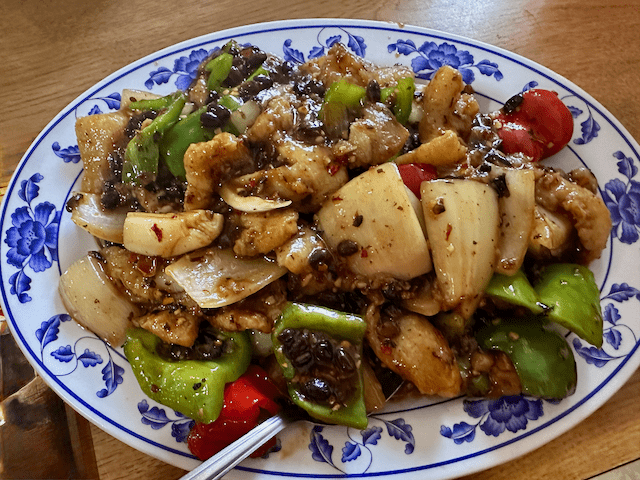
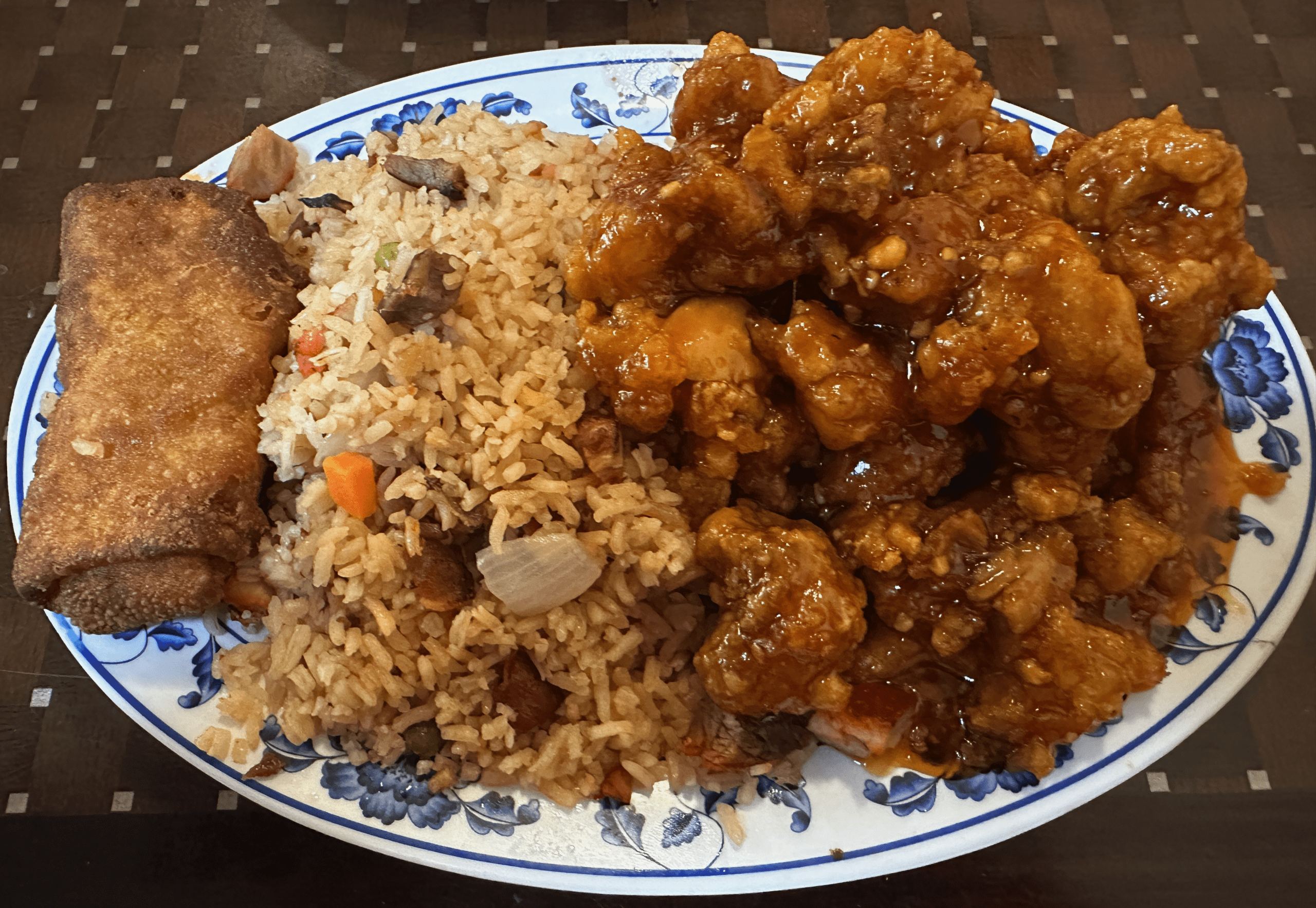
In 2022, Freddie Wong posted a TikTok video that went viral on several social media platforms. In the video, Wong, purports to find the most “authentic” Chinese food by utilizing restaurant review website Yelp in a unique way.  “The easiest way to find authentic Chinese food, assuming you’re living in a major metropolitan area, is to go on Yelp and to look for restaurants with three-and-a-half stars,” declared Wong in his TikTok video, which garnered an astonishing 7.2 million views in only two days. “Exactly three and a half, not three, not four. Three-and-a-half stars is a sweet spot for authentic Chinese food.” Again, the assumption is based on living in a major metropolitan area where there are a preponderance of “authentic” Chinese restaurants.  In cities such as Albuquerque, few restaurants even offer a traditional Chinese menu (if you ask for it).  Among those is East Ocean which coincidentally or not is rated  exactly three-and-a-half stars on Yelp.  A Duke City mainstay for more than thirty years, East Ocean has a huge following that includes  George Thorning, my friend and colleague at the University of New Mexico.   Though he did experience a bit of consternation when the restaurant changed…

East Asian Kitchen – Albuquerque, New Mexico

Perhaps more than anyone I’ve ever met, my Singaporean friend Ming Lee (God rest his beautiful soul) regarded people by the content of their character, not by physical characteristics.  So, it surprised me to hear him joke “we all look alike.”  It was an unsolicited admission that even he couldn’t always discern the cultural genesis of Asian people he met.  He also joked “at least I can always tell where an Asian restaurant’s food comes from.”  Ming was a bona fide gastronome who introduced me to the cuisine of Singapore and Malaysia.  Like me, he disliked restaurants in which overt homogenization of Asian food was apparent.  Sure, different culinary cultures across Southeast Asia have borrowed from one another over the millenia, but most adapt to cultural tastes rather than copy exactly. Ming was wary of Asian restaurants that purported to serve the cuisine of more than one Southeast Asian nation.  To him, the concepts of global cuisine and multicultural restaurants “dumbed down” what is best about each culinary culture.  We disagreed on the concept of fusion cuisine, the blending of elements from different cultures, creating new dishes that offer several cultures on a plate.  I like the concept when executed…

Red Chilli House – Albuquerque, New Mexico

Red “Chilli” House…doesn’t “Chilli” read like a misspelled word that knocked a spelling bee contestant out of the competition?  Or like someone added one too many letter “l’s” to the already misspelled word “chili?”  Actually, that spelling (which some of us purists consider Texan) is by design.   The delightful Chinese restaurant sporting that appellation–which opened its doors in June, 2024–wouldn’t change it.  Among other things, it illustrates just how important Capsicum is in some provinces of China, particularly Sichuan and Hunan. Capsicum, as most New Mexicans know, is the genus to which all chili (chile in New Mexico) peppers and bell peppers belong. The fruit of the capsicum plant contains a chemical called capsaicin, the active ingredient that gives chile its piquancy.  Historians widely agree that capsicum was unknown outside the tropical and subtropical regions of the Americas before 1490s.  That’s when Christopher Columbus sailed the ocean blue and brought this red-fruited plant along with other food plants, such as maize, beans and squash, from the New World to the Old. When introduced to China in the 16th Century, chile peppers were called “barbarian peppers” on account of their foreign origin.  Eventually the province of Sichuan developed a profound…

Fei’s Cafe – Albuquerque, New Mexico

Some say the map of China looks like a chicken.  The province of Sichuan in Southwest China would be right in the stomach of that chicken.  That’s fitting because the cuisine of Sichuan is internationally renowned for its liberal use of spice.  What characterizes Sichuan from the other regions of China is its use of Sichuan peppercorn, chilies, and the ability to take even the most mundane of ingredients to create fabulous dishes.  There’s a term for the flavor profile associated with Sichuan cuisine.  It’s the word “mala” which translates to “numbing spice.”  The “ma” portion of that term comes from the use of Sichuan Peppercorns (which are actually in the same botanical family as citrus, not chilies).  Sichuan peppercorns create a tingly, electric, buzzing, salivating, sensation on the palate. Sichuan peppercorns  are not spicy. The heat in Sichuan cuisine comes from la – or spicy. A variety of chilies are used in Sichuan cuisine. When long-time reader Nathaniel recommended Fei’s Cafe, he explained “It’s by far the best Chinese food I’ve had in ABQ, comparable to Boston or LA. It’s a real hole in the wall and really authentic. They don’t seem to be getting a lot of business, for…

Best Lee’s – Rio Rancho, New Mexico

When does confidence become audacity? Is there a point at which a claim becomes braggadocio? To what extent can you trust a review on a hometown magazine? These were all questions we sought to answer during our inaugural meal at a Rio Rancho Chinese restaurant with the quaint name “Best Lee’s.”Best Lee’s is ensconced in the Southern Plaza Shopping Center in the same suite that held Peking House, a Chinese restaurant so mediocre I chose not to write anything about it during our one and only visit. In truth, we thought Peking House was still happily torturing taste buds until reading the December-January 2007 edition of Rio Rancho magazine (now defunct). A published review practically gushed with effusiveness over a dining experience at Best Lee’s. Then there’s the menu which proudly proclaims “best food in town.” That’s an audacious claim we were eager to validate or debunk. The menu, by the way, is encyclopedic in its volume, listing well over a hundred items in various categories: appetizers, soup, fried rice, lo mein, sweet and sour, seafood, poultry, pork, beef, vegetables, chow mein and chop suey, chow mein fun, diet special dishes, and the ever-present chef’s specials.   Best Lee’s opened for…

Chopstix – Albuquerque, New Mexico

And I find chopsticks frankly distressing. Am I alone in thinking it odd that a people ingenious enough to invent paper, gunpowder, kites and any number of other useful objects, and who have a noble history extending back 3,000 years haven’t yet worked out that a pair of knitting needles is no way to capture food? ~Bill Bryson The precise date in which chopsticks were first used has been lost in time. Archaeological evidence found in burial plots indicates they are at least 3,200 years old though some scholars believe they’ve been around even longer than that. Even the evolution of chopsticks is in debate. Some surmise that chopsticks evolved from the practice of using wooden sticks to stir food as it cooked on large pots over an open fire. Others believe that hasty eaters broke twigs from trees to retrieve food as it cooked. Whenever their origin and whatever its genesis, chopsticks have, for thousands of years, been the main tableware of the Chinese. By the Fifth Century A.D., the use of chopsticks had even spread from China to present day Japan, Korea and Vietnam. The dualistic philosophies of Yin Yang that seek universal balance and harmony even posit…

Fan Tang – Albuquerque, New Mexico

For “city dwellers” Chinese restaurants are ubiquitous.  There’s one in every corner   Most urbanites were weaned on Chinese food.  It’s as much a part of their diet as “American” food.  Those of us who grew up in the “sticks” during the stone age had to travel great distances to find Chinese food…and when we did find a Chinese restaurant, we really had no idea what we were getting ourselves into.  Everything we knew about that mysterious, exotic cuisine came from television programs in the days long preceding the Food Network.  Every once in a while, mention was made on one of those  television shows about egg foo young.  I’m thinking maybe Maxwell Smart may have mentioned egg foo young during in an episode in which he battled his nemesis “The Craw“, er…The Claw. As chronicled on Gil’s Thrilling…my very first experience with Chinese food transpired in Lexington, Massachusetts within easy walking distance of the famous Lexington Minuteman Statue.  My friend (and boss at the time) Paul Venne enjoyed my bumpkinly naivete.  I literally had no idea about Chinese food other than the little bit learned from television.  He recommended starting out at the Chinese Food 101 level.  That meant egg…

El Palacio Imperial – Albuquerque, New Mexico

“Tradition is everything.  It’s very important. But we need to remember that the traditions of today Were the modernity of the past. And that the things we think are very science fiction type of things Will be the traditions of tomorrow.” ~Chef Jose Andres Chef Jose Andres was the founder of the World Central Kitchen which provides large-scale relief to communities affected by natural disasters and conflicts around the world.  He’s one of Time Magazine’s  world’s 100 most influential people.  He earned a Presidential Medal of Freedom for his altruism as well as for being the Spanish-American culinary innovator who popularized tapas in the United States.  His list of accomplishments and the reach of his philanthropic efforts mark him as one of those rare human beings whose influence and impact extend far beyond the kitchen. Several years ago, my Kim and I visited China Poblano, a spectacular restaurant launched by Chef Andres in Las Vegas, Nevada.  This eatery pays tribute to the concept of East meets West, serving both Mexican and Chinese foods.  Las Vegas Weekly called China Poblano “quite simply the perfect restaurant for today’s hipster foodie.”  China Poblano is not a fusion restaurant per se in that it doesn’t…

Noodle Works – Albuquerque, New Mexico

“To witness the birth of a noodle is a glorious thing. I have listened, spellbound, as an 85-year-old noodle chef in Beijing told me why the act of making noodles helped him make sense of the world.” -~Terry Durack, Noodle In the movie Mr. Nice Guy, martial artist cum actor Jackie Chan portrays a  chef with a successful television show.  In the movie’s opening scene, Chef Jackie is presiding over a flour-dusted table, stretching, twisting, and pulling a piece of dough into fine strands of noodles, a process the TV host can only describe as “alchemy.”   For the culinary obsessed among us, that was the highlight of the movie, all the “special effects” we needed.  Later on, Chef Jackie would be stretching, twisting and pulling a drug lord and his syndicate in much the same manner as he did the noodles. There’s something almost mystical about the artisan process of pulling noodles by hand.  Certainly for the onlooker, it’s entertaining to the point of being mesmerizing.  It’s not prestidigitation in that there’s no sleight of hand to deceive you.  It’s sheer brilliant mastery of an time-honored craft.  It’s performance art and scientific precision in one.  Learning to repeatedly stretch…

BUDAI GOURMET CHINESE – Albuquerque, New Mexico (CLOSED)

“The true gourmet, like the true artist, is one of the unhappiest creatures existent. His trouble comes from so seldom finding what he constantly seeks: perfection.” –Ludwig Bemelmans By definition, gourmets are connoisseurs, taking food more seriously than most and embodying the axiom “live to eat rather than eat to live.” True gourmets, as Ludwig Bemelmans would define them, appreciate food of the highest quality, exalting only in the rarefied experiences–those which require the most discerning palates and noses to cognize subtle nuances in complex and sophisticated flavors and aromas. Bemelmans, himself an internationally known gourmet, posited that the true gourmet will find joy only in tasting, smelling and appreciating perfection, not in its pursuit. I’ve known several true gourmets fitting Bemelmans definition. Most of them are insufferable and condescending. Though endowed with refined palates cultivated by years of indulgence in the finest foods and blessed with olfactory senses which would put a German shepherd to shame, they derive no sensuous enjoyment from most culinary experiences. Nothing is quite good enough. Nothing meets their demanding and exacting standards. Dining (they don’t eat) with them is a test in patience as they deride and diminish everything put before them. Perhaps the…

Tasty Noodles & Dumplings – Albuquerque, New Mexico

The first time I noticed that the dishes served to people of Asian descent weren’t covered in neon bright sauce, I wondered why those strange looking dishes weren’t on the menu.  Or maybe I just didn’t see them.   I asked my server (who was barely conversant in English) and was essentially told I wouldn’t like “authentic” Chinese food.  “What the heck am I eating?” I  asked myself.  That was the beginning of my explorations into the ancient and traditional culinary culture of China.  I delved into just what dishes are considered “authentic” and just what “authentic” means. Dogmatists and purists insist that dishes that weren’t “invented” in China are spurious, not legitimate.  They use such terms as “Americanized” and “white-washed” to describe those dishes.  They point out that much of the Chinese food served across the fruited plain is stickier, sweeter, and unhealthier than traditional dishes served in China.  They don’t necessarily point out that some of the differences between Chinese food from China and Chinese food served in the states is because of the wide availability of American ingredients such as carrots, snow peas, green peppers, broccoli and mushrooms. Additionally, Chinese immigrants were partly forced to rely on…