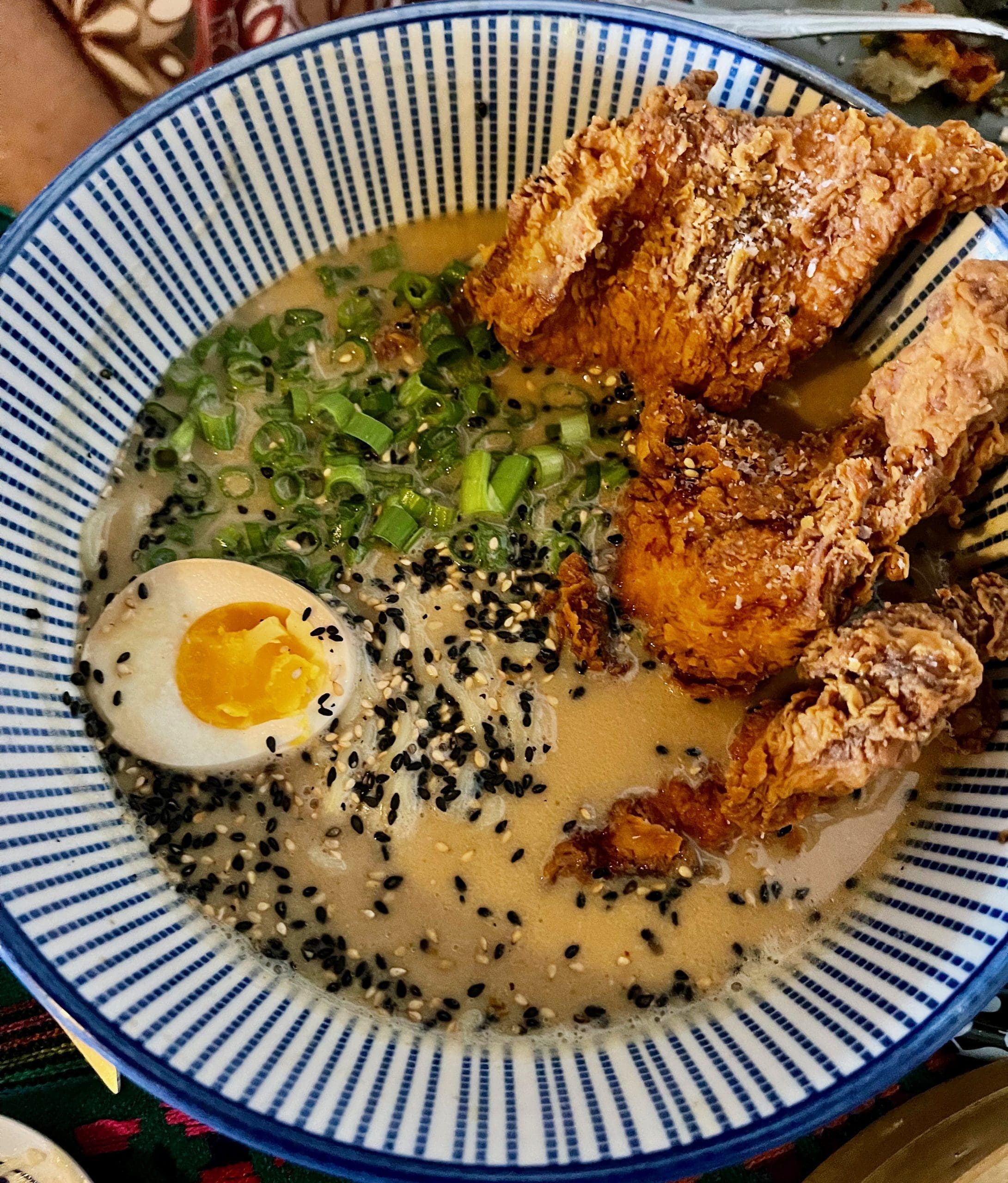
Oni Noodles – Albuquerque, New Mexico

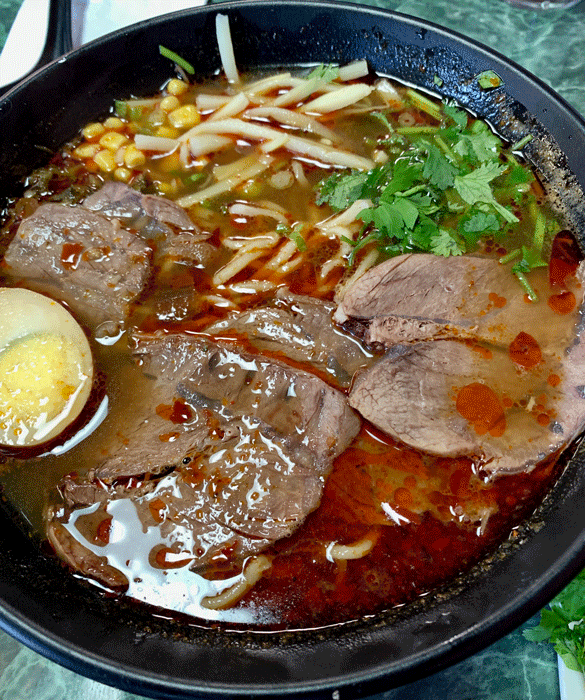
In retrospect, the monsters and bogeymen who frightened impressionable children of my generation were pretty lame. Perhaps the most lame of them all was Frankenstein, a lumbering behemoth who walked around with his arms outstretched like a sleepwalking Shaquille O’Neal. Frankenstein snarled and growled a lot, probably because Gene Hackman poured hot soup on his lap. Then there was that pasty-faced vampire Dracula who could be repelled with garlic (which explains his aversion for Italian food). Dracula couldn’t even enjoy New Mexico’s 310 days of sunshine without sizzling and hissing like a strip of bacon. In comparison Japan’s monsters are pretty badass. Godzilla, a foul-tempered prehistoric sea monster prone to  tantrums destroyed Tokyo several times and was pretty much impervious to conventional weaponry. Godzilla’s nemesis, the fierce Mothra was a powerful psychic (not in the “unfold the mysteries of your future for $29” sort of way) who could really blow your mind…away. Then there are the Oni, a number of supernatural ogres with really cool powers. Oni can cause disease and disaster and are associated with bad luck, misfortune and the consumption of human flesh. To my friend Carlos, a devotee of manga (Japanese comics) as well as mangia (the…

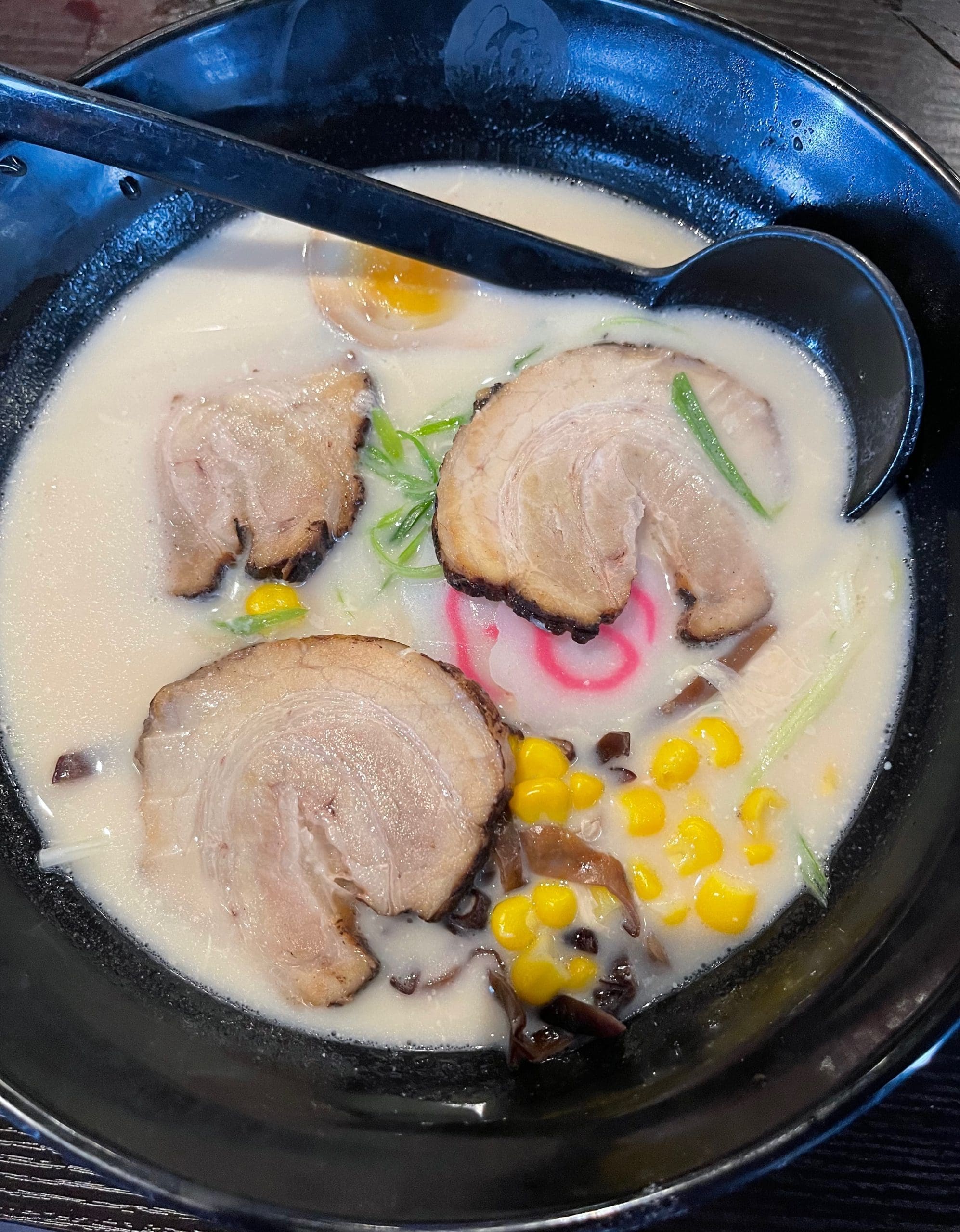
Aji Ramen – Albuquerque, New Mexico

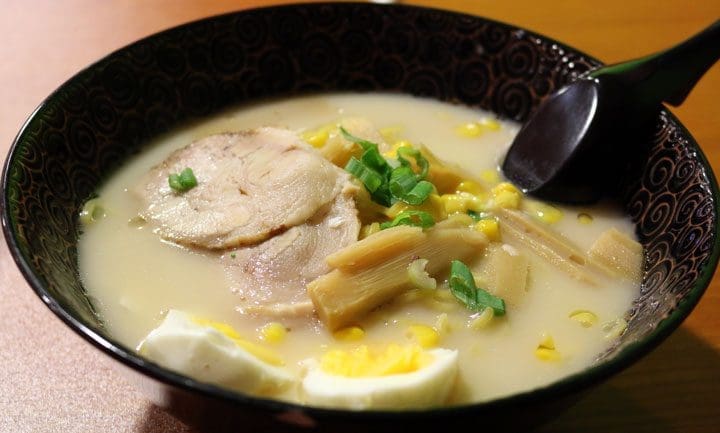
If a television show was to be created about ramen (some pronounce it ray-men), it would probably be called “Everybody loves ramen.”  According to the World Noodles Association (yes, there is such an entity), Americans consume 5.15 billion servings of instant ramen every year.  If you think that’s a lot, the United States ranks as only the sixth-largest consumer globally, significantly far behind such Asian nations as China and Indonesia.  Still, the land of spacious skies and fruited plains ranks as the top ramen consumer outside of Asia.   The per person consumption rate among Americans is 15 servings of ramen per year.  Would you believe South Korea is ranked the world’s number one per capita in instant noodle consumption (72.8 servings of instant noodles per annum)? Perhaps because of my non-traditional route (night school and testing out of courses) to higher education, I’ve never had instant ramen.  That’s right.  In my 39 years on planet Earth, my lips have never partaken of the food most commonly associated with college students.  Maybe it’s a good thing.  The high-calorie content and the high concentration of refined carbohydrates, fats, and sodium  in instant noodles, contribute to an increased risk of metabolic disease.  Though…

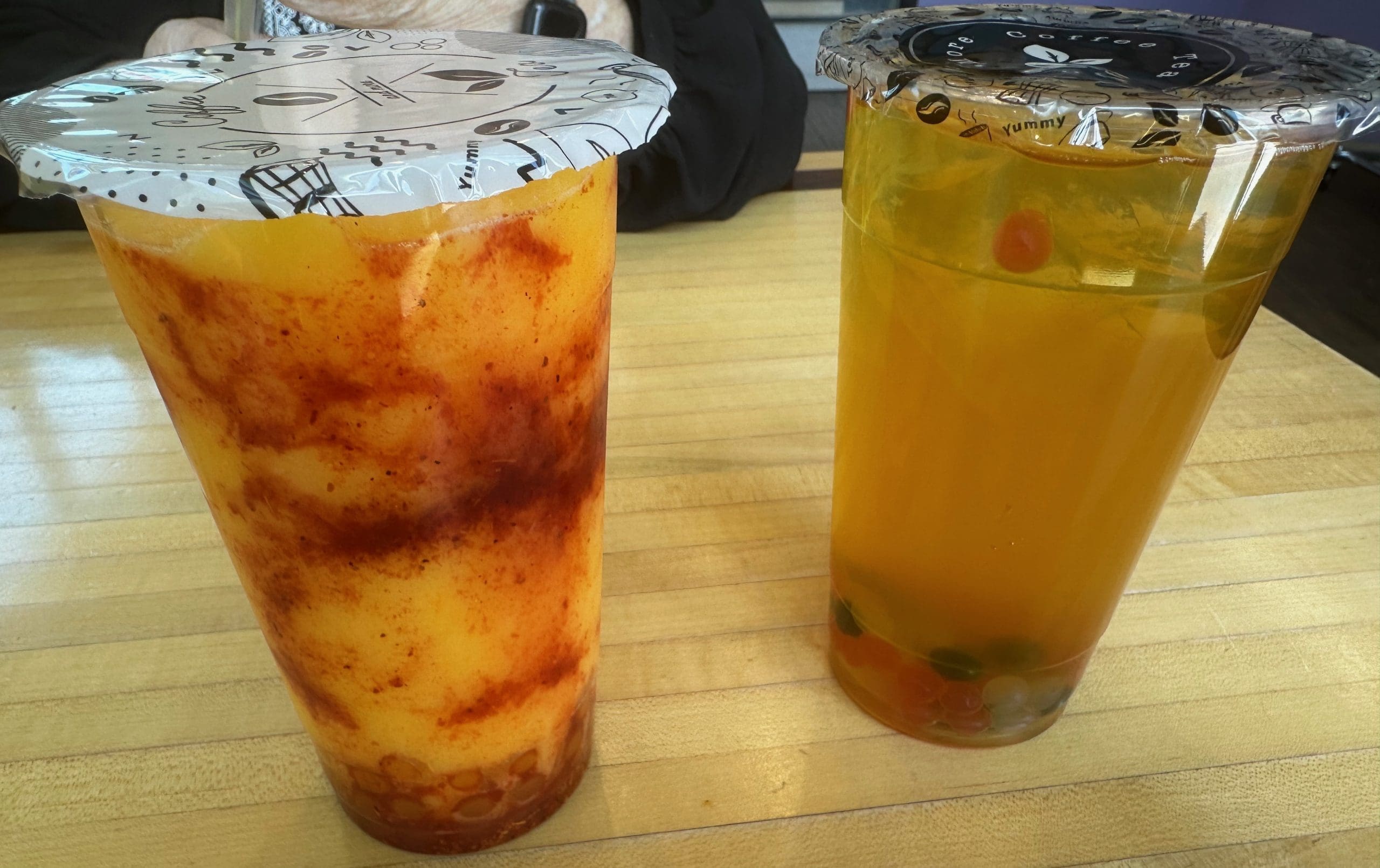
Kawaii Boba Cafe – Albuquerque, New Mexico

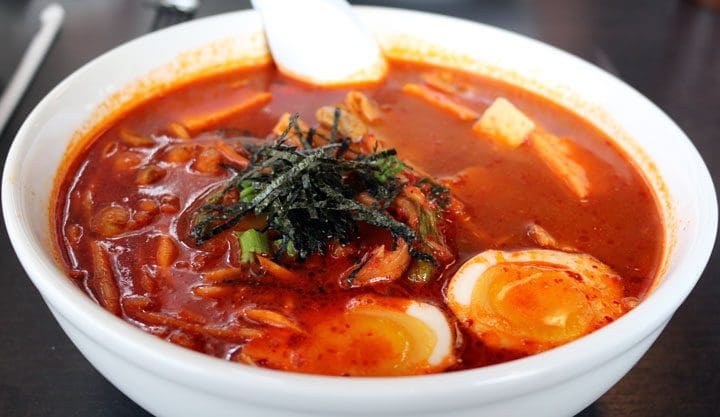
I have a confession to make.  I just don’t get anime…and can’t figure out the pokemon craze.  That’s a rather starting admission for an Information Technology (IT) professional to make.  Maybe I need help?   After all, for your stereotypical male IT professional, anime and pokemon are just steps in the typical progression of IT affectations.  They’re the logical graduation that follows a rather unhealthy obsession with Princess Leia and all things Star Wars.  Which reminds me, I found Star Wars silly and boring.  Since I’m airing dirty laundry, I may as well admit I’d just as soon watch paint dry as play a video game.  Any video game. Nor do I ever celebrate Pi day (March 14th) and my Kim had to explain what Star Wars Day (May 4th) means (May the fourth be with you). My male colleagues in the IT profession, several of whom still live in their mom’s basement, are probably apoplectic about these revelations.  They probably think I don’t like dinosaurs either.  Well, er…   All these heretical confessions probably mean I’ll have to renounce all my IT certifications and turn in my beanie.  Next thing you know my techno-nerd colleagues will hack my computer to…

El Charlatan – Socorro, Texas (CLOSED)

Everyone should have a friend like Steve Coleman, the erudite owner of Steve’s Food Page. Not only is he a great guy and a lot of fun to spend time with, he’s a superb host and tour guide.  During a two-day sojourn to “El Chuco,” Steve not only showed us the sights, he gave me a much-needed lesson about history New Mexico and Texas share.  He explained that during the Pueblo Revolt of 1680, members of the Isleta Pueblo in New Mexico were displaced to El Paso along with Oñate and the Spaniards.  Today, descendants of those Native Americans reside in a Native American Pueblo in the Ysleta section of El Paso just about three miles from El Charlatan, our dining destination.  We were looking forward to Steve ferreting us through the historic El Paso Mission Trail, a nine-mile route representing a segment of El Camino Real de Tierra Adentro (Royal Road of the Interior), the historic trail that ran from Mexico City to Santa Fe.  Alas, unseasonably fierce winds (another commonality New Mexico and Texas share) obfuscated our view of the churches as we drove past (at least one of) them.  On the Fujita Scale, a measure of wind speed,…

Fun Noodle Bar – Albuquerque, New Mexico

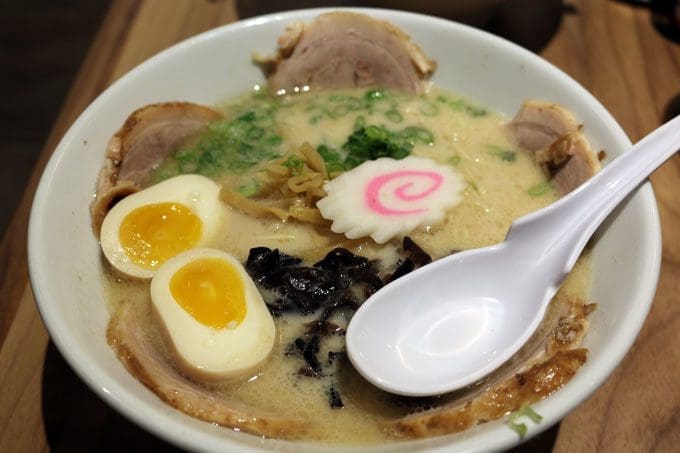
By definition, many, if not most noodles are fun.  No, not fun as in luxuriating in a tub filled with ramen (albeit non-edible, synthetic noodles) with real tonkatsu (pork bone) broth.  Yeah, that really is a thing in Japan.  Nor does my contention that noodles are fun have anything to do with the Simpsons episode in which Bart was threatened with “forty whacks with a wet noodle.”  It doesn’t even have anything to do with the Beach Boys classic “Fun, Fun, Fun” song.  It especially has nothing to do with those buoyant polyethylene foam “noodle” tubes people bring to swimming pools. In a classic example of Gil style “swerve,”  Fun refers to Chinese noodles made from rice flour or some other kind of starch (as opposed to mein, which are noodles made from wheat).  So, when you order “chow fun” at a Chinese restaurant, what you’re really ordering is stir-fried rice noodles usually served with vegetables or meat.  And when you order “chow mein,” it’s crispy, fried wheat noodles that’ll be ferried over to your table.  So, as you see, many noodles are, by very definition, fun noodles. Not that noodles can’t be fun or entertaining.  During our inaugural visit…

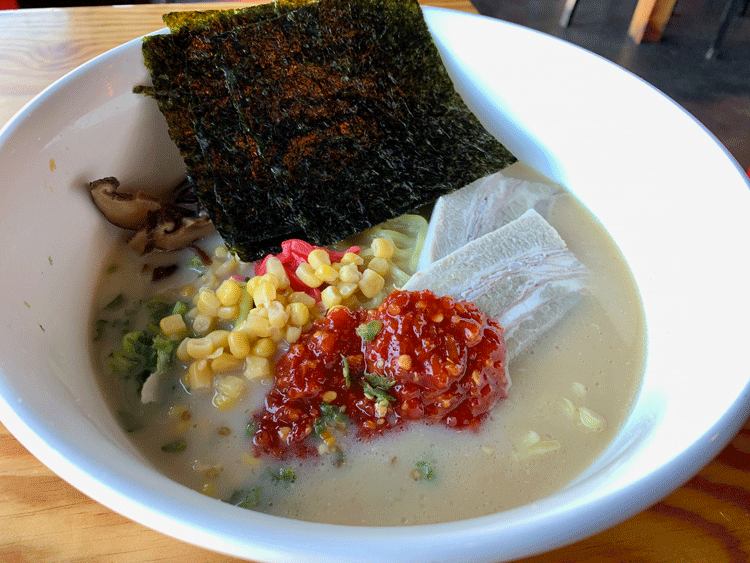
O Ramen – Albuquerque, New Mexico

“Food, like a loving touch or a glimpse of divine power, has that ability to comfort.” ~Norman Kolpas According to most online definitions, the term “soul food” defines the cuisine associated with African-American culture in the southern United States. In wide use since the 1960s, the term originated and came into heavy use with the rise of the civil rights and black nationalism movements. Though still most widely associated with the African-American culture, over the years “soul food” has become synonymous with basic, down-home cooking, especially of comfort foods…and as Cracked magazine puts it, soul food is “the real reason why white people like Cracker Barrel.” While the term “soul food” has, by definition, been culturally limiting and exclusive, in recent years the term has been broadened to include other cultures, albeit with a prefixed qualifier. In 2011, for example, New Mexico Magazine’s celebration of the Land of Enchantment’s “best eats” included the category “New Mexican soul food.” It was a declaration that New Mexican cuisine can also feed and nurture the soul. When my friend and culinary kindred spirit Nikko Harada used the term “Japanese soul food” to describe the food at O Ramen, it brought a broad smile…

Iron Cafe – Albuquerque, New Mexico (CLOSED)

“Ramen is a dish that’s very high in calories and sodium. One way to make it slightly healthier is to leave the soup and just eat the noodles.” ~Iron Chef Masaharu Morimoto America may be a multicultural melting pot, but thriving within its most populous metropolises are ethnic neighborhoods–pockets of diversity residing in two worlds, retaining many of the cultural and culinary traditions of their motherland while integrating into and pursuing the American dream. Cities such as San Francisco, Los Angeles and even Las Vegas, Nevada have long realized that these ethnic enclaves offer a treasure trove of cultural and culinary experiences. Most of these neighborhoods welcome culinary tourism–the opportunity to showcase the cuisine of their homelands. Obviously Albuquerque doesn’t have the population to support a “Chinatown” or a “Little Seoul,” but the Duke City does offer multicultural dining diversity representing many of the world’s cuisines. Most of the city’s ethnic restaurants are strewn throughout the metropolitan area where they’ve integrated into the fabric of neighborhoods which may or may not have an ethnic population base.  With few exceptions–a small cluster of Mexican restaurants in the South Valley, for example–you don’t see clusters of ethnic restaurants from the same country…

Nori Ramen & Sushi Bar – Rio Rancho, New Mexico

From our home in northeast Rio Rancho, it’s about thirteen miles to the Nori Ramen & Sushi Bar on Southern Boulevard. It would have been safer to run with the bulls at Pampalona than it was driving the half hour it took me to get to Nori. In those thirty minutes, an impatient tailgater blasted her horn at me for having the audacity to come to a complete stop at a stop sign in our subdivision. As she roared passed me on a 25 miles-per-hour street, she contemptuously extended her middle finger out the window (in the same way drivers espying the Dallas Cowboys plate on my car acknowledge the Cowboys are number one). Once on Highway 528, I witnessed drivers running red lights, exceeding the speed limit by at least warp five, turning from the wrong lane and not using turn signals (even though the season of lights is approaching). “Phew,” I thought “at least we don’t live in any of the other 48 states whose drivers are more impolite.” Yep, you read that correctly. A June, 2017 survey conducted by Kars4Kids ranked New Mexico as the second-most polite state in which to drive. At this point you’re probably…

Nanami Noodle House – Albuquerque, New Mexico (CLOSED)

If Chinese superstitions have any credence, some of us may not be long for this world. Chinese superstitions posit that long noodles symbolize a long life. Ostensibly, if you cut your noodles, you’re cutting your life short. Instead of cutting your noodles, the Chinese advocate slurping up long noodles without breaking them. When it comes to noodles, the Chinese should know. After all, they’ve been preparing noodles longer than any culture in the world. In 2005, archaeologists uncovered a 4,000-year-old bowl of noodles in Northeast China, the earliest empirical evidence of noodles ever found. Buried under ten feet of sediment, an overturned sealed bowl contained beautifully preserved, long, thin yellow noodles made from two kinds of millet. Archaeochemist Patrick McGovern indicated that “even today, deft skills are required to make long, thin noodles like those found” at the Chinese site, adding that “this shows a fairly high level of food processing and culinary sophistication.” If you’ve never seen the art-and-science process of hand-making noodles, it should be on your bucket list–and because the process is quickly becoming a lost art, you should place it near the top of that list. Fortunately you don’t have to go far to witness veritable…

Naruto – Albuquerque, New Mexico

During a 2015 episode of the Travel Channel’s Delicious Destinations, glaborous host Andrew Zimmern articulated what may be the very best–or at least most comprehensive–definition of comfort food ever. “Comfort food,” he explained, “makes us feel good. Every culture has its favorites–satisfying classics carried throughout the generations. Simple recipes loaded with carbs and full of love. It’s the taste of a feeling: warm, cozy, hearty and homey. Comfort foods satisfy more than physical hunger. They’re the feel good favorites that connect us to our past, family and cultural classics that fill us with sustenance and warm feelings at the same time.” At first browse, it appears that Zimmern’s definition applies solely to the act of consuming comfort foods, however, read closely and nowhere within that definition is it explicitly stated that comfort foods have to be eaten in order to be warm, cozy, hearty and homey. Nor do we have to masticate, graze, sup or savor comfort foods in order to feel good or to satisfy more than our physical hunger. Whether deliberate or unintentional, Zimmern’s definition can also apply to acts other than eating one’s food. Indeed, for some of us, the sense of warmth, coziness and comfort from…