
Grammatically any of the following is correct: Laotian cuisine, Lao cuisine or the cuisine of Laos. Just don’t ever call it “Laosy cuisine.” That would not only be a malapropism, it would be wholly inaccurate. The cuisine of Laos is among the most dynamic and delicious in Southeast Asia, if not the world. One of the reasons Laotian cuisine doesn’t receive the accolades it deserves is because of its neighbors. The Lao People’s Democratic Republic is a landlocked country in Southeast Asia bordered by Myanmar (formerly Burma), China, Vietnam, Cambodia and Thailand. To some extent, these neighbors (at least China, Vietnam and Thailand) have surpassed Laos on the world’s culinary stage–not necessarily because their cuisine is superior, but because it’s got a much larger platform.
It’s no surprise that Lao cusine has been greatly influenced by neighboring nations, but a French influence is also in evidence. From 1893 to 1954 when it gained full independence, Laos was part of the Protectorate of French Indonesia. So what’s the Cuisine of Lao like? It might help to understand that its closest “relative” is the cuisine of the Issan region of northern Thailand. New Mexicans who love their food a bit on the incendiary side would love Issan style Thai food which is more highly spiced than cuisine at other regions of Thailand. Spiciness aside, there are other differences between Thai and Lao cuisine. Where Thai food is colorful and exotic, Lao food is more basic and simple. Interestingly, the savory dishes of Laos are never sweet and the concept of “sweet and sour” is considered foreign and bizarre.

A Lao saying about its cuisine can be translated as “sweet makes you dizzy; bitter makes you healthy.” The cuisine of Laos incorporates a wide variety of bitter ingredients including mint and dill, two herbs generally ignored by their neighbors. Other cooking herbs of vast importance in Lao cuisine are galangal, fish sauce, garlic, shallots and lemongrass. These ingredients help give the cuisine of Lao a more intense flavor profile than the cuisine of neighboring nations. If a dish is intended to be sour, you can bet it’ll be intensely sour at a Lao restaurant.
Recent years have seen an increasing number of Asian restaurants in the Duke City serving more than one type of Asian cuisine. Among them was Albuquerque’s Sakura Sushi which had the pedigree to do it exceptionally well…until its closure in October, 2025. Still, you wouldn’t expect to find Lao cuisine in a restaurant named Sakura Sushi until you read the “subtitle” on the marquee: Thai and Laos cuisine. You might visit for the sushi, but you’ll keep coming back for the Lao. Sakura Sushi was owned and operated by Vong and Pialo Soumphonphakdy, both natives of Laos. Vong, who previously plied his trade as sushi chef at Minato’s (closed) Eurasia (also defunct) and Neko Sushi (also closed) artfully wields his knives behind the sushi bar at Sakura. His wife Pialo is the kitchen chef, preparing all the Thai and Lao cuisine.

In January, 2025, the Soumphonphakdy family launched its second restaurant in the metropolitan area. As with Sakura Sushi, its name “Vong Sushi” is subtitled “Thai and Laos Cuisine.” Vong Sushi is located in a very familiar location north of Enchantment Hills Blvd. in Rio Rancho, a location that has seen three Sushi-Thai restaurants over the years. Though we visited every one of them, Vong Sushi is the first to have won us over (hence the only one worth writing about). Credit the personable and attentive service from Dao (Vong and Pialo’s very cute daughter) for much of that, but the cuisine has a lot to do with it, too. Vong Sushi is terrific.
The interior at Vong Sushi probably reflects a Japanese theme more so than either Thai or Lao. The color palate includes wasabi green walls festooned with framed art depicting colorful aquatic life in a natural setting. The cynosure of the restaurant is probably the sushi bar which faces the most inspired works of art, including a spectacular lion fish. Seating is comfortable and well-spaced. Locals have started to figure out Vong Sushi isn’t a renamed instantiation of previous tenants, hence increasing traffic. After three visits, we’ve discovered this wonderful restaurant has earned much-deserved loyalty.

The restaurant’s website informs visitors that “Vong Sushi Thai & Laos Cuisine is a delightful culinary journey through Southeast Asia. From authentic Thai noodle dishes, flavorful homemade Laotian sausages, to fresh and artfully prepared sushi, each creation reflects the rich heritage and distinct flavors of the region.” That menu lists only seven Lao cuisine items which might be incorrectly credited to Thailand. Those include laab and papaya salad. Menu categories include noodle soups, curries, soup/salads, seafood, noodle dishes, teriyaki dishes, stir-fried dishes and fried rice. Then, of course, there’s a wide selection of sushi: hand rolls, sashimi, veggie rolls, nigiri, chef’s specials and for peckish diners, three sushi boats.
Appetizers

7 August 2025: You can have satay, dumplings and egg rolls in virtually every Thai restaurant in town. Vong Sushi offers a decidedly different and delicious selection of “small plates” sure to please. Among them is Moo Tod (tender pork marinated in garlic pepper sauce and tempura battered served with a side of sweet and sour sauce). The marinated pork is deep-fried until imbued with a golden brown sheen. It’s light and crispy, resembling deep-fried fish. The sweet and sour sauce is mostly sweet, but it’s flecked with crushed peanuts to lend savory notes that break things up a bit.
15 January 2026: Culinary historians note that tempura became extremely popular in the 1960s into the 1980s. At about that time, other Japanese items such as sushi rolls and Japanese steakhouse also saw a rise in popularity. Today, tempura is virtually mainstream. Americans embraced tempura because it is a lighter, healther, crispier fried option than many American foods. Today, you won’t find many Japanese restaurants that don’t offer tempura. It’s also popular in Thai and Lao restaurants. Vong Sushi offers tempura vegetables and tempura seafood (two shrimp, two calamari, two crab sticks, two white fish and two scallops). It had been years since my Kim and I had ordered a tempura dish. This version reminded us why we love tempura so much. Each lightly breaded seafood delight was delightfully crispy, sheathing very fresh seafood. Tempura doesn’t obfuscate the inherent flavors of seafood or vegetables which meant we were able to enjoy our seafood in all its glory.

17 September 2026: According to one popular folk legend from the Ming Dynasty (not the fantastic Albuquerque restaurant), a hardworking government minister was so dedicated to copying massive piles of official records that he refused to stop writing to eat. His clever wife invented a wrapped, handheld food filled with vegetables and meat that he could easily eat with one hand while continuing to write with the other. In actuality, spring rolls originated in ancient China as thin spring pancakes filled with seasonal fresh vegetables to celebrate the new life and harvest of spring. Vong Sushi’s spring rolls (rice wrapped rolls stuffed with fresh lettuce, bean sprouts, carrots, cucumbers, mint, sweet basil and cilantro served with sweet and sour sauce. They’re offered with your choice of four “modifiers”: shrimp, spicy tuna, spicy crab, tofu and vegetable. Shrimp is an excellent choice.
17 September 2026: It took five visits to Vong Sushi before finding something less than stellar. Conceptually that item sounds absolutely delicious, an appetizer which pairs New Mexico’s sacrosanct green chile with a traditional Asian egg roll. That pairing was a green chile and cheese egg roll. Doesn’t that sound fabulous? Alas, it’s an idea destined to fail. The most obvious reason for it being such a disappointment is the egg roll wraps. Instead of the thin wheat-based wrappers traditionally used on Thai egg rolls, thicker Chinese wrappers were used. Dao explained that’s by necessity. Thai wrappers are too thin to support melting cheese and the other ingredients typically used on Thai egg rolls much less the green chile. The second reason this appetizer didn’t work is that the egg rolls spent too much time in oil that may have been too hot. It just didn’t work.
Entrees

7 August 2025: Fried rice originated in China, initially as a way to utilize leftover rice and other ingredients, preventing food waste. The dish became a staple throughout Southeast Asia due to its convenience and ability to incorporate various flavors and ingredients. Vong Sushi offers four types of fried rice: Japanese fried rice, Thai fried rice, spicy fried rice and pineapple fried rice (eggs, pineapple chunks, celery and onion with your choice of protein). More than other Asian restaurants serving fried rice, Vong Sushi is generous with its protein portions. My Kim’s choice of pork was perfectly prepared and complemented the sweet-sour pineapple very well.

7 August 2025: Laab (also spelled larb, laap, or larp) has its genesis in Laos and is considered the country’s national dish. While also popular in Thailand, particularly the northeastern Issan region, its roots are definitively Laos. Laab made in Laotian restaurants tends to be darker, more earthy and salty than laab made in Thai restaurants. More than in Thai restaurants, laab prepared by Lao chefs is heavily reliant on fermented fish sauce. Vong Sushi’s laab (from the Lao section of the menu) is also seasoned with lime juice, lemon grass, yellow and green onions, toasted rice powder, cilantro and meat. It’s served with your choice of protein (pork, chicken or beef) and can be prepared to your heat preference. At “hot” (not Thai hot), the laab is maybe not as piquant as New Mexico’s sacrosanct green chile. It’s served with several Romaine leaves so you can construct wraps.

15 January 2026: Americans know what they like and have a tendency to forego other options. Many of my friends will order the same dish every time they visit a restaurant. I couldn’t find a statistic showing what percentage of Americans order the exact same meal, but I did discover that more than half (56%) choose restaurants they frequently visit for delivery. Almost half (49%)–driven by routine and convenience–make repeat delivery orders at least weekly. Statistics don’t bear this out, but I’m willing to bet that when ordering from a Thai restaurant, most diners will order pad Thai.
It always makes me happy to see my Kim order something she hadn’t ordered before. Her husband’s adventurousness must be infectious. It makes me deliriously happy when what she orders turns out to be outstanding. One such example is Rad-na (which sounds like a Romulan or Klingon term). Rad-na is flat rice noodles stir-fried with sauteed broccoli and Thai gravy. Like President George H. W. Bush, my Kim loathes broccoli so she asked for carrots instead. You won’t find many Thai restaurants serving Rad-na. That’s a shame because it’s a very tasty dish. The rice noodles resemble Italian papardelle are drenched in a luscious pork gravy. Though my Kim doesn’t like gravy, she thoroughly enjoyed the Thai gravy (Lynn, I hope you’re not in shock). Thank goodness she didn’t tell me how “rad” her dish was.

15 January 2026: At the risk of sounding hypocrital (or worst, like a politician), I do admit to ordering one dish more than half the time when we visit Thai restaurants. That dish, however, is so versatile it’s made several different ways with many different ingredients. Of course, my favorite of all Thai dishes is curry. Vong Sushi’s masuman curry (potatoes, carrots, peanuts, coconut milk and your choice of protein) is quite good. Even though our server (not the wonderful Dao) didn’t ask what my preferred “heat level” was, the curry had a nice piquancy. Moreover, it was redolent with the addictive properties of a great curry. I don’t subscribe to the healing nature of aromatherapy, but believe the aroma of a great curry can cure all ills, especially when it’s redolent with a complex mix of sweet, sour, salty, and savory, with warm, aromatic spices.
In 2011, 2020 and 2021, mausuman curry (spelling may vary) was ranked the #1 “World’s Best Food” by CNN Travel Is it any wonder it’s called the “king of curries.” This wildly popular Thai staple is a specialty of Vong Sushi, ranking it as among the very best I’ve ever had. This sushi is redolent with coconut milk, but unlike at some Thai restaurants, it’s not as cloying as a dessert. Ask for it at the “Hot” or “Thai Hot” level if you like your food to bite you back. Accompanied by a bowlfull of rice to mollify its piquancy, it might make you cough and sputter, but the endorphin rush is so, so worth it.

27 March 2026: My brother Mario and I visited on the Friday preceding Palm Sunday. Dao apprised us that Catholic diners were packing the restaurant to fulfill the Church’s “no meat on Lenten Friday” edict. That’s a good reason to enjoy some of Vong Sushi’s outstanding seafood items. Another reason is that for pure deliciousness, you can’t beat the seafood items. We shared the seafood tempura which Mario declared superb. Mario had the seafood pho (as good as any he’s had at any Vietnamese restaurant) while my choice was the red curry with seafood (shrimp, squid, scallops, mussels). It’s the best seafood curry dish I’ve ever had!
Red curry shares many similarities to green curry: a coconut base, a soup-like curry sauce, preparation and ingredients (such as red and green peppers, basil and bamboo shoots). The biggest difference is the curry paste. Red curry uses red chilies while green curry employes the more piquant fresh green chili peppers. That makes red curry the less fiery of the two, but it’s also less sweet and (arguably) more delicious. Vong Sushi’s rendition is outstanding! At the “hot” degree of piquancy, it’s perfect for seafood (which doesn’t usually go well with overly spicy chili). Too much heat and you can’t taste the sweetness of the scallops and the brininess of the mussels. Even without the seafood, this red curry is a terrific dish. The seafood makes it sing even louder.

28 March 2026: Another Thai dish which should be very popular during the week leading to Christ’s crucifiction is Pad Ga Plao (usually spelled Pad Kaprao). By any spelling, it’s a wonderful dish, especially if you like fiery foods. Pad Ga Plao is a stir-fry dish made with minced meat (pork, chicken, or beef), Thai basil, garlic, chilies, and soy sauce, served over rice.
Thai basil has bold, pungent, and peppery properties with distinct notes of clove, anise, and lemon. It is more astringent and spicy than sweet basil, often featuring a slight numbing, minty, or refreshing tingling sensation on the tongue when eaten raw. On Pad Ga Plao, it’s not a raw additive. It’s stir-fried with other ingredients. It pairs very well with Thai chilies. That’s what has always endeared me to this aromatic and absolutely mouth-watering dish. Vong’s version doesn’t mince the proteins used on the dish. It slices them up into bite-sized pieces. That’s a more Westernized way of serving proteins on some dishes. Pork is my favorite protein on this dish.

17 June 2026: Although there is no official term for someone who loves curry as much as I do, in a broader, more general sense perhaps the term “capsaicinophile” will do. Either that or “chilehead.” Capsicinophie is a scientific or technical term for someone who loves spicy food. Chilehead would apply to me and probably two-thirds of New Mexico’s population, certainly those of us who were weaned on red and green chile. It’s often surprised me that love of chile doesn’t always translate to love of other spicy foods. It almost pains me to learn otherwise adventurous eaters don’t like Thai curry. Aside from insanity, there are probably three reasons: (1) the heavy use of fish or shrimp paste; (2) its broth-like consistency; and (3) its intense herbal use of fresh chiles. Thai curry diverges sharply from thicker, spice-heavy western stews and Indian curries.
So, if you consider yourself a capsaicinophile but don’t like Thai curries, that means there’s more curry for me. Vong Sushi’s curry menu lists four options: red curry, yellow curry, green curry and massaman curry. On the seafood menu, you’ll also find seafood curry (waxed about above). As of our fifth visit, I had worked my way through two of the four curries. Rather than choosing one of the remaining curries, I asked Dao to bring me either the yellow curry or the green curry. She ferried over a heaping bowl of green curry (bamboo shoots, sweet basil, bell peppers and coconut milk). Its arrival was preceded by the aromatic wafting of fresh, herbaceous notes simmering in a rich, flavorful broth. Bamboo shots are a unique feature of green curry, lending a very pleasing textural contrast to the crunchy peppers. The sweet basil has a blend of sweet, herbaceous mint and earthy black pepper, with distinct undertones of anise (licorice) and clove, giving green curry its distinct personality. Then there’s the heat. Order it at “Thai hot” is you’re a true capsaicinophile.

17 June 2026: While the cuisine of Thailand and Laos may share billing on the marquee they’re essentially subtitled. It’s sushi for which Chef Vong is best known and sushi which takes priority on the marquee. The restaurant’s sushi menu features basic rolls, chef’s specials, dragon rolls, tempura rolls, veggie rolls, hand rolls, nigiri, sushi combos and happy boarts. You’re sure to quell your sushi fix. Like so many capsaicinophiles, in my youth I thought sushi was a test of manhood. It was supposed to be enjoyed with enough American wasabi (a mixture of European horseradish, mustard powder, and green food coloring) to defoliate a forest. Alas, it prevented me from enjoying the inherently wonderful flavors of the seafood and vinegared rice.
When my Kim lost her sense of taste (preventing her from enjoying piquant foods) for hot foods years ago, it gave me the impetus to consume sushi without wasabi. Wouldn’t you know it? Sushi became so much better when the native flavors of seafood and the chef’s magical sauces take precedence. Giving my Kim carte blanche to order the sushi she wants means ordering such “unmanly” items as the Toot-Z-Roll (lobster, shrimp tempura and cuumber topped with avocado and unagi sauce) at Vong Sushi. Never mind the name. this roll has nothing to do with flatulence nor does it have that aftereffect. It’s a very tasty roll and my Kim loves unagi sauce (maybe because it’s as sweet as most teriyaki).
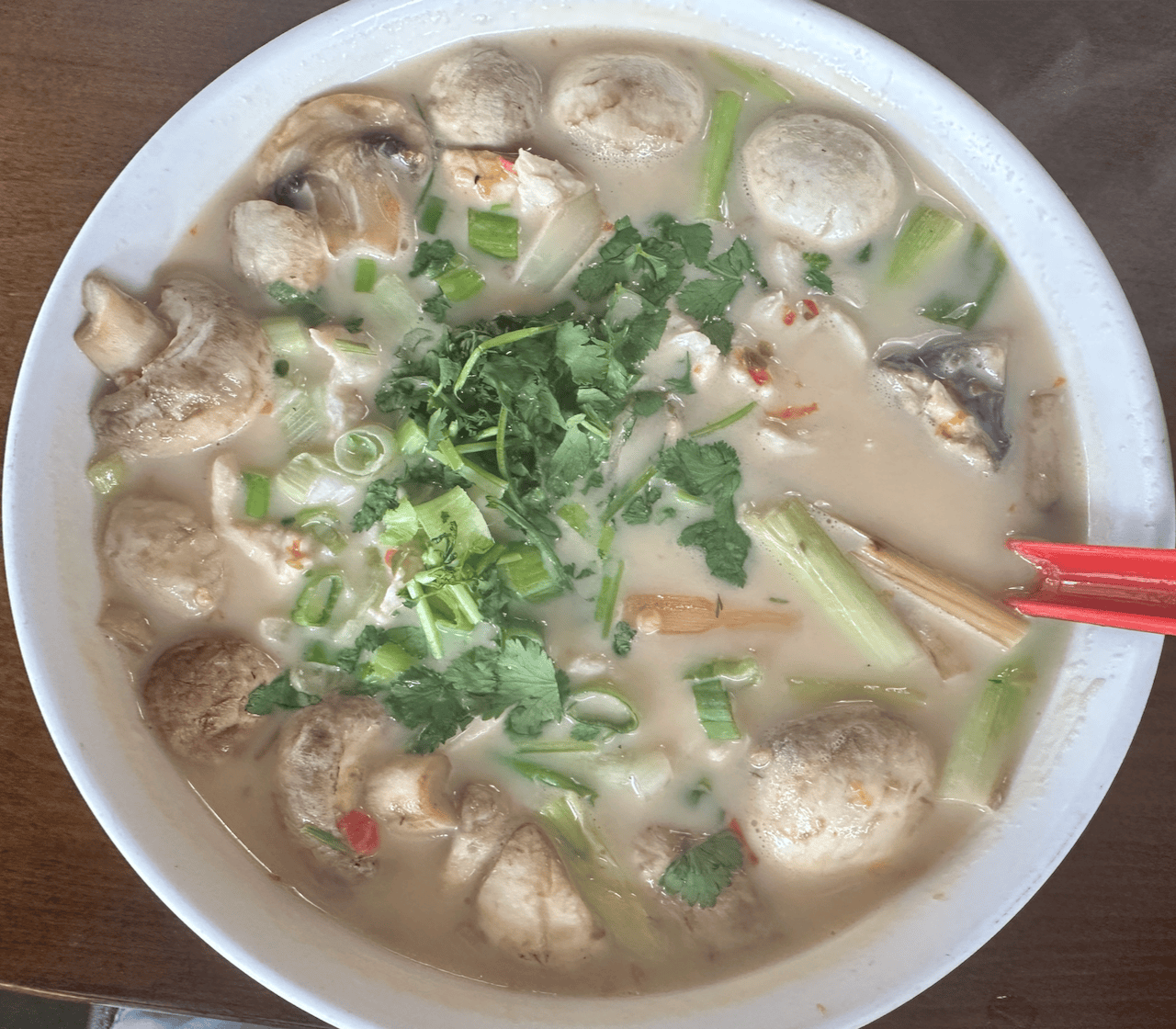
17 September 2026: The menu section titled “Noodle Soups & Soups” is graced by nine offerings including the aforementioned pho. My favorites are the Thai soups tom yum and tom kha gai. No, these soups aren’t named for some guy named “Tom” who loves them. Perhaps the most famous of all Thai soups is tom yum, the translation of which means to boil (tom) and yum (mix) . Even better than a great tom yum is tom kha gai. Here “tom” means “to boil,” “kha” means “galangal” and “gai” means chicken. This Thai coconut chicken soup is infused with the classic Thai herbs: lemongrass, galangal, and kaffir lime leaves. Another key component is coconut milk.
Vong Sushi’s tom kha gai (lemongrass, tomatoes, lime leaves, galangal, onions and mushrooms topped with cilantro) ia the best in town, a heart-warming elixir that will cure whatever ails you. It’s creamy and delicious, but probably shouldn’t be ordered at a heat level any greater than “hot.” Thai hot might incinerate your taste buds so much that you won’t be able to taste the amazing interplay of ingredients. In particular, the coconut milk and kaffir lime leaves work so well together that the pairing belongs on a hall-of-fame of outstanding ingredient pairings. Though tom kha can be prepared with your choice of proteins, it seems to work best with chicken (gai).
Dessert

15 January 2026: It’s not summer unless we indulge in mangoes with sticky rice, a wonderful dessert which originated in Thailand. This dish combines sweet, ripe mangoes with warm, sweet sticky rice and creamy coconut milk. Although Asian restaurants aren’t widely known for desserts, two–mangoes with sticky rice and roti–Thai postprandial treats are among our favorite desserts of any culinary culture. Both are relatively simple with absolutely no amelioration needed. We find that we enjoy mangoes with sticky rice even at the height of winter when mangoes tend to be green and not as sweet. It’s just one of the very best desserts in any culinary culture.
Sushi may be the cuisine listed first on the marquee, but the Thai and Lao cuisine deserve at least equal billing. Vong Sushi Thai & Laos Cuisine is a real find in Rio Rancho.
Vong Sushi Thai & Laos Cuisine
7820 Enchanted Hills Blvd., N.E.
Rio Rancho, New Mexico
(505) 404-6186
Website |
LATEST VISIT: 17 September 2026
1st VISIT: 7 August 2025
# OF VISITS: 4
RATING: Excellent–High quality dining experience; very good to excellent food, attentive service, and a well-maintained atmosphere; worth a detour.
COST: $$
BEST BET: Laab, Pineapple Fried Rice, Moo Tod, Mangoes With Sticky Rice, Seafood Tempura, Masuman Curry, Rad-Na, Red Curry With Seafood, Pad Ga Plao, Green Curry, Tom Kha Gai, Spring Rolls
REVIEW #1481
Still working our way through the rich menu at Vong, but we agree with everything you have written. The sushi options are a bit unusual and very good. We love the massaman curry. I will try the seafood red curry next visit — trying to plan one soon.
— Christopher, Dining in the 505
Thank you, Christopher. I’m VERY impressed with your Dining in the 505 Blog and look forward to more of your excellent reviews.
Gil, this looks like a great addition to the Rio Rancho dining scene. I used to regularly pass through Amarillo and almost always tried to stop at one of the various Lao restaurants there. One of them had the best yellow curry I’ve ever had, so this would be one thing I would probably check out if I could at any Lao restaurant. At another restaurant I tried the sticky rice, a giant ball of rice that sicks together so you can hold little balls of it it in your hand and sop up juices and bites of food such as laap (the spelling that matches the way it is pronounced) and papaya salad. It is apparently not served here but perhaps would be at one of the other Lao restaurants (and yes, Lao food is diverse enough there could be different menus at different restaurants and all of them be authentic). The sticky rice that comes with desserts, etc. might be similar but it’s not the kind you eat with the food.
Food tourists could visit Pagosa Springs, Colorado for a Hmong (an ethnic group within Laos) owned restaurant, MEE Hmong Cuisine. I’m not sure about its authenticity but it has very good food. MEE shows that there can be diversity and even Americanization of food served with a Lao base and it would still be very enjoyable–not something I would likely say about other Asian cuisines such as Thai that I think has to be really authentic to be good. Anyway it is probably the scarcity of Lao food that makes it so fun to explore. It is hard to find enough Lao restaurants anywhere in the Southwest to really become an expert with the cuisine.
Thank you, Steve. When you visit your hometown of Oklahoma City later this summer, I hope you have plans to visit Ma Der Lao Kitchen, the best Laotian restaurant in which we’ve dined. It’s a two-time James Beard award finalist with a menu of Lao specialties not found in most restaurants (especially those which purport to serve both the cuisines of Thailand and Laos). Sadly, all too often at such restaurants the cuisine of both nations is overly sweetened (for American tastes). Kudos for finding more authentic Lao experiences during your travel. Now I’ve got to go to Pagosa Springs one of these days.