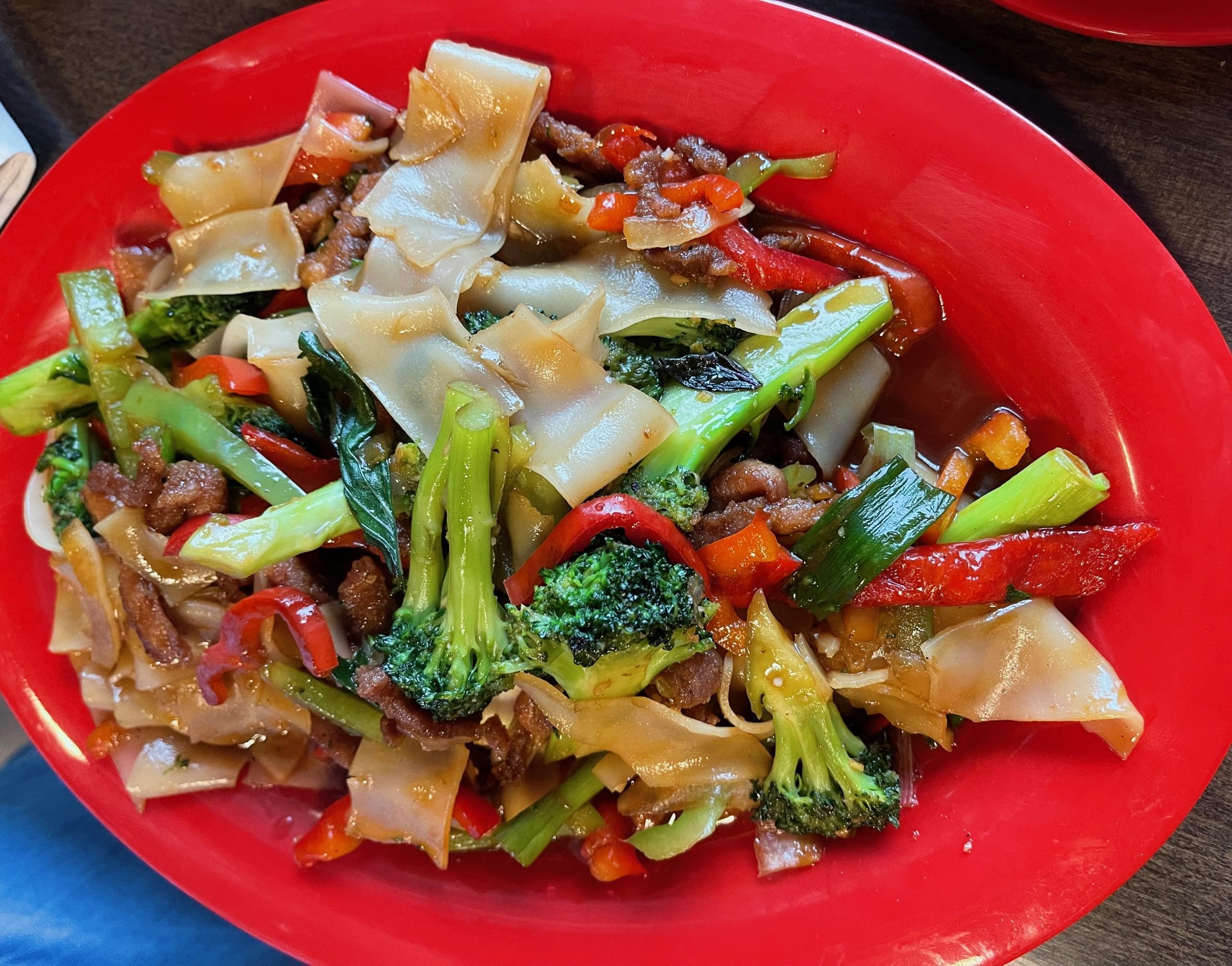
Thai Heritage & Vegan – Albuquerque, New Mexico

Who among us hasn’t learned at least one thing about Thai culinary heritage from The Big Bang Theory? In a 2011 episode, for example, we learned that according to Thai tradition the last morsel of food, the greng jie, goes to the most important person in the room. At least that’s what Sheldon tells Penny when she reaches for the last remaining dumpling. Thanking everyone for the honor, she devours the dumpling. Sheldon’s retort: “I’ve seen pictures of your mother. Keep eating.” Some of us learned that Thai food is meant to be eaten with forks not chop sticks though in Thailand, they don’t put the fork in their mouth. It’s simply a tool to put the food on a spoon which then goes into the mouth. We also learned that Sheldon, the quirky wunderkind with an obsessive compulsive tendencies orders mee krob and chicken satay with extra peanut sauce on Mondays. Every Monday! As an adventurous diner with polygamous culinary tendencies, the concept of ordering the same meal repeatedly is galling. When expressing my intolerance towards monogamous (monotonous?) diners to my Kim, she quickly knocked me off my high-horse, reminding me that whenever we dine at a Thai restaurant…

Thai Street – Albuquerque, New Mexico (CLOSED)

By chronological standards, Thai cuisine–especially as we know it today–is relatively new to the world culinary stage.  Culinary historians believe Thai cuisine may be as young as 1,400 years, coinciding with a mass migration of people from regions of China.  These settlers dined mostly on seafood, herbs and plants prepared mostly by stewing, baking and grilling (over time, stir-frying and deep-frying also became popular).  Large domestic animals such as water buffalo and oxen were too valuable to slaughter for food.  As such, meat was used very sparingly though considering the settlers’ propensity for seasoning, a small amount of meat went a long way.   While Chinese–particularly Szechuan–dietary practices were the most significant early influences, the introduction of other ingredients and culinary techniques began to define the Thai food with which we are familiar today. Foremost were curries from the exotic subcontinent of India which people infused with coconut.  After the European discovery of the American continents, Portuguese mariners brought chili spices to the region.  These were the forerunner of the incendiary dishes which give Thai cuisine their popularity and explosions of flavor.  Understandably, regional preferences were developed with five or so distinct regional styles of cooking defined.  Variations resultant from…