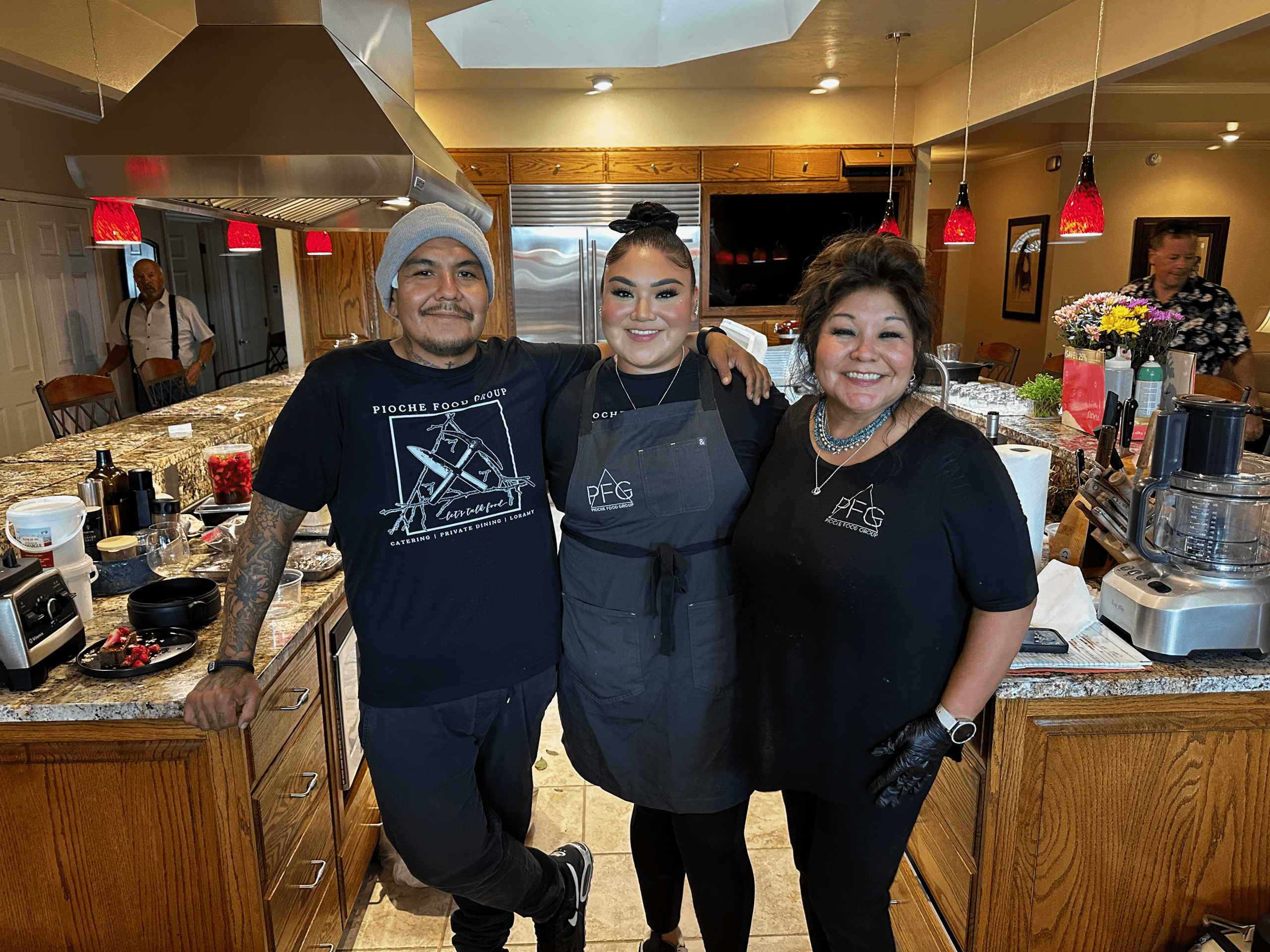
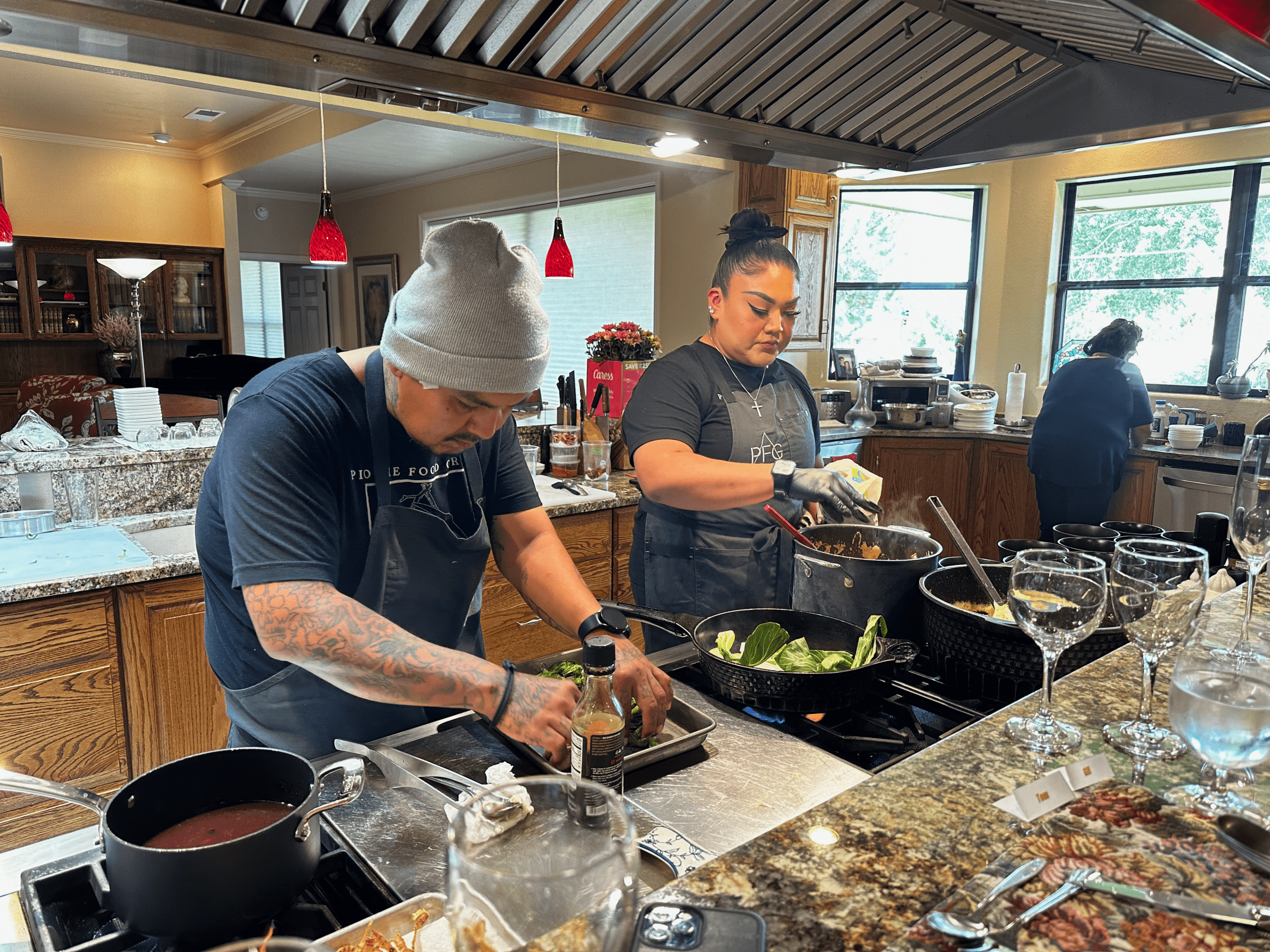
As my friend and retired restaurateur Tom Hamilton and I watched the Pioche family prepare a meal for some twelve guests, we both marveled at the quiet efficiency of the kitchen. A veteran of decades leading highly-regarded kitchens, Tom related that most kitchens are a loud and frenetic hive of activity amped up to high volume. Communication among kitchen staff is an absolute must to ensure synchronicity, especially when multiple courses are being prepared. Instead of the characteristic chaotic din of most restaurant kitchens, the Pioche family worked in harmony, focusing on the quiet, efficient, and harmonious execution of the multitudinous tasks involved in the preparation of a nine-course meal.
It probably shouldn’t have surprised us so much that the Pioche family worked in such consonance. After all, a traditional traditional Navajo (Diné) approach to family and communication is deeply rooted in the concept of K’é, a system of kinship and connectivity. This approach emphasizes respect and collective responsibility. While Chef Justin Pioche is the marquee name, he deflects praise and credits his sister Tia and mom Janice. He’ll tell you he can’t operate without them and he’s not just being modest. Like concordant instruments in an orchestra, each family member performs specific tasks, the end result being a wonderful meal that absolutely wows guests.
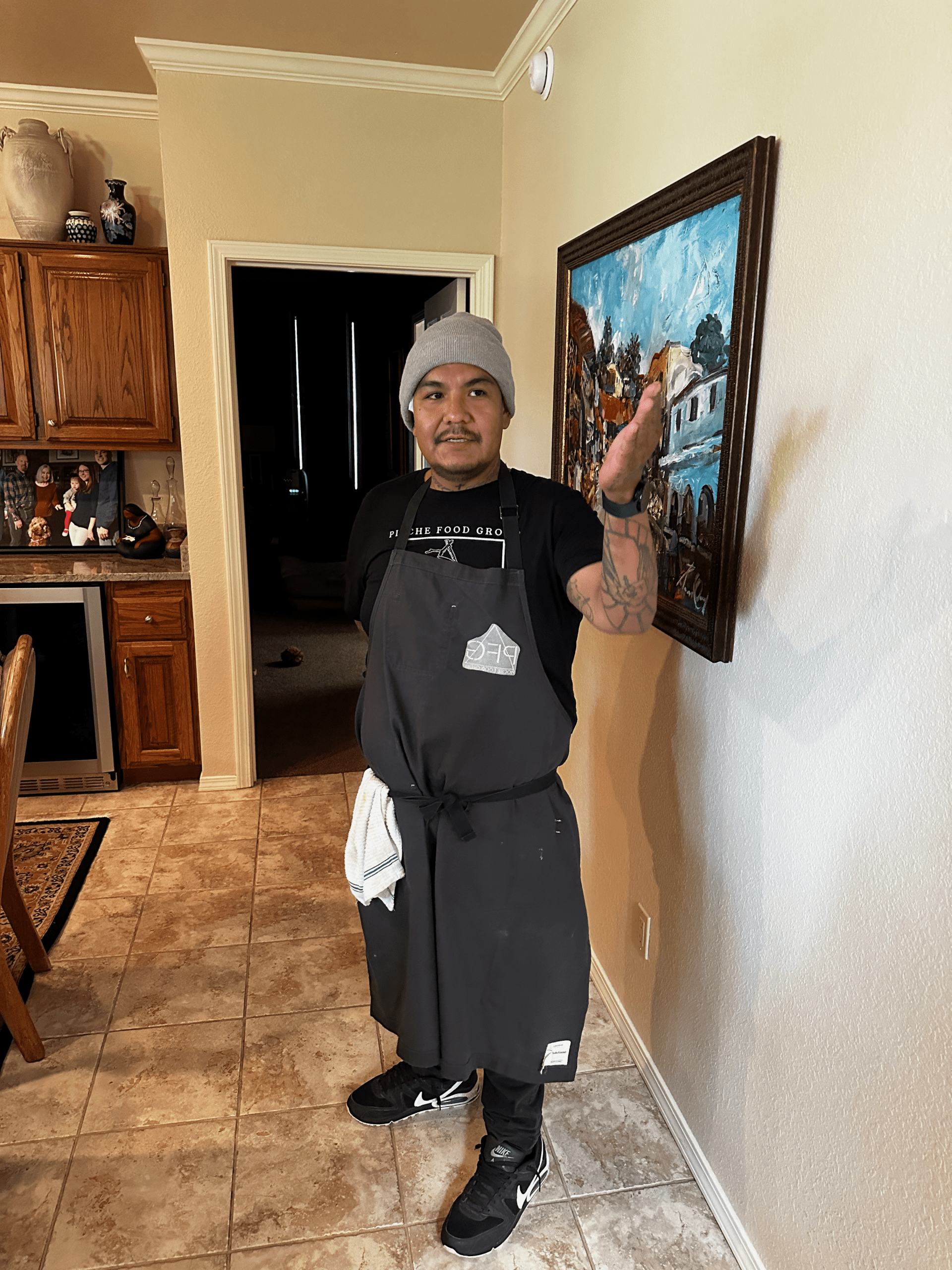
You won’t find the Pioche family operating out of a permanent brick-and-mortar location. It wouldn’t work in the Farmington area where the family is based. Though Farmington is New Mexico’s sixth most populous city, it’s still basically a low middle-class, meat and potatoes region that might not fully grasp the Pioche culinary experience. That experience is centered around LorAmy, a pop-up dining series in which Chef Justin presents a varying seasonal menu (usually around eight courses), inspired by his Navajo culture. Unexpected palate-pleasing twists and turns titillate and wow diners as the Pioche family puts their hearts on a plate. Whether preparing Navajo tacos at the Santa Fe Indian Market or feeding dignitaries at an event sponsored by the Native American Culinary Association, the Pioche Family always gives their all.
When Tom and I were discussing great restaurant meals in the Land of Enchantment, I told him about the LorAmy concept. (LorAmy is a combination of the chef’s grandmothers’ first names, fitting considering the matrilineal traditions of the Navajo). It intrigued Tom so much that he called his brother Greg and suggested we work together to plan a LorAmy event. Greg graciously agreed to host the event at his beautiful Farmington home. Our gregarious host seated me next to Tom on the bar overlooking Greg’s spectacular kitchen. The “best seat in the house” gave us ample opportunity to observe the family in action and to ask questions.
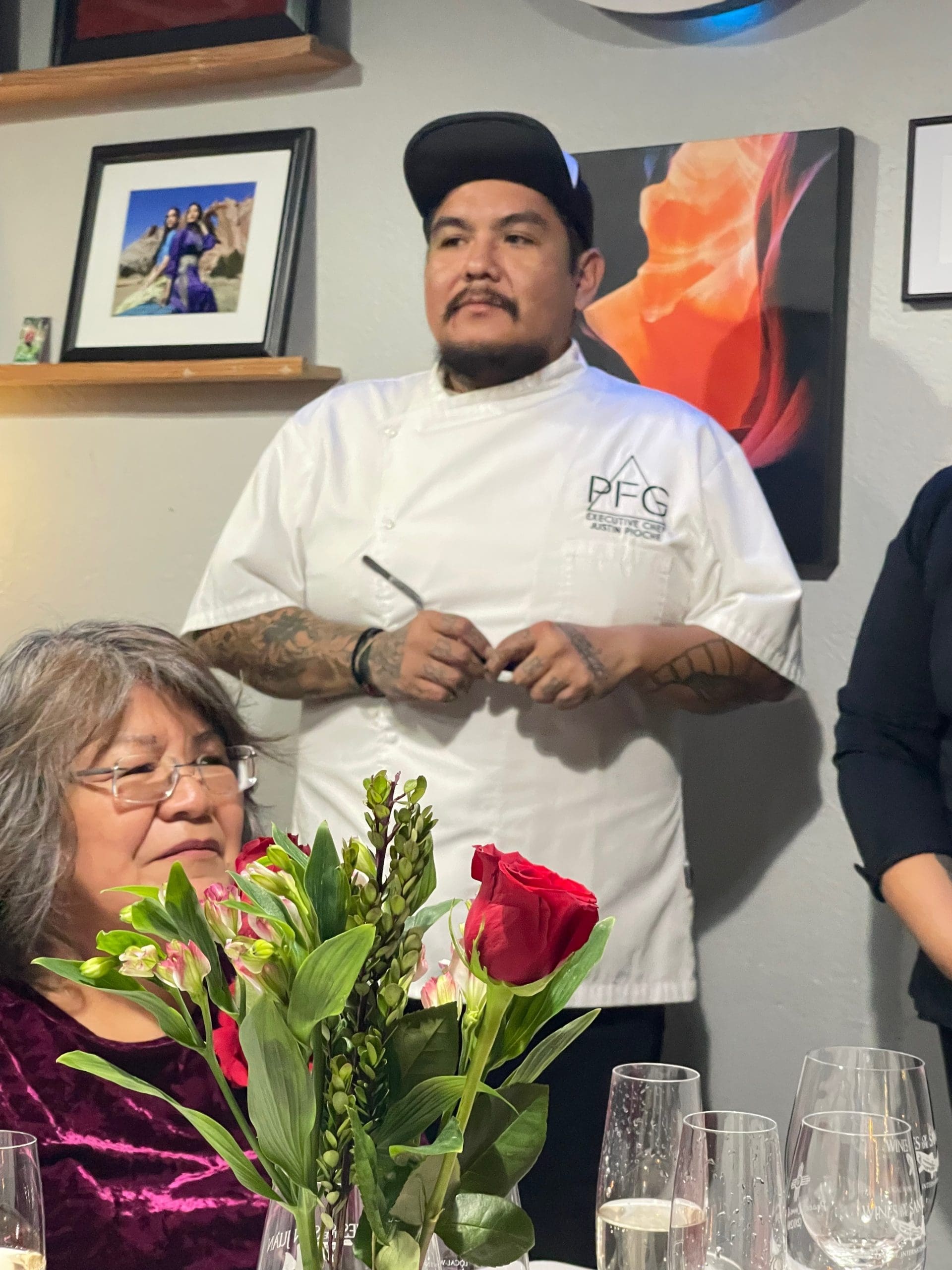
We learned, for example, that the name “Pioche” is actually French and translates to “pickaxe.” As Janice explained, one of the family grandmothers was captured by French settlers. Children born to that grandmother were christened with the Pioche name. Imagery on the shirts worn by the family are replete with symbolism expressing their heritage and faith. Formed into a cross on the shirt are a pickaxe and a chef’s knife. Chef Justin explained that the three-sided frame around that cross represents the three members of the Pioche Food Group: himself, his sister and his mother. The three sides also represent the Holy Trinity: Father, Son and Holy Spirit. Christian faith is very important to the family. Every LorAmy meal begins with Chef Justin leading a prayer of thanksgiving and praise.
In 2023, Chef Justin was a finalist for the James Beard Foundation’s “Best Chef – Southwest” honor. Though he did not win the award, he gave the culinary world notice that his unique approach to food inspired by and deeply-rooted in his Navajo heritage is going places. Observing his beautifully plated creations will probably lead you to question all the stereotypes you may have had about Navajo cuisine. You won’t, for example, see fry bread or mutton on a plate. You might, however, see caviar, bok choy and freeze-dried roses. That’s Chef Justin being creative, sometimes employing molecular gastronomy techniques to maximize a dishes flavor profile. You’ll also note that many of the indigenous flavors he uses are not to be found in the Southwest. The Pioche Food Group sources ingredients from Oregon, Minnesota and even Canada for some of their creations.
Chef Justin clarifies that unlike some chefs (three-time James Beard Foundation winner Sean Sherman, for example), his menus are not intended to employ solely ingredients available to indigenous people before the colonization of the Americas. Instead, the studious chef pursues his passion by researching ingredients and techniques that will help him optimize the flavor profiles of every dish. His talents are continuously evolving and growing. In both LorAmy events I have attended, he changed the menu significantly while staying true to his profound respect for his people’s history. Chef Justin shares that history while introducing specific dishes. Should a dish include peaches, you’ll learn of the atrocities visited upon the Navajo people by Kit Carson whose “scorched earth” campaign resulted in the burning down of over 4,000 peach trees across the Navajo stronghold.
It might surprise you to learn that the seeds of Chef Justin’s culinary career germinated with a simple dish of fry bread and fresh peas prepared by his grandmother. He has never forgotten the impression that uncomplicated dish left on his taste buds and memory. It inspired him to pursue a culinary degree from the Arizona Culinary Institute followed by years of working under some of the most highly regarded chefs in Arizona’s finest restaurants. He and sister Tia have also “staged” (an unpaid apprenticeship or working trial in a different kitchen to learn new techniques, cuisines and operational styles) at some of the country’s best restaurants. Tia and Justin, for example, staged at both Chicago’s Alinea, one of the country’s few three Michelin star restaurants and Ever, a two-star Michelin recipient. Justin also staged at Noma in Copenhagen, Denmark. Noma was rated the best restaurant in the world five times, in the years 2010, 2011, 2012, 2014, and 2021 by The World’s 50 Best Restaurants list
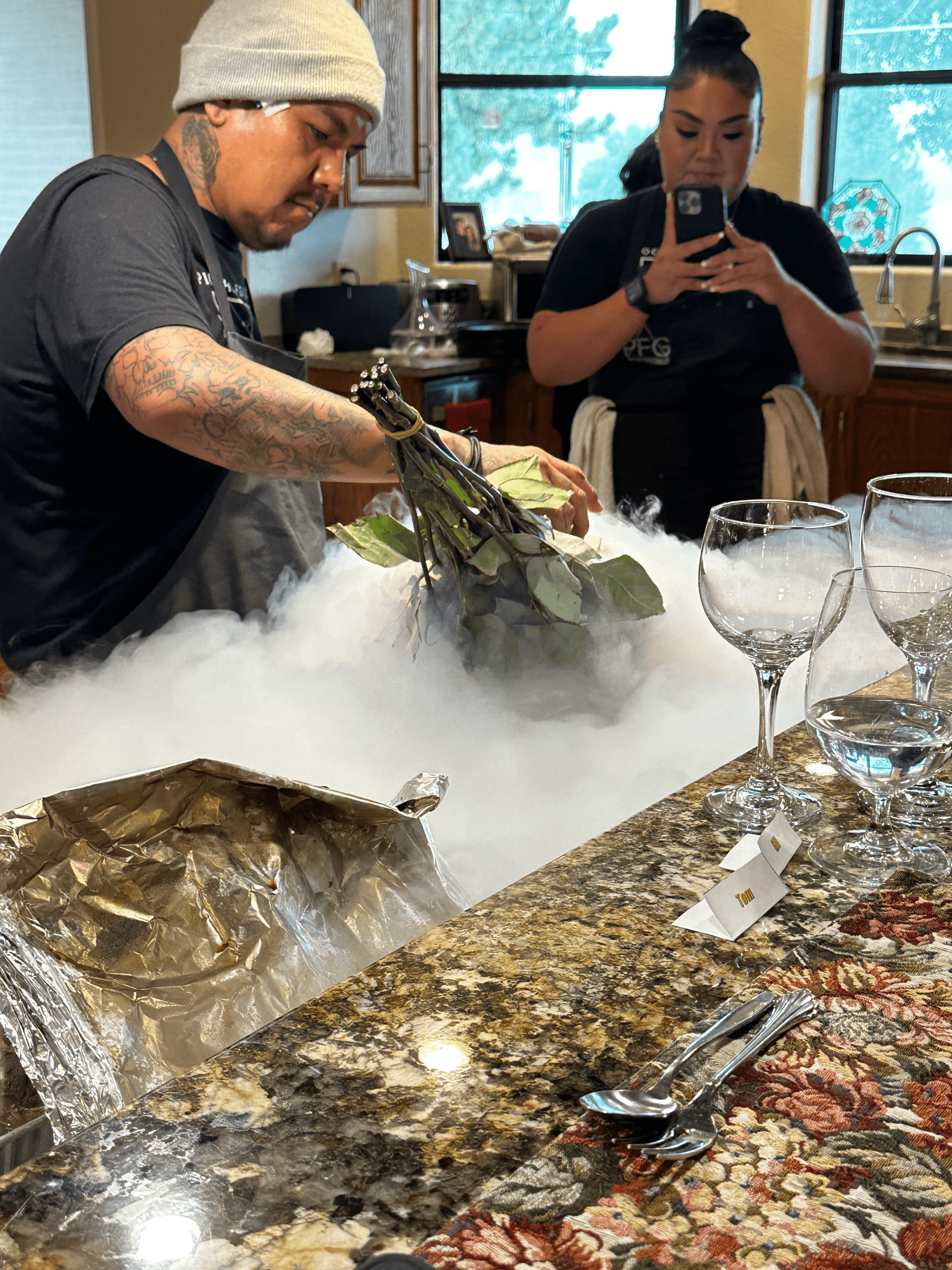
The Pioche family is so passionate about the provenance of the ingredients they use that they partner with Navajo-Ethno Agriculture, ahands-on tribal community educational farm in the Four Corners region of the Navajo Reservation. The farm is committed to preserving traditional Navajo crops and techniques. Chef Justin is very active in the farm’s teaching environment, passing what is known about culture, history and heritage foods. Different schools are invited to the farm where students learn about agriculture, Navajo foods, how those foods are cultivated and more. The school not only imparts agricultural knowledge, it imbues students with a sense of traditional Navajo pride.
Chef Justin recognizes that a lot of Navajo land is vastly underutilized or not utilized at all. He calls it “feeding my soul” when he teaches youth on the farm. His hopes are to eventually own and operate a Pioche Food Group Farm where he can hire Navajos and teach them to farm. When the family arrived for the event at Greg’s home, they were noticeably tired, having spent the previous days on the farm. Despite a grueling work schedule, they use their platform for the betterment of their community. Mom Janice can’t help but beam at her very accomplished brood.
After Chef Justin benediction, our first “course” was a glass of Dééh (Tea) made from what is essentially a “weed” that’s abundant wherever there is a good source of water, which commonly includes the runoff areas from roads during monsoon season. It grows wild on the Pioche’s yard. The acerbic flavor of the tea is ameliorated by melon balls, sweet ash and sumac. Yes, sumac. Navajo sumac is loosely related to the sumac used to season a lot of the Middle-Eastern food with which you might be familiar. Sumac berries, rich in vitamin C, are used by Navajo people for food, medicine and dyes.
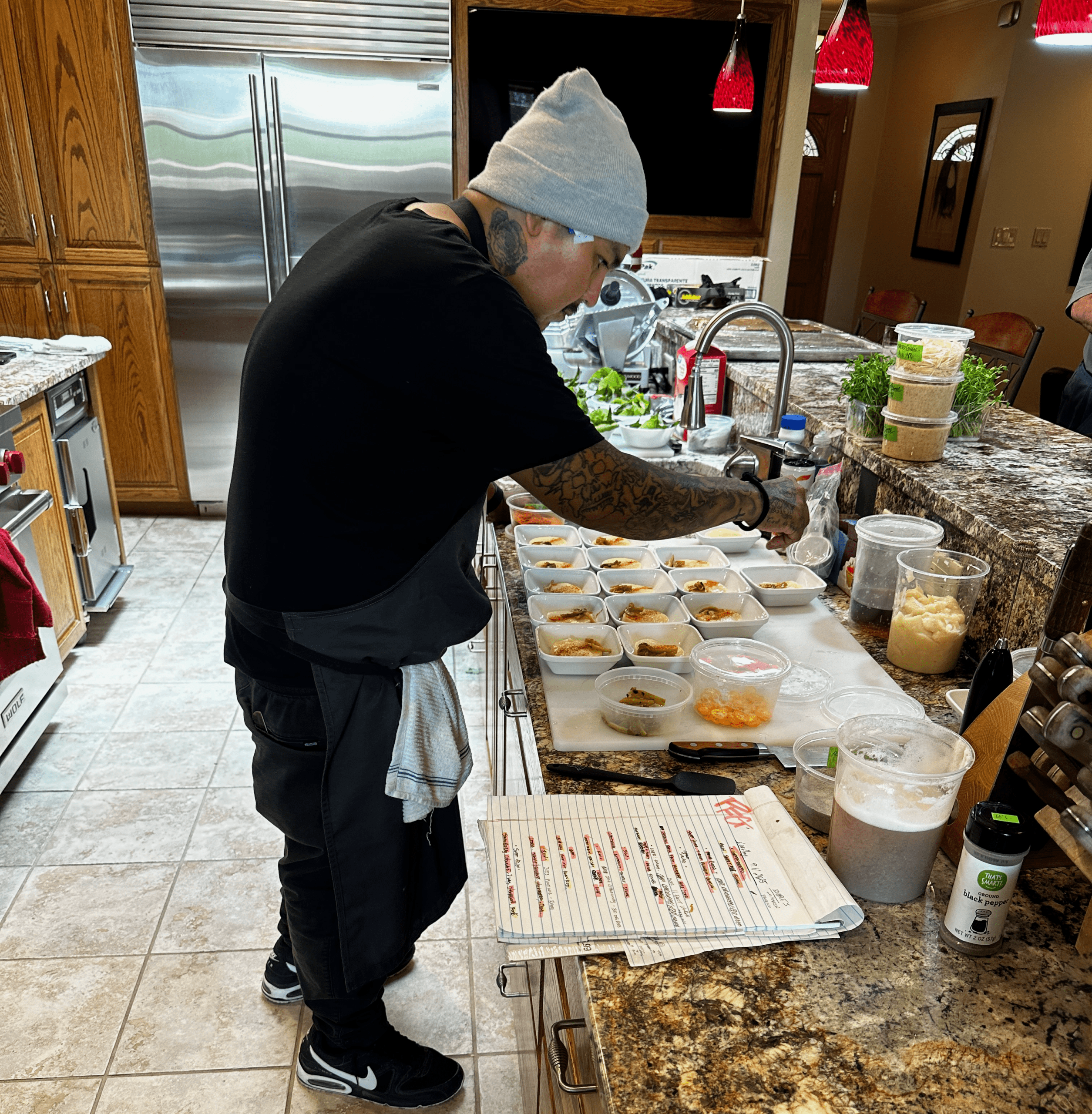
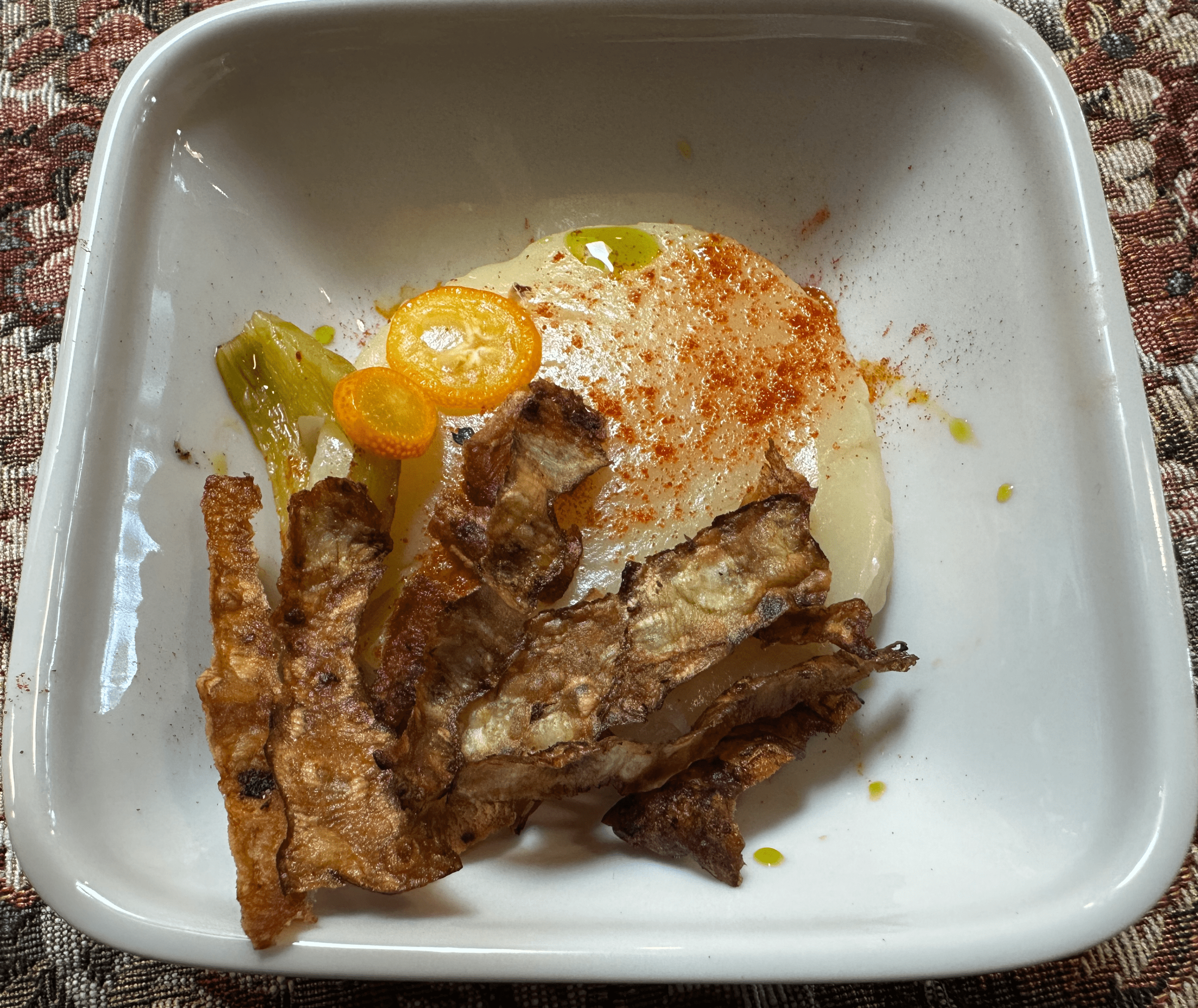
The Dééh may not have been everyone’s “cup of tea” (play on words here), but the second course more than made up for it. That course was a beautifully plated rectangular bowl of panna cotta. Most of us recognize panna cotta as an Italian dessert with a velvety-smooth and creamy texture. Literally meaning “cooked cream,” panna cotta can also be a savory dish as the Pioche’s version was. The cooked cream was essentially the essence of sweet potato with notes of turnip. Anaheim and Guajillo chiles added slightly fruity, piquant notes though this dish could hardly be called “hot” (even my chile avoiding bride enjoyed it). Plated with the panna cotta were sunchoke chips and heirloom kumquats.
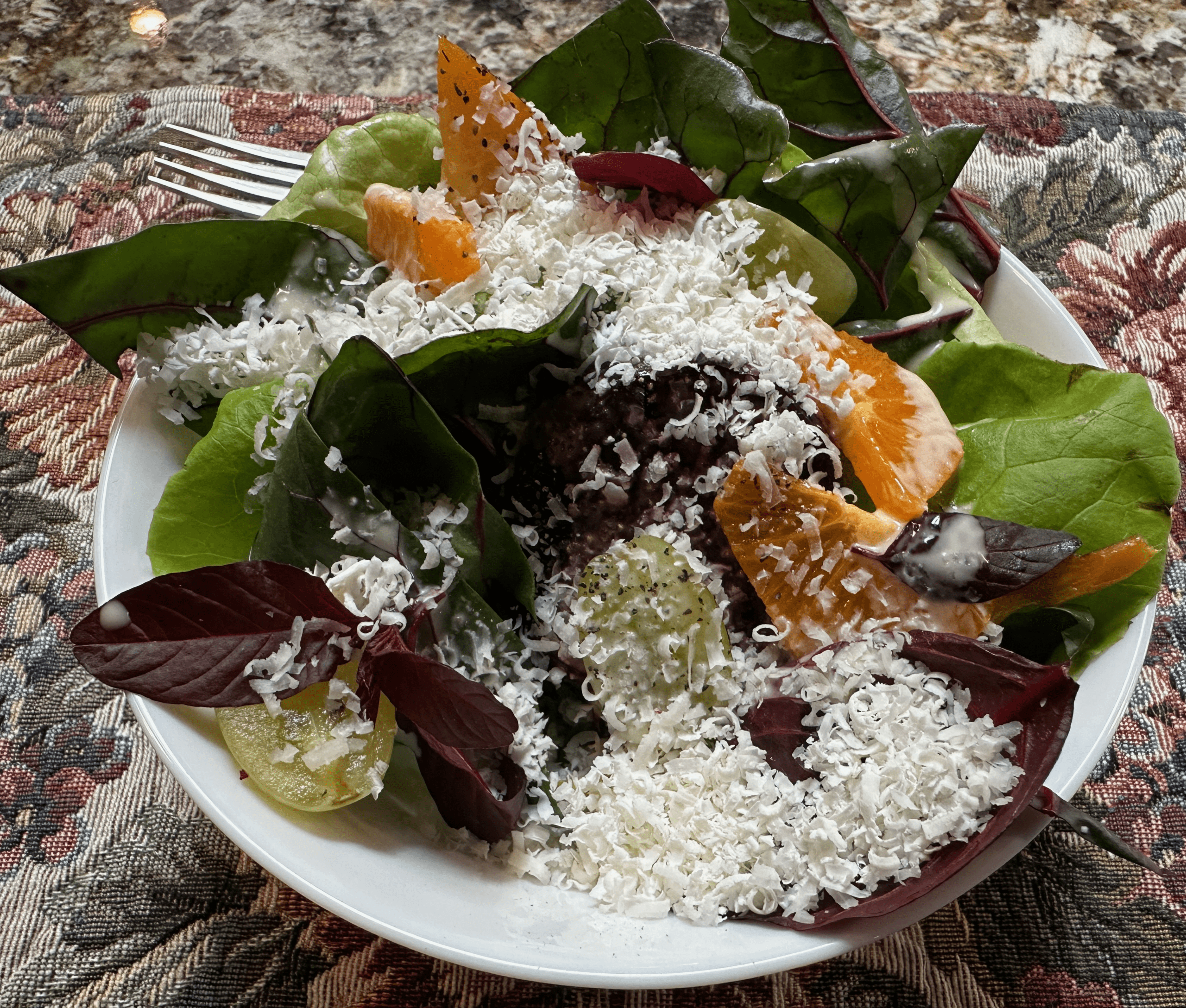
It became readily apparent to guests that plating is an art at the Pioche experience. Nothing is haphazardly thrown together on a plate. Chef Justin told me the plating is in keeping with the Navajo concept of “Hózhó,” a Navajo word that means “walking in beauty” (as Janice and Tia certainly do) – or living in a manner that strives to create and maintain balance, harmony, beauty and order. Janice elaborated that “Chef Justin was taught from his elders that Hozho is actually the balance between good and bad. We truly walk in harmony and beauty when we recognize the good and bad in life.” Beauty and order are evident in every plate. Even on a relatively simple chard salad (dandelion, beets, fruit, Manchego, apple cider dressing). Chef Justin introduced the salad as the “healthy portion of the meal.” Healthy certainly doesn’t mean ordinary. This was a delicious salad.
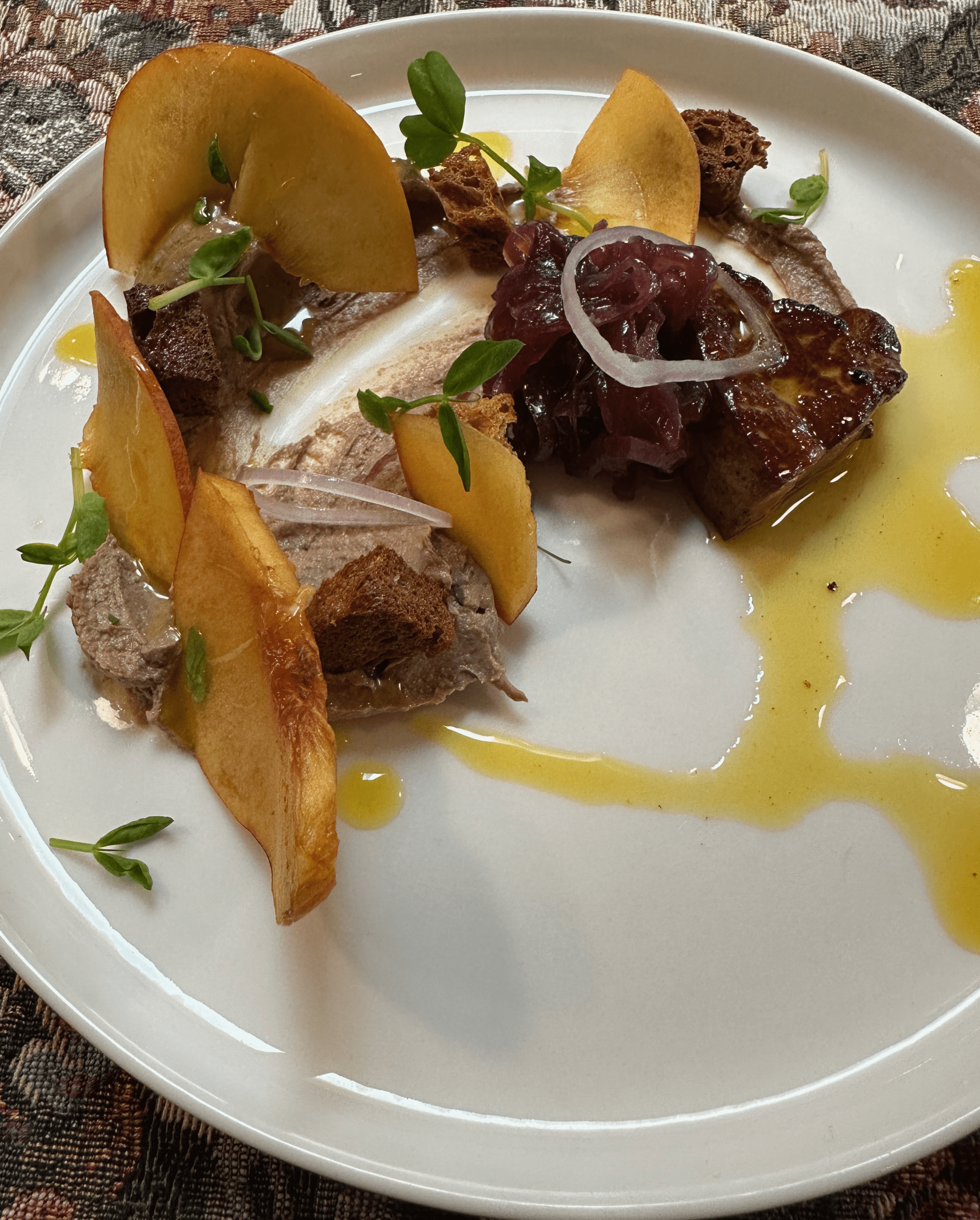
At the end of the meal, Janice polled guests to determine what their favorite dish of the event was. For many of us, the most transformative dish was the foie gras done two ways. Chef Justin introduced the dish as “Liver and Onions.” Our host Greg actually generously donated the foie grass (for which we owe him copious thanks). My favorite preparation style has long been as a pâté where its rich, buttery and delicate flavor and distinctive fatty consistency shine. The mousse-like pâté was superb! It’s much too rich to enjoy in copious portions, but it impressed itself on our taste buds for a long time. Tia’s contribution to this plate was an outstanding seared foie gras topped with fennel. Peaches, long the agricultural pride of the Navajo nation, provided a wonderful sweet-tangy counterbalance to the foie gras.
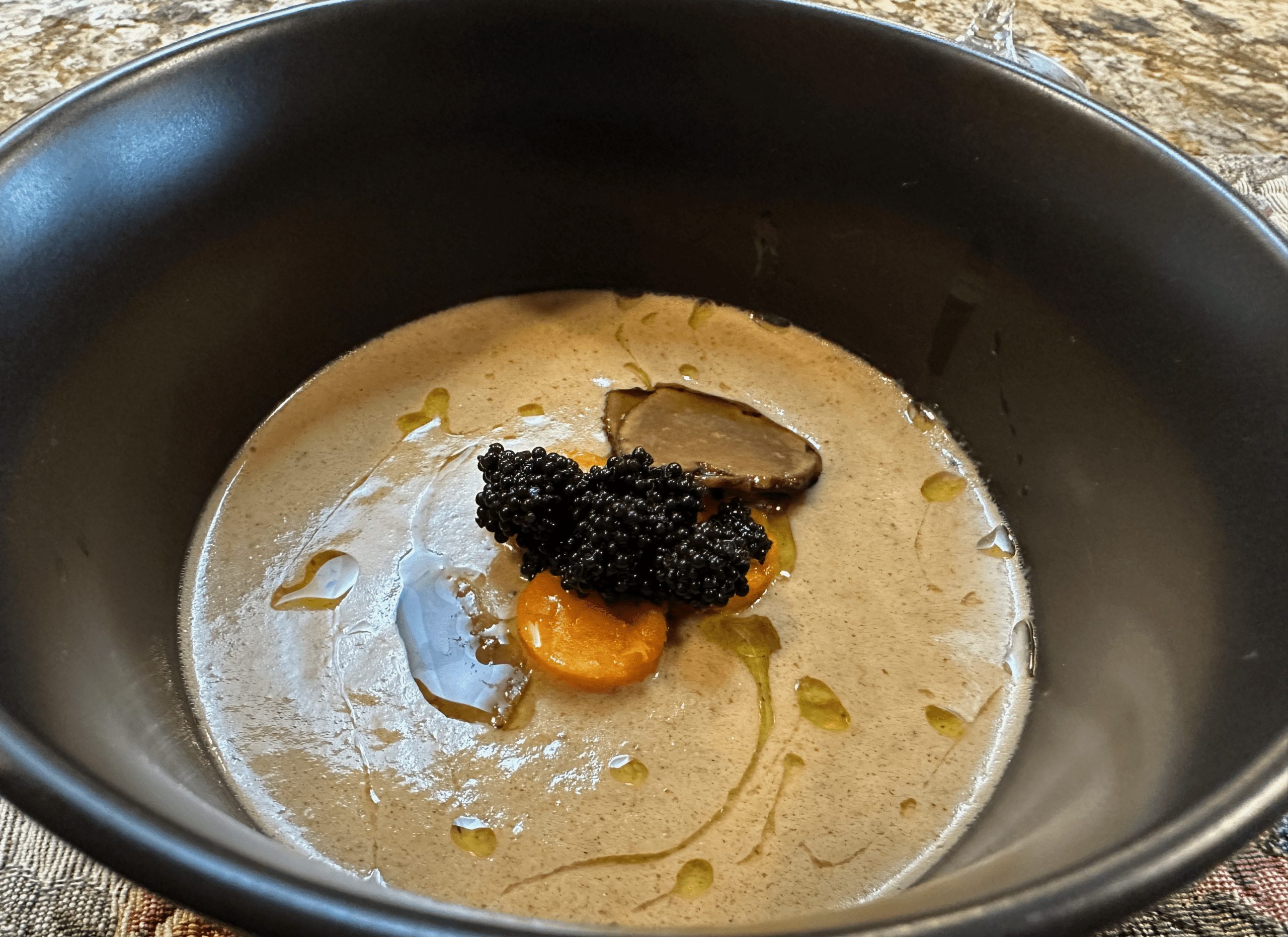
As a young sprout whose teeth resembled a winding road, I wore braces for two years. That meant eating a lot of soup every time my sadist…er, orthodontist tightened those torturous braces. The experience heightened my appreciation for two soups in particular: cream of mushroom and butternut squash. My tastes then were for Campbell’s. Today those salt-bombs would never grace our kitchen. Instead, sophisticated soups are a passion. Chef Justin soup (chanterelle, butternut, truffle, caviar) is in rarefied air as one of the very best soups I’ve ever had. This soup is laden with umami, the so-called “fifth taste.” It’s sheer genius, the combination of ingredients and flavor profiles that made this grown man swoon.
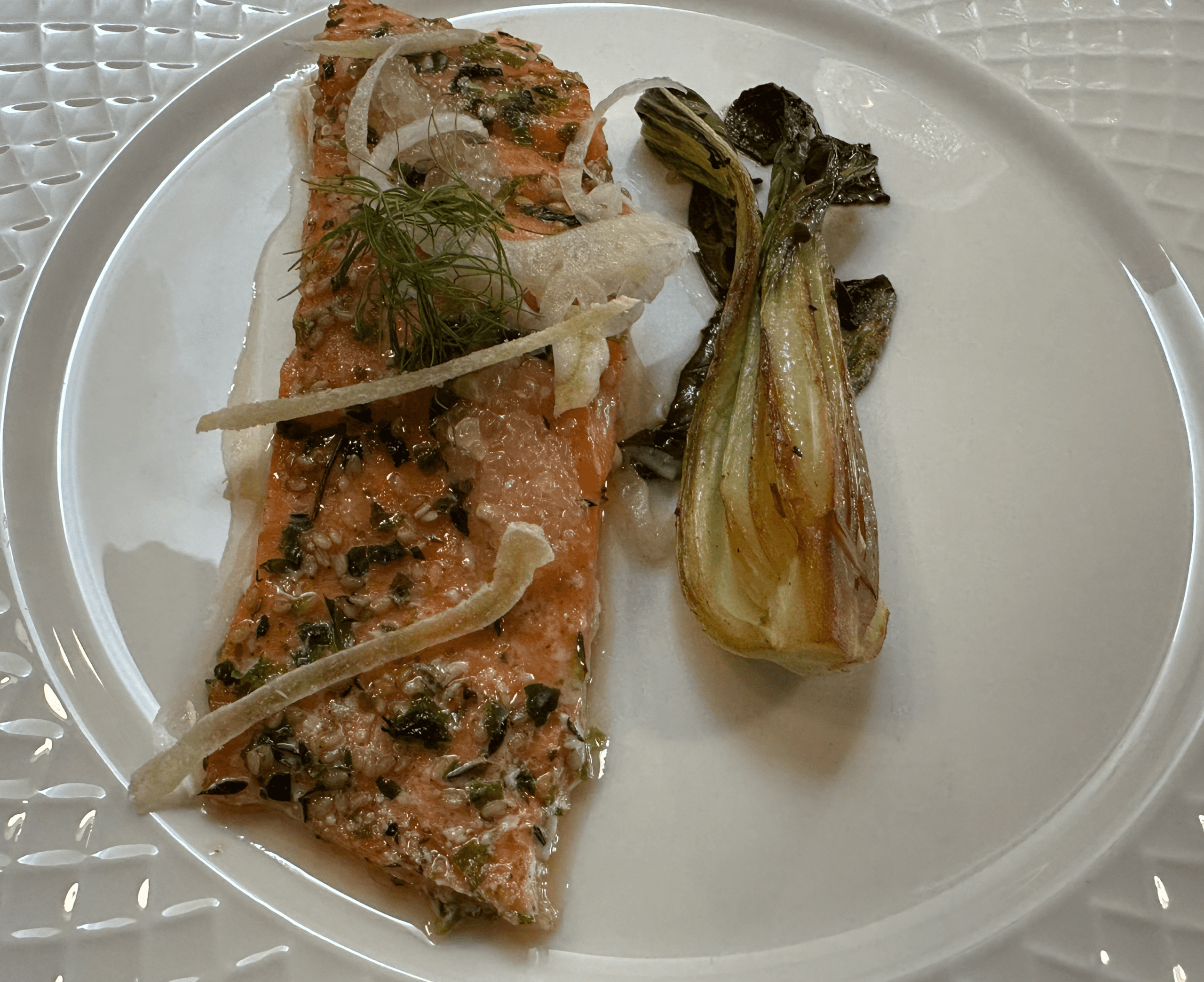
Tom was most excited about the ocean trout served with bok choy. It’s one of his favorite delicacies of the sea, one he enjoys every time he visits New Orleans. Ocean trout looks (a rosy pink-orange flesh) and tastes similar to salmon though it’s far less oily. It’s sweeter and milder than salmon with a delicate, buttery texture. Chef Justin prepares this rich, succulent and clean flavored fish with ginger and lime though not so much that it takes away from the briny qualities of the fish. Charred bok choy was a surprising though wholly complimentary, providing flavors (peppery, grassy, spinach-like) that work with ocean trout.
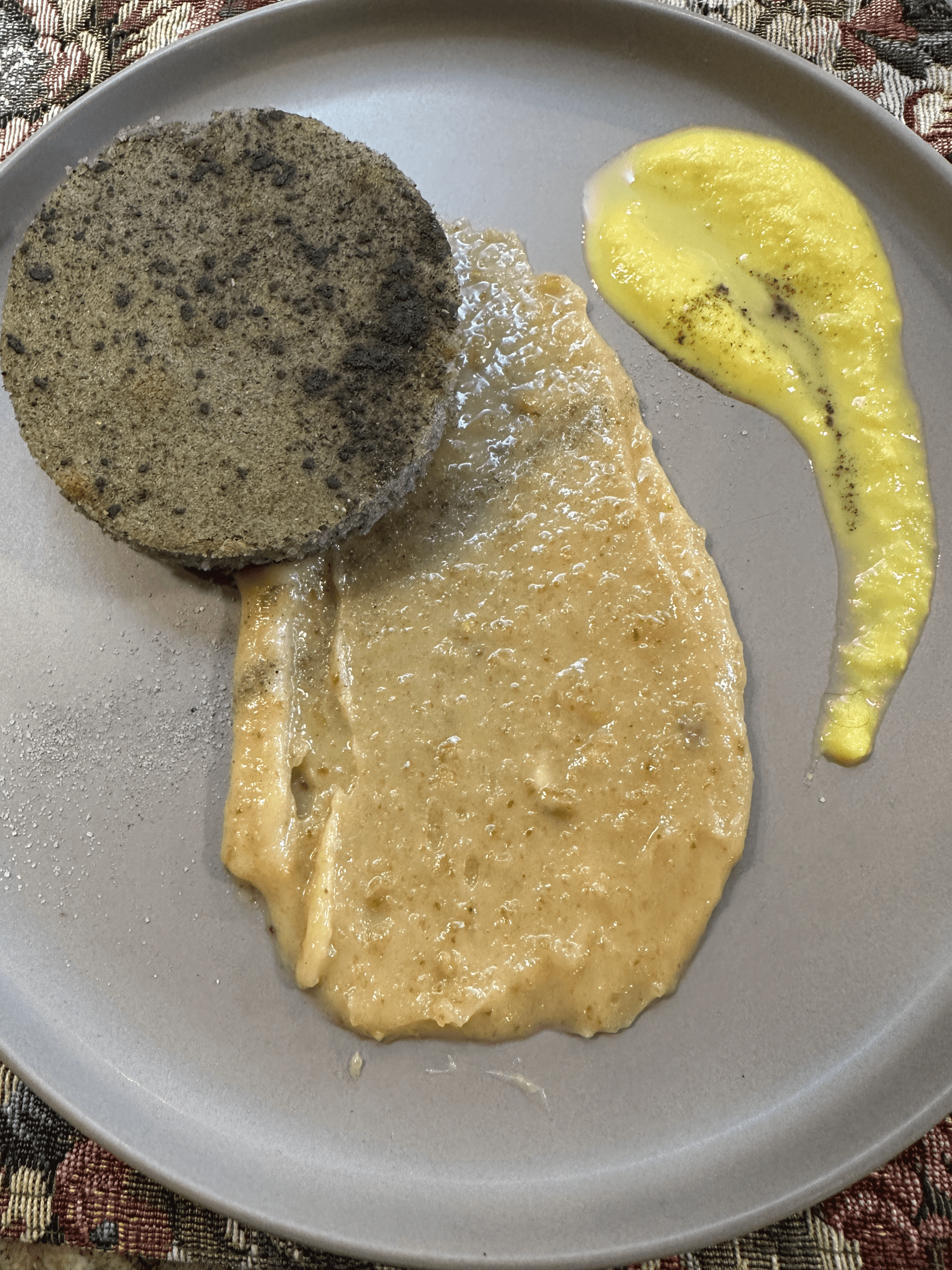
Few meals would be complete without a bread (Bááh) course. Though she doesn’t consider herself a baker, Tia’s bread courses are always a hit at LorAmy events. This isn’t the horno-baked bread or fry bread you might associate with indigenous peoples. For this event’s bread course, Tia created a circular blue corn bread plated with a smear of pine nut spread and a smaller streak of corn koji. The pine nut spread is sweet with a subtle hint of pine that will transport your mind and taste buds to New Mexico’s pine forests. The corn koji is a bit more challenging to explain. Koji is defined as “any grain that has been inoculated with the mold Aspergillus oryzae.” Essentially, koji can be made from almost any grain. Koji is a revolutionary approach to using grain molds to create absolute deliciousness. The Pioche’s corn koji exemplifies the chef’s creativity and constant study.
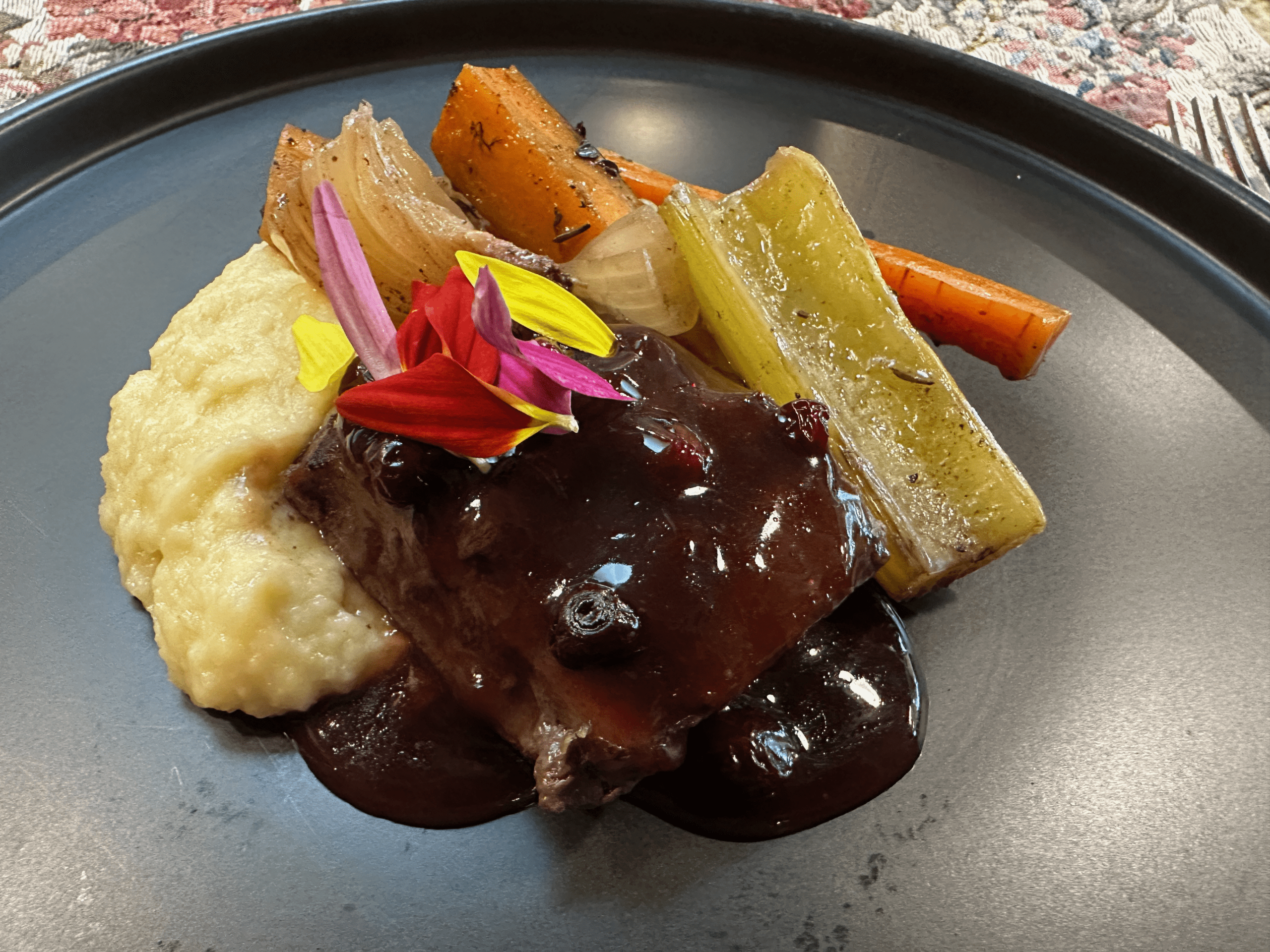
Our final savory course was deer. Chef Justin explained that the deer was shot with a bow and arrow by a relative. More than any deer I’ve had, this deer was tender and wholly lacking in the gaminess often associated with deer. One of Greg’s friends, who admitted to having subsisted on deer for several years, claimed this was the best deer he’s ever had. That’s quite an endorsement. Topped with a huckleberry demi, the deer inherited the berry’s complex sweet-tart flavor with earthy and herbal notes. Its preparation was much like a very tender pot roast, rendering the deer tender enough to cut with a fork. The deer was served with a parsnip mash that had me asking why such a mash hasn’t replaced the ubiquitous mashed potatoes.
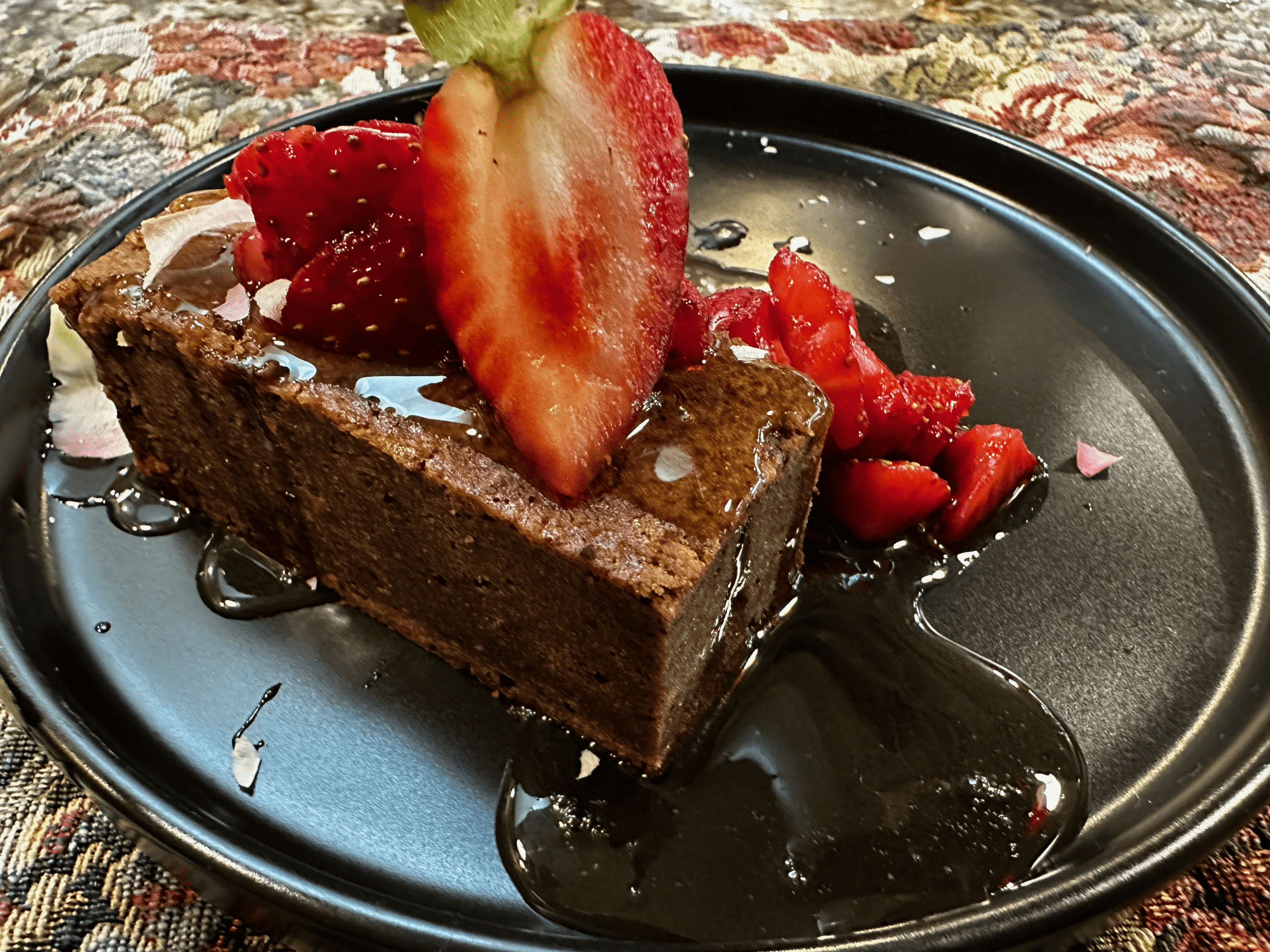
Fittingly, our final course was called Sweet Adieu. Chef Justin likened it to a sort of bread pudding, but it was wholly unlike any bread pudding of my recollection (and I’m somewhat of a bread pudding aficionado). This picturesque tart is chocolate two ways–in cake form and as a drizzle–topped with macerated strawberries. While not quite as sweet as Janice and Tia (what could possibly be?), this sweet end to a fabulous meal was a complex confection which won over ever heart in the place. Chef Justin used frozen nitrogen on a dozen long-stem roses as an entertaining and edible effect. The application of nitrogen was reminiscent of London on a foggy day. It brought oohs and aahs to our tables, but not as much as actually eating this decadent dessert.
When dinner concluded, guests lingered–not quite in postprandial topor, but in pure contentment at having enjoyed world-class dining and hospitality. The Pioche family was characteristically warm and open as we showered them with praise and awe. If you would like to experience this uniquely wonderful experience, make sure to follow the Pioche Food Group on its Facebook page. When an event is announced, make reservations quickly to ensure a meal you’ll long remember.
LorAmy Event: 10 February 2023
Having devoured all the Tony and Ann Hillerman books centered in and around the Navajo Nation, I thought I knew quite a bit about the Diné. That was until Brian Schwartz, an extraordinary food writer from Oklahoma, offered me his ticket to an event showcasing the talents of James Beard Best Chef – Southwest nominee Justin Pioche. I immediately took stock of just what I knew about Navajo culinary traditions. I knew the Navajo are widely credited with the “invention” of fry bread during their brutal internment at Bosque Redondo. History taught me that lush Navajo peach orchards were destroyed during a scorched earth campaign by Kit Carson. I knew from personal experience that Navajo cooks prepare the best mutton I’ve ever had. I also surmised that Navajo cooks and chefs held very true to culinary traditions and ingredients, many of which were adopted by New Mexicans.
>My lack of knowledge of Navajo culinary culture and traditions having been revealed, I lept at Brian’s kind invitation. Besides the curious appellation “LorAmy” just beckoned for further discovery. Neither a Navajo culinary tradition or a culinary term, LorAmy is a Farmington pop-up dining series from Diné chef Justin Pioche of the Pioche Food Group. The name is a combination of the chef’s grandmothers’ first names, fitting considering the matrilineal traditions of the Navajo. Lorene is his mother’s mother’s name and Amy is his father’s mother’s name. At a table set for twelve, Chef Justin presents a varying seasonal menu (usually around 8 courses), inspired by his Navajo culture. Unexpected palate-pleasing twists and turns are sure to please you as the Pioche family puts their hearts on a plate.
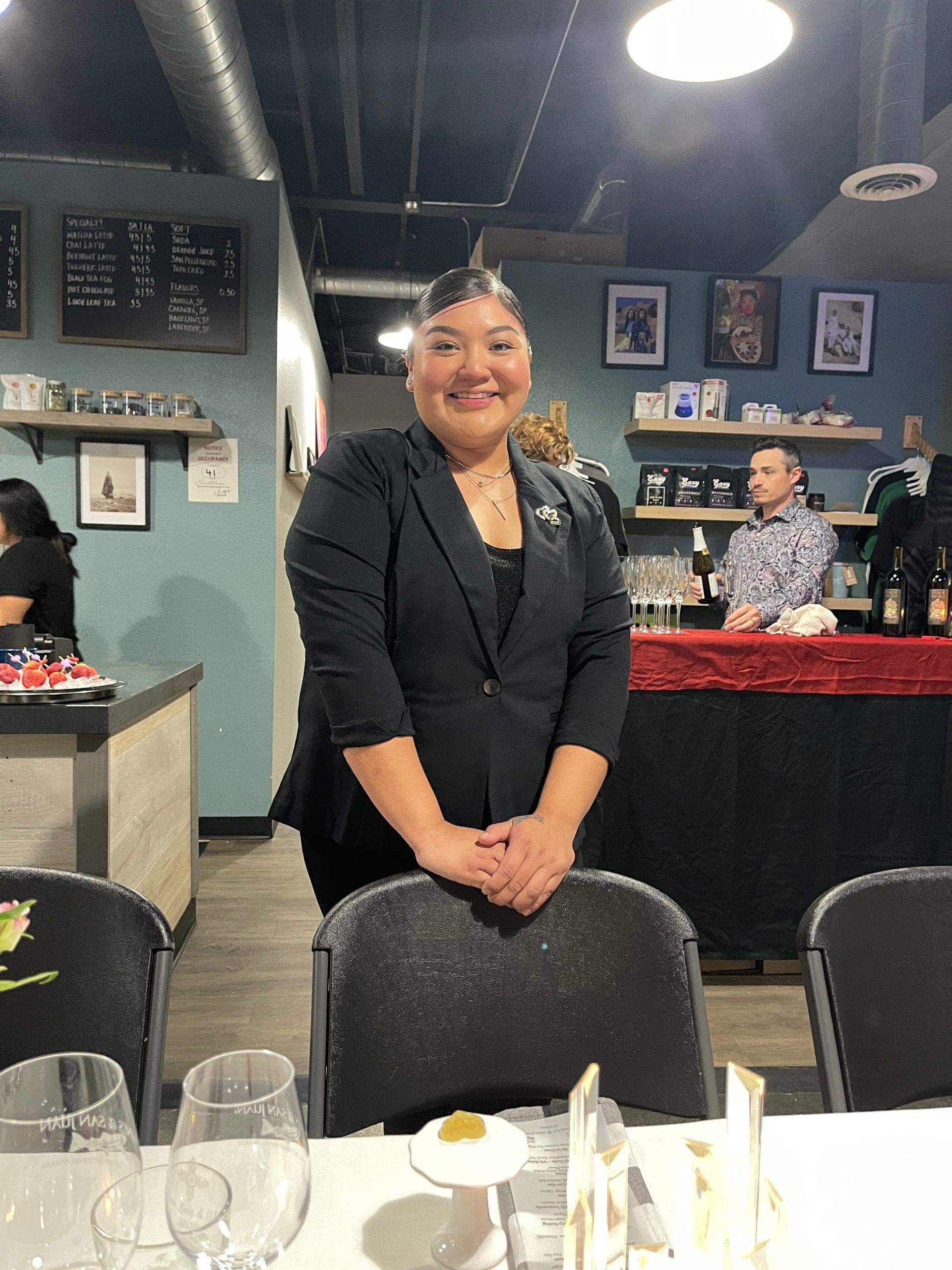
Family is at the heart of the Pioche Food Group, an innovative Navajo owned and operated food service company. At the Chef’s right hand is his baby sister, the effervescent and beautiful Tia. She’s the face of the the Pioche Food Group, the front-of-the-house personality who orchestrates each events’ proceedings. She describes her relationship with her big brother as “best friend, room mate, business partner and co-conspirator.” Naabeehó sáanii (Navajo women) are the center of the family, the keepers of wisdom and conservators of ancestral teachings. This would become increasingly obvious to me during the evening as I was seated with three of Chef Justin and Tia’s aunts and shared a delightful conversation with their mother Janice, youthful looking enough to pass for their sister.
No strangers to adversity or to surmounting challenges, the Pioche family lived in Phoenix in an east-facing apartment with no air conditioning. Tia credits their dirt poor existence with their humility and resilience. When the family returned to the Farmington area, learning to cook became a necessity for Justin. Both parents worked, so when he came home from school, he would make simple meals for his younger siblings. He began his culinary career at 17, working at Francisca’s, a Mexican restaurant in Farmington. After a demotivating experience at the Central New Mexico Community College, Justin almost gave up on pursuing a career as a chef. Fortunately Janice continued to steer him in the direction of a degree in culinary arts from the Arizona Culinary Institute in Scottsdale.
After graduating in 2014, Justin started what would become a burgeoning culinary career that will certainly not culminate with being nominated for a prestigious James Beard award. In fine dining restaurants helmed by celebrated chefs Beau MacMillan and Kevin Binkley, he was inspired to innovate while learning the business aspects of restaurant management. Chef Binkley emphasized “everything on the plate should serve a purpose, and not just be there for aesthetics,” a lesson took to heart. Moving back to Upper Fruitland, he worked at chain restaurants in Farmington, a disheartening experience which didn’t stretch his talents. Offered an opportunity to take an excursion to Israel, Justin started hosting pop-up dinners to raise money for his trip. Upon his return, he and Tia decided to continue hosting pop-up dinners in the Four Corners area. Thus the Pioche Food Group was born.
In addition to periodic pop-up dinners, The Pioche Food Group owns and operates a food truck. Four corners locals at our table shared that it’s the very best food truck in the Farmington area and–in at least three cases–was the reason some of those locals signed up for the LorAmy event. Within the vast expanse of the Navajo Nation are two farms in which Justin works and innovates, developing new ways to grow crops consistent with Navajo foodways. He periodically invites high school students work on the farm to learn these farming techniques. At other times, he takes promising students to Phoenix and mentors them in “fine dining” techniques. He recruited one group of students to help prepare a charity dinner for hundreds of guests. Justin champions the Careers through Culinary Arts Program (C-CAP), a workforce development nonprofit that provides underserved teens a pathway to success.
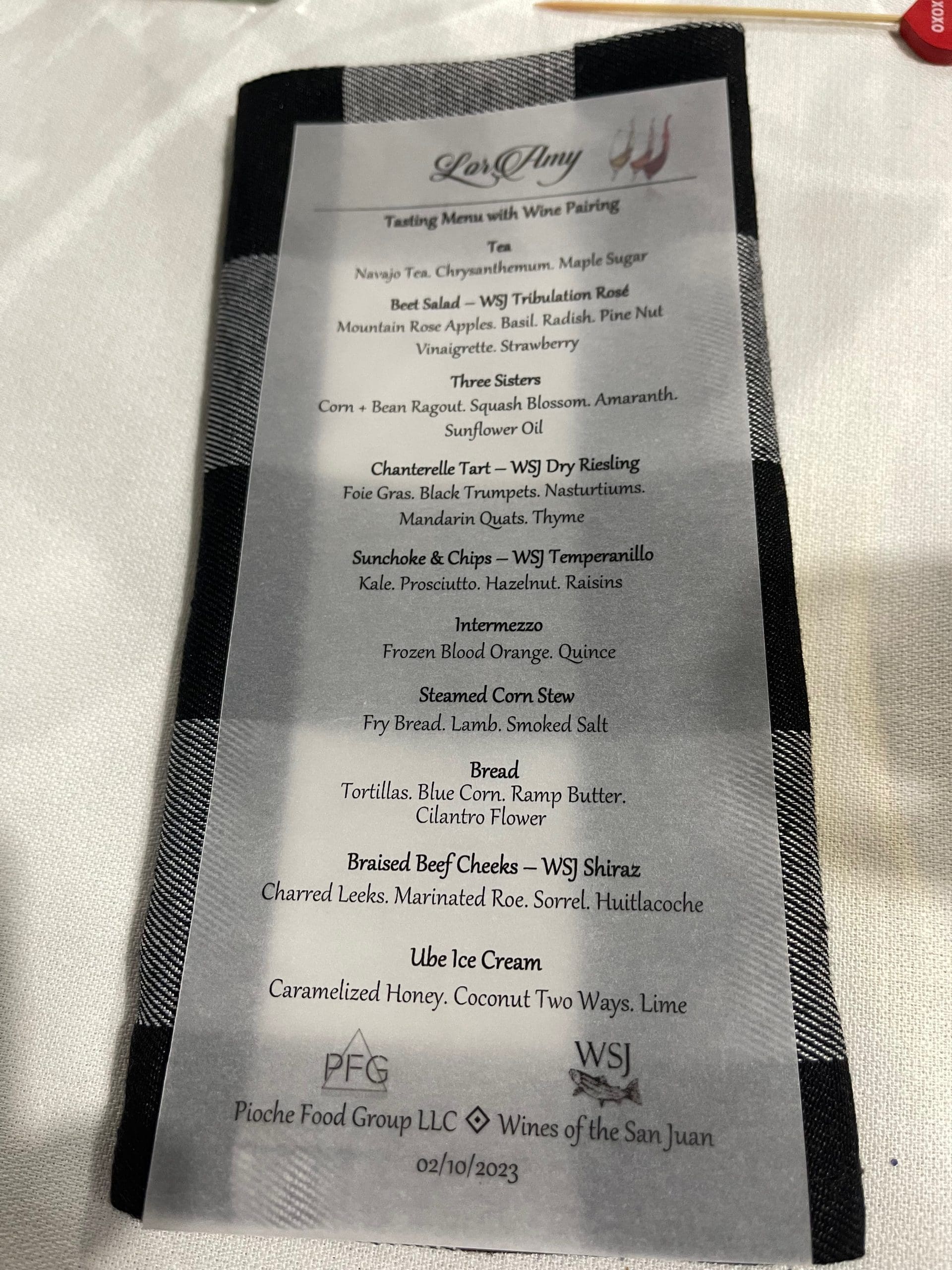
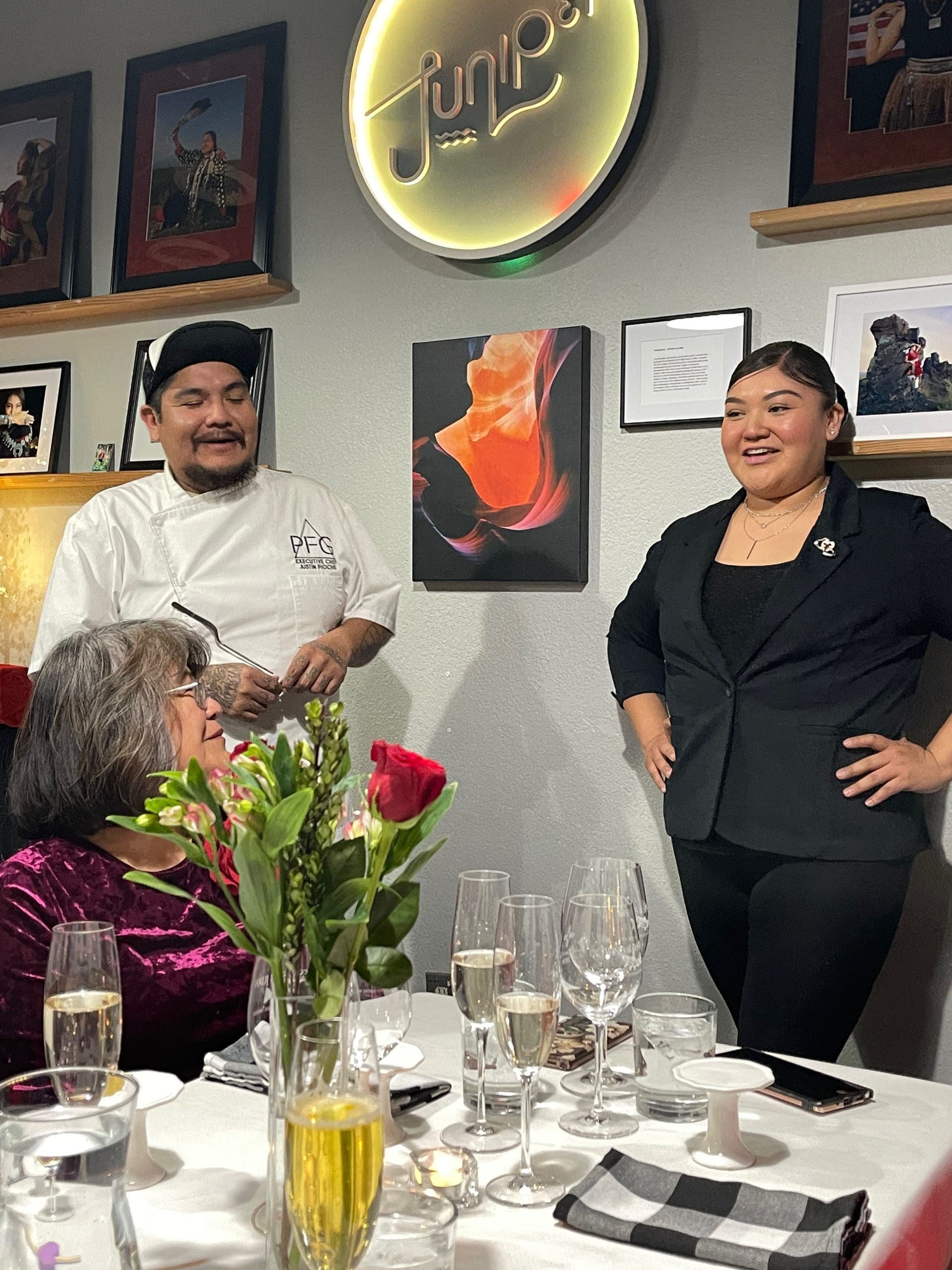
The exclusive LorAmy Valentine’s Day Dining Experience I attended took place on February 10th at the Juniper Coffee & Eatery on College Blvd. Juniper is itself a Native owned restaurant earning acclaim. I was immediately smitten by the charming Tia who greeted me at the door. In that I was the only unaccompanied guest, she seated me next to her three aunts and one uncle. As is usually the case when you’re seated at a community table with people you don’t know, conversation was initially guarded and mostly of the small-talk variety. It wasn’t long before the ice was broken and we laughed like long-lost friends. Justin’s and Tia’s aunts regaled me with stories of their talented nephew and beautiful niece. They gave me a better education about Navajo culture than Tony and Ann Hillerman have.
Each place setting on the table was resplendent with generously poured champagne flutes courtesy of Wines of the San Juan. For those of us who don’t imbibe adult beverages, sparkling cider and water were provided. Flutes and glasses were faithfully replenished throughout the evening along with an introduction of wines paired with each dish. Lit candles were further illuminated by unique glass candle holders reminiscent of major league baseball’s commissioner’s trophy. A single heart-shaped gelee (a French term for a jelly-like food) was placed on a small glass platform. Justin and Tia introduced the evenings proceedings followed by Justin delivering a blessing.
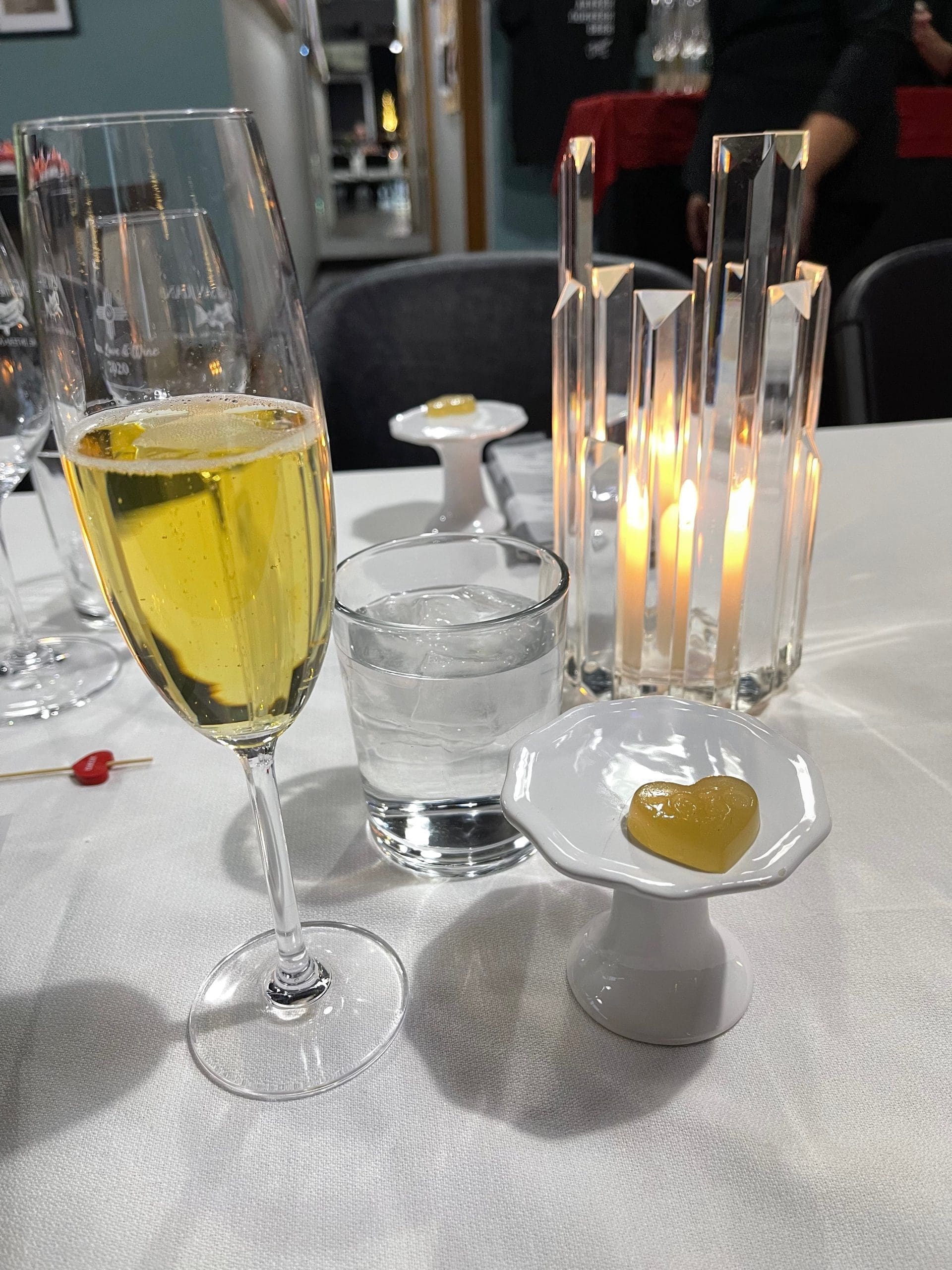
Our first course was a Navajo tea made with chrysanthemum and maple sugar. Regular readers might know that tea in all its forms and manifestations is the only “food” I don’t like, but I was determined to drink it all even if it meant one big swig. Thankfully, that single gelee was intended as a palate cleanser after drinking down the tea. As tea goes, it wasn’t bad, but I don’t believe I’ll be giving up my beverage of choice (water) any time soon.
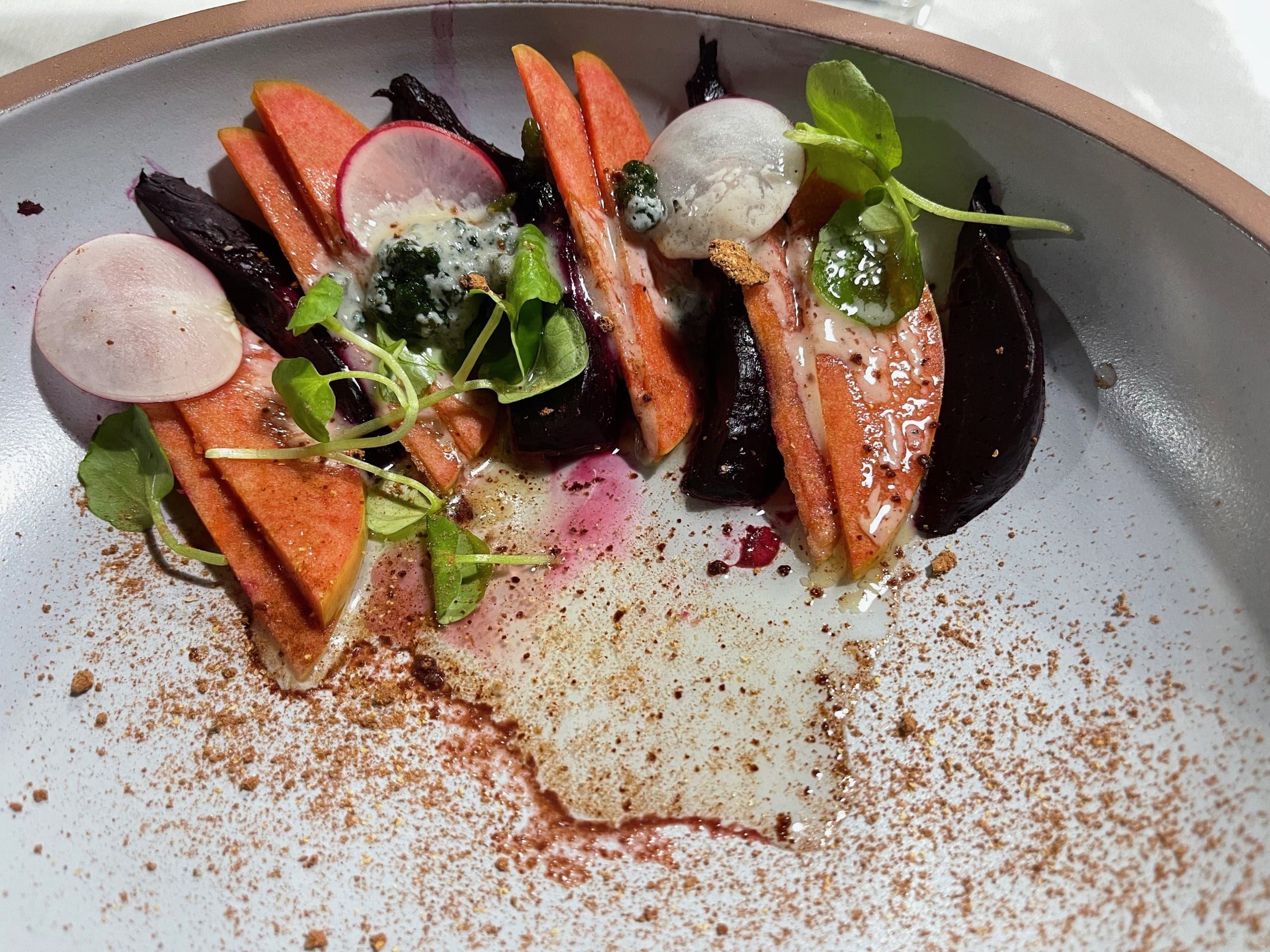
Our second course was a beet salad (Mountain Rose apples, basil, radish, strawberry, pine nut vinaigrette). The Mountain Rose apples, a unique heirloom variety grown only in the Hood River Valley of Oregon, surprised everyone at our table. We all wondered if they had been doctored to give them their unique coloring, a shade of red-pink blush. Imbued with the aroma of strawberries and a slightly sweet and mildly tart flavor, they were a huge hit. So were the earthy beets with their pronounced purplish-red coloring and floral flavor with a hint of sweetness. As with every plate with which we were presented, there was no one ingredient that didn’t serve a purpose and that didn’t delight our taste buds.
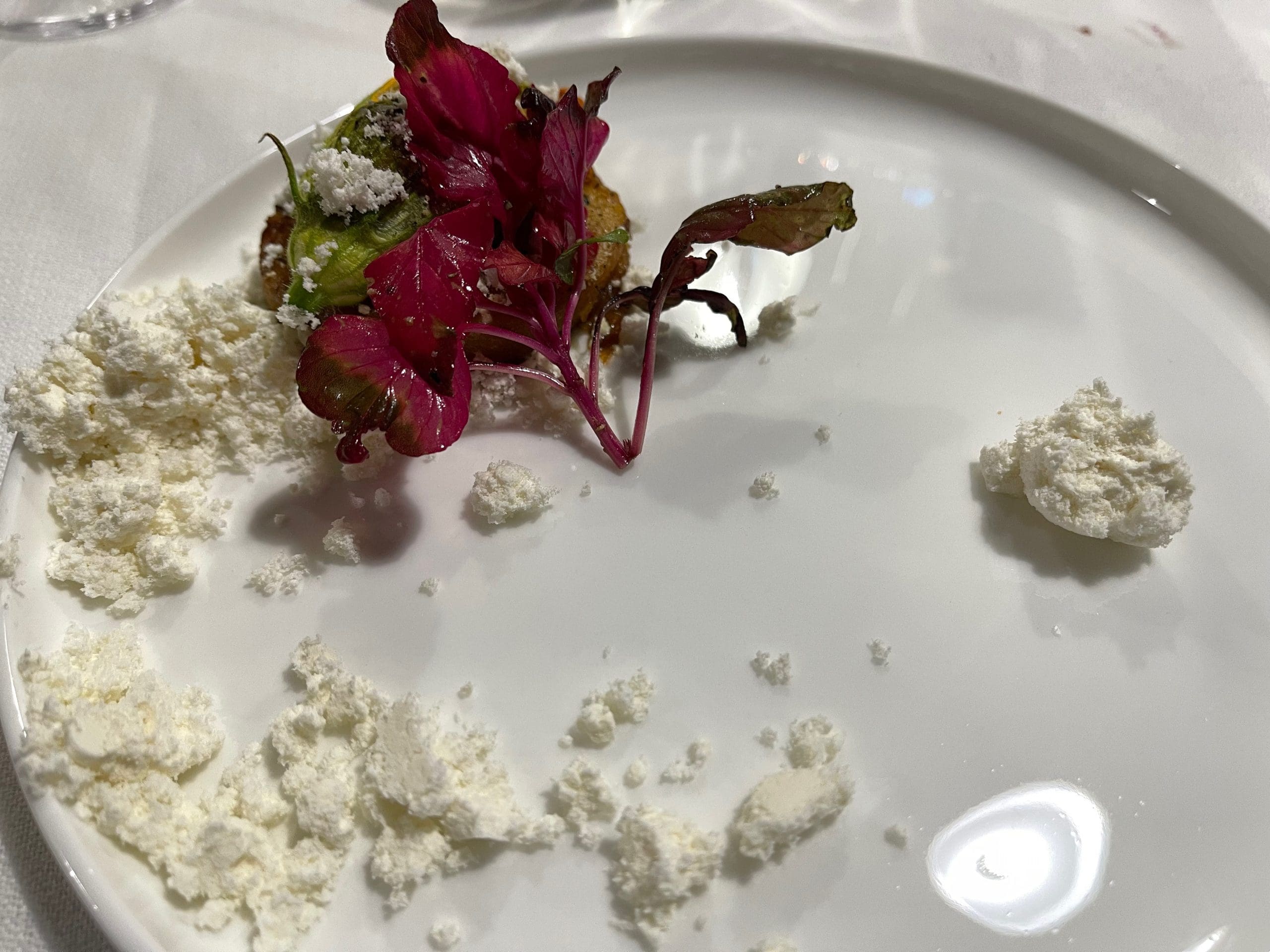
Justin explained the importance of the three sisters (corn, squash and bean) to the Navajo culture, enlightening us on symbiotic growing methods that bring out the best in all three when planted together. Growing tall and lush, the corn plant shields low-lying squash from the hot sun. In honor of that culinary triumvirate, his next course was fittingly called Three Sisters (corn and bean ragout, squash blossom, amaranth, sunflower oil). Employing molecular gastronomy techniques, Justin transformed the liquefied sunflower oil into a fine, powdery form. That was just one of several surprises. The squash blossom was filled with a corn and bean ragout that showcased all three sisters working deliciously together. For me, the corn niblets were very reminiscent of corn steamed in an horno.
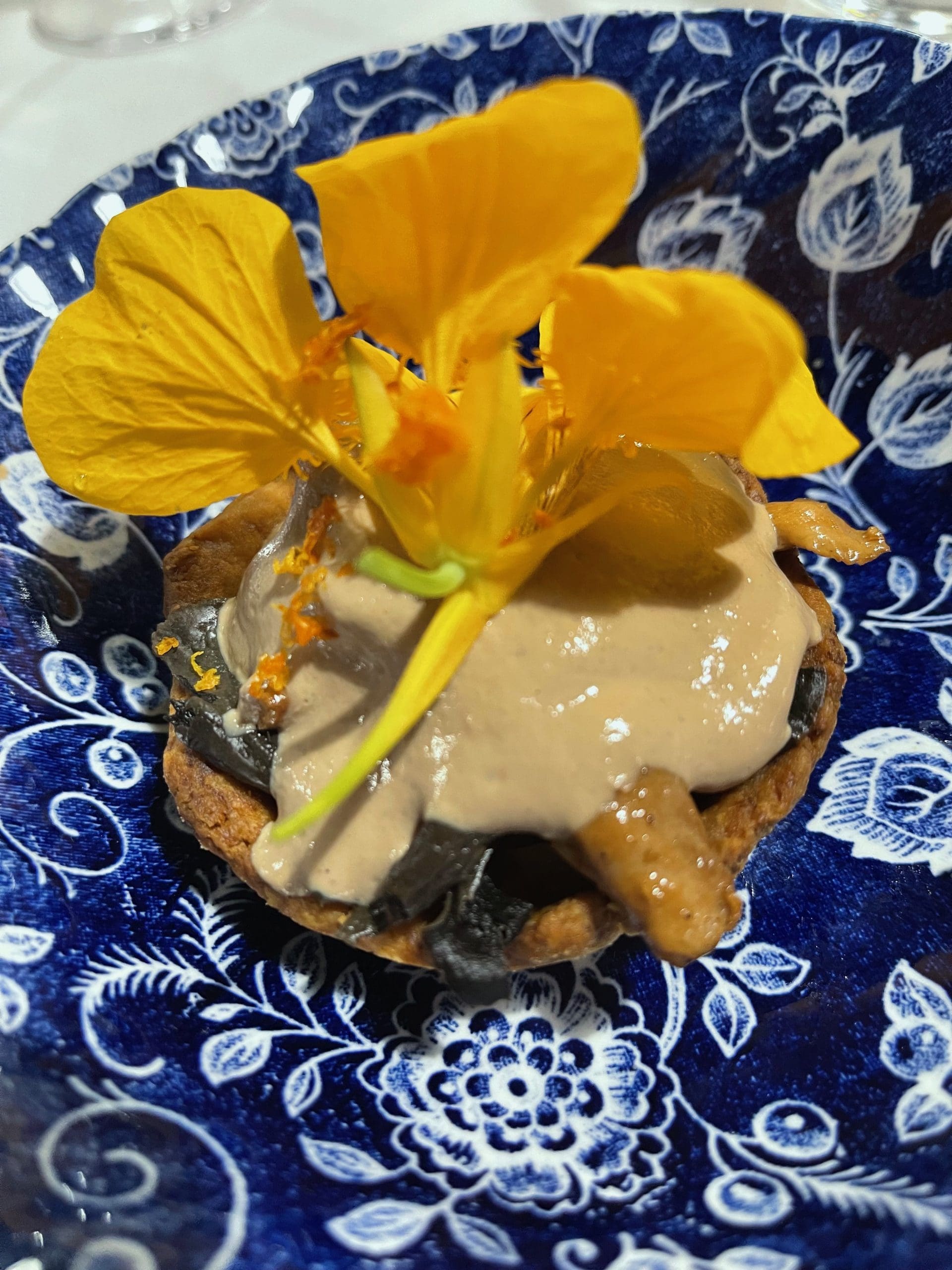
Reminiscent of a Georgia O’Keefe painting of flowers (without the sensuality) is the chanterelle tart (foie gras, black trumpets, nasturtiums, mandarin quats, thyme). Using the term umami to describe foods with mushrooms is probably cliche, but in this case so very accurate. Foie gras has a “beefy” rich and creamy flavor that pairs magnificently with chanterelles. Among mushrooms, chanterelles have a unique flavor in that they have discernible fruity notes and an aroma similar to apricots. Tia, whose main interests are in the hospitality side, baked the crusty tart. Nasturtiums are not only beautiful flowers, they actually possess a light peppery flavor.
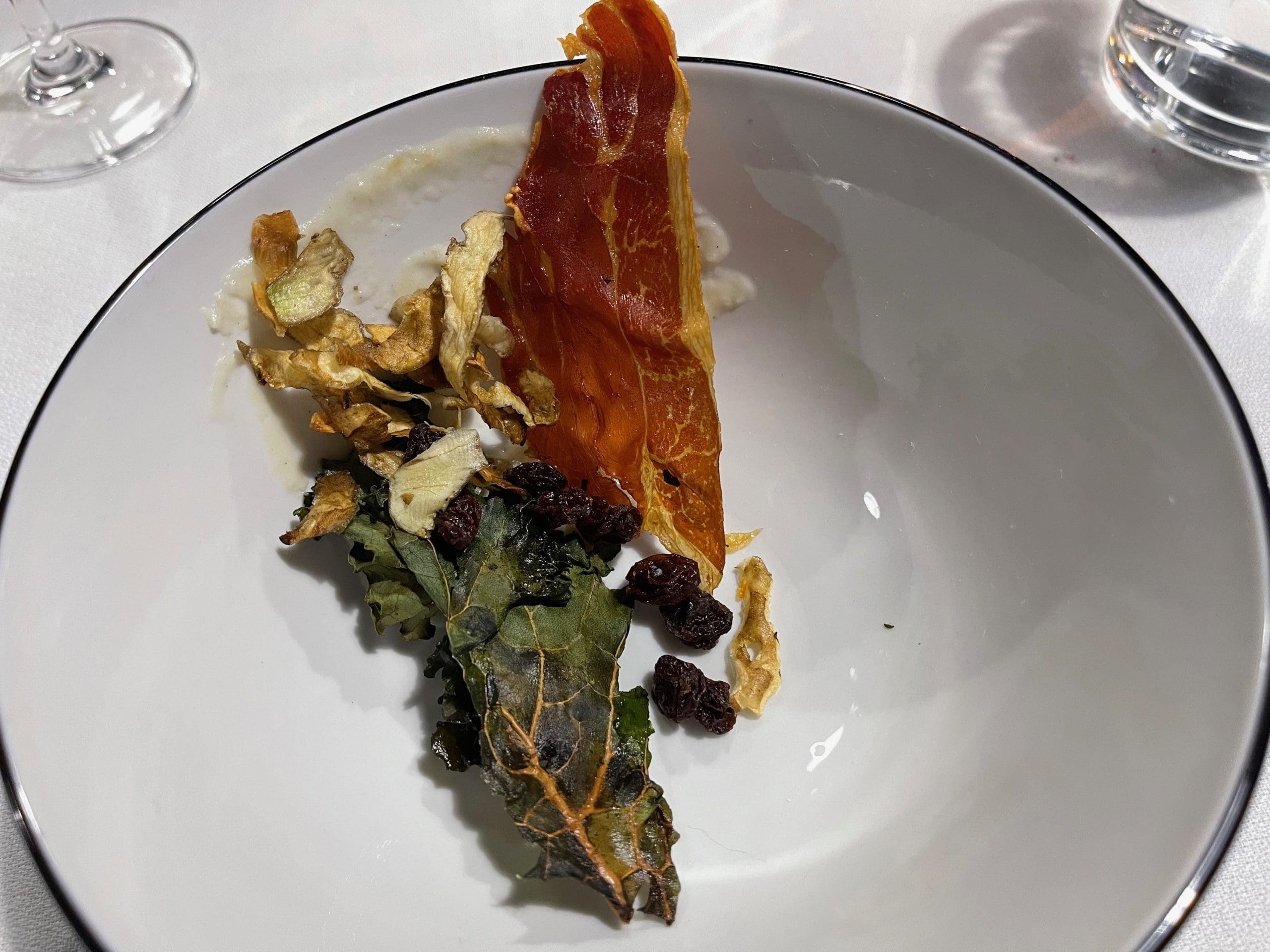
Although everyone at our table enjoyed every course, perhaps the one course eliciting the most enthusiasm was the sunchoke and chips (kale, prosciutto, hazelnut raisins). Only a few of us had ever had sunchokes in any manner. Also known as Jerusalem Artichokes (even though they’re neither from Jerusalem or from the artichoke family), sunchokes are actually the root of a species of sunflower plant which grows in New England. When baked into chips, they have an addictive, slightly sweet and earthy flavor. Sunchokes do not store starch. As such, they do not impact the body’s blood sugar level, which is great for those on a low “carb” diet. While sunchoke chips were the biggest hit, the crispy kale was also well received. Raisins offer a delightfully sweet contrast.
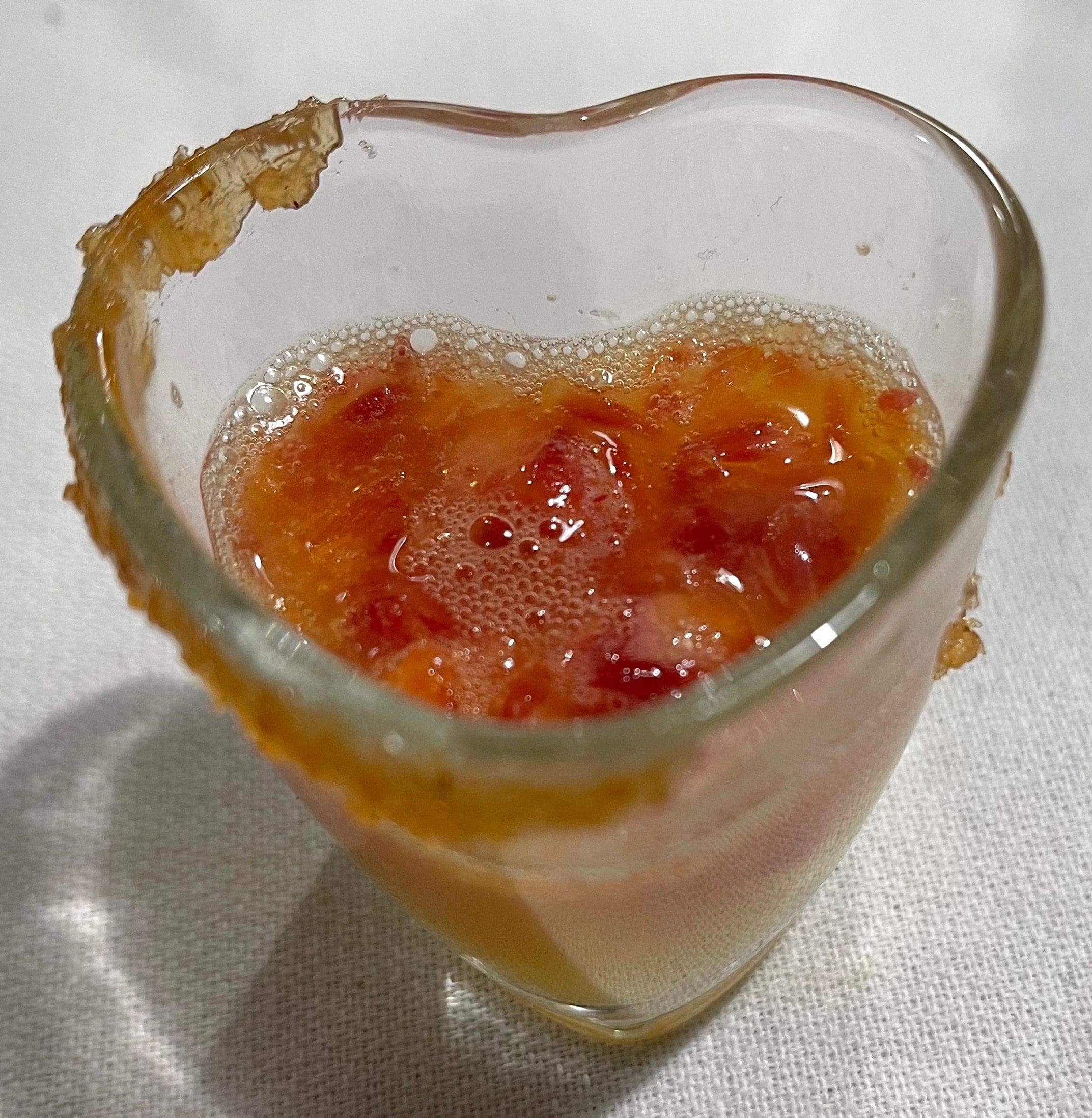
Intermezzo, an Italian term which means “a brief interlude or diversion” was next. Justin filled a heart-shaped shot glass with frozen blood orange. The shot glass had a quince rim, similar in principle but not taste to the salt on the rim of a margarita. Much as we may have wanted to slowly savor this refreshing palate cleanser, it was so good most of us downed it quickly. The quince rim was a nice tough. Unless cooked, quince can be very astringent, a quality which would not have been as greatly appreciated as the sweet, vanilla-like quince rim we licked off the glass.

Even the Tony Hillerman Portal contends that “fry bread is a result of Navajo contact with white settler colonial practices, specifically during their 1864 internment at Fort Sumner after their forced Long Walk from their traditional homelands near Canyon de Chelly, Arizona to the Bosque Redondo location of Fort Sumner in the Pecos River Valley in New Mexico.” The untold history is much more bleak. Tia explained the tragic story of Navajos dying of gastric distress from consuming wheat flour to which the Diné were not accustomed. Because the Navajo were not given pots and pans, they did not “invent” fry bread at the Bosque Redondo (but they would later on). They mixed flour with Pecos River water and consumed the resultant mixture, a sure invitation to dysentery or worse.
Justin’s reinterpretation of fry bread was much more palatable. Most of us think of fry bread as a plate-sized disk of shortening, flour and salt fried in grease or oil. Instead of the stereotyped disk-shaped fry bread (which Health magazine ranks as one of the fifty most unhealthy foods in the country), we were presented a dense orb more reminiscent of a “donut hole” than fry bread. It didn’t taste like a donut hole. It tasted like maybe the best fry bread we’ve ever had as confirmed by oohs and aahs a plenty. Fry bread was one component of the Steamed Corn Stew (fry bread, lamb, smoked salt), maybe not even the best. My favorite was the lamb presented in smaller than bite-sized pieces. If you associate lamb with gaminess, you’ll be surprised at just how mellow and delicious it can be when prepared by a chef-genius.
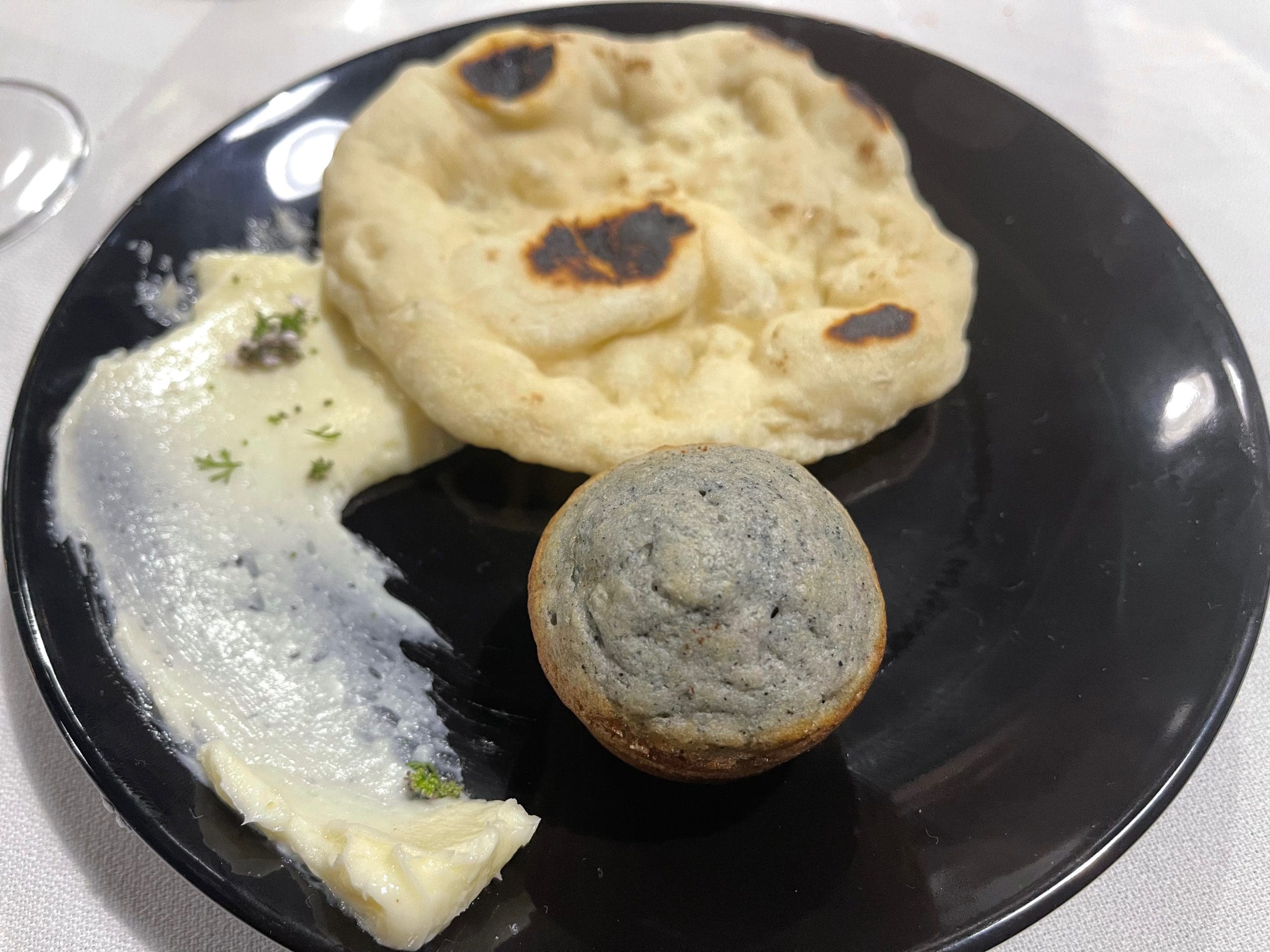
Tia’s culinary prowess was on display on the bread course (tortillas, blue corn, ramp butter, cilantro flour). She’s no slouch on the kitchen. Her tortillas reminded me of my sainted Grandma Andreita’s tortillas. Thicker and more dense than most tortillas, they just begged for butter and Tia provided among the best, most herbacious butter of my experience–a soft, easy-to-spread ramp butter. She described ramps as coming from the same family as onions and garlic, tasting very similar to a combination of the two. Also on the plate was a single blue corn muffin as thick, dense, moist and delicious as you can imagine.
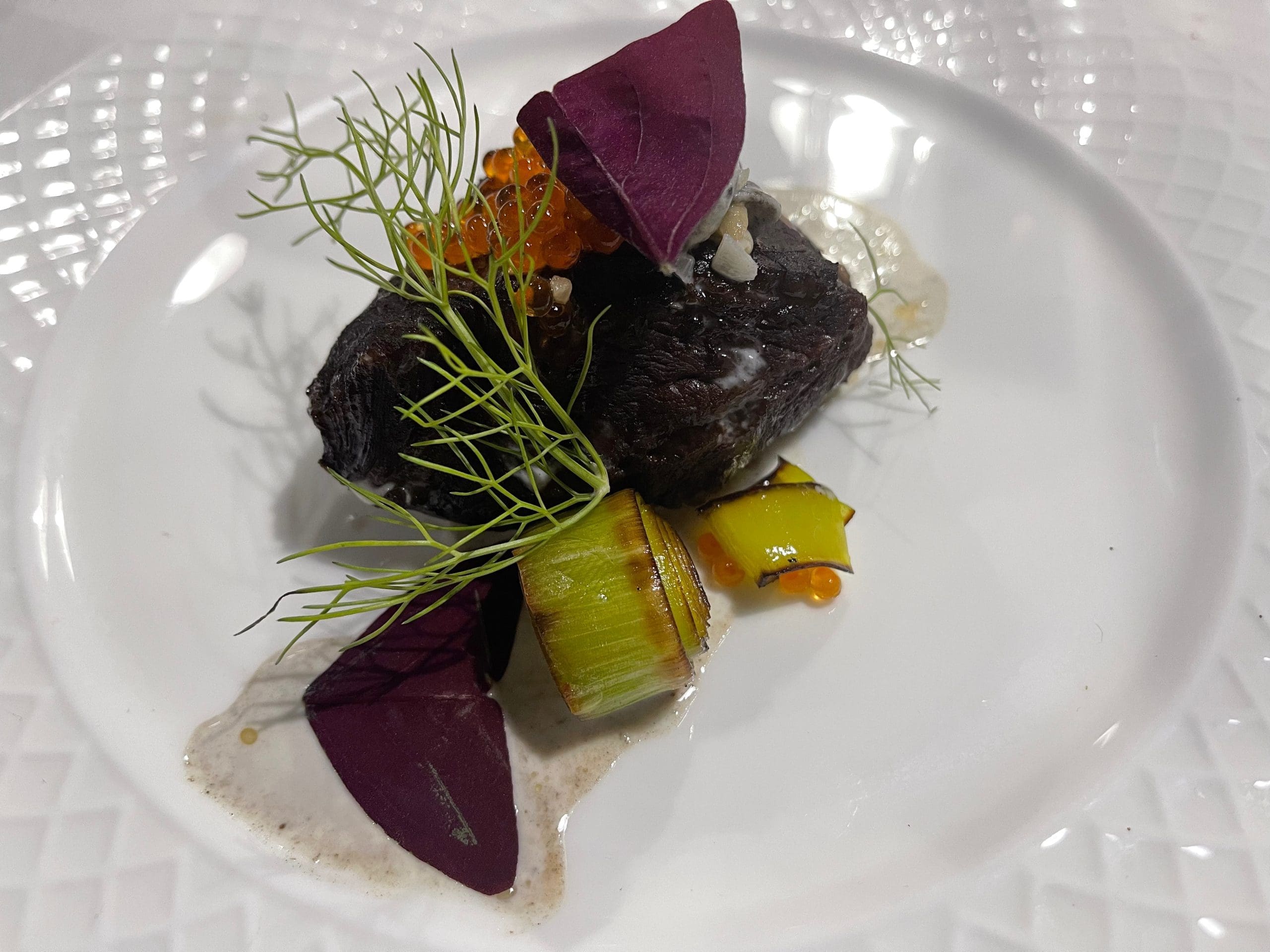
The main course of the evening was braised beef cheeks (charred leeks, marinated roe, sorrel, huitlacoche). Beef cheeks are highly esteemed by high-end chefs (think Michelin-starred restaurants) for their robust flavor and unique texture. Rich and savory with a soft, mouthfeel, they’re so tender you can cut them with a spoon or fork. Beefy notes permeate their essence. Justin’s mastery of slow-cooking techniques brings out the very best qualities of braised beef cheeks. Few beef dishes have wowed me as much. Ever! Justin also managed to transform huitlacoche (corn smut) from its native mushroom-like texture to a liquefied gravy form. It enhanced the flavor of the beef cheeks even further. Huitlacoche is one of my favorite foods in the universe. Tobiko eggs (fish roe) delighted the Pioche aunts who’d never had anything like it.
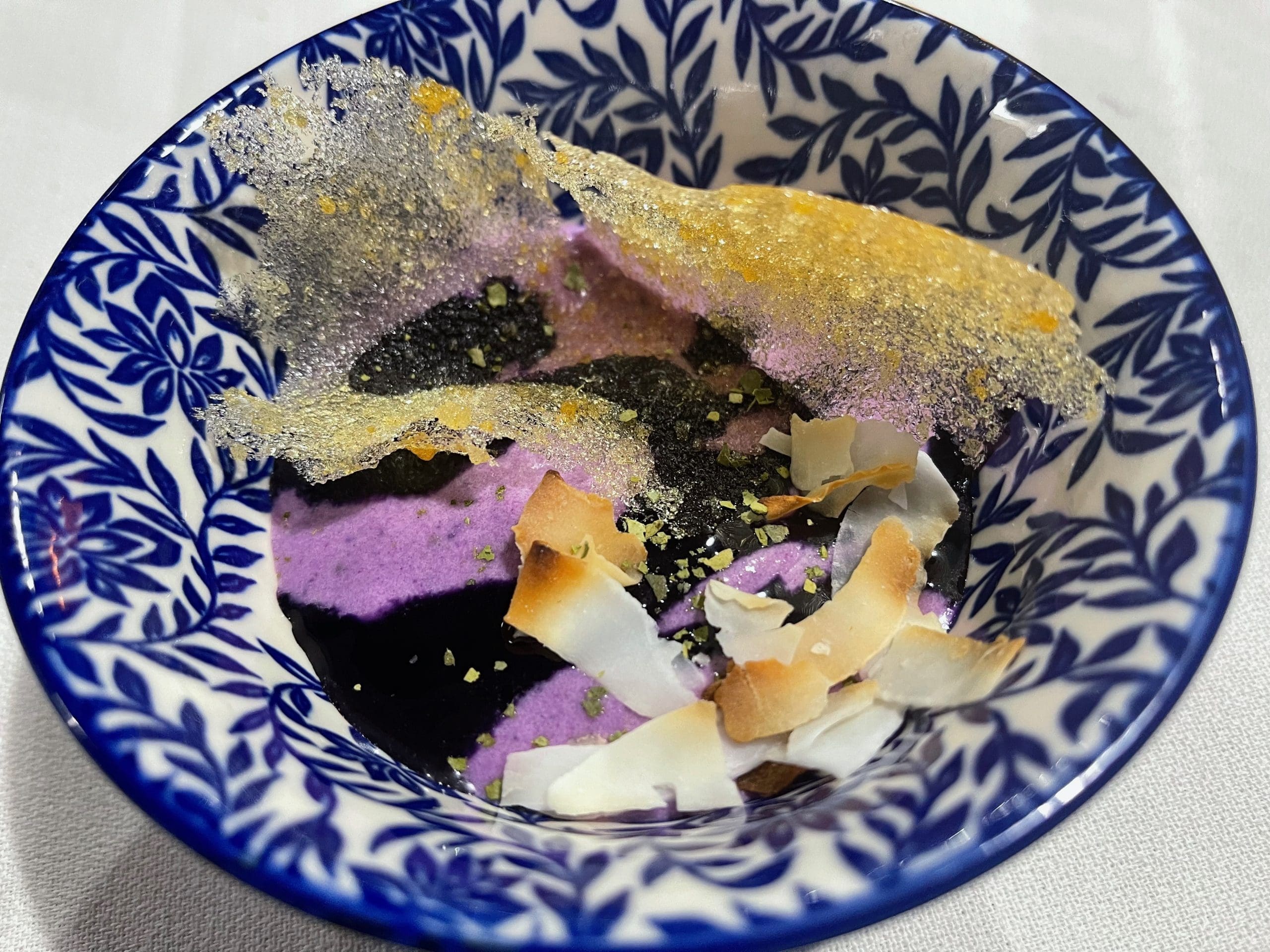
When it came time for the dessert course, some of us became melancholy in realizing the night would soon be over. To no surprise, the dessert course was also something with which few of us were acquainted, an ube ice cream (caramelized honey, coconut two ways, lime). Though often referred to as purple sweet potatoes, ube are yams with a dark, rough-looking skin. Ground into a powder, they are often used in Filipino desserts characterized by their bright purple color. Kudos to Justin for creating one of the most unique ice cream, one that captures the flavor essence of ube, a rich sweet taste with vanilla notes. Just as delightful as the ice cream was the caramelized honey, deep and rich in color and as intensely flavored as honey from a comb.
When the event ended, no one was in a hurry to leave. Twelve people came together as strangers and left as friends. That’s the power of great food and a fabulous event orchestrated by a wonderful family. From experiential and culinary standpoints, this was a stand-out event, one which should be shared with people you love.
Pioche Food Group
Upper Fruitland, New Mexico
(505) 258-2907
Website| Facebook Page
LATEST VISIT: 11 September 2025
1st VISIT: 10 February 2023
# OF VISITS: 2
RATING: Exceptional – Superior quality; above and beyond nearly all restaurants; harmonious blend of high-quality cuisine, impeccable service, and a curated atmosphere, characterized by consistency
COST: $$$$$
BEST BET: LorAmy Event
REVIEW #1318
I thought the restaurant was called Pinche Food Group…🤣…that would be a better name, IMHO…
You must be thinking about this spot: https://pinchestacos.com/.
Fascinating. Thanks for the effort you put into this, Gil. No doubt it was its own reward, but still … well done.
Outstanding food aside, the real reward was getting to spend time with Justin, Tia, Janice and the family, all of whom are over the moon about the recent swearing-in of Navajo Nation Vice President and UNM alumnus Richelle Montoya. This is a tremendous boon for the Navajo Nation’s proud matrilineal traditions. One of the wonderful aunts told me about having scaled Canyon De Chelly at night using only the sheer cliff’s footholds and a flashlight. I would love to see the Pioche Family Group host an event in the Albuquerque area. I would be first in line.