to reach out eagerly and without fear for newer and richer experience.”
~Eleanor Roosevelt
The longest-serving first lady in United States history aptly expressed what could be the official lifestyle motto of Costa Rica. Economizing on words, it’s a lifestyle Costa Ricans call “Pura Vida.” This colloquial phrase translates to “pure life,” but means so much more. It’s a lifestyle in which you choose to live to the fullest, while nurturing the mind, body and soul. You can hear the phrase “Pura Vida” echoing throughout Costa Rica. It’s used as a greeting or expression of happiness, accurately describing the tranquility, wonder and adventure that await visitors and those fortunate enough to live in this idyllic paradise. Costa Rica is truly an energizing getaway, where visitors can enjoy the latest practices in relaxation and personal care, participate in exciting activities set in a lush natural environment and delight on healthy and nourishing gastronomy.
During my eighteen years at Intel, I was blessed to work with and consider as friends several developers from the rainforested Central American Utopia. Technically and attitudinally they were a joy to work with. “Pura vida” was not only the way they approached their lives. It was the way they approached work. While American developers (not all of them, obviously) had a tendency to whine about deadlines and challenges, my “Tico” friends saw them as opportunities to surmount. Oh, don’t call them “Costa Ricans.” The primary nickname for Costa Rica’s citizenry is “Tico” for men and “Tica” for women, a term derived from the country’s unique Spanish dialect where the diminutive suffix “-Tico” is frequently used instead of the standard “-ito” (which is common in New Mexico).
As much as Ticos relished their work, it was after work that their affable and joyful nature was most in evidence. That’s particularly true of the the times we broke tortillas with them. My favorite anecdote about one such experience comes from my friend and colleague Bill Hanson who related that he was hosting several of his Tico employees at Intel’s Ocotillo (Arizona) plant. Like me, Bill delights in introducing his friends to new culinary adventures. Unfortunately, not all our colleagues were similarly inclined (despite one of Intel’s corporate values being “risk-taking”).
One of our colleagues convinced the “Ticos” that the restaurant they should not miss for a “true American dining experience” was Claim Jumper, a regional chain (and slight upgrade from Chili’s). Ever the gracious host, Bill acquiesced to the Ticos’ request. He recalls: “As each dish was produced and delivered to the table I sank further into my chair as the American decadence of over indulging was displayed in glorious Sysco provided plates heaping with food. Each dish could have easily have served three people as I sat and wondered how much food was actually consumed versus how much went into the dumpsters out back.”
Ticos, it seems, are born with bottomless bellies. We never saw an empty plate or leftovers remain on a table after a meal with our Tico friends. “Don’t these guys ever get anything to eat in Costa Rica?,” we wondered. Costa Rica is known for being fresh, flavorful, and generally mild. Unlike some other Latin American cuisines, Costa Rican food is not typically spicy. Instead, it emphasizes mild flavors from herbs, vegetables, and spices. You won’t find burritos, tacos or quesadillas at a Tico restaurant. Nor will you have profligate portions of mostly empty calories. What you will find is a venue in which you’ll be fed generous portions served with a smile.
Albuquerque has not had an affluence of Costa Rican restaurants, but those mighty few (actually the one) have acquired national prominence. Chief among them is the Guava Tree Cafe which MSN once named one of the fifty best restaurants in the United States. A number of restaurants showcase the cuisine of other Central and South American nations. There are similarities among the cuisine of those nations and the cuisine of Costa Rica, but differences are pronounced. In July, 2018, with the launch of the El Vado mixed use complex, a second restaurant offering the cuisine of Costa Rica launched. Today Buen Provecho remains the last survivor among original tenants.

At its heart and essence El Vado remains a motel, launched as the El Vado Auto Court Motel in 1937. Today it’s an amenity-rich 22-room boutique model with conveniences of which motorists could not have conceived in 1937. Most rooms are standard king bedrooms replete with custom-made furniture. Local art festoons the walls and original vigas hang overhead. Those include an event center, an amphitheater venue for concerts, outdoor lounge area, a tap room showcasing local brews and food pods in which local food vendors offer culinary diversity and deliciousness. The food pods are Lilliputian in size, ranging from 191 square feet to 495 square feet.
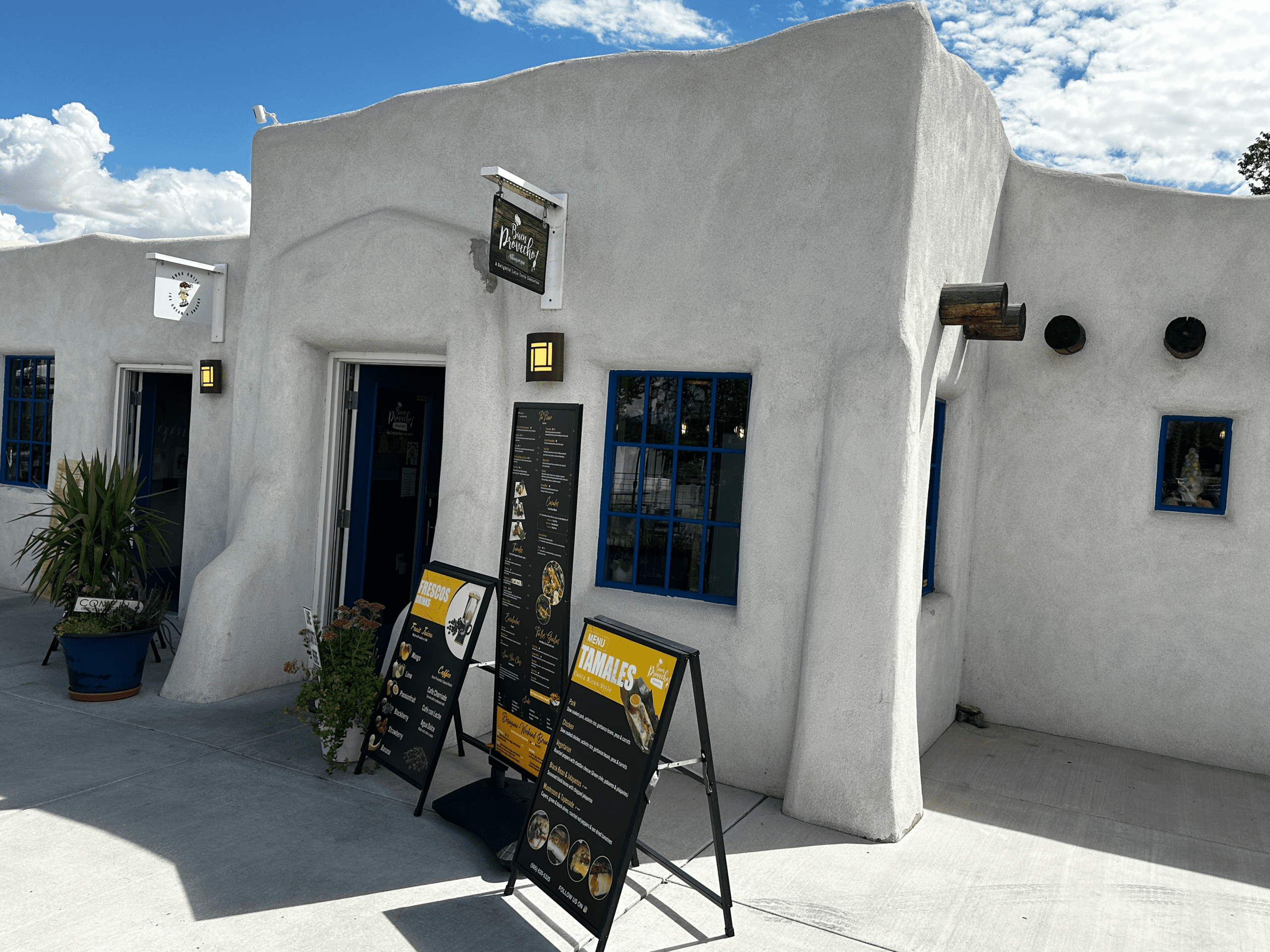
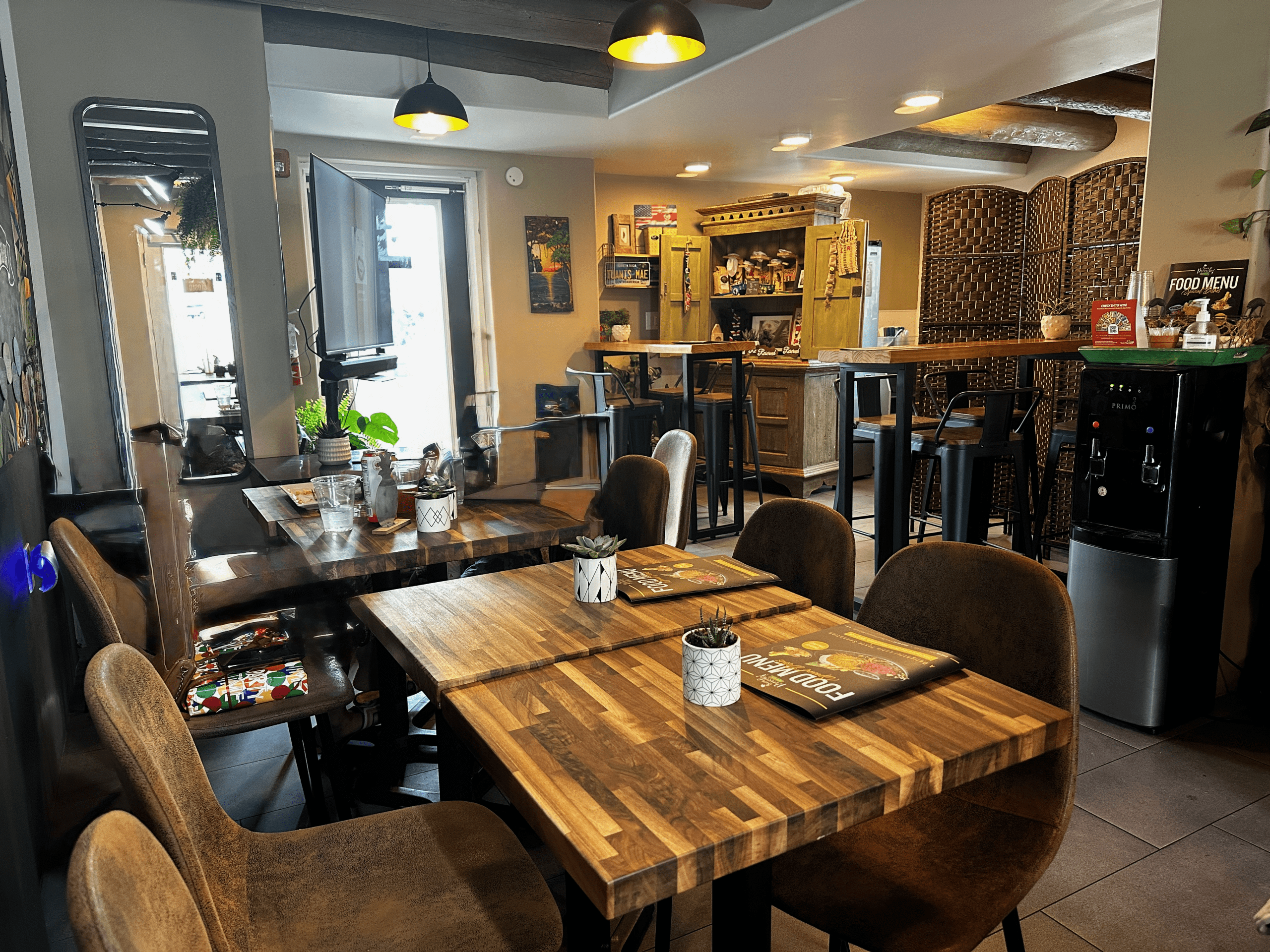
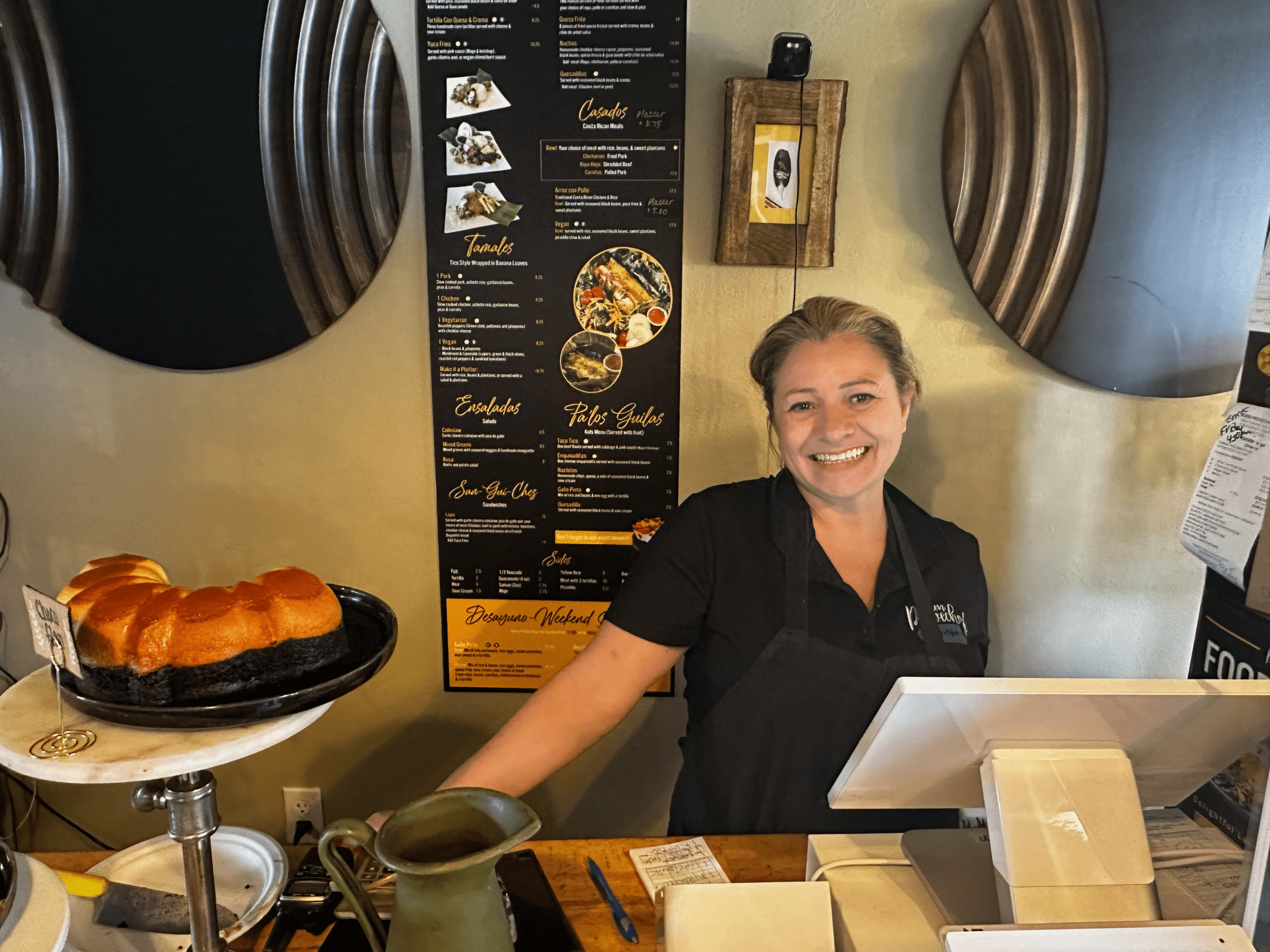
Buen Provecho occupies the largest pod on the complex, boasting of seating for several guests on two- and four-top tables. The term “Buen Provecho,” by the way translates from Spanish to “enjoy,” but as with “Pura Vida” it means so much more. It’s a polite expression which means “to wish someone enjoyment and well being from their meal.” It conveys a heartfelt desire that the food will not only be delicious, but nutritious and beneficial to the person eating it. It’s a customary way to display courtesy and good table manners when someone is about to eat, eat, or even walk by someone who is eating. The spirit of “buen provecho” is alive and well in the form of owner Kattia Rojas, a lovely woman with a broad smile and amicable nature.
In April, 2025, Kattia was named as one of ten semifinalists for the James Beard Foundation’s “Best Chef – Southwest” honor. It’s an accolade very few chefs obtain over the course of their entire careers. Predictably that honor brought with it an infusion of curiosity-seekers who might not otherwise have visited Buen Provecho or experienced Costa Rican cuisine. With only about one-hundred Costa Rican families in Albuquerque and about half that number in Santa Fe, diners heretofore unfamiliar with Costa Rican cuisine have become return customers. Our inaugural visit transpired at 3PM when the restaurant was devoid of guests. Appearances are deceiving. Maria, our server, told us Buen Provecho was “slammed” over lunch. Because El Vado’s food pods are subject to Albuquerque’s dissociative identity disorder weather, winters tend to be especially challenging. Fortunately, Buen Provecho has a thriving take-out and catering business.
If New Mexico’s ubiquitous winds haven’t knocked down the restaurant’s outdoor menu boards, you can study the menu before you enter, but our preference will now forever be stepping inside and chatting with Kattia. She’s got a smile that can chase away the darkest of days…and if her smile doesn’t accomplish that, the two cakes strategically positioned on the counter will. Kattia is a superb baker. She’s got more than thirty cakes in her repertoire. Those cakes would tempt Job. But first, something to drink. At Kattia’s recommendation, my Kim and I had frescos (sometimes called “batidos”), refreshing beverages made from fresh fruit and mixed with water or milk. Make it milk! Much like the batidos at Havana Restaurant, the frescos are several orders of magnitude superior to American milk shakes. Lime and mango frescos have none of that “artificially sweetened” flavor we dislike so much.
Irish playwright George Bernard Shaw may have intended his quip about “‘two countries divided by a common language” to be about England and the United States, but the phrase could well have been said about Spanish and it would include multiple Spanish-speaking countries. As I studied the menu, I noted several difference in the Spanish spoken in New Mexico and Costa Rican Spanish. Our server Maria, who’s originally from San Luis Potosi, Mexico has also seen those differences. For example, the menu lists appetizers as “Pa’Picar.” For both Maria and I, that term would translate to “to sting” as in by a bee. In the vernacular of Ticos, “pa picar” ‘means “to snack on or nibble small bites of food before a meal.”
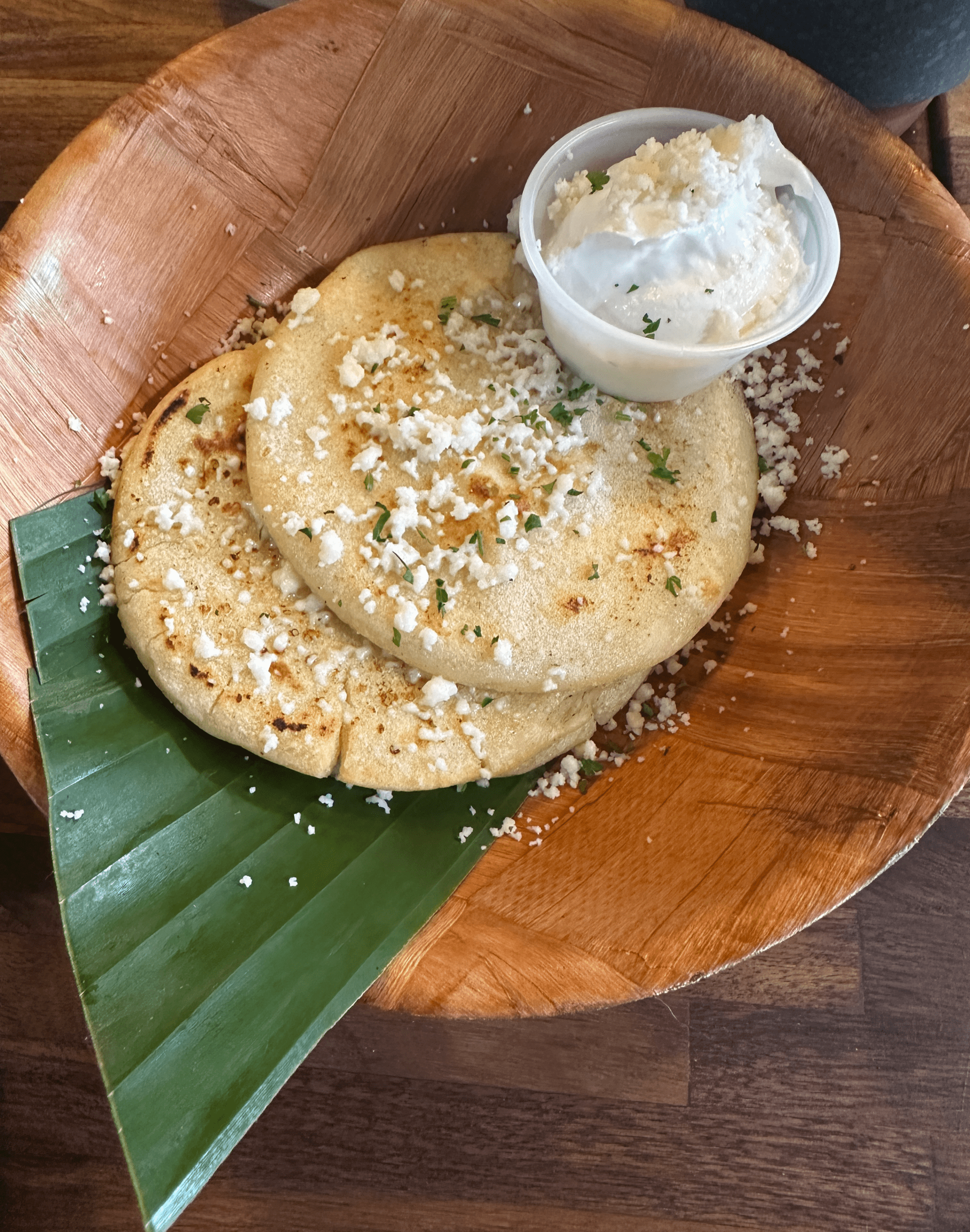
Ten items festoon the “pa’picar” section of the menu. Some–such as the beef and potato empanadas and nachos–may have a passing resemblance to their counterparts from other Latin American cuisines, but they’re uniquely Costa Rican. Not being nearly as adventurous an eater as her husband, my Kim wanted to start with tortillas con crema y queso (three handmade corn tortillas served with cheese and sour cream). Great choice! The tortillas are outstanding! They’re much thicker than Mexican corn tortillas, in fact more closely resembling pupusas. With a pronounced corn flavor, they’re a wonderful foil for the crema. This pa’picar item is testament that sometimes simple is best.
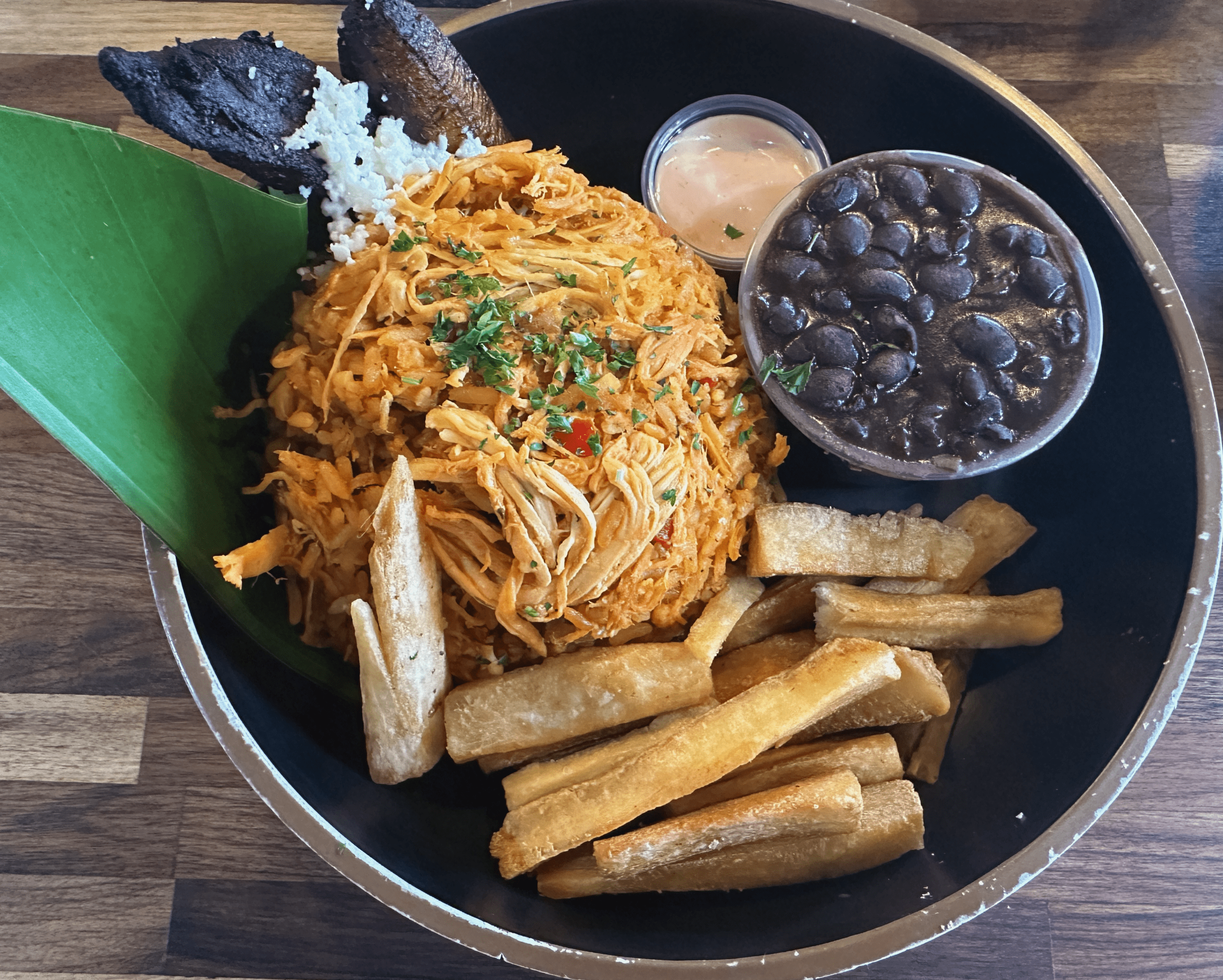
Maria and I shared a few laughs when I reminded her that “Casados,” the Costa Rican term for entrees has an entirely different meaning in Mexican and New Mexican Spanish. She knows the term to mean “married,” while New Mexicans may also know it to mean “hunted” (as in hunted deer). In Costa Rica, “casado” is a traditional and iconic entree composed of rice, beans, a protein (like chicken, beef, or fish), fried plantains, and a fresh salad or picadillo (sautéed vegetables) served on a single plate. My choice was arroz con pollo, a dish most Latin American cuisines have in common (though not necessarily in the way it’s prepared). Buen Provecho’s version of arroz con pollo is served with seasoned black beans, yucca fries and sweet plantains. The arroz con pollo is very flavorful, an amalgam of spices, vegetables, and tender chicken along with chicken broth, tomato paste, and a variety of spices. Rice was moist without being soupy. This rich and savory elixir is a cure-all for whatever ails you.
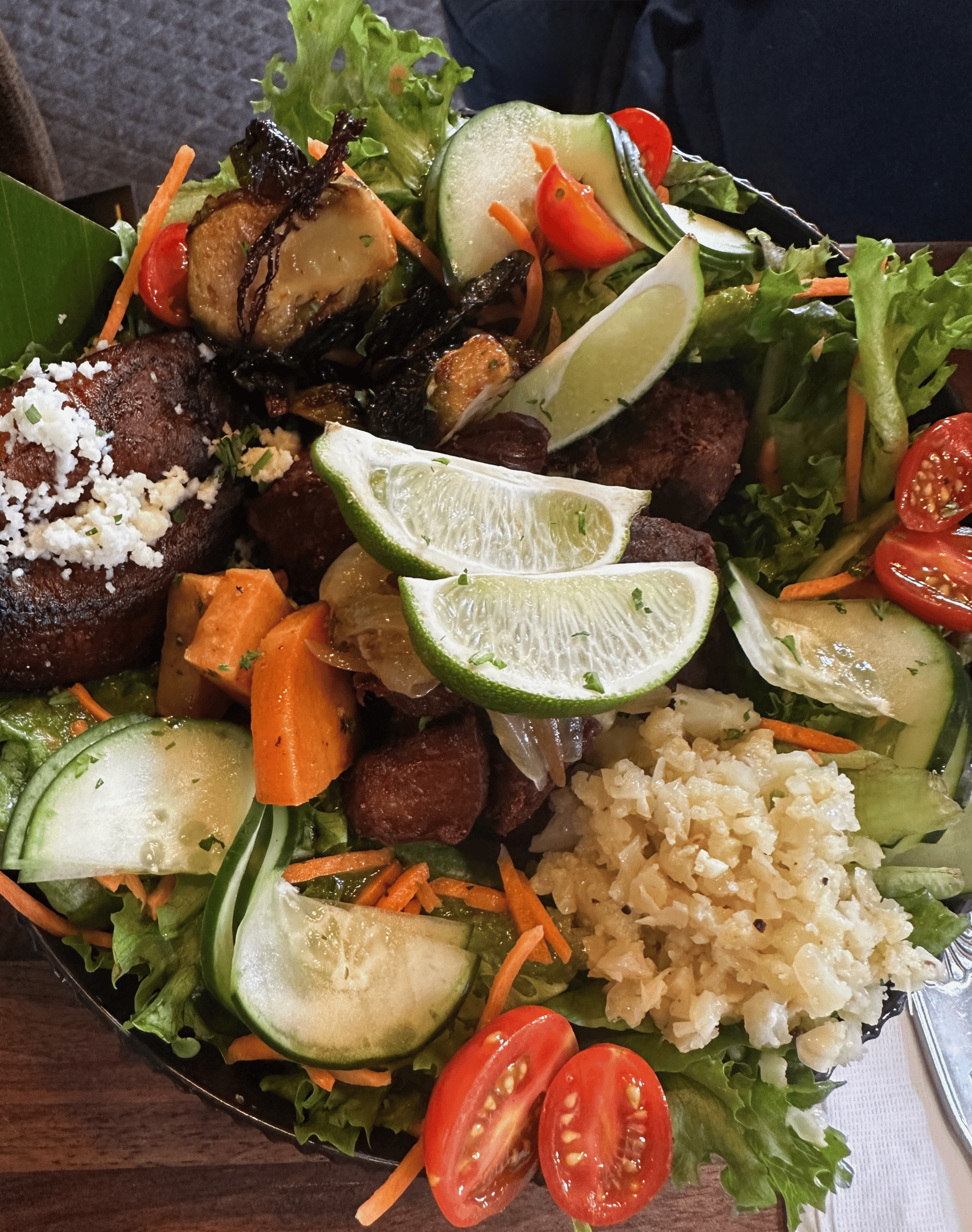
My Kim’s choice was the chicharron plate which came with beans and sweet plantains atop a bed of fresh greens. Normally this plate also includes rice, but my Kim opted for something else, a cauliflower dish that actually resembled rice. The chicharrones are chunky, biite-sized nuggets of porcine perfection. Unlike New Mexican chicharrones which are mostly fatty with traces of pork meat, these chicharrones are more meat than they are fatty. They’re crispy, crunchy and comparatively low in salt. The cauliflower was wonderful. Sometimes we forget it can be even when not covered in queso. This plate is available with ropa vieja (shredded beef) or carnitas (pulled pork). Maria related that a Cuban customer once asked for “ropa sucia” which translates to dirty clothes.
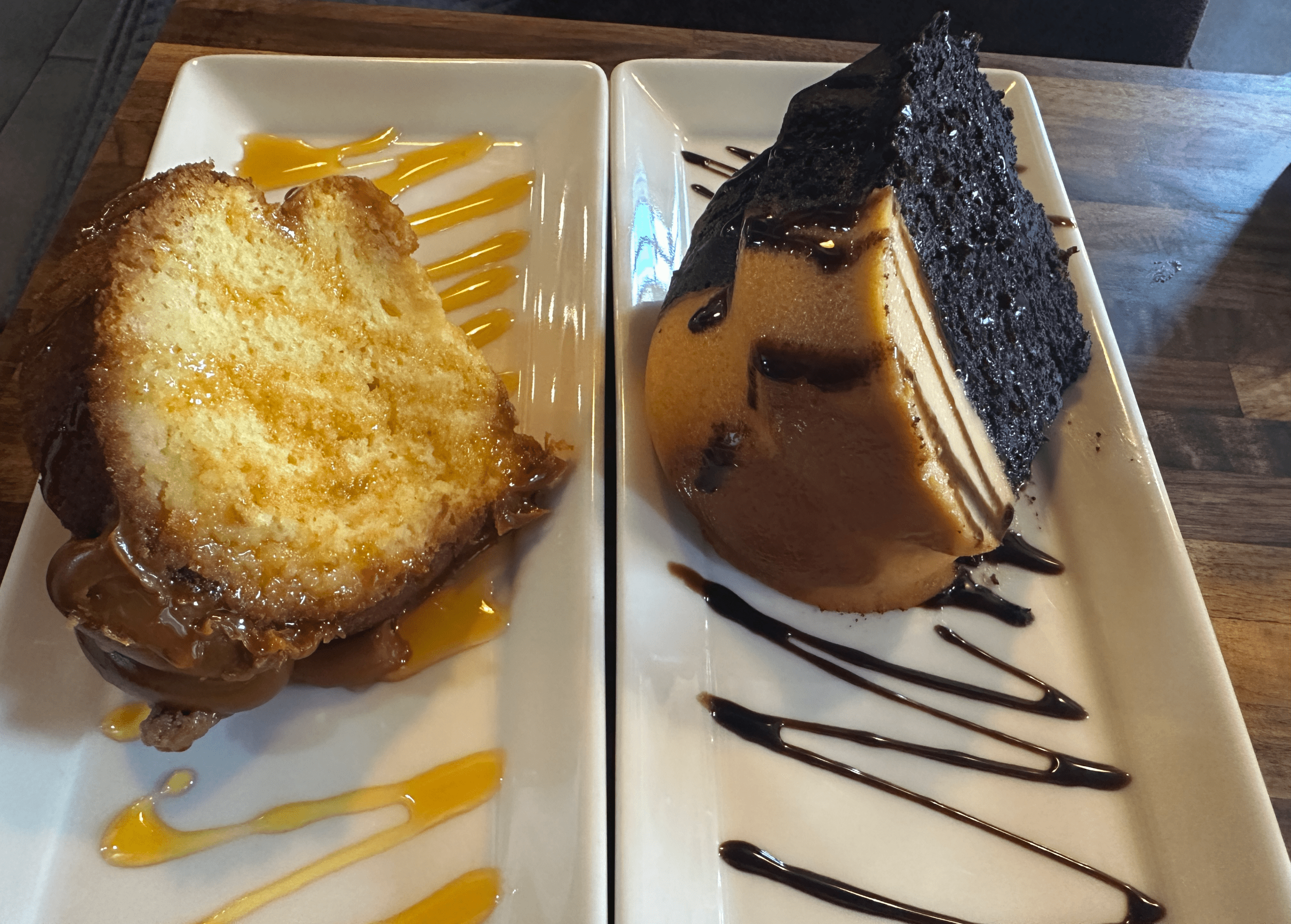
Knowing we both had a generous slice of cake awaiting us should have made us polish off our meals more quickly, but frankly we were enjoying our bounty so much that we savored slowly. The cake was certainly well worth waiting for. My clice was the rum and pecan cake, a very moist and very delicious slice drizzled with caramel. The alcohol content of the rum may have been burned off in the baking process, but the flavor of rum is strong and oh, so wonderful. My Kim’s chocoflan was equally formidable. The butterscotch flan layer was my favorite while my chocoholic bride enjoyed the rich, moist chocolate and the chocolate drizzle. If these two cakes are indicative of Kattya’s baking skills, you should plan on a visit to Buen Provecho soon.
Buen Provecho is a real find. I”m surprised it took us seven years to make it to this outstanding Costa Rican treasure which all my Tico friends would have said was “Pura Vida.”
Buen Provecho
2500 Central Avenue, S. W. #3,
Albuquerque, New Mexico
(505) 620-5325
Website | Facebook Page
LATEST VISIT: 5 September 2025
# OF VISITS: 1
RATING: N/R
COST: $$
BEST BET: Arroz Con Pollo Plate, Chicharron Plate, Tortillas Con Queso Y Crema, Rum and Pecan Cake, Chocoflan Cake, Lime
REVIEW #1487
They have two locations. The one on Central and Buen Provecho Barelas @ 1407 4th St SW.
Buen Provecho launched its second instantiation in late January, 2026. It’s located at 1407 4th, S.W., Suite A., about 400 feet from the famous Barelas Coffee House.
What a find indeed, Gil! This is a delightful place with lovely people and great food. It doesn’t get any better than that when you go out to eat. Today on my inaugural visit with some friends we sampled the empanadas, chicken tamales and arroz con pollo. We selected our desserts when we placed our food order. After paying, our hostess asked if we wanted forks right now to start sampling the cakes we selected and what could I say except, yes!! Our treats were a chocolate flan and mango coconut. I appreciated the fact that they weren’t overwhelmingly sweet. Just tasty. I first had empanadas in another lifetime made by a South American woman. I have never, ever encountered anything like what she made until today. Buen Provecho’s empanadas are stuffed with beef and potato in a crispy fried wrapper and served with a mildly spiced pico. Fabulous. Tamales were given two thumbs up (and looked like manna from heaven) and I have nothing but good things to say about my arroz con pollo. I’m not a big rice fan in general but I have to say that Kim missed out on a good one. Whatever rice this was with whatever spices they used made it very moist and flavorful and delicious. Have I mentioned their hospitality yet? Warm, welcoming and accommodating. I even felt like we were in Costa Rica because all the staff and several of the customers were speaking Spanish. The employees speak perfect English, don’t get me wrong, but their preferred method of communication with each other was Spanish. Just added to the ambience! This is going back on my list as a can’t wait to do another visit. Tamales next time, and I did have my eye on that rum pecan cake that you chose, Gil. 😋
I’m so happy you enjoyed Buen Provecho so much. Kattia is indeed the consummate host–so kind and gracious. Her desserts are phenomenal, some of the very best in Albuquerque (and they’re all calorie-free).