Spinn’s Burger & Beer – Albuquerque, New Mexico

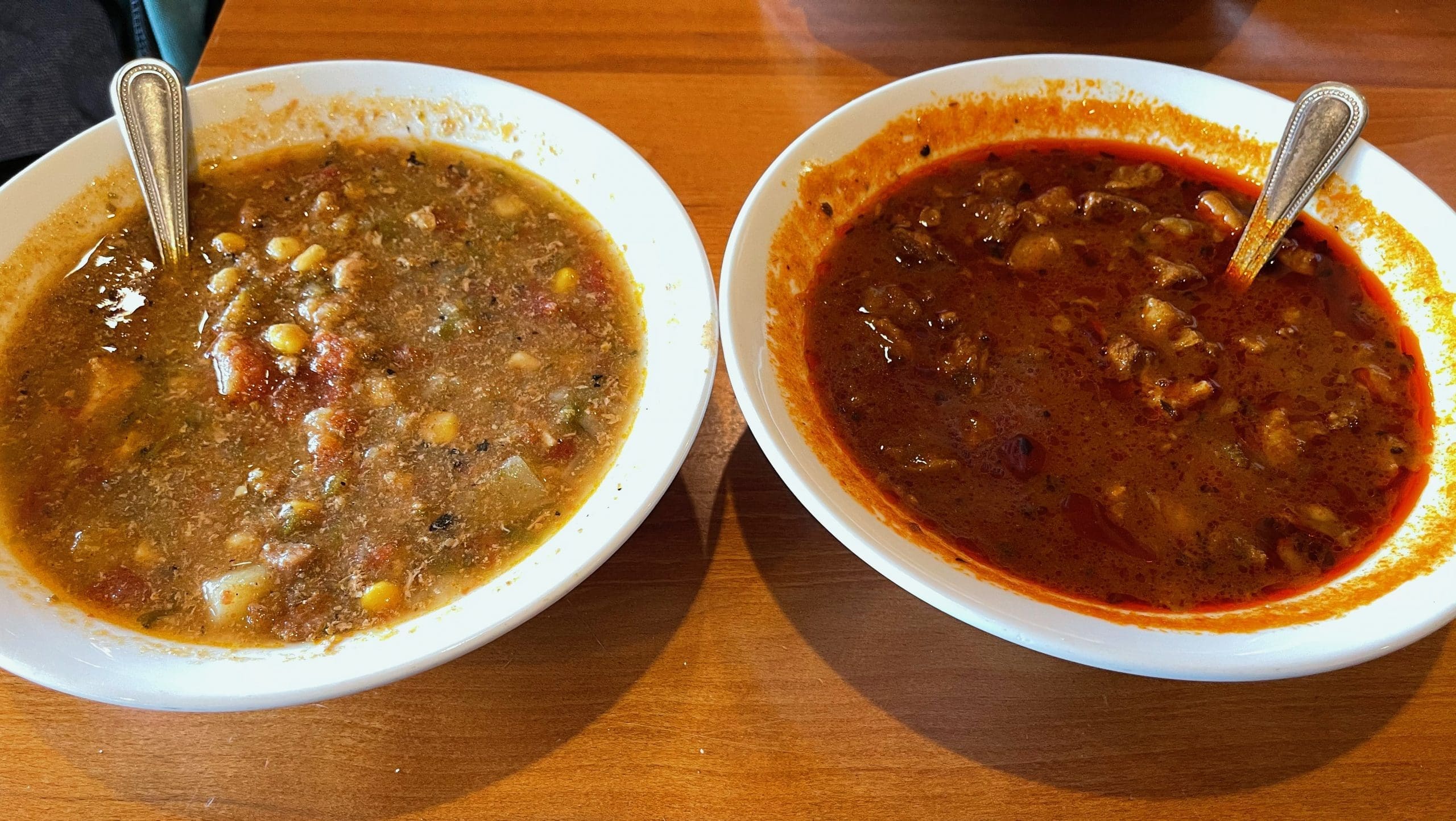
Like him or not, few would disagree that former New Mexico Senator Pete Domenici was one of the most effective legislators on either side of the aisle. Since his election to the United States Senate in 1972, “Saint Pete” as he is known by admirers and critics alike effectively directed the appropriation of significant federal largesse upon the Land of Enchantment. For many native New Mexicans, one of his shining moments came in 1983. During a debate about the spelling of the word (chili or chile), Domenici clarified for the Congressional record that “chili” is “that inedible mixture of watery tomato soup, dried gristle, half-cooked kidney beans, and a myriad of silly ingredients that is passed off as food in Texas and Oklahoma.” Motivated by Dominici’s impassioned plea, on November 14, 1983 the Albuquerque Journal declared “The I’s of Texas are no longer on us. ‘Chili is dead. The only time we will use “i” will be when we quote the written word of some Texan.” Not to be outdone, in January, 1988 a bipartisan bill was introduced in the New Mexico State Legislature threatening that any New Mexican who misspells “chile” as “chili will automatically be deported to Texas.…

Indian Pueblo Kitchen – Albuquerque, New Mexico

>Pedro de Castaneda, a Spanish explorer who chronicled Coronado’s expeditions through the southwest from 1540 to 1542 observed that corn, beans, and squash were the main staples of the pueblo diet. Of the three, which have come to be known as “Three Sisters,” corn was the most important. It was boiled whole, toasted on the cob, or dried and ground into a fine powder easily cooked as bread or gruel.  Every day female family members knelt before metates (grinding stones), grinding corn to feed their gods, fetishes and kin. One crushed the maize, the next ground it and the third ground it even finer. Castaneda observed that the women worked joyfully at this task.  The three sisters of corn, beans and squash remain an integral part of the pueblo diet. Think “pueblo harvest” and the first image the term evokes is likely of the classical “horn of plenty” motif depicting a bountiful cornucopia in which corn, beans and squash spill out of a goat’s horn.  This rich symbolism of pueblo life also represents the cuisine at the Indian Pueblo Kitchen (formerly known as Pueblo Harvest), a restaurant which celebrates the culinary traditions of New Mexico’s nineteen Indian pueblos and showcases…