L&L Hawaiian Barbeque – Rio Rancho, New Mexico

It’s amusing to reflect back on what children of my generation considered funny during the prehistoric days before Nintendo, iPhones and even before color television.  As children were apt to do, we found humor in terms related to scatalogical and bodily functions such as caca, poo poo, pee pee and moco.  The latter is the Spanish term for booger.  Our reaction to learning that Hawaiians actually ate “loco moco” (which translates from Spanish to  “crazy boogers”)  would have beeen simultaneously raucous and nauseating.  Sure, most of us grew up eating chicharrones, menudo and morsillas, but only a crazy person would admit to eating boogers. Hawaiians do indeed eat loco moco, but it has nothing to do with boogers, crazy or sane.  Loco moco is a contemporary (circa 1949) and simple Hawaiian dish consisting of rice, a hamburger patty, and an egg smothered in a savory gravy.  As to the genesis of the name, the loco moco was named for a Hawaiian boy nicknamed “Loco.”  “Moco” was added simply because it rhymed and sounded mellifluous.  During my perigrinations across the country, I’ve had loco moco a number of times.  Though palatable enough, it never struck me as particularly memorable.  “If only,”…

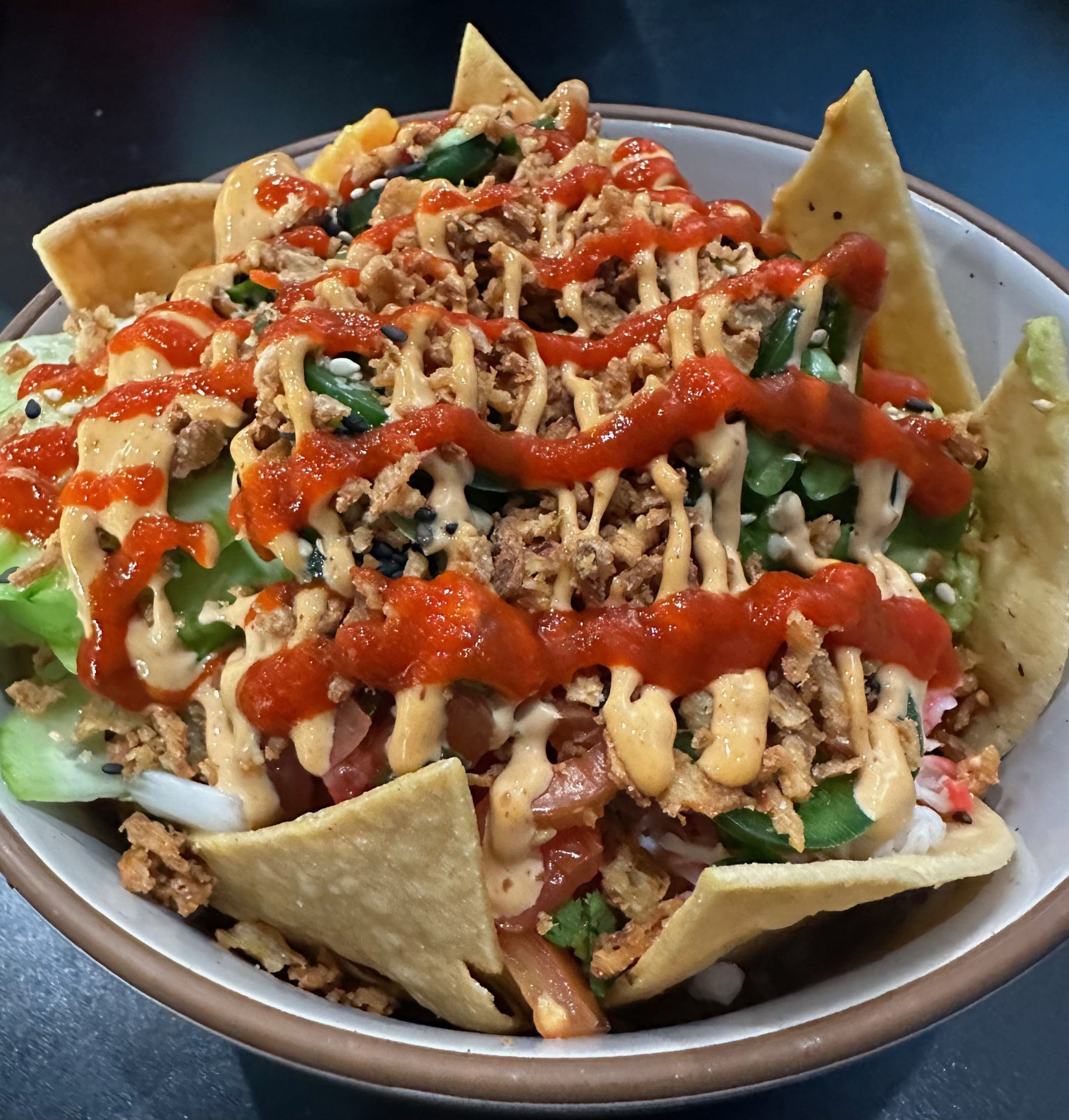
Poké Serrano Asian-Latin Fusion – Rio Rancho, New Mexico (CLOSED)

Ask most people what comes to mind when they think about Hawaiian food and the likely answer is Spam®.  No matter how much the Aloha State’s tourism department does to showcase the state’s diverse and exciting culinary culture, the stereotype that Hawaiians eat Spam® for breakfast, lunch, dinner and snacks in between meals is engrained in many of us.  Because Hawaiians do consume seven-million cans of  Spam® per year (with a population of 1.42 million residents in the Islands), it begs the question “Is it really a stereotype if facts bear out the fact that Spam® is so immensely popular in Hawaii.” Not everyone who spends time on the sandy beaches is as svelte as portrayed by media.  Widespread obesity plagues the Islands.  Some of that may be attributable to the quintessential canned ham product proudly made in Minnesota, a processed food  replete with salt and other “bad for you” things. Spam® became a vital part of the Hawaiian diet during World War II when rationing was a fat of life for its citizenry.  Hawiians figured out how to incorporate Spam® into their diet and figured out it’s a pretty versatile product.  Note: If you’re from Northern New Mexico and…