Village Pizza – Corrales, New Mexico

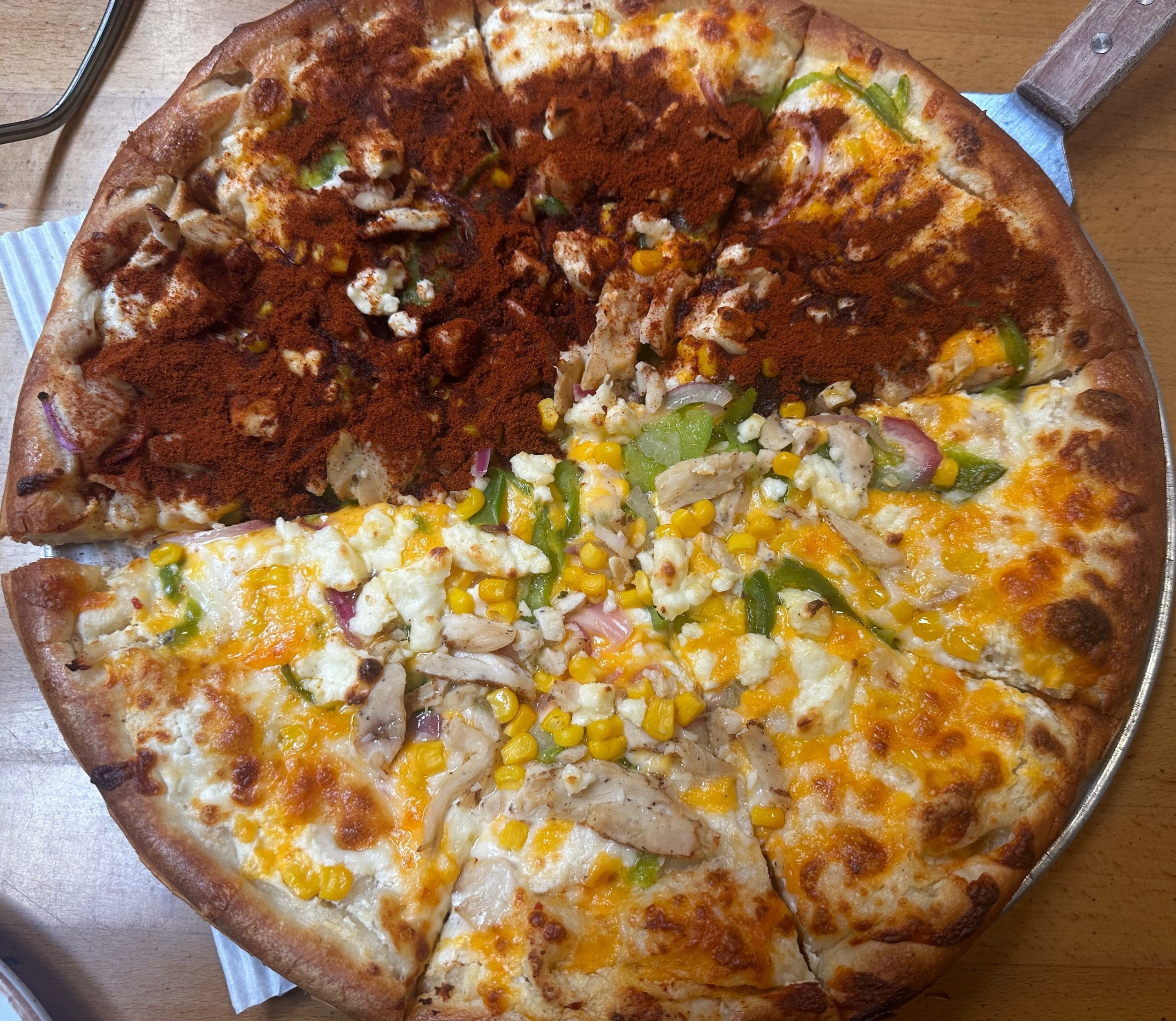
Research has proven that taste buds are dulled by high altitude and cabin pressure, so as an aircraft climbs, our sense of taste diminishes by as much as 30 percent. That explains why many passengers praise airline food on flights in which meals are actually served. It’s probably not that the food is good; it’s more likely that their sense of taste is diminished. Alas, it’s not solely high altitude and cabin pressure which can diminish the sense of taste. On this blog I’ve catalogued some of those factors: the use of spices (i.e., cumin) that mask the purity, earthiness and richness of red chile; the use of inferior ingredients that can’t mask the lack of quality; the impairing effects of alcohol on the senses of smell and taste; improper preparation time and so forth. One factor I have not touched upon is “too much of a good thing.” At Village Pizza, the pizza buffet  (discontinued since the Cabrona Virus) was so inviting, so tempting, so alluring that you were bound to consume more than you should. In all its glory and splendor, the pizza buffet was as enticing as the sirens of Greek mythology who lured nearby sailors with…

El Camino Dining Room – Los Ranchos de Albuquerque, New Mexico

Many of us who predate, however slightly, the explosion of institutionalized fast food retain a fondness for the remaining independent family restaurants whose arsenal in the competition for hungry diners consists of reasonable portions of great meals at budget-conscious prices all served by a friendly and accommodating waitsfaff. An Albuquerque restaurant which epitomizes those ideals is the El Camino Dining Room, captured brilliantly above by the fabulous photographer Deanna Nichols. The El Camino was built by Clyde H. Tyler in 1950, five years after the latest “war to end all wars” and 13 years after Route 66 was “straightened” so that it would bypass Santa Fe completely.  Albuquerque was much more innocent back then.  Some might even describe it as a “cow town trying to be a city.”  At the time, 44% of America’s population resided in rural areas and the Duke City’s population was only 96,800. Despite no longer being part of Route 66, one of the city’s busiest thoroughfares was 4th Street on which commerce was burgeoning.  It was the perfect location for an independent family restaurant, far from the cavalcade of Howard Johnson’s type restaurants which grew along the interstates. Similar to Howard Johnson’s which prided itself…