La Posta De Mesilla – Mesilla, New Mexico

If only walls could talk, you’d want the adobe brick walls at La Posta (The Inn) to recount their impressions of the veritable “who’s who” of Western history who once sought shelter within its fortified walls.  You’d want those walls to reveal their thoughts of legendary outlaw Billy the Kid who hung out at La Posta on his road to notoriety.  You’d want those walls to tell you about the steely presence of General Douglas MacArthur, who commanded Allied forces in the Pacific Theater during World War II. You’d want those walls to share their account of Generalissimo Pancho Villa, another sojourner who sought shelter at La Posta.  Certainly no raconteur could provide the details known only to the walls at La Posta when it quartered controversial frontiersman Kit Carson or for then General, later President, Ulysses S. Grant. Built in the 1840s by Sam and Roy Bean, themselves  historical luminaries, La Posta was originally a freight and passenger service.  After the Civil War, it became part of the Butterfield Stagecoach line which ferried passengers and mail from eastern outposts in Memphis and St. Louis to California.  During the 1870s and 1880s, the sprawling edifice was home to the Corn…

Los Ojos – Jemez Springs, New Mexico

Shortly after the Civil War, General William Tecumseh Sherman had the occasion to conduct an inspection trip of frontier outposts in the southwest.  He wasn’t impressed by what he saw in New Mexico, writing in a report that “We should have another war with Mexico and force them to take the Territory (New Mexico) back!”  As an unabashedly proud native New Mexican, it’s hard for me to comprehend that anyone couldn’t see the incomparable beauty of the Land of Enchantment which to me is obvious everywhere I turn. Were I able to go back to General Sherman’s time, there are so many sights I would like to show him that would certainly change his unflattering perception.  Near the top of that list is New Mexico’s Route 4, the magnificent two-lane highway which forms the main artery of the Jemez Mountain Trail National Scenic Byway.  Route 4 follows the braided, narrow path of the murky Jemez River which slices through lush wilderness, storied Spanish and Native American pueblos and colossal canyons reaching to the clear, cobalt skies.  The canyon walls are stratified in deep earthy hues while the color of the river changes from chocolate brown to a brilliant red found…

MARY & TITO’S CAFE – Albuquerque, New Mexico

Old-timers whose opinions I respect consistently rate Mary & Tito’s as Albuquerque’s best restaurant for New Mexican food, a restaurant that has been pleasing the most savvy and indoctrinated palates alike since 1963. It takes a lot to impress some of those old-timers, none of whom see much substance in the flash and panache of the nouveau restaurants and their pristine veneer and effusive, over-the-top flamboyance. These guys and gals are impressed only by New Mexican food the way their abuelitas prepared it–unadorned, authentic and absolutely wonderful. If you want to evoke their ire, take them to one of the chains. Worse, try sneaking some cumin into their chile. Just how good is Mary & Tito’s? In a span of two days, three people whose opinion on food I value weighed in, prompting me to ponder that question and not just take for granted that it’s “one of” the very best restaurants in New Mexico.” World-travelers Randy and Bonnie Lake experienced an epiphany during their most recent visit, marveling at just how much better Mary & Tito’s legendary red is than other red chile they’ve ever had. Bill Resnik who’s authored a cookbook on New Mexican cuisine was more to-the-point,…

Chope’s – La Mesa, New Mexico

During my Kim’s inaugural visit shortly after we retired from the Air Force in 1995, we ran into a former Las Cruces resident now living in the nation’s capital. His near teary-eyed testimony about how much he missed Chope’s was more powerful than a Sunday sermon.   When he kissed the hallowed ground in front of Chope’s, we knew he meant it.  An elderly gentleman recounted the time Chope’s salsa was so hot it made him hiccup for three days.  A middle-aged woman from Las Cruces rhapsodized about Chope’s chile rellenos, her testimony practically eliciting involuntary salivation in the impromptu audience of queued patrons.  Chope’s has had a similar effect on most its guests for six generations. Perhaps the consummate mom-and-pop operation, Chope’s had the most humble of beginnings.  Nearly a century ago,–1915 to be precise–Longina Benavides began selling enchiladas to her neighbors in the farming community of La Mesa.  A   kerosene lantern hanging outside the front door of the circa 1850s family home signaled the availability of  enchiladas just off the stove.  When Longina’s son Jose inherited the home, he and his wife Lupe continued the family tradition of feeding their neighbors.  They named the family business “Chope’s,” the…

The Mine Shaft Tavern – Madrid, New Mexico

“You load sixteen tons and what do you get? Another day older and deeper in debt. St. Peter, don’t you call me cause I can’t go. I owe my soul to the company store.” Those immortal lyrics, hauntingly performed by crooner Tennessee Ernie Ford describe with a poignant reality, the plight of the American miner even onto the 20th century. By payday, which came at month’s end, miners did indeed owe their souls to the company–for the company house in which they were living, for groceries to feed their families, for doctor bills and even for the tools they used to mine. They were paid in scrip which could only be spent at the company store, leaving them no choice but to buy from the companies. Despicably, this allowed the company to gouge the miners with vastly over-inflated prices, leaving miners with families inextricably in debt to the company. When they got paid at month’s end, any money left after settling their debts to the company was insufficient to last through the following month. This vicious cycle was perpetuated the following month when miners again had to pay the company first and were lucky to have anything left for their…

Buckhorn Saloon – Pinos Altos, New Mexico

In 1859, 49ers returning home from California discovered gold among the tall pines (Pinos Altos) north of Silver City. Word spread like wildfire.  In short order, there were more than 700 men prospecting in the area. As with other boom towns, rampant lawlessness made prospectors lives exciting to say the least.  Miners faced an anything goes attitude in the pursuit of gold punctuated by frequent raids by marauding Apaches.  In the “Apache War” of 1861, Cochise joined his father-in-law Mangas Coloradas (an Apache war leader who towered at 6’7″) and some 400 Apache warriors to drive away miners from their traditional homeland. In its early days Pinos Altos saw a veritable who’s who of fame and infamy.   In the 1860s, Old West legend Roy Bean operated a mercantile in Pinos Altos before moving to West Texas to gain fame as Judge Roy Bean “The Law West of the Pecos.” Henry McCarty (William Bonney was just an alias), the infamous Billy the Kid, began his life of crime in the area.  As the area’s gold began to deplete, families turned to ranching.  Some of the largest ranches in the country once were located just outside of town.  Evidence of ranching…

Western View Diner & Steakhouse – Albuquerque, New Mexico

Since the 1930s, neon signage has been a prominent and vital part of Route 66 as it meanders through Albuquerque. From the foothills of the Sandias in the east to the parched desert expanse of the west, Route 66 is festooned with vibrant neon signage that cuts a luminous swath through the city. The nocturnal spectacle of glowing neon might be the siren’s call that has drawn generations of “cruisers” to Central Avenue. One of Albuquerque’s most prominent neon spangled signs celebrates Route 66 as it spans across all four lanes of Central Avenue near its intersection with Coors Boulevard Southwest. Literally at the shadow of that span is the Western View Diner & Steakhouse which has been pleasing weary travelers and hungry locals since 1937 thanks to generous portions of reasonably priced and delicious comfort food with a homemade taste that comes from years of plying its culinary craft. To say the Western View Diner & Steakhouse was at Albuquerque’s western fringes back when it launched seven decades ago is an understatement. Aside from sagebrush and vast expanses of horizon, there wasn’t much in the city this far west. The Western View is one of the very few surviving…

Duran’s Central Pharmacy – Albuquerque, New Mexico

In an early episode of the Andy Griffith Show, while contemplating a job offer in South America, Andy tried to assuage his son Opie’s concerns about leaving Mayberry. Instead, he wound up confusing Opie by explaining that people in South America ate something called tortillas. Opie wondered aloud why anyone would eat spiders (tarantulas). Had Opie ever tasted the delicious, piping hot, just off the comal 10-inch buttered orbs at Duran’s Central Pharmacy, it’s unlikely he would ever confuse those grilled spheres with any arachnid. That’s because Duran’s features some of the very best tortillas of any restaurant in New Mexico. These are not the flavorless, paper-thin, production-line, machine-fashioned orbs you find at some restaurants (can you say Frontier Restaurant). Duran’s tortillas are made to order on a real comal and shaped by skilled practitioners using a well-practiced rolling pin. It’s the way abuelitas in New Mexico have done it for generations, a time-honored tradition Duran’s honors–with one exception. No lard is used on these tortillas; they’re strictly vegetarian. You can tell and appreciate the difference. In its annual Food & Wine issue for 2012, Albuquerque The Magazine awarded Duran Central Pharmacy a Hot Plate Award signifying the selection of…

Circle T Burgers – Belen, New Mexico

The year was 1958.  The average American wage-owner’s income was $4,650 per year.  A Ford automobile cost between $1,967 and $3,929.  Milk was $1.01 per gallon.  Bread cost 19 cents a loaf and a can of Chef Boyardee spaghetti went for 19 cents a can.  First class US postage was raised to 4 cents after having held at 3 cents for more than a quarter-century.  A gallon of gasoline cost 24 cents. In 1958, the United States had two-thirds of the world’s 47-million television sets and many of them were tuned in to Gunsmoke, Father Knows Best, Dinah Shore and The Jack Benny Show.  France gave the world the disposable Bic pen (which very few people under 20 have even heard of today).  Corningware dishes, the hula hoop and stereo records were introduced.  To pay for this copious consumerism, American Express introduced the first credit card. The “King” Elvis Prestley was inducted into the United States Army. Prince, Andy Gibb, Madonna and Michael Jackson were born. In the world of sports, Pele scored two goals to lead Brazil to victory at the 1958 World Cup.  Wilt Chamberlain left the University of Kansas to play with the Harlem Globetrotters.  Ohio State…

NOPALITO RESTAURANT – Las Cruces, New Mexico

Growing up in rural Northern New Mexico, my siblings and I thought all Mexican food was the same–the way my mom, grandmothers and aunts prepared it (which is to say it was outstanding).  At the time New Mexicans hadn’t universally acknowledged that the genesis of our cuisine wasn’t solely Mexico.  Back then, only the most savvy culinary historians were crediting Spanish and Native ingredients and preparation techniques as differentiating factors that made New Mexican cuisine unique.  It also wasn’t that long ago New Mexicans were spelling our official state vegetable as “chili.”   No, that’s not an episode of the Twilight Zone.  It’s the way it was just a few decades ago when all three of  my sisters matriculated at New Mexico State University. We didn’t know what to think when they’d return home on long weekends and holidays and prepared these strange and different “Mexican” dishes.  Sour cream enchiladas?   Con queso made with muenster cheese?  Green chile salsa?  Rolled enchiladas?  Gorditas?  Those “Mexican” restaurants in Las Cruces were either revolutionizing Mexican food or they didn’t know what they were doing.  It didn’t take long before we all embraced these new dishes and looked forward to sampling other delights from…

The Owl Cafe & Bar – San Antonio, New Mexico

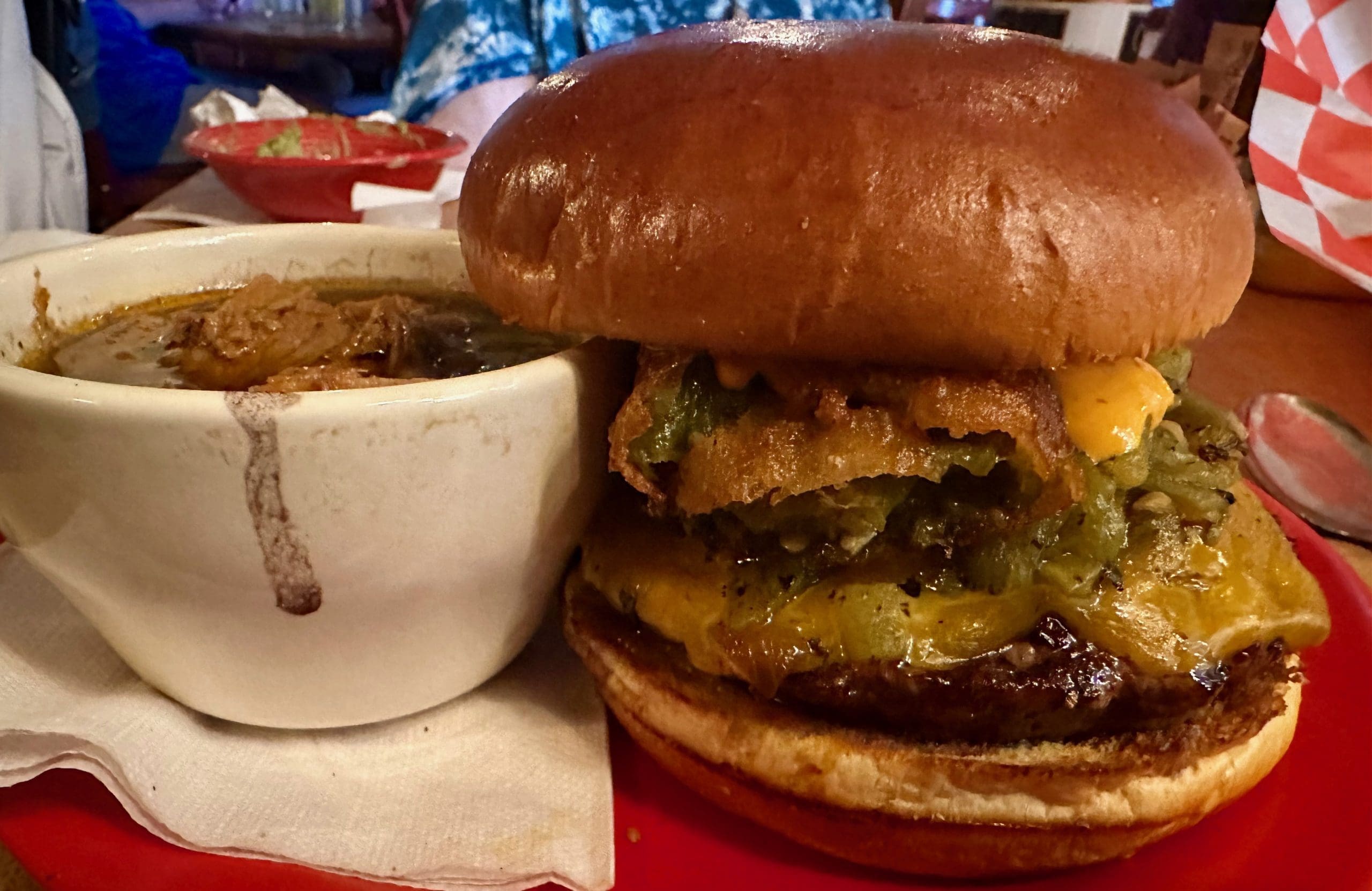
25 February 2023: Over the past twelve years, the Owl Cafe in San Antonio, New Mexico has been one of the three most frequently launched reviews on Gil’s Thrilling (And Filling) Blog, ranking behind only Mary & Tito’s and the Buckhorn Tavern as the third most frequently launched review of all time. What accounts for the Owl’s popularity? It truly is a timeless institution beloved for its consistently excellent burgers. San Antonio may be but a blip on the map, but its storied and pioneering history make this sparsely populated agricultural community arguably one of New Mexico’s most important towns.In 1629, San Antonio was the site on which Franciscan friars planted the first vineyard (for sacramental wine) in New Mexico (in defiance of Spanish law prohibiting the growing of grapes for wine in the new world.) San Antonio was the birthplace of Conrad Hilton, founder of the ubiquitous Hilton Hotels and more importantly, one of New Mexico’s original legislators after statehood was granted in 1912. San Antonio was also the gateway to the Trinity Site in which the first atomic bomb was detonated in 1945. While these events are historically significant, they are also inextricably bound by one common element–the uncommonly ordinary facade…