Original Hamburger Works – Phoenix, Arizona

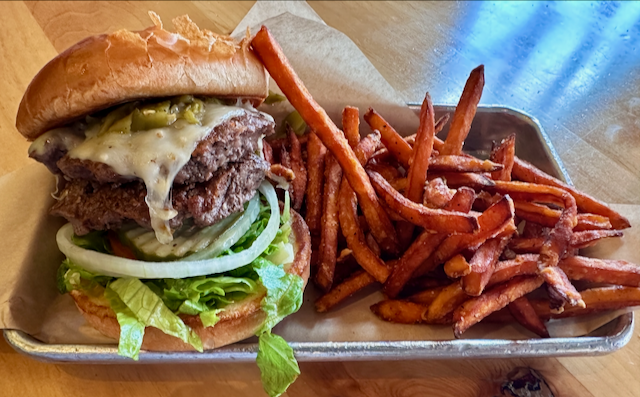
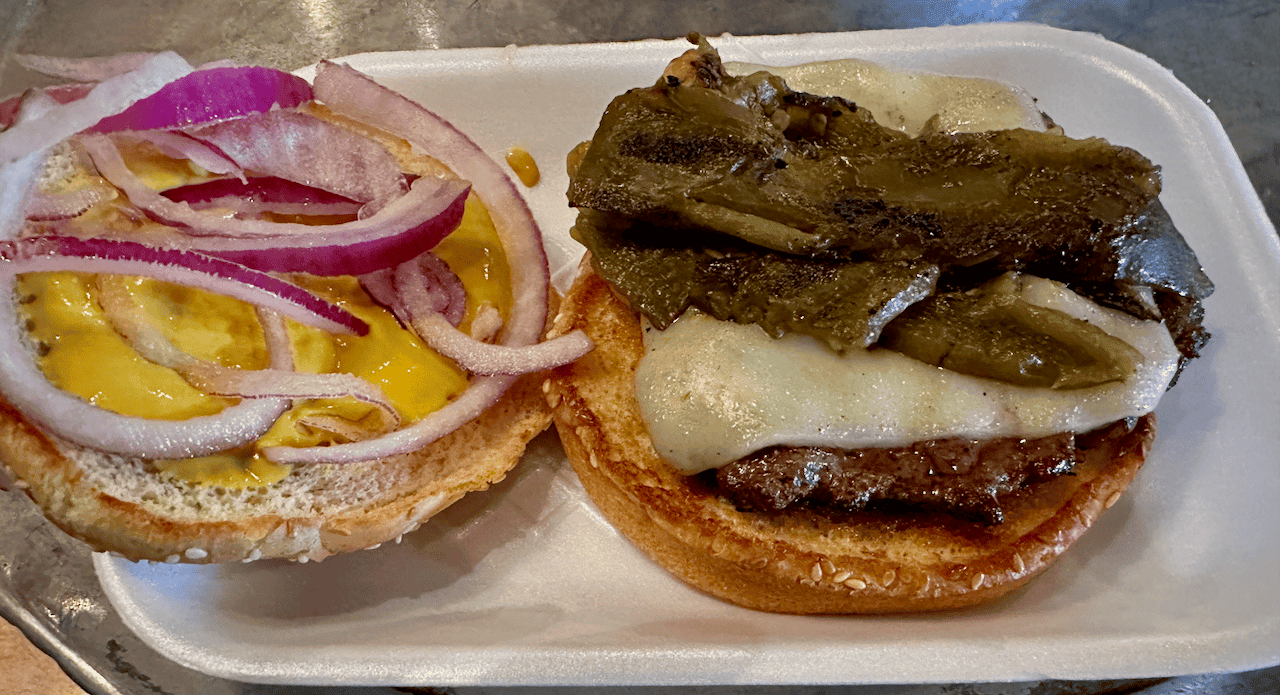
“When in Phoenix, do as Phoenicians do.”  If that means staying in air conditioned confines during the summer, we’re doing it.  If that means sticking with local culinary fare, not so much.  Blame that on “Only in Arizona,” a travel and lifestyle publication from the good folks who bring us “Only In Your State.”  A recent edition of Only in Arizona celebrated a “Phoenix Burger Joint” that “Has Cooked Over Real Mesquite for 40 Years.”  As if mesquite grilled burgers aren’t enticing enough, the article boldly declared “The green chile cheeseburger, with jalapeño cheese and a grilled green chile on top, is the one that converts first-timers into regulars.   Hmm, a green chile cheeseburger in Arizona that might actually be pretty good; it just hasn’t been my experience. Admittedly, I’ve only had fewer than a handful of green chile cheeseburgers in the Grand Canyon State.  Any memorability they have can be attributed to how mediocre (or worse) they’ve been.  Arizona would never be able to entice savvy staycators and Hatch familiar visitors to the “Arizona Green Chile Cheeseburger Trail.”  That doesn’t mean they shouldn’t try.  They might first want to spend some time on New Mexico’s trail to see how…

Grassburger – Albuquerque, New Mexico

For nearly a decade, television viewers have been subjected to a very successful advertising campaign depicting contented cows talking and singing about the pleasures of life in sunny and warm California. The slogan for the “happy cows” campaign’ is “Great cheese comes from happy cows. Happy cows come from California.” The campaign would have you believe the cows are happy because they feast and frolic on a diet of delicious grass from verdant hillsides and not on troughs full of grains which don’t taste quite as good. I don’t know about cows being happier because they graze on grass, but can certainly attest to being a happier diner when enjoying a diet of grass-fed beef. Generations of New Mexicans, particularly from the more verdurous northern villages, find the notion of grain-fed cattle heretical. All our cows are grass-fed thanks to open-range grazing laws which allow carefree cows to traipse up and down the streets in search of unfenced (or poorly fenced) yards in which the grass does appear to be greener. In the late spring when mountain snows have started to melt, many ranchers herd their cattle into the mountains where meadowlands near the timberline are abundant. In fall when…

Mick’s Chile Fix – Albuquerque, New Mexico

Addicts are all too familiar with the symptoms, especially the insatiable cravings that can only be quelled by a fix. There’s nothing like the high you get from the addictive mistress that is New Mexican chile. That’s why we willingly singe our tongues and scald our taste buds to get that fix. What gives chile its intense fire and creates the need for a fix is a chemical called capsaicin, a natural ingredient that stimulates the mouth’s nerve endings, causing a burning sensation. In response to this burning sensation, the brain releases endorphins, natural painkillers that may produce a temporary “high.” So, the more of a fiery chile you eat, the stronger the soothing effect. Even though chile isn’t medically addictive, some chile lovers may be hooked on the high they get…just ask anyone in New Mexico who loves the stuff. Better still, ask a chile addict who no longer lives in New Mexico and can’t get the stuff everyday. The withdrawal is painful. In dreams they are plagued by the unrequited yearning which can be fulfilled only by a satisfying bowl of red or green. They wake to drool soaked and chewed up pillows. New Mexicans are fortunate indeed…

Duran’s Central Pharmacy – Albuquerque, New Mexico

In an early episode of the Andy Griffith Show, while contemplating a job offer in South America, Andy tried to assuage his son Opie’s concerns about leaving Mayberry. Instead, he wound up confusing Opie by explaining that people in South America ate something called tortillas. Opie wondered aloud why anyone would eat spiders (tarantulas). Had Opie ever tasted the delicious, piping hot, just off the comal 10-inch buttered orbs at Duran’s Central Pharmacy, it’s unlikely he would ever confuse those grilled spheres with any arachnid. That’s because Duran’s features some of the very best tortillas of any restaurant in New Mexico. These are not the flavorless, paper-thin, production-line, machine-fashioned orbs you find at some restaurants (can you say Frontier Restaurant). Duran’s tortillas are made to order on a real comal and shaped by skilled practitioners using a well-practiced rolling pin. It’s the way abuelitas in New Mexico have done it for generations, a time-honored tradition Duran’s honors–with one exception. No lard is used on these tortillas; they’re strictly vegetarian. You can tell and appreciate the difference. In its annual Food & Wine issue for 2012, Albuquerque The Magazine awarded Duran Central Pharmacy a Hot Plate Award signifying the selection of…

Ruby’s Tortilleria – Bernalillo, New Mexico

“A tortilla can be the, I would say, the most meaningful, the symbol of the Mexican cuisine, it’s the heart of the Mexican cuisine, the soul … the most recognizable element of the Mexican cuisine.” ~ Hugo Ortega James Beard Nominated Chef In 1519, when Hernan and his Spanish conquistadors arrived in Mexico, the indigenous people had never seen anyone like the bearded strangers attired in imposing armor made of iron.  These light-skinned strangers, some of whom had eyes of blue or green, arrived in “floating mountains” significantly larger than the canoes used by the natives.  The arrival of the strangers coincided with an Aztec prophecy, leading Montezuma, the Aztec ruler, to believe that perhaps Cortés was the Aztec god Quetzalcoatl, the “feathered (bearded) serpent.”  According to legend, Montezuma convened his most sage advisors who counseled their leader to proceed with caution.  They dispatched emissaries to greet the strangers and offer them two types of food:  the food of the gods, covered with the blood of human sacrifice; and the food of humans, including avocados, turkey and soft, flat corn breads they called tlaxcalli (from the verb “ixca” (to cook [on a comal: grill or griddle]).  The Spaniards chose the…