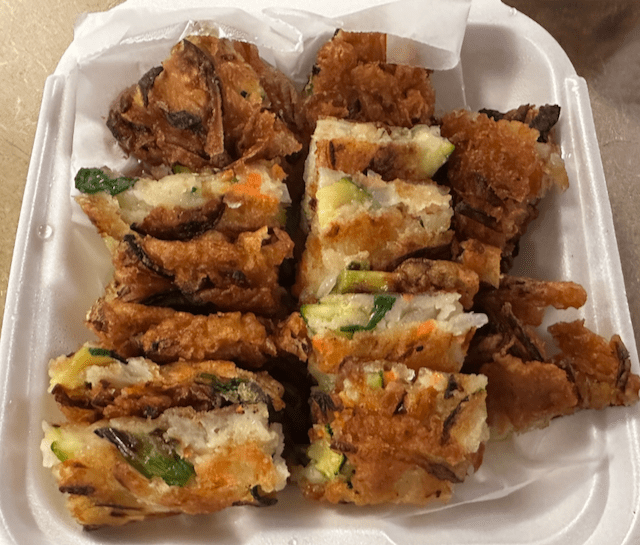
Asian Pear – Albuquerque, New Mexico

“Careful Father, this stuff will melt your beads.” ~Lt Colonel Henry Blake, MASH 4077 Just as Hogan’s Heroes helped establish the perception many Americans (at least of my generation) had about German food, the television show MASH was the first introduction many of us had to Korean food. Set in South Korea during the Korean War, the series centered around a group of resilient doctors, nurses and support staff in an isolated hospital compound which saw more than its share of wounded. Not only did each half hour episode depict–sometimes rather graphically–the horrors of war, it painted a rather poignant and entirely accurate picture of sacrifice and hardship. Some of the sacrifice and hardship came at the hands of the kitchen staff which concocted some of the most unsavory fare conceivable (imagine a restaurant today serving creamed turnips, spam lamb and cream of weenie soup). Indigenous cuisine was apparently even worse because no matter how bad chow hall food was, the MASH team didn’t walk down to the nearby village for a meal of Korean food. And, as the quote above illustrates, when they did partake of Korean food, the impression given was that it was almost lethally piquant. Compared…

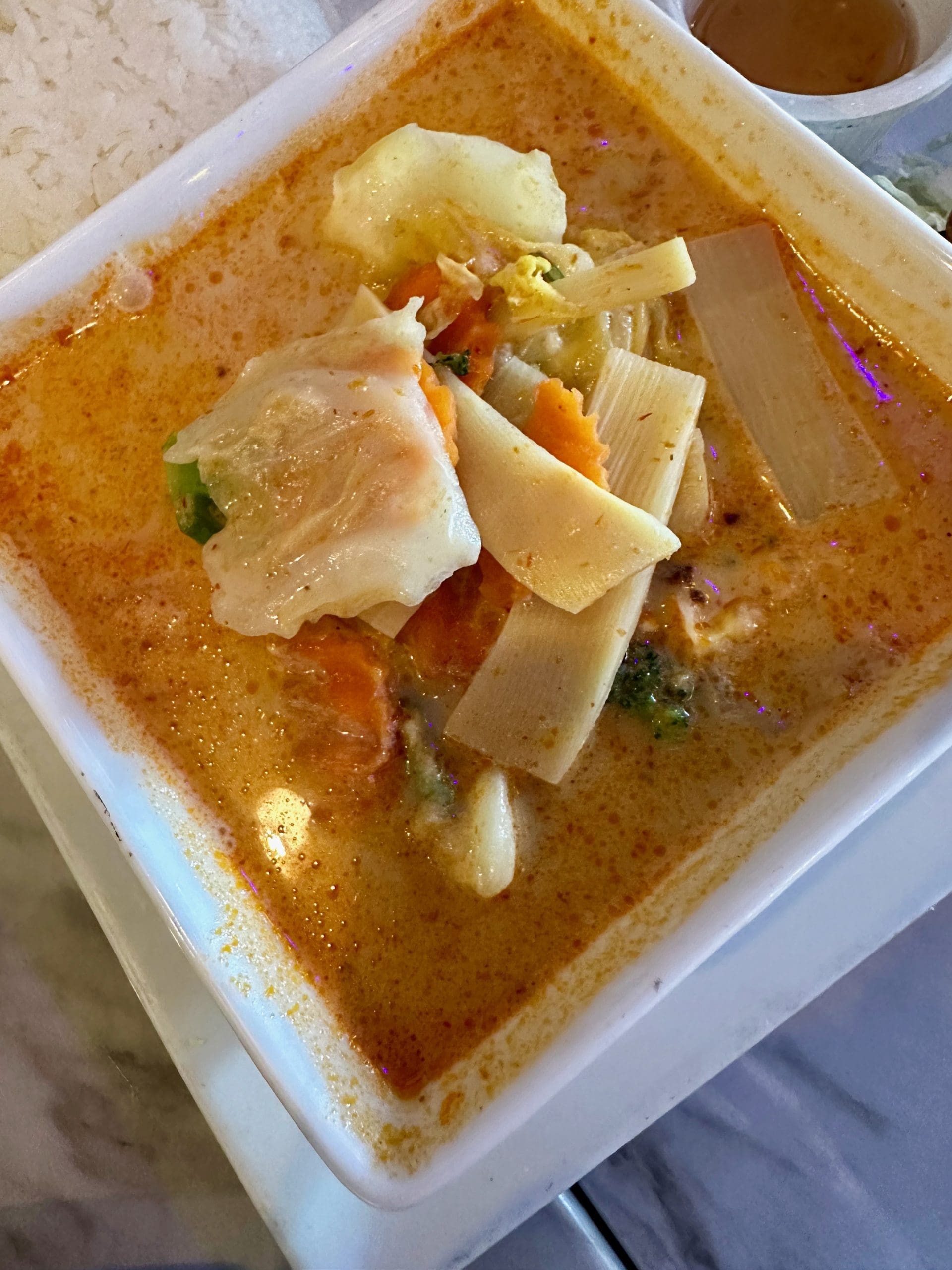
Thai Spice – Albuquerque, New Mexico

“Thai food ain’t about simplicity. It’s about the juggling of disparate elements to create a harmonious finish. Like a complex musical chord it’s got to have a smooth surface but it doesn’t matter what’s happening underneath. Simplicity isn’t the dictum here, at all. Some westerners think it’s a jumble of flavors, but to a Thai what’s important, it’s the complexity they delight in.” ~Chef David Thompson Complexity of flavors, disparate elements, a jumble of flavors…these are the expectations diners have come to expect from Thai restaurants. The underlying foundation of Thai cuisine, going back to Chinese influences as early as the 10th century, is to achieve a satisfying and exciting taste experience through the relationship between five fundamental tastes: sweet, salty, spicy, sour and bitter. Properly balancing these flavors is the true essence of Thai cooking. Overemphasizing any of these fundamental tastes, particularly “sweet” and a Thai restaurant risks its cuisine being labeled “Americanized.” For a cuisine to be considered “Americanized” isn’t necessarily a bad thing. Generations of Americans have grown up enjoying American Chinese foods developed by Americans of Chinese descent. Such familiar offerings as chop suey, crab Rangoon, pepper steak, fried wontons, sesame chicken and even the ubiquitous…

Vintage 423 – Albuquerque, New Mexico

My friend Bill Resnik, a professional stand-up comedian for more than two decades, performs a bit in which he “translates” Spanish terms for linguistically challenged audiences.  “Paseo del Norte,” for example, translates to “Paseo of the Norte.” For Duke City residents, the “Northern Route” is no joke.  It’s the corridor from the Northeast Heights to Albuquerque’s burgeoning West side, ferrying nearly 100,000 vehicles a day.  Paseo del Norte is widely credited with the rapid development–from 30,000 residents in 1980 to more than 85,000 in 2006–of the city’s growth north of Interstate 40 and west of the Rio Grande.  What most city residents don’t realize is that the official Department of Transportation designation for the 25-mile passage is State Highway 423. It makes sense therefore that a restaurant in which people connections are made daily would incorporate into its name the highway designation for the bridge (figuratively and literally) between Albuquerque’s residents.  Because of its extensive wine offerings, the word “Vintage” (as in the year or place in which wine of high quality was produce) also makes sense, ergo Vintage Four Twenty-Three, a sophisticated and trendy milieu unlike any in the Duke City.  Launched in January, 2012, Vintage has since been…