El Guero Canelo – Tucson, Arizona

If asked to participate in a word association exercise, any well-traveled foodie undergoing psychoanalysis would find it easy to name the first food that comes to mind when a city is mentioned: Philadelphia – the Philly cheesesteak sandwich; Boston – baked beans; Chicago – Italian beef sandwiches; San Francisco – sourdough bread; Milwaukee – butter burgers; San Antonio, New Mexico – green chile cheeseburgers.  You get the point.  Some foodies might not know that Philadelphia is the birthplace of liberty, but they know about Geno’s and Pat’s King of Steaks and their decades-long battle for Philly cheesesteak supremacy. You might find it strange that seemingly pedestrian foods would be the defining cuisine of burgeoning cosmopolitan cities, historically significant metropolises and tiny hamlets in the desert, but it’s not solely foodies who associate foods with places. Anthropologist Maribel Alvarez of the University of Arizona says the “quintessential food of Tucson” is the Sonoran hot dog, explaining that instead of taking guests to high-end restaurants, locals will bring their out-of-towners to one of the city’s purveyors of Sonoran hot dogs. Hot dogs, like baseball and barbecue, aren’t exclusively the domain of Americans any more.  In fact, they never were. Before you call…

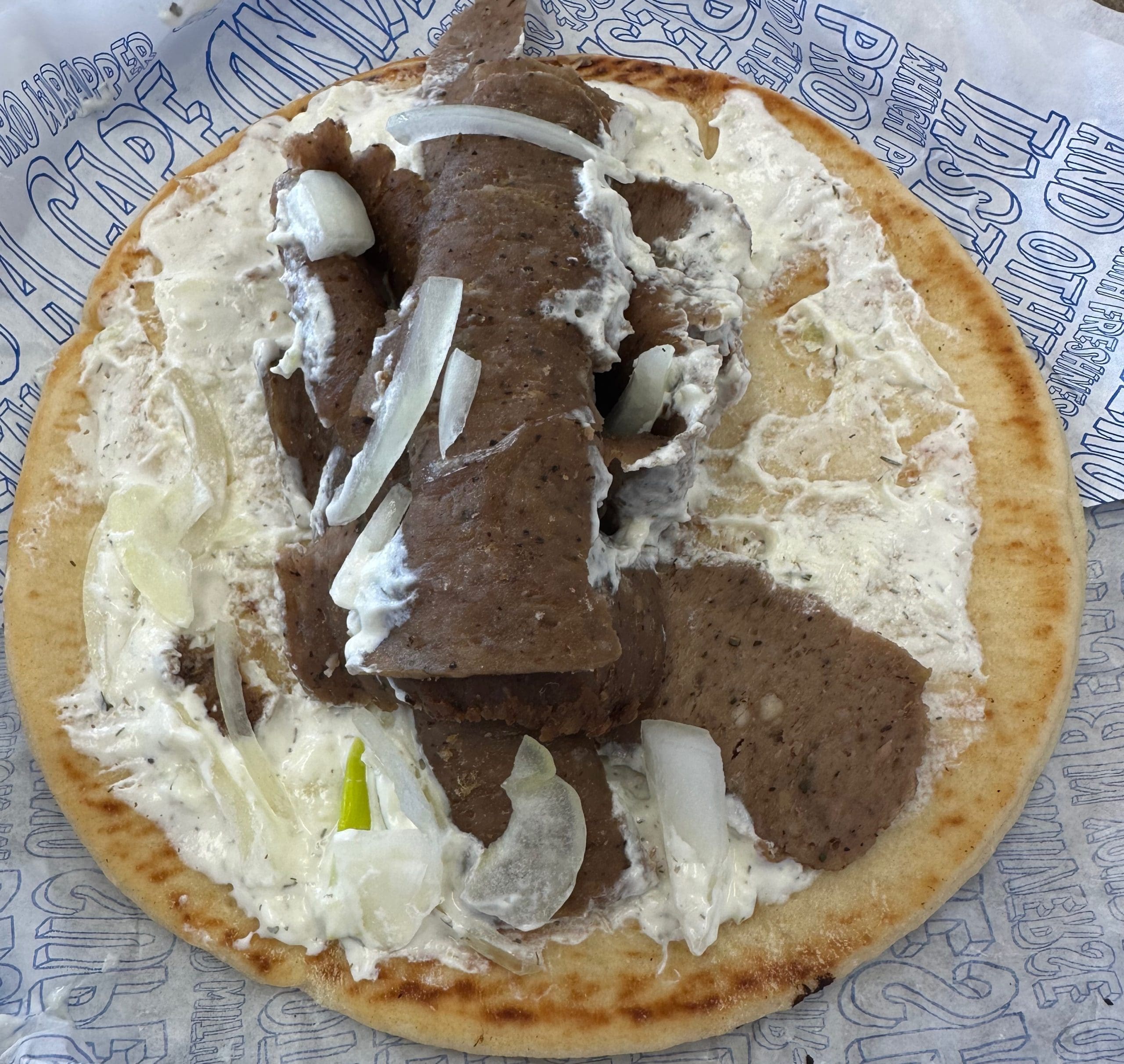
Gyros Shack – Albuquerque, New Mexico

When my dear friend Adelchi Parisella introduced me to Greek food at Gyros Mediterranean back in the early ’80s, I thought to myself “now this is the food of the gods.”  As curious as any cat, I naturally researched whether or not the Greek gods of Mount Olympus actually did eat gyros and patates.  The only two “foods” I could recall the gods eating were ambrosia and nectar.  Research revealed that while ambrosia and nectar were the gods main source of substance, the haughty  mythological beings actually consumed other foods, none of which were gyros and patates. Dionysius, the the god of wine and pleasure and Priapus (a minor rustic fertility God, who protected the male reproductive organs)  were fond of figs.  Dionysius is also associated with intoxicating and hallucinogenic wine which lured gods and mortals alike to an ecstatic frenzy  No one particular god is associated with the lotus, but it must have been popular in that it was unanimously described as a narcotic, which brought about sleep and “forgetfulness.”  The’ eleventh labor of Hercules was to steal apples from “the garden of the Hesperides,” The  golden and gleaming apples were supposed to grant immortality to those who got…