Annapurna Ayurvedic Cuisine – Los Ranchos de Albuquerque, New Mexico

“Vegetarians, and their Hezbollah-like splinter faction, the vegans, are a persistent irritant to any chef worth a damn. To me, life without veal stock, pork fat, sausage, organ meat, demi-glace, or even stinky cheese is a life not worth living. Vegetarians are the enemy of everything good and decent in the human spirit, and an affront to all I stand for, the pure enjoyment of food.” Anthony Bourdain’s dour diatribe on the “evils” of vegeterians and vegans is hardly unwonted.  The internet is rife with mean-spirited assailments against people who choose a plant-based diet that includes fruits, cereal grains, seeds, nuts and vegetables and may or may not exclude dairy products and eggs.  Reciprocation in kind is also well represented on the Internet by vegetarians and vegans who lambast the carnivorous cravings of meat-eaters. This lack of civility and parochial discourse is usually reserved for politics and ideologues (on both sides of the aisle) who can’t concede any merit whatsoever about the opposing viewpoint.  It’s not enough to disagree with someone else’s opinion or choice, dissenters on both sides seem to have a base need to resort to derisive pejoratives. So, just how do you resolve differences of opinion without…

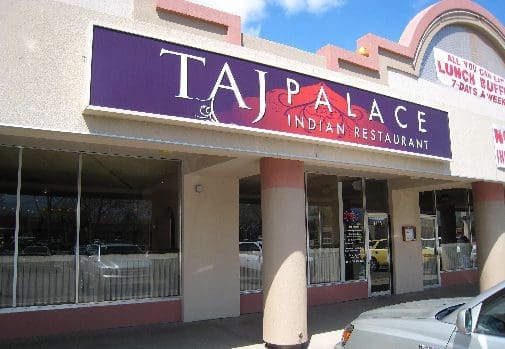
Taj Palace – Albuquerque, New Mexico

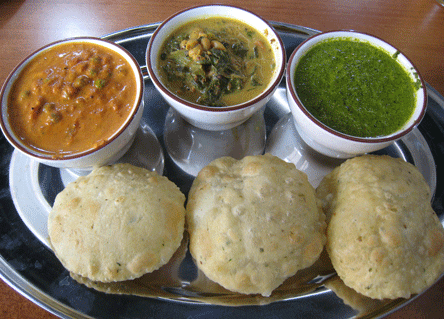
Indian cuisine is one of the world’s most diverse and sophisticated cuisines, fashioned over time by ancient traditions, diversity of religion, climatic variety and the influence of neighboring countries.  It is so diverse, in fact, that the characterization “Indian cuisine” would be wholly inaccurate. There are more Indian cuisines than there are regions in this ethnically diverse subcontinent comprising 17.5 percent of the world’s population. While categorization by geographical region–North Indian, South Indian, East Indian and West Indian–is prevalent, such groupings are at least partially exclusionary of cuisines whose basis is religious, especially the Hindu and Muslim faiths.  One of the great things about being an aficionado of Indian cuisine is that we can appreciate both its tremendous diversity and the unifying threads that make it one of the world’s great cuisines. One commonality is the wide range of spices which produce its inimitable aromas and flavors. Indian restaurants have long graced the Duke City dining scene, albeit in relatively small numbers compared to restaurants of other ethnicities.   A commonality among most Albuquerque Indian restaurants is the ubiquitous presence of the buffet. Buffets are more responsible for introducing diners to Indian cuisines than any other factor. This is evidenced by…

Bombay Grill – Albuquerque, New Mexico (CLOSED)

The unmistakably pungent aroma of exotic spices wafts through the air and remains with you long after you’ve finished your meal at the Bombay Grill, a 2004 entrant in the growing northwest Albuquerque dining scene (which, unfortunately, is dominated by mediocre chains). That’s the last time you’ll see “mediocre” and Bombay Grill in the same sentence because this charming and outstanding Indian cuisine establishment is high on our “must return” list. There are many reasons for that and they’re certainly not encapsulated in the gargantuan lunch buffet. The lunch buffet is admittedly a wonderful way to introduce novitiates to one of the world’s most sophisticated and ancient cuisines, one that in which herbs and spices are used liberally to flavor each dish. Bombay Grill specializes in the cuisine of Northern India where dairy products such as paneer (a farmer’s cheese similar to cottage cheese), yoghurt and ghee (clarified butter) are typical ingredients. Chefs in Northern India also employ the tandoor, a large cylindrical coal-fired oven to prepare various flat “breads” such as naan and roti. The Bombay Grill occupies the site of a failed Chinese restaurant and though it can’t hide some of the architectural features of its predecessor, it…