
NOTE: In July, 2025, Taco Santo ceased operating as a taqueria, reverting back to Holy Burger, long one of the city’s most popular burger joints.
Jay Rayner, one of my very favorite restaurant critics and authors, has an inimitable gift for luring readers with reviews that go far beyond describing food. His review of Santo Remedio, a Mexican restaurant in London, is one such example, starting with his astute observation about the debate between authenticity and verisimilitude in culinary culture: “All too often in the food world, the war of expertise becomes a lumbering battle between the Real Thing and the Good Stuff. The Real Thingers have knowledge and experience on their side. They’ve eaten dishes in their place of origin, when you have not. By contrast, all the Good Stuffers have is enthusiasm. They don’t care whether these Korean chicken wings are as they would be in downtown Seoul. All that matters is that they taste good.”

Raynor’s “the real thing” is represented by purists and traditionalists who have not only eaten dishes in their place of origin, but in the manner in which those dishes were originally created. The “good stuff” is represented by chefs seeking not to emulate a dish in the precise manner in which it was originally created, but to take an original approach to preparing and serving it. While the former is concerned with preservation and the status quo, the latter sees all foods as evolving–constantly changing and made better by virtue of experimentation with culinary techniques and ingredients. Traditionalists in “the real thing” vein may see the evolution of foods as culinary appropriation.
The “real thing” or “good stuff” argument is reminiscent of Lite Beer From Miller commercials in which celebrated athletes vociferally argued for “tastes great” or “less filling” as if both were mutually exclusive. I tend to have a “real thing” or “good stuff” debate with myself when visiting restaurants like Albuquerque’s Taco Santo where it could be argued that copious liberties are taken with ingredients used to create humble taco. Taco Santo’s menu is an example of “good stuff” imagineering. Then again, culinary historians believe the first people to create tacos were the indigenous people of Mesoamerica who are thought to have filled tortillas with a large variety of ingredients such as beans and agave worms as well as other local delicacies. “Other local delicacies” is another way of saying carte-blanche, limited only by the availability of local ingredients.
It’s unlikely Taco Santo would ever fill tortillas with agave worms–and if they did, I would probably be one of only a few diners intrepid enough to enjoy them. The evolution of the taco was largely influenced by Spanish conquistadores who introduced the soft, maleable flour tortillas beloved today. As new ingredients were introduced, the taco evolved, from corn, beans and agave worms to tacos constructed with meats and cheeses. This sparked a new culinary phenomenon. Throughout the 20th Century, food vendors graced the streets of Mexican cities , proffering a fast and affordable meal to passers-by. Grilled meats such as beef and steak quickly became all the rage in the northern regions of Mexico accompanied with local chiles used to create spicy sauces. Carne asada (grilled beef) came to be a staple in many Mexican restaurants.
Mexicans migrating to United States sparked the evolution and widespread adaptation of the taco. Mexican restaurants sprouted in the 20th Century. In the mid-20th Century, restaurateur Glen Bell created the hard shell taco. Bell went on to create Taco Bell, arguably the most recognizable taco-based fast-food chain in the world. “Americanized” (particularly in Tex-Mex cooking) recipes included “chili” powder (an amalgam of several spices and seasonings) and such ingredients as Cheddar cheese and iceberg lettuce. Though other foods have grown in popularity, it’s the humble taco that has propelled Mexican food to the culinary phenomena it is today.
If it sounds like the “real thing” versus “good stuff” argument is a moot point with respect to the taco, many of us would have to agree. Tacos are both the real thing and the good stuff no matter whether constructed on flour or corn tortillas and regardless of ingredients. Like so much of Mexican food, tacos are an evolving food item created on the back of traditional ingredients and preparation methods. Fittingly, Taco Santo self-glosses as “a unique twist on traditional and modern flavors.” Study the menu and you’ll be pleasantly surprised at the inventivenes of tacos and other items.
Tacos occupy the first spot on the menu, followed by “Starters,” “Sides,” “Salad/Bowls,” “Kid Tray,” “Desserts,” and “Drinks.” There are nine tacos on the menu (none of which are made with agave worms), spanning a vast spectrum–from a Korean short rib taco to a Vietnamese banh mi taco. More traditional taco fare–carnitas tacos and baja fish tacos–are also available as are two vegetarian options: roasted cauliflower and Brussels sprout. Among the six starters are the usual chips and salsa, guacamole and con queso options as well as ceviche. Three salad/bowls will also appeal to health-minded diners. There are three desserts on the menu, all of them served in glass jars. As of this writing, the drinks menu does not include aguas frescas though our server told us they’re frequestly requested.
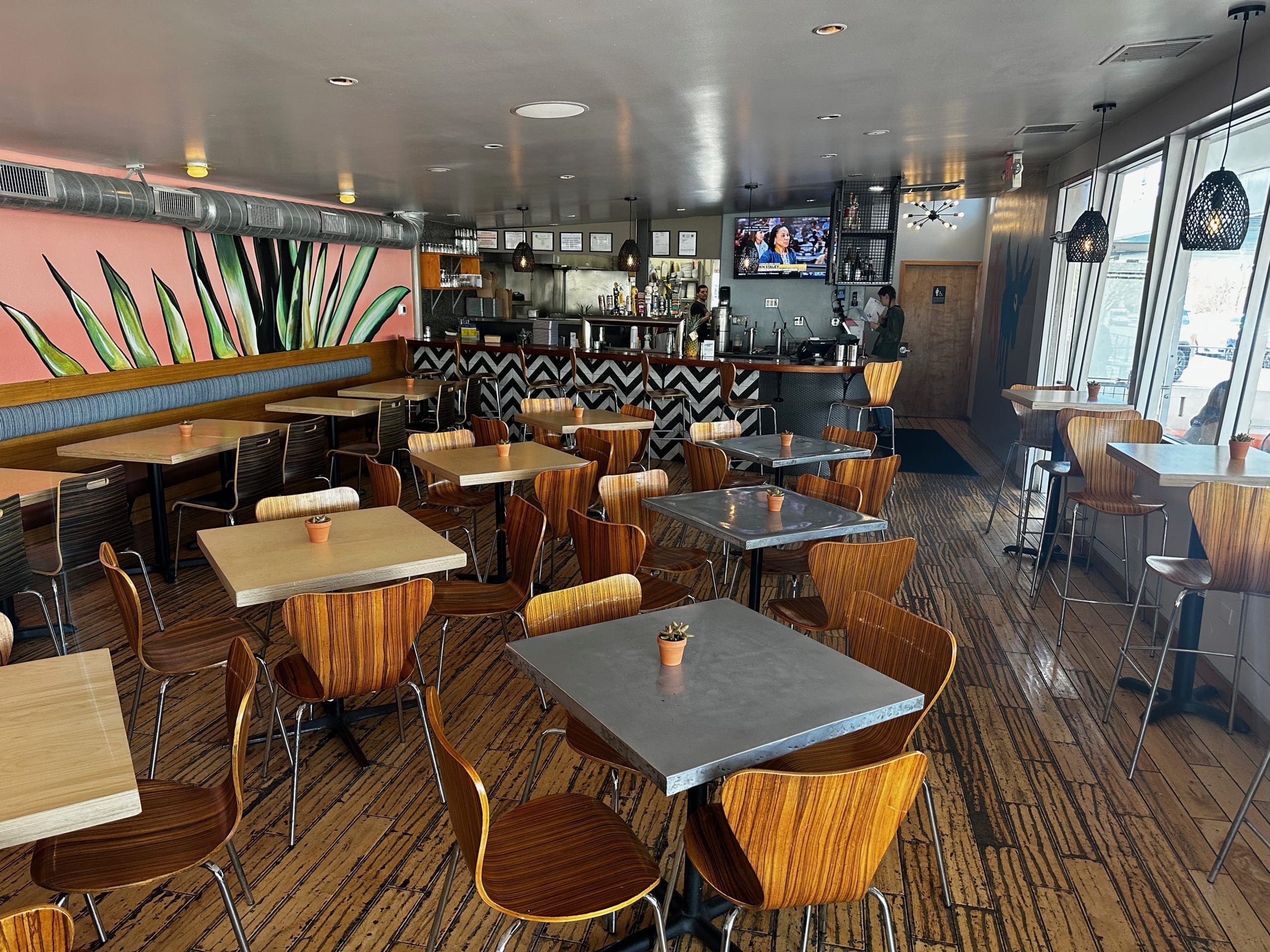
If you’re wondering where the name “Taco Santo” came from, hearken back to 2011 when Chris Medina, a veritable “lifer” in the culinary business launched a restaurant christened “Holy Cow.” Holy Cow eventually became “Holy Burger” and served Duke City diners until 2025 when replaced by a gourmet taco concept named Taco Santo. Taco Santo is blessed with continuity, helmed by Medina and the same ownership group who opened Holy Cow. Long-timers know that Taco Santo is located at the long-time site of Bob’s Fish and Chips, an Albuquerque institution which closed in 2006 after more than fifty years of serving Albuquerque. The venue has a capacious dining room and a patio from which you can enjoy the city’s salubrious sunshine.
We had the dining room to ourselves for much of our inaugural visit. True, it was 2:30PM and well past the lunch hour, but we were still surprised the restaurant wasn’t packed as new restaurants in the city tend to be. We were also surprised that Taco Santo offers tableside service. We were given menus and given time to peruse them before our gracious server arrived to take our order. She shared that lunch crowds tend to be small compared to crowds who show up after work hours.
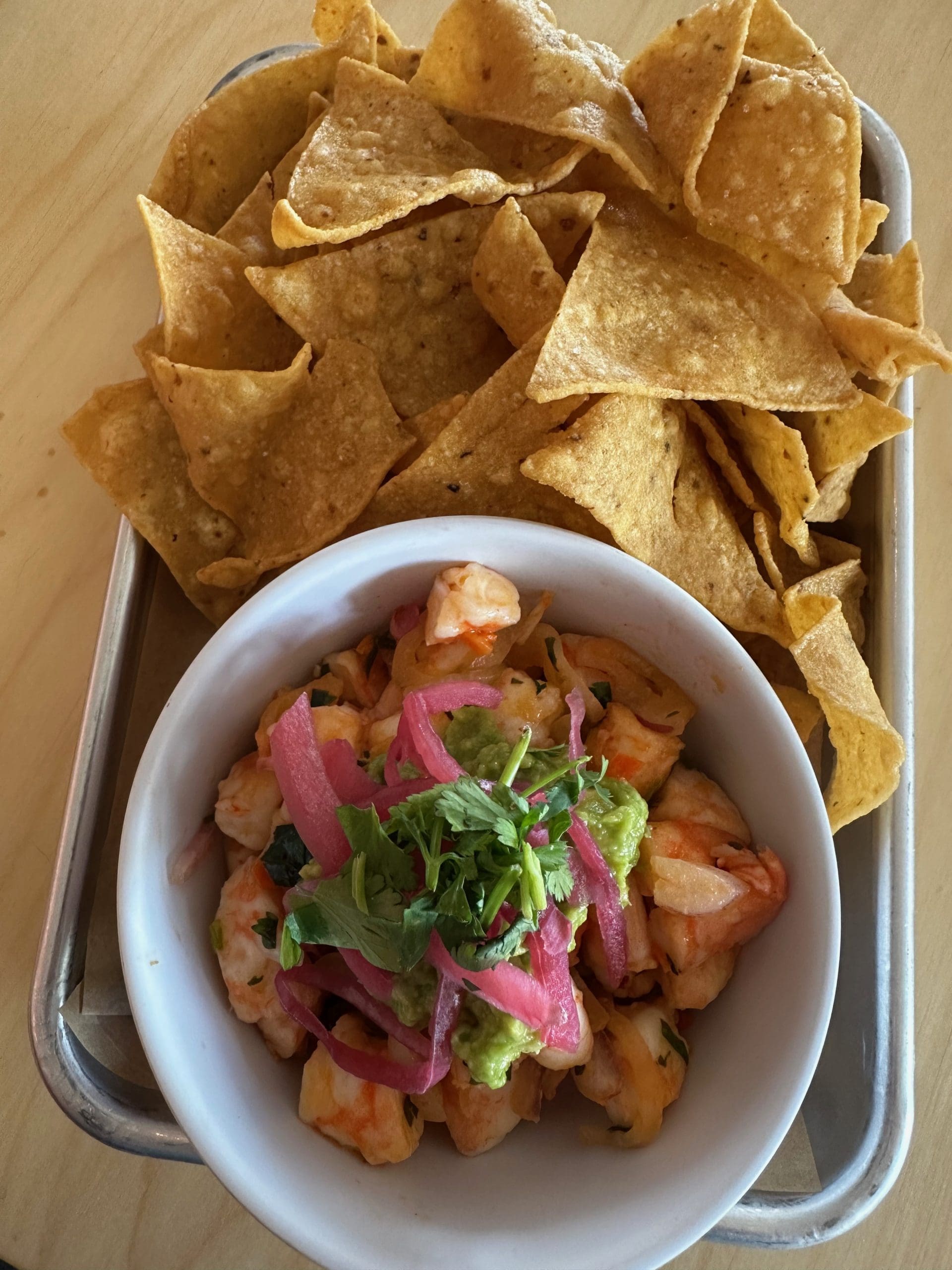
Because we had enjoyed ice cream at Heidi’s before trekking to Central Avenue, we didn’t order as much food as we typically do. Rather than enjoying the trio santo of salsa, con queso and guacamole, we began our meal with ceviche (citrus marinated shrimp, guacamole, pickled red onion and tortilla chips). Compared to ceviche at many Mexican restaurants, Taco Santo’s version is made with larger pieces of fresh, crispy shrimp. It’s also not nearly as lip-pursingly sour as some ceviche tends to be. Our server informed us that the marinade includes habanero, one of the world’s most piquant peppers, and that the ceviche would be rather hot. At the risk of braggadocio, this asbestos-tongued critic didn’t find it particularly piquant. Another highlight is the warm, salted chips with which the ceviche is served. It’s somewhat different than ceviche being piled on a tostada.
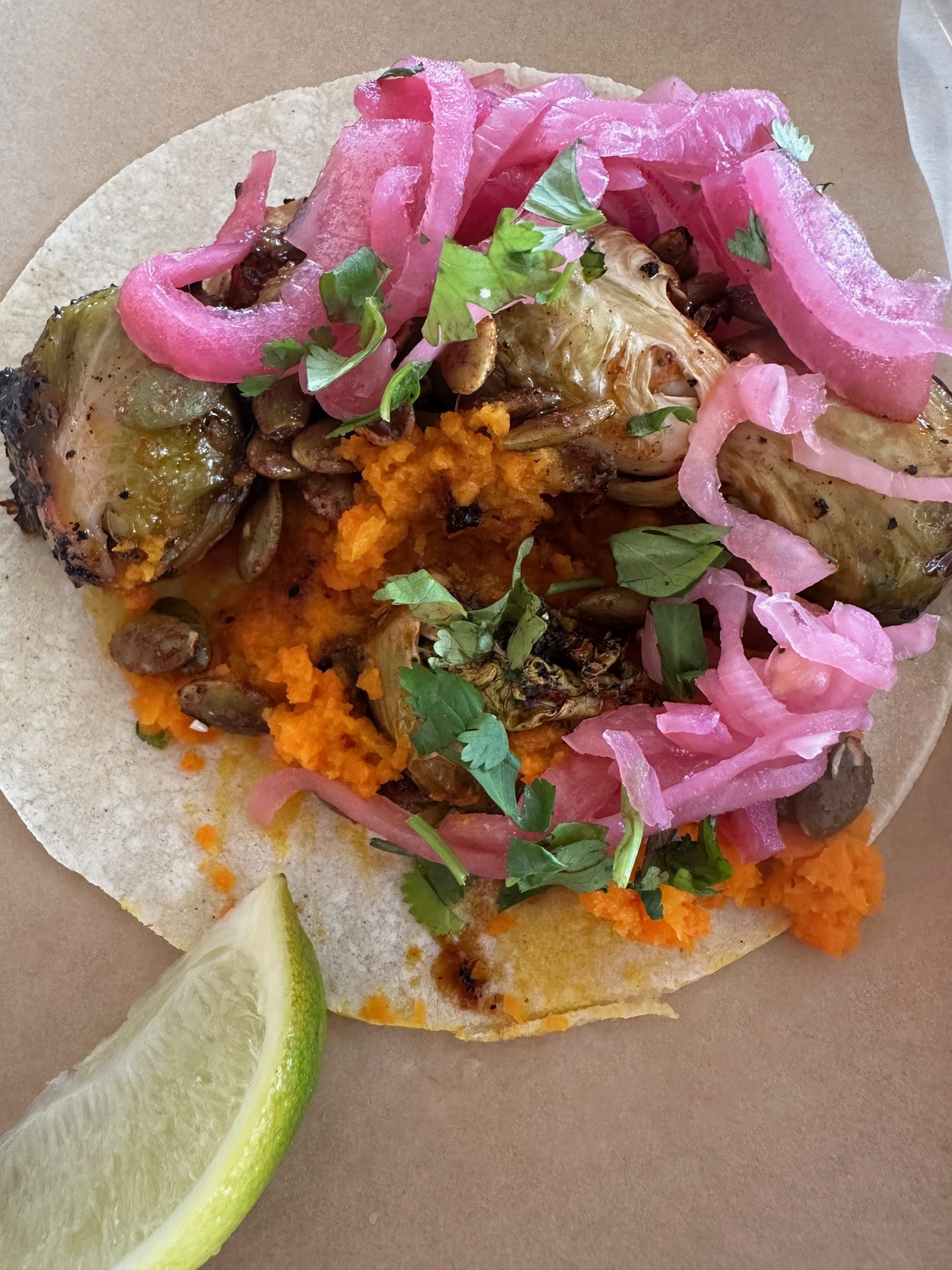
My first taco at Taco Santo was (surprise, surprise) was the Brussels sprout taco (roasted honey chipotle glazed Brussels sprouts, curried carrot purée, candied pepitas, pickled red onion). Studying its composition might give you the impression that it’s a rather sweet taco. Instead, you’ll find it’s rather balanced with the pickled red onion providing a counter-balance to the honey chipotle glazed (which had barely discernible heat). Pepitas provided a pleasant contrast to mostly soft ingredients, lending a delightful crunch and salty notes.
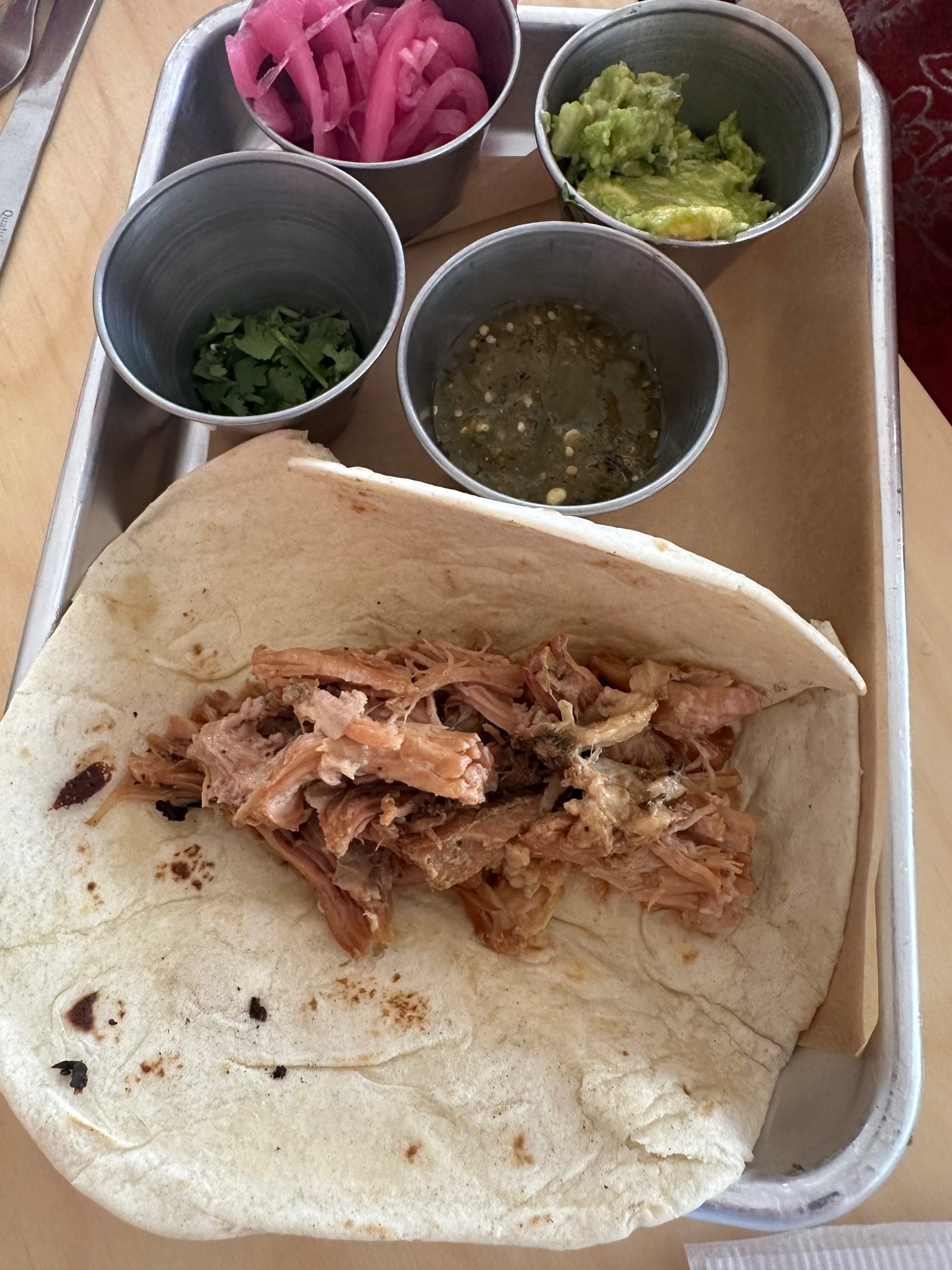
My Kim is besotted with the carnitas taco (pork confit, classic guac, roasted tomatillo salsa, pickled red onions) sans the roasted tomatillo salsa. She calls it the best carnitas she’s ever had, admitted to a bit of jealousy that the pork was confit to a level of flavor optimization she hadn’t previously experienced with carnitas. Tender tendrils of pulled pork carnitas on a flour tortilla were indeed an exemplar of how carnitas should be made. She asked that all other items (cilantro, pickled onions, guacamole and tomatillo salsa) be served on my side, a boon for my reaching over to enjoy them.
San Pascual is the patron saint of kitchens and Saint Lawrence is the patron saint of cooking. If there’s a patron saint of tacos, it would be interesting to get his or her take on the “real thing” and “good stuff” debate going on when I visit Taco Santo.
Taco Santo
700 Central Avenue, S.E.
Albuquerque, New Mexico
LATEST VISIT: 28 March 2025
# OF VISITS: 1
RATING: N/R
COST: $$
BEST BET: Carnitas Taco, Brussels Sprout Taco, Ceviche
REVIEW #1462