
As a precocious sprout growing up in an agrarian hamlet in Northern New Mexico, I dreamt of travel and adventure. My voracious reading habits included hours immersed in world book encyclopedias, world atlases and National Geographic magazines. By my eighth birthday, I was creating maps of the world free-hand and knew more about history and our planet than most of my teachers. I longed to visit and plunge myself in wonders and cultures that existed for me only in books. My longing to experience the world outside of Peñasco was, in fact, the primary reason I joined the Air Force days out of high school. While my service career did broaden my experiences, my desire to see and do even more has never waned. Alas, now that my Kim and I have the financial means to travel virtually anywhere, health issues have left us more homebound than we would like.

Thankfully, I can still travel vicariously through my brothers and sisters, all of whom have traveled the globe. In 2024, my brother Mario and his better half Diana visited Petra in Jordan, one of the sites I first read about in preadolescence. I don’t have a jealous bone in my body and don’t begrudge my siblings being able to travel to faraway lands. It does, however, bother me somewhat that they don’t always sample or enjoy the broad expanse of culinary opportunity offered to them. Neither Mario or Diana was particularly impressed by Jordan’s Middle Eastern cuisine. Aargh! I sometimes wonder if I’m related to my five siblings, only one of whom has an adventurous palate. Sure, they’re jetsetting far and wide, but so much of the experience should center around every country’s culinary culture–especially the unfamiliar.
As for Petra, I can only dream of the civilization that more than 2,000 years ago, built a spectacular ancient city and archaeological site in Jordan. Carved into beautiful rose red-colored rock with exquisite artistic details and surrounded by large, vibrant mountains and canyons, Petra is considered one of the seven wonders of the world. Petra is a UNESCO World Heritage Site known for breathtaking structures carved directly into pink sandstone cliffs. In its halcyon days, Petra was a thriving center of commerce until trade routes changed and the city was abandoned in the 6th Century.
Not surprisingly, Petra is referenced in the Old Testament, albeit by its Hebrew name, “Sela,” which means rock. Specifically, Isaiah 16:1, enjoins: “Send lambs as tribute to the ruler of the land, from Sela, across the desert, to the mount of the Daughter of Zion.” Some biblical scholars believe Petra is a potential place of refuge for the Jewish people during the end-times period of the tribulation. This belief stems from interpretations of passages in Zechariah, Daniel and Revelation that seem to suggest that God will protect a remnant of Israel in a hidden location within the region of ancient Edom (modern-day Jordan), where Petra is located.
While my Kim and I might never make it to Petra ourselves, we would surely have gained a few pounds feasting on the wondrous Middle Eastern cuisine for which Jordan is renowned. Nora’s Cafe, a 2025 addition to the Duke City’s burgeoning culinary scene, is the next best thing to dining in Jordan. Not since the San Pedro Middle East Restaurant (now known as Al-Qud’s Mediterranean Grill & Grocery) launched in 2010 have we been so excited about a Middle Eastern restaurant as we are about Nora’s. That means Nora’s is in rather rarefied air as one of the best Middle Eastern eateries in Albuquerque.
Frankly, we didn’t have high expectations about a restaurant named “Nora’s Cafe.” It sounds so parochial and main street any-town America. Our friend Lynn Garner and her dining companions, who didn’t have misgivings about the name, raved about it. Their endorsement weighs heavily. As for the name, in Arabic culture, we learned the name Nora means “light” or “brilliance.” Sufyan, the restaurants general manager, accomplished chef and member of the family that owns Nora’s explained that in a family which has sired nothing but males, his niece Nora is the only girl. That’s two great reasons the name Nora’s makes sense.
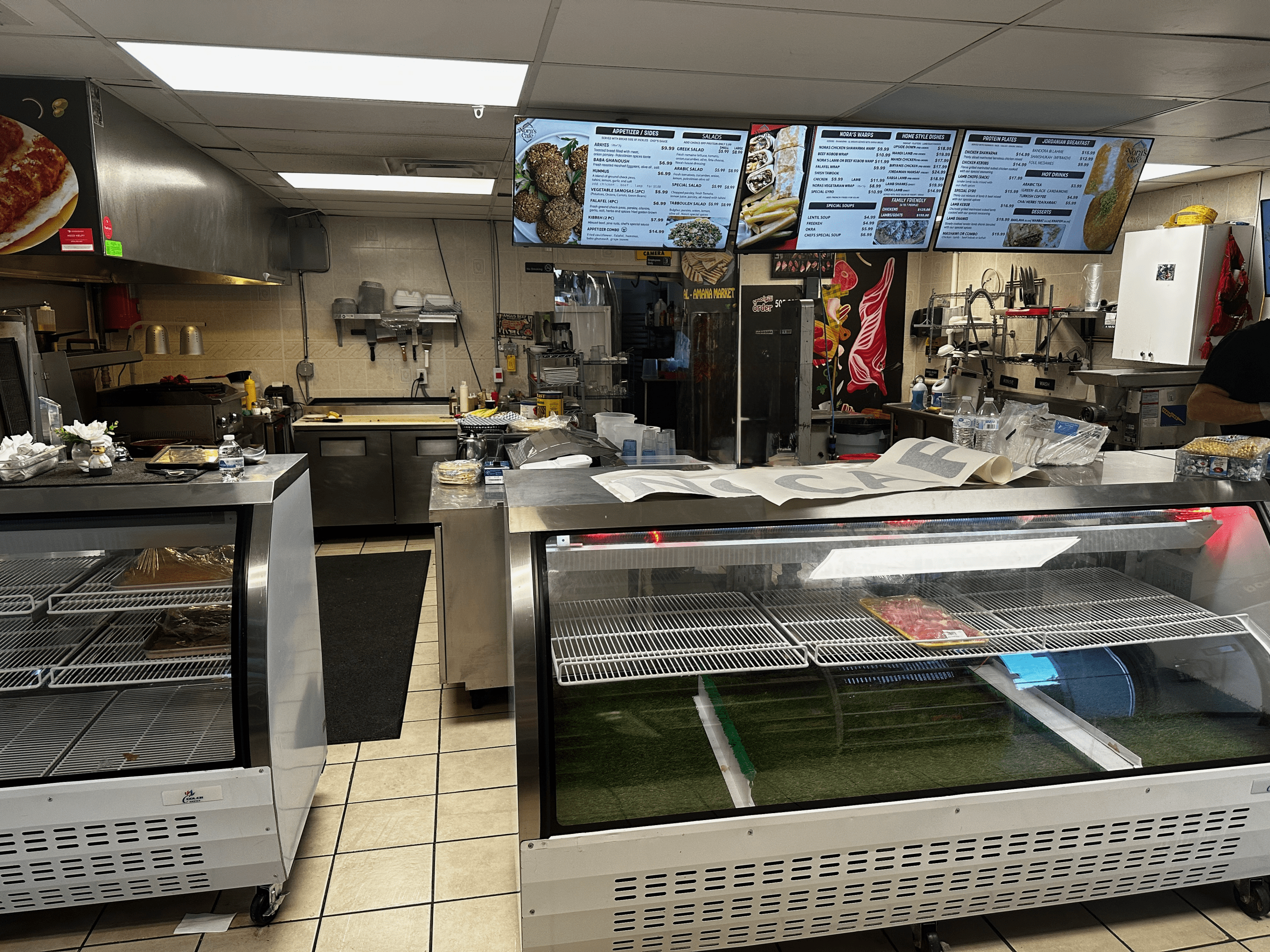
Nora’s is located on Menaul closer to Juan Tabo than to Eubank. Immediately next door is the Alamana Market where you can purchase halal meats as well as pastries and Middle Eastern comestibles. The restaurant’s entire menu is posted above, more temptation for those of us who love meats. Among the market’s offerings are sheep’s head (which makes a wonderful consommé) and goat’s head (presumably also excellent). Sufyan shared that a Middle Eastern bakery will be occupying the space to the cafe’s immediate east. It’s a family owned and operated enterprise with everything you could possibly want in one location.
Service is unfailingly polite at Nora’s. Sufyan loves to discuss Middle Eastern cuisine and is well-connected in the community. Among family friends are the Abdeljalil family which owns the aforementioned Al-Qud’s. Sufyan invited comparison between Nora’s and Al-Qud’s, boasting that many of Nora’s dishes are the best he’s ever had–and he’s a well-traveled guy. Sufyan is a classically trained chef, having completed a rigorous five-year degree program in Jordan. He can cook anything, but his heart is with Middle Eastern cuisine. During the delightful hour-and-a-half we spent at Nora’s, Sufyan insisted we try the Arabic tea and tabouli, neither for which we were charged. Both were superb! I can’t guarantee you’ll get free food when you visit, but you will be well taken care of.
Nora’s menu will be familiar to all aficionados of Middle Eastern cuisine. Take a leap and try Jordanian food, some of which was made during the halcyon days of Petra. Under the menu heading “Home Style Dishes,” you’ll see several Jordanian dishes. Some are available on a daily basis while others require that you pre-order them. Friday’s special is Jordanian mansaf, the national dish of Jordan. Traditionally mansaf is a communal meal of lamb and rice layered with thin flatbread, topped with fragrant rice and tender bone-in lamb, then drenched in the unique yoghurt sauce before being garnished with toasted nuts and parsley. Just our luck our inaugural visit was on a Thursday.
The menu also includes a “Jordanian Breakfast” menu that lists items I’ve enjoyed for lunch and dinner at other Middle Eastern eateries. My knowledge of two of them–shakshukah and foul medames–was a surprise to Sufyan who remarked that “I’ve tried everything.” Not quite though I’m certainly willing to try. Other menu sections list Salads, Appetizers/Sides,”Wraps, Special Soups, Protein Plates, Hot Drinks and Desserts. It’s a menu that reads better than some novels. Best of all, it won’t empty your wallet.
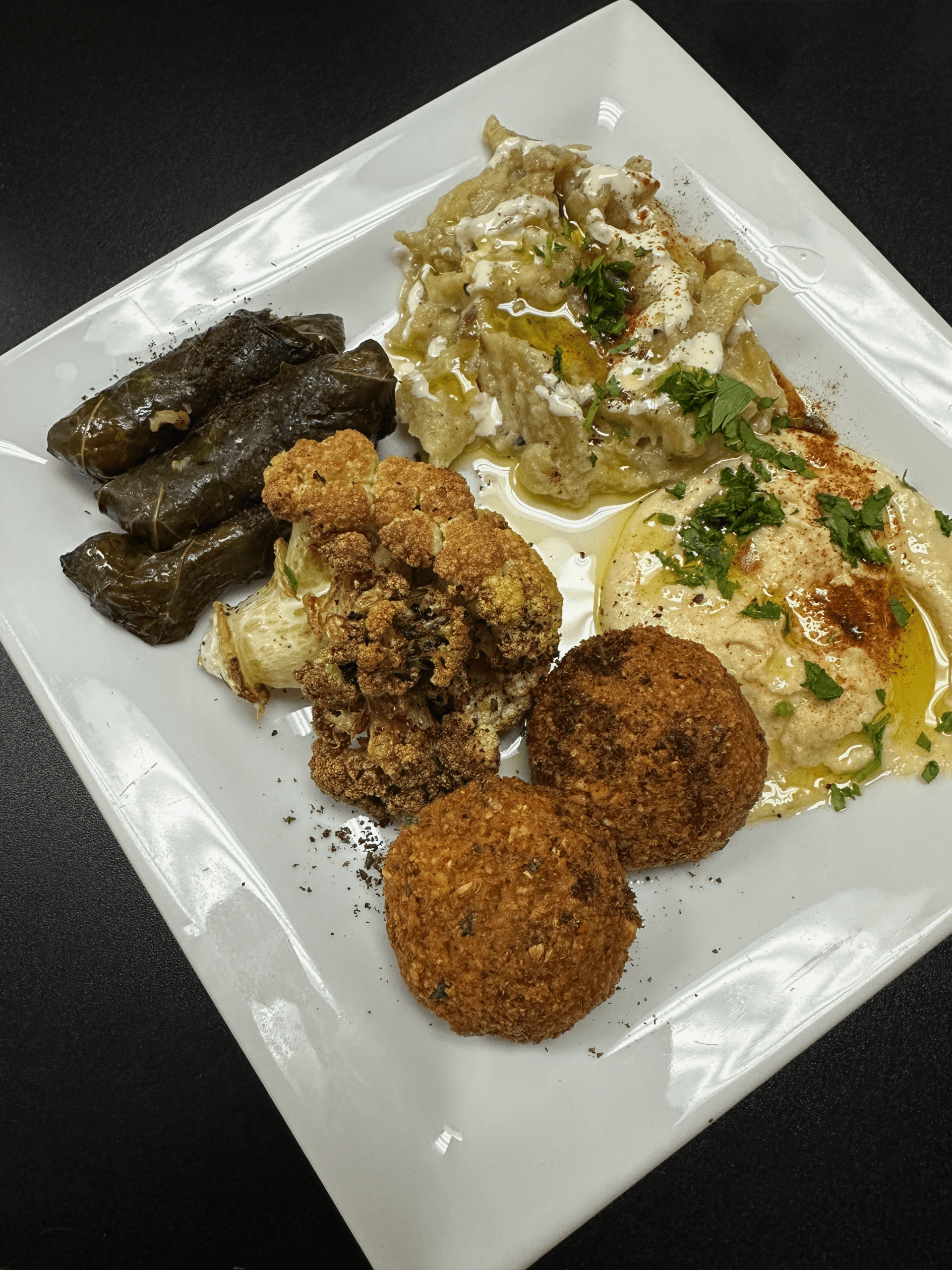
2 October 2025: Our friend Lynn raved about the Appetizer Combo, a generous platter replete with baba ghanoush, fried cauliflower, hummus, falafel and grape leaves served with bread. Her affections were not misplaced. This is a wonderful appetizer, a superb introduction to the high quality and freshness of Nora’s cuisine. Sufyan proudly explained that everything at Nora’s is made “home style” just as it would be prepared at home when feeding the family. That’s readily apparent. The baba ghanoush is some of the best we’ve had. It’s smoky, rich, and absolutely addictive, with an earthy eggplant base complemented by a nutty, creamy tahini flavor. My Kim was besotted by the fried cauliflower, a dish we’ve rarely encountered. The falafel has a delicate spiciness that my Kim couldn’t handle, but most New Mexicans would appreciate.
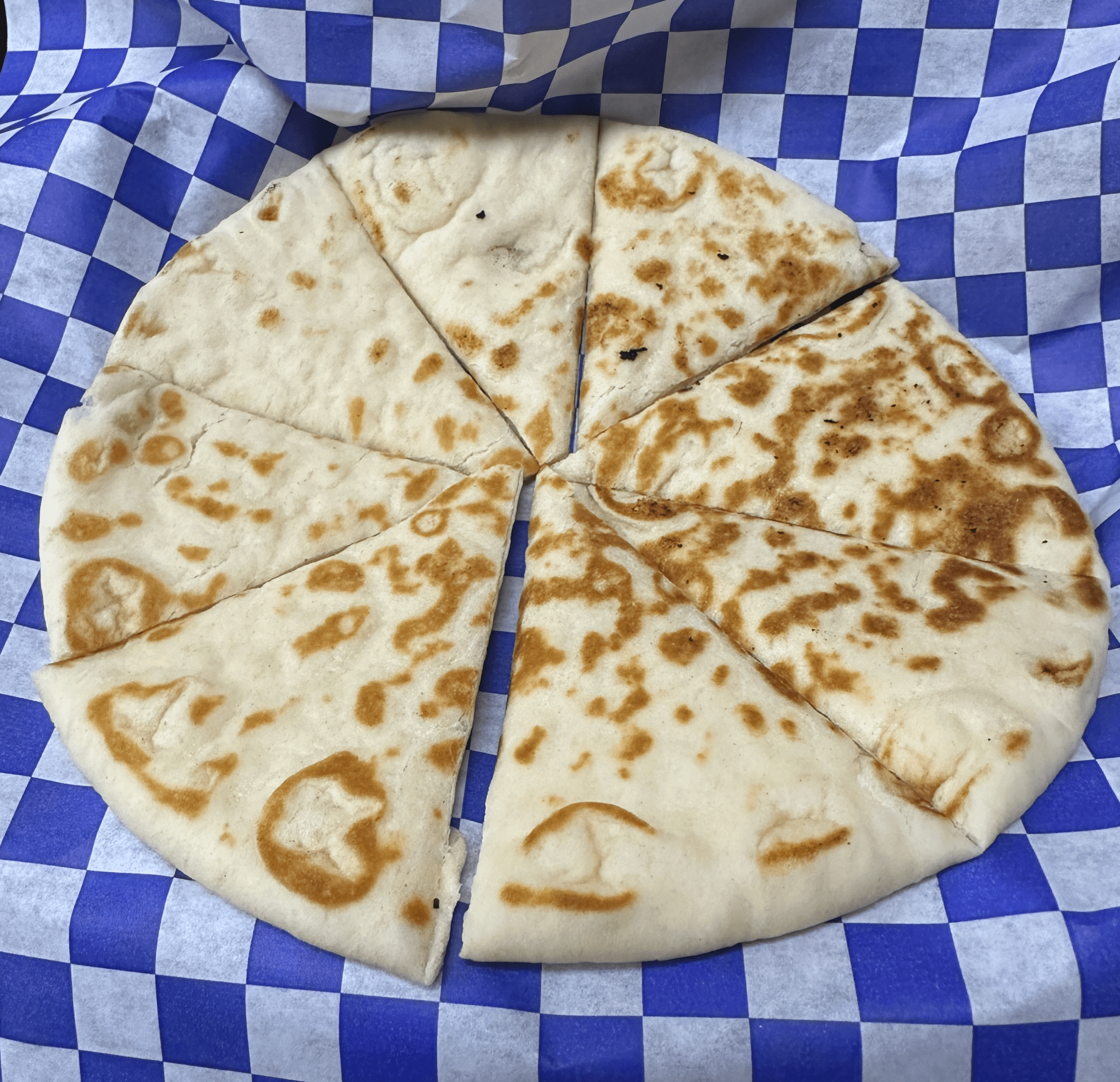
2 October 2025: The bread, what most would term as “pita,” is wonderful. In Arabic culture, bread is a deeply symbolic food. It represents life, a divine gift, hospitality, and community. Bread is often eaten with every meal. It’s served with the appetizer combo in a plate with several wedge-shaped slices forming a circle. The bread has a light pinto pony char. It makes an excellent dip for the baba ghanoush and hummus though you could eat a plateful by itself and be entirely satisfied. Bread is one of those foods that has been made by many cultures across the millennia. Along with tortillas and naan, I might be able to subsist on bread alone despite Matthew’s exhortation that “man cannot live on bread alone.”
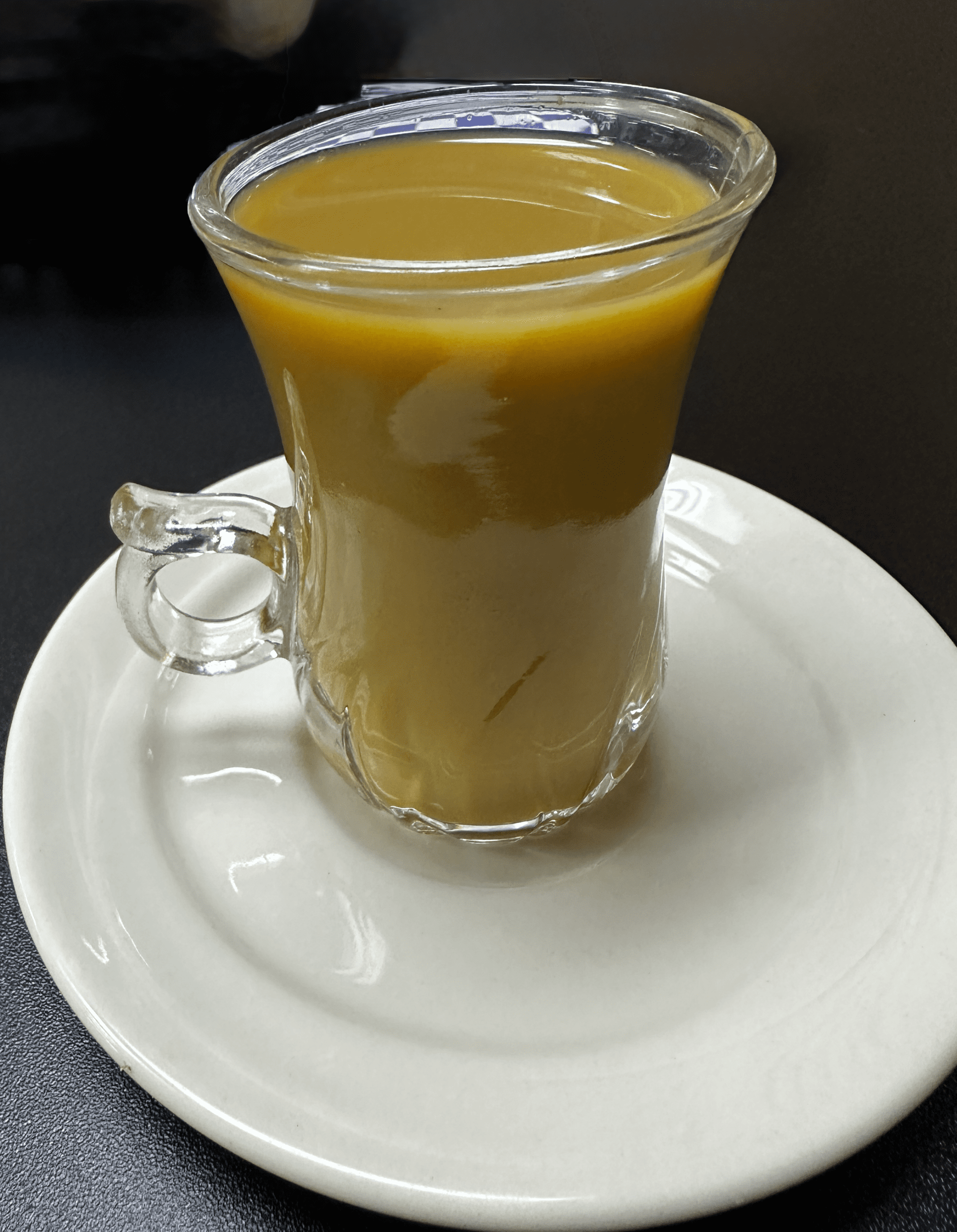
2 October 2025: Though I pride myself on a fearless palate, the one “food” I dislike immensely is tea. That stems from having attended a Boy Scout swim camp at Lake Conchas where the only beverage provided was tea. Should it be served with a meal, I look for the nearest plant where I can dispose of that offensive beverage. Still when Sufyan ferried over two cups of Arabic tea, I was determined not to offend our host and rebuff his kindness. As it turns out, Arabic tea is quite palatable with both green and black cardamom providing a slight kick reminiscent of cloves. This is one tea I won’t kick off our table.
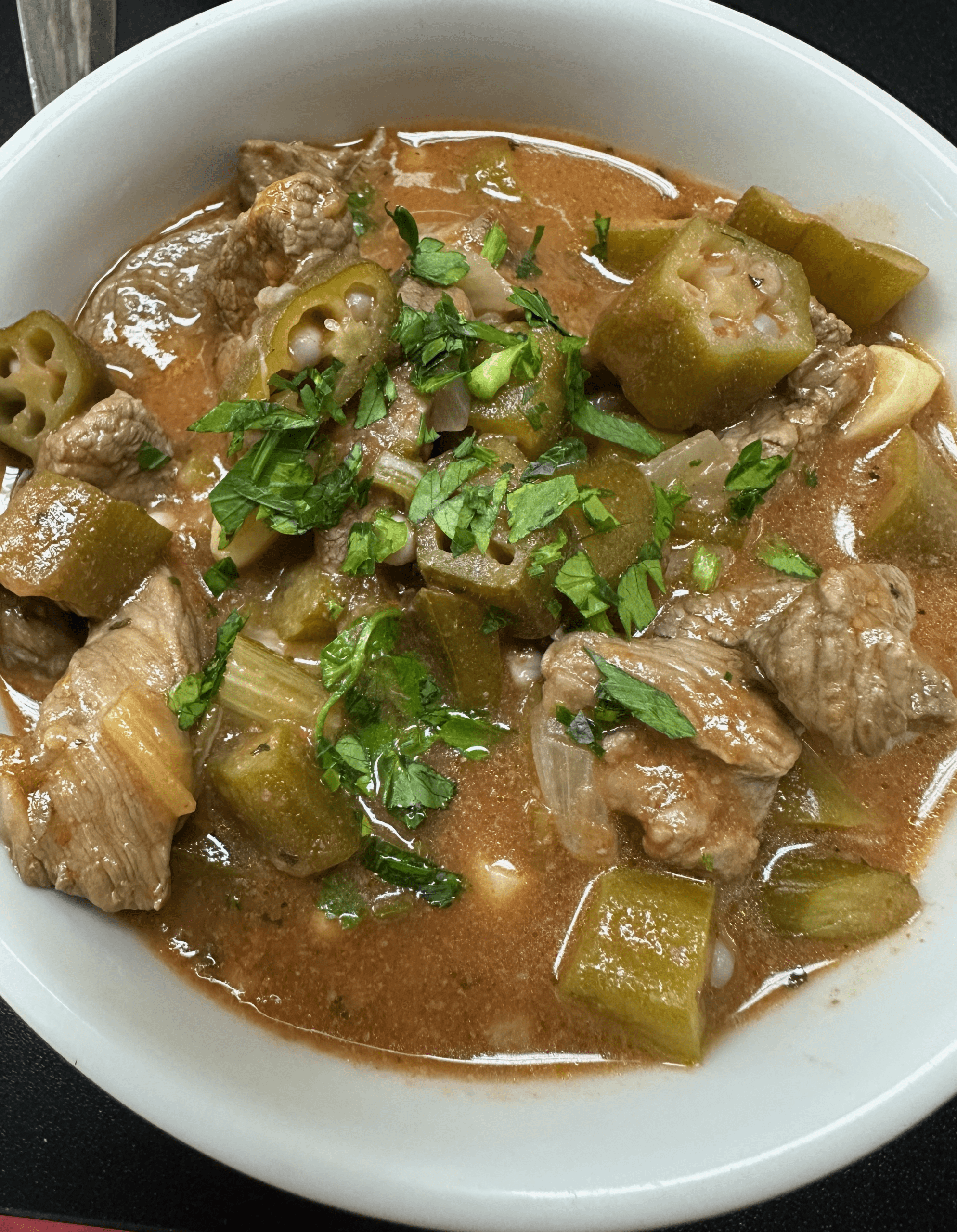
2 October 2025: The dish Lynn and her culinary cohorts enjoyed most may have been the lamb and okra soup. It’s one of three soups on the daily menu in addition to a chef’s special soup (mushroom on the day of our inaugural visit). Rightfully so, Sufyan raved about the soup, particularly the chef’s preparation of the lamb. Indeed, generous bite-sized chunks of tender lamb were absolutely mouth-watering. Sufyan explained that the secret to preparing lamb as well is selecting a lamb that’s not too old or too old. It’s a special balance the chef understands. He also shared that many people find the “sliminess” (mucilaginous) of okra off-putting, but was confident that wouldn’t be the case with us. The baby okra was fresh with a slight herbaceousness. This is one soup everyone should try.
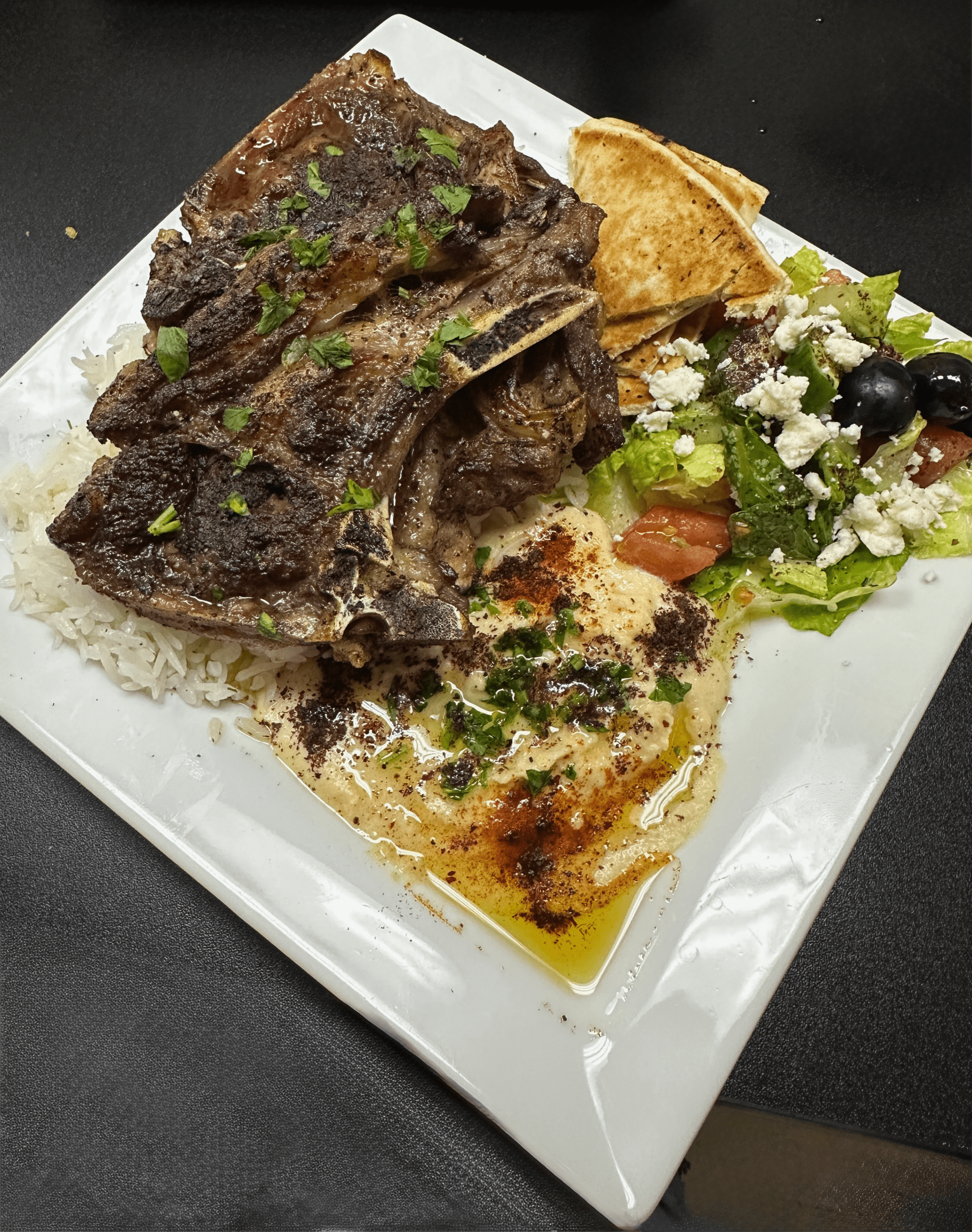
2 October 2025: I had to do a double-take when perusing the menu and seeing under the “Protein Plates” a rack of lamb chops for less than twenty dollars ($16.99 as of this writing). Normally you can expect to pay upwards of $35 for lamb chops and you’re getting off cheap at that price. Not only will you get lamb chops, but they’re accompanied by hummus, rice, a salad and more of that fantastic Arabic bread. The lamb chops are not “Frenched” (the process of cutting away fat and meat from the bone end for esthetic presentation) so they’re not as fancy as high-end lamb chops. Because there’s still quite a bit of fat on the bone, you’ll have to work just a bit harder for the well-seasoned lamb. It’s well worth the effort.
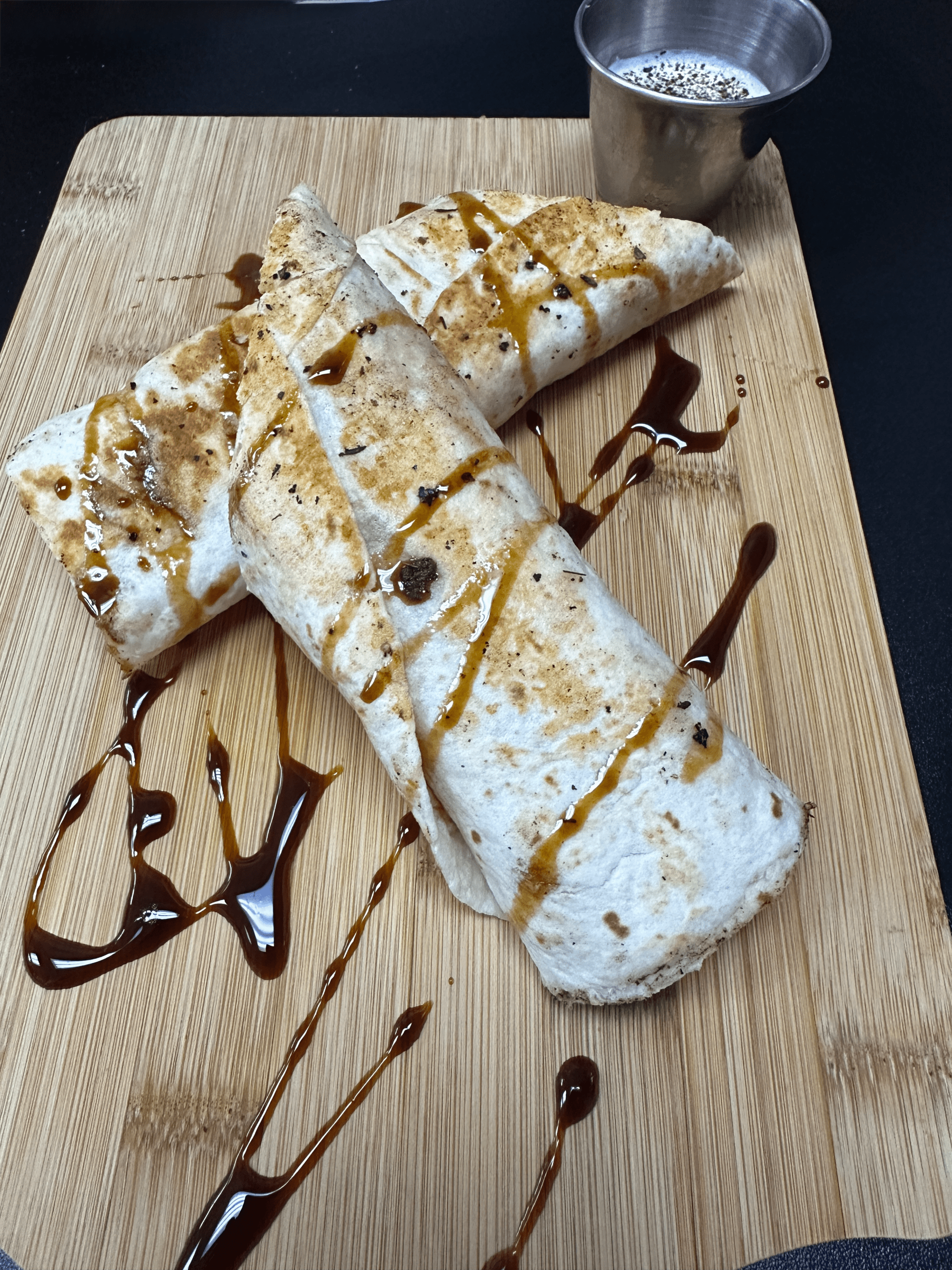
2 October 2025: My Kim’s choice was a beef kebob wrap. Instead of Arabic (pita-like) bread, the wrap was made with shrak bread, a large, unleavened, and extremely thin flatbread reminiscent of a flour tortilla. The shrak is engorged with moist, well-seasoned beef and is served with a yoghurt sauce somewhat like tzatziki. Drizzled onto the board on which the wrap is served is a pomegranate sauce not unlike a good balsamic. Noticing how enamored we were of the pomegranate sauce, Sufyan told us it’s available in the market as is a similar sauce made with dates. Though not nearly as thick as gyros, sliced in two the wrap might be even larger. It’s also quite good.
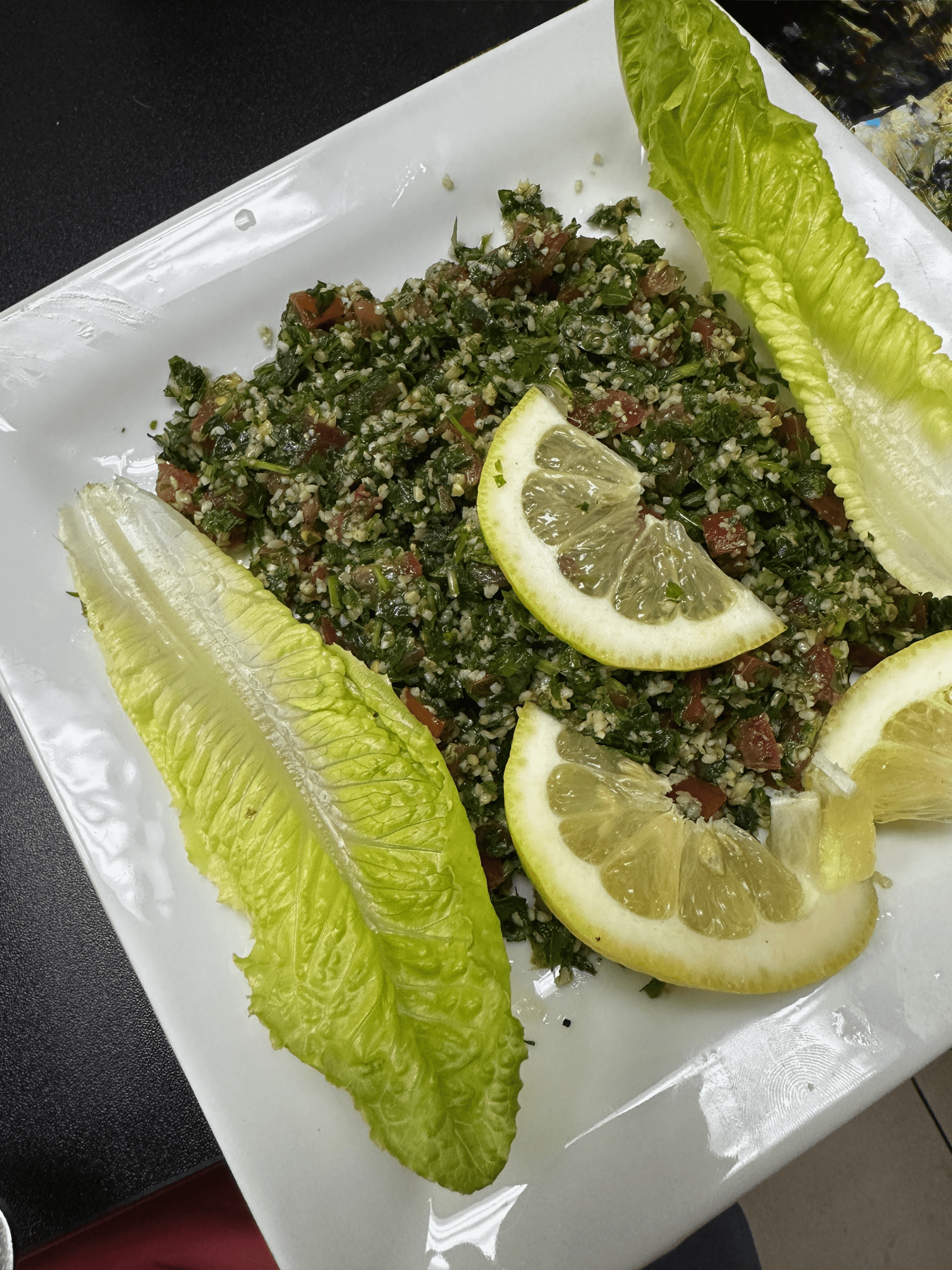
2 October 2025: You might think that with my bumpkinly upbringing I wouldn’t have a very broad exposure to cuisines of the world. For the most part, would be true. Thankfully among our neighbors were Albert and Jeanette Owen, a wonderful Lebanese couple. Jeanette was a terrific cook whose tabouli showed us there’s more to salad than iceberg lettuce with dressing. Nora’s tabouli brought back memories of some of the best neighbors anyone could have. It’s got a pungent, herbal flavor with subtle peppery notes and brightness from the many chopped herbs (including mint and parsley) and lemon juice. This is one of the best versions of the popular Middle Eastern salad we’ve ever had.
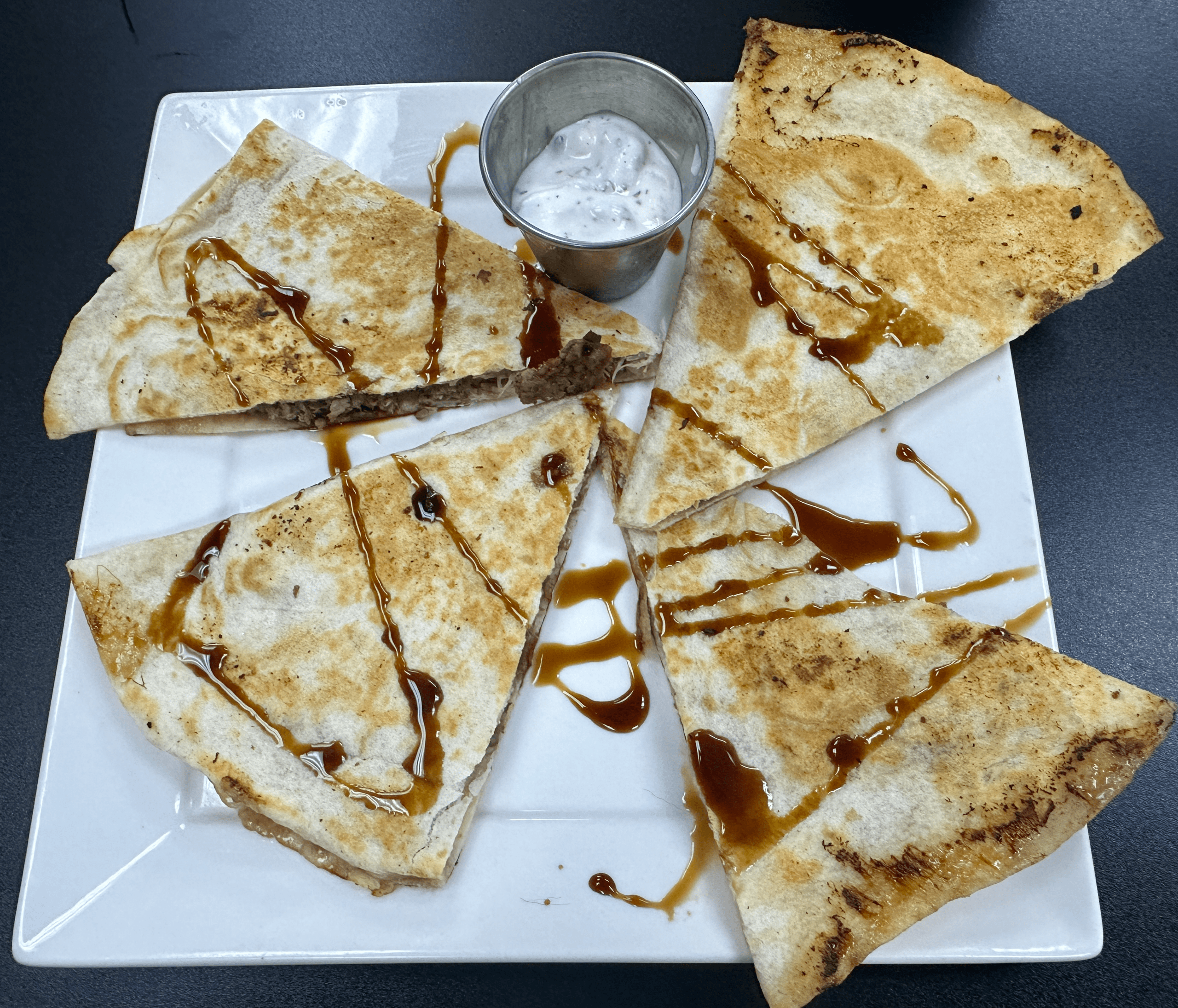
10 October 2025: Though it’s difficult to pry ourselves from the appetizer combo, we had to try arayes, a delightful appetizer neither of us had previously had. The menu describes arayes as “toasted bread filled with meat, onion, parsley and Palestinian spices. Four triangle-shaped wedges are drizzled with a sweet-sour date syrup and served with tzatziki sauce. Crispy Arabic bread is a new experience for us. Each wedge is crispy while the ingredients sheathed within are tender and moist. The date syrup adds a surprising dimension, one counterbalanced by the tangy, slightly sour tzatziki sauce. This is yet another great starter.
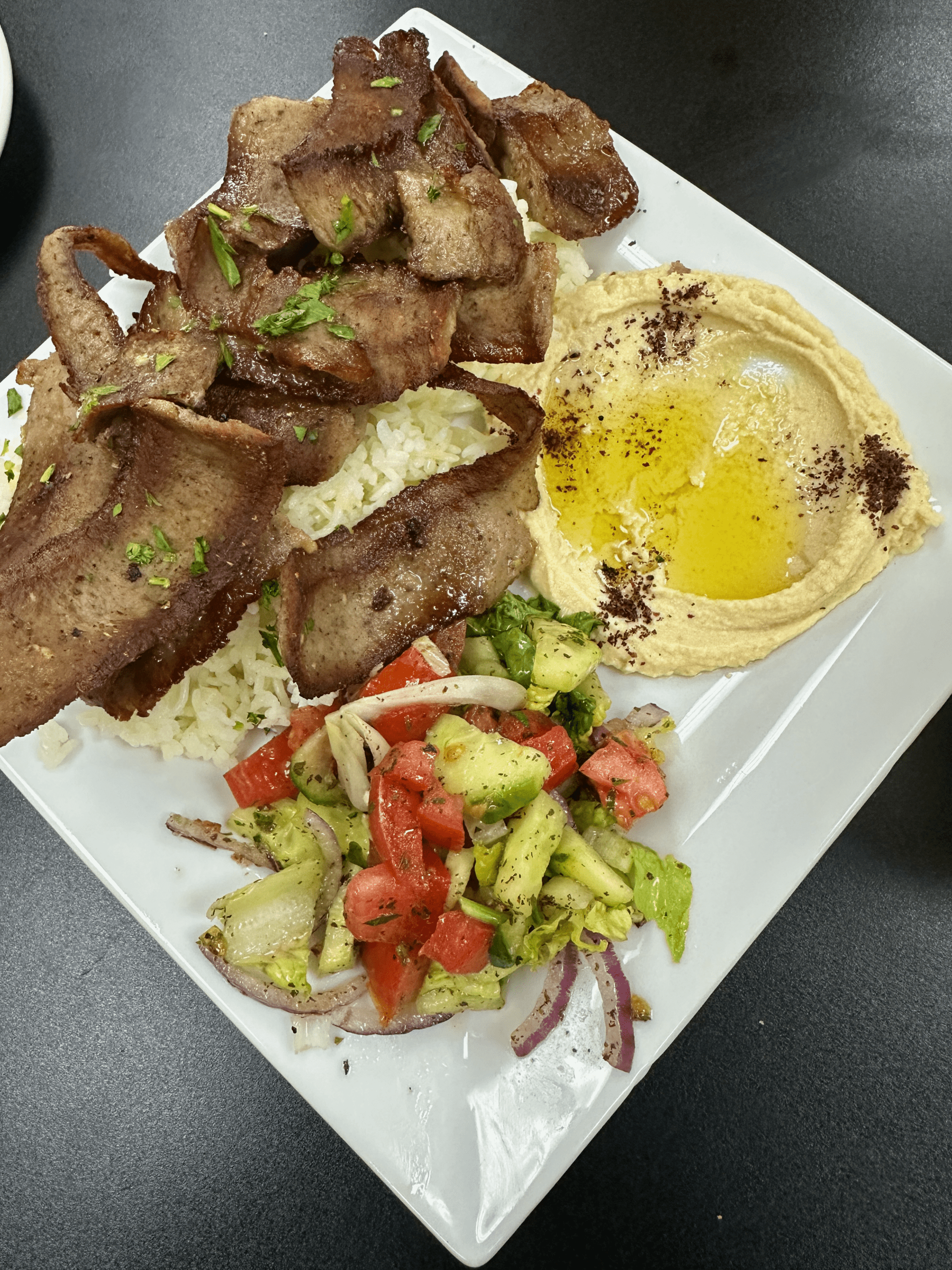
10 October 2025: Although the standard definition of a gyro is “meat cooked on a vertical rotisserie, then sliced and served wrapped or stuffed in pita bread,” Nora’s version (special gyro on the menu) comes with pita on the side. This plate is replete with gyro meat (an amalgam of beef and lamb) atop rice, an Arabic salad (fresh tomatoes, onion, cucumber, lemon, Palestinian olive oil) and hummus. Every element of this plate is as good as it can possibly be. My Kim found the Arabic salad surprisingly good for such a simple salad. Credit the freshness of each ingredient for that. The gyro meat is nicely seasoned with a slightly crispy exterior and tender, moist interior.
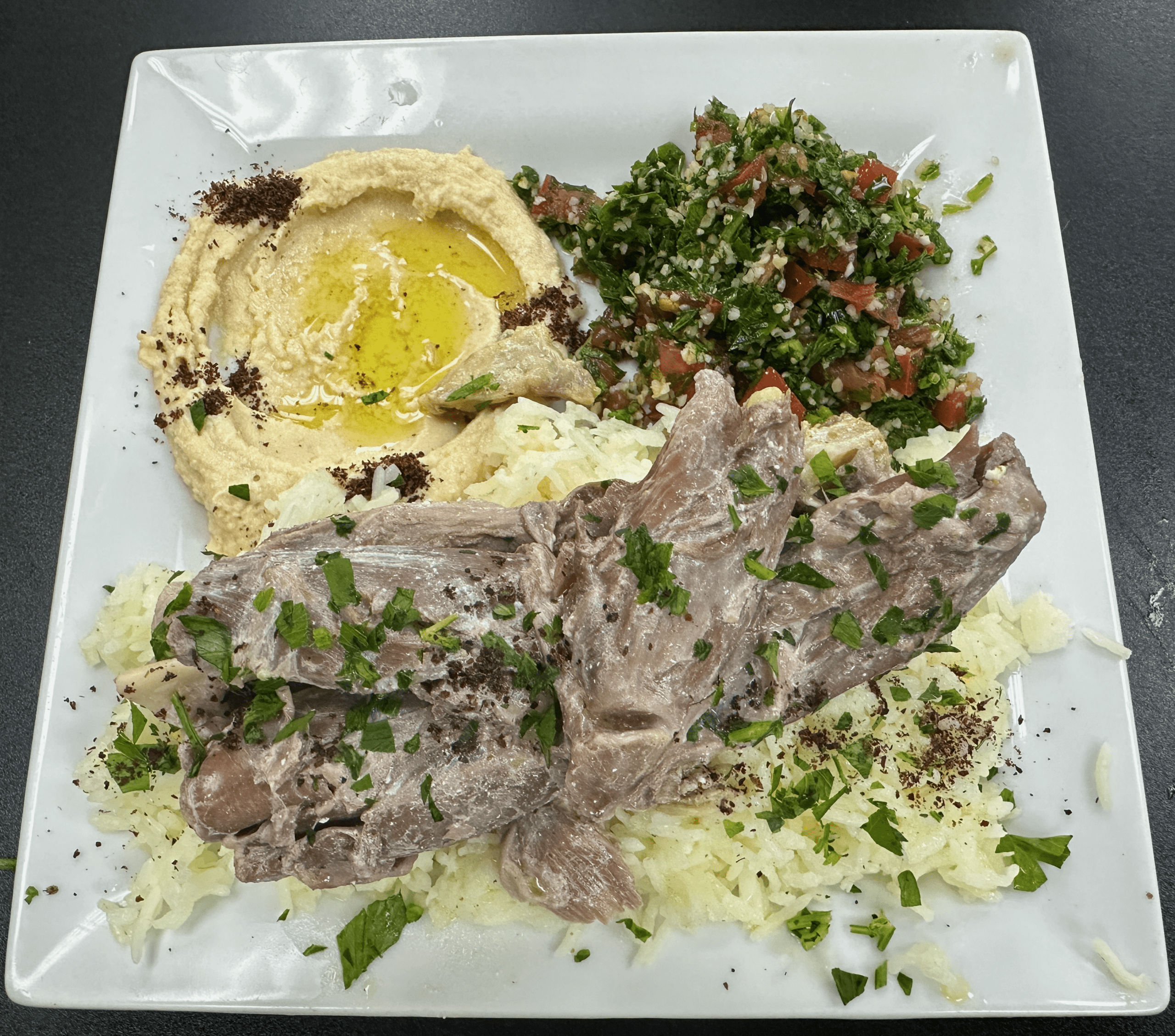
10 October 2025: Mansaf is considered the national dish of Jordan, holding significant cultural importance. In Jordan, mansaf represents ihospitality, unity, and cultural heritage. It’s central to major social events like weddings and family gatherings, where it signifies generosity and is eaten communally from a large platter. Historically, mansaf has also been used to resolve conflicts and restore peace between tribes, with the act of sharing the meal serving as a peace-making ritual. Hmm, that sounds like a Nobel Prize worthy dish. Alas, Nora’s serves mansaf only on Fridays. Mansaf is made with tender lamb or goat in a sauce of fermented dried yogurt called jameed. It’s served over rice which acquires some of the delightfully sour flavor of the jameed.
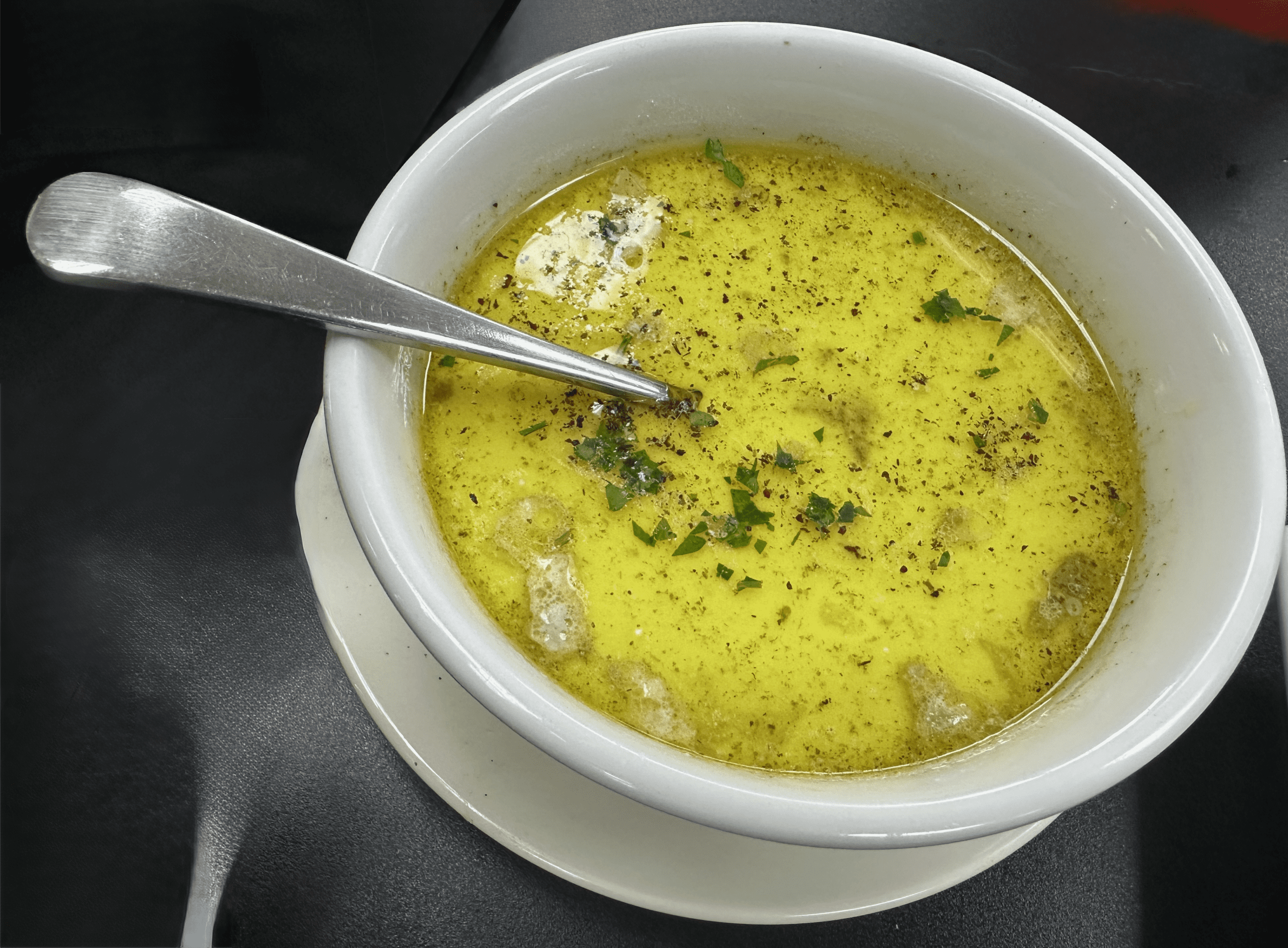
10 October 2025: At Nora’s, mansaf is plated generously with hummus and tabouli. Sufyan also ferried over a hearty bowl of soup made from a lamb stock and enriched by yoghurt. He indicated that soup is essential to the experience of enjoying the dish as Jordanians do. Mansaf is not the most attractive dish on the menu (boiled lamb isn’t especially appetizing to the eye), but it should be on every foodie’s bucket list. The lamb is amazing. Any gaminess you might imagine is well taken care of by the jameed. It’s a very tender lamb that chews easily and practically melts in your mouth. The soup is wonderful, too. Shards of that tender lamb float around in the wondrous lamb stock while the tangy yogurt gives you a soup experience unlike any other. Fridays aren’t just the last day of the workweek. Fridays are now the day in which mansaf shines at Nora’s.
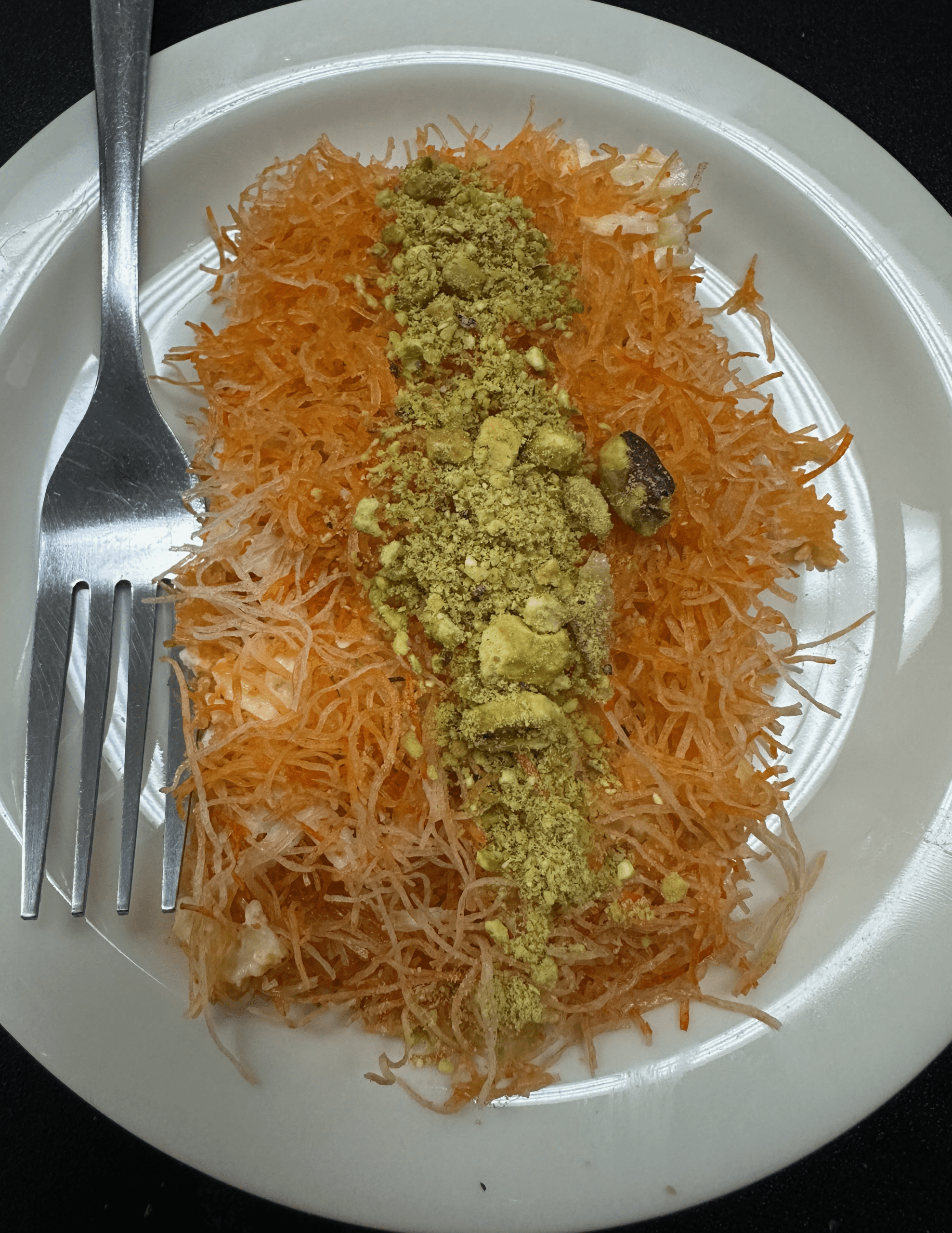
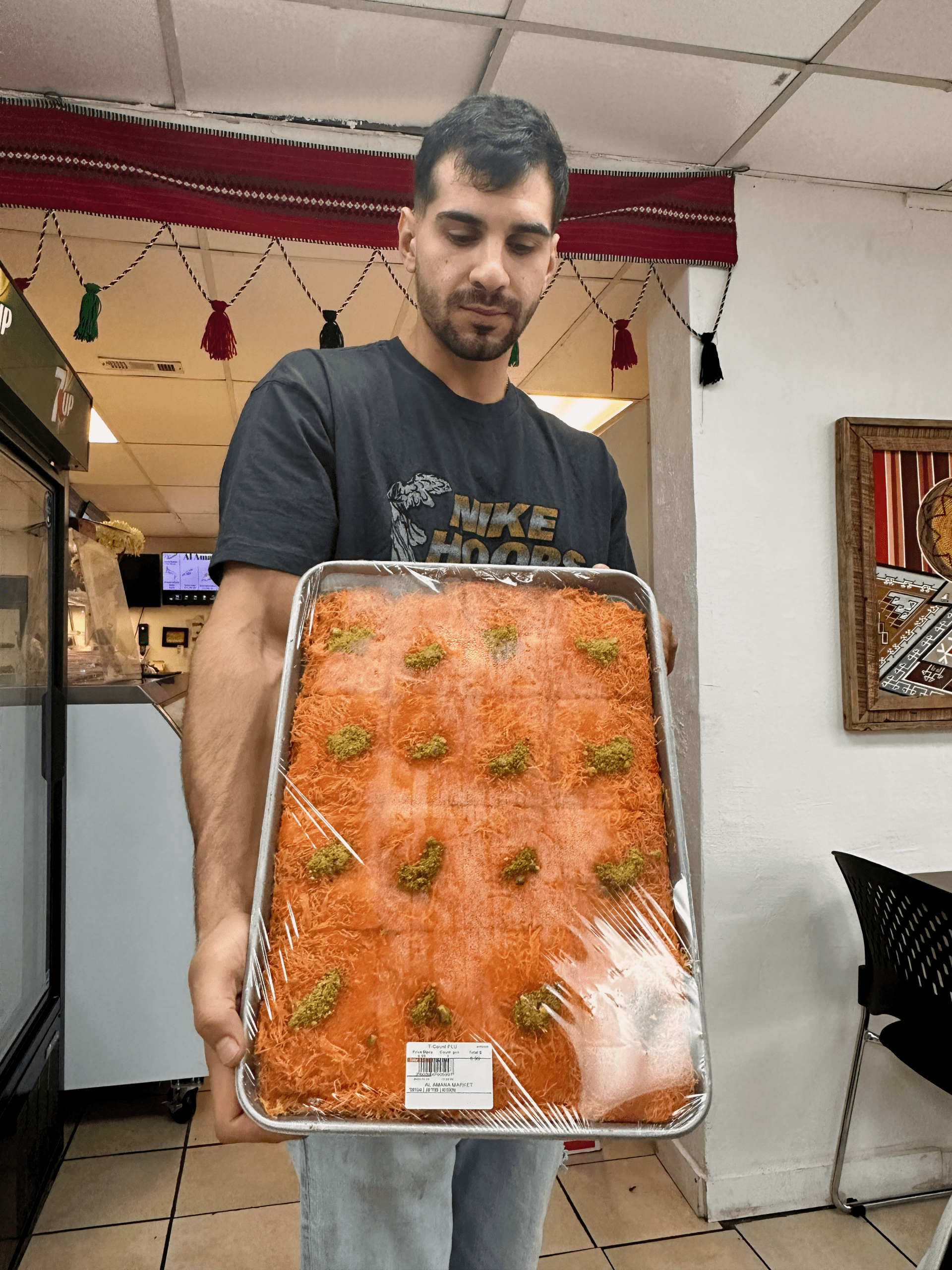
2 October 2025: Unless you already know what it is, the first time you see a slice of knafeh destined for your table you’re likely to think it’s topped with shaved carrots similar to my favorite Indian dessert Gajar ka halwa (make sure to visit Namaste for my favorite version). Despite appearances, no carrots were harmed in the creation of knafeh, one of the most popular of all Middle Eastern desserts. My Egyptian friend and former colleague at UNM, Nader Khalil introduced me to this fabulous dessert some time ago and it’s become an obsession for me, too. Norah’s version is superb! What you might mistake for carrots is actually crunchy kadaif (angel hair) made from wheat flour and sugar with water into a type of phyllo dough and then shredded to resemble fine angel hair. Two layers of kadaif are filled with a layer of akkawi (a warm cheese), sprinkled with nuts, and baked. After baking, the warm kanafeh is topped with a delicious syrup of sugar and rose water then topped with crushed pistachios (almost necessary because this is a very sweet dessert). Kanafeh just might just become one of your favorites.
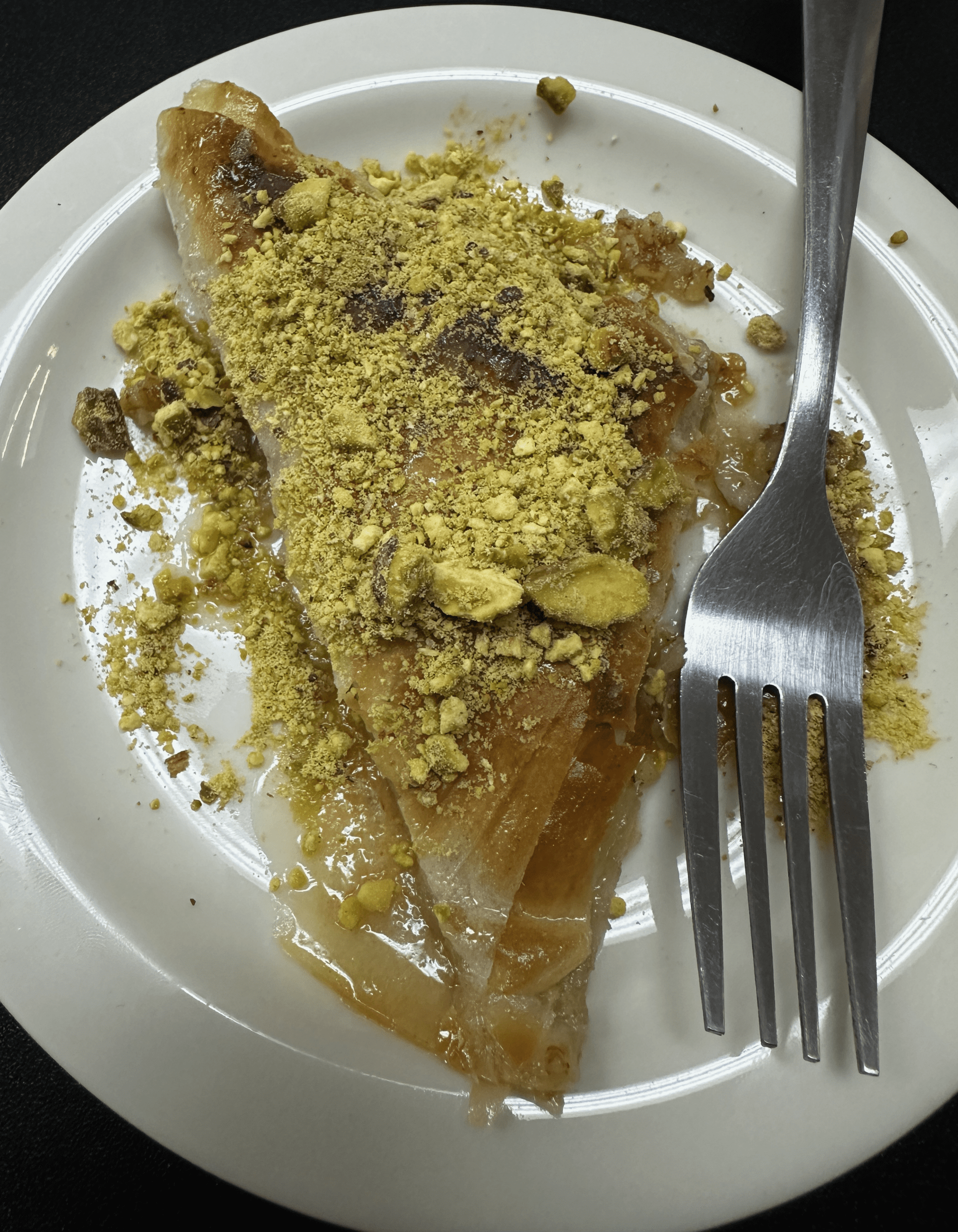
2 October 2025: Pistachio baklava is a Middle Eastern layered dessert made from numerous sheets of phyllo dough brushed with butter, filled with finely ground pistachios, and baked to a golden-brown color before being soaked in a sweet syrup. That sentence probably had you at “dessert,” but reading its description isn’t nearly as transformative as enjoying pistachio baklava. This crispy, sweet, nutty, and flaky confection is absolutely sublime. If pistachios aren’t your thing, Nora’s also offers walnut and almond baklava.
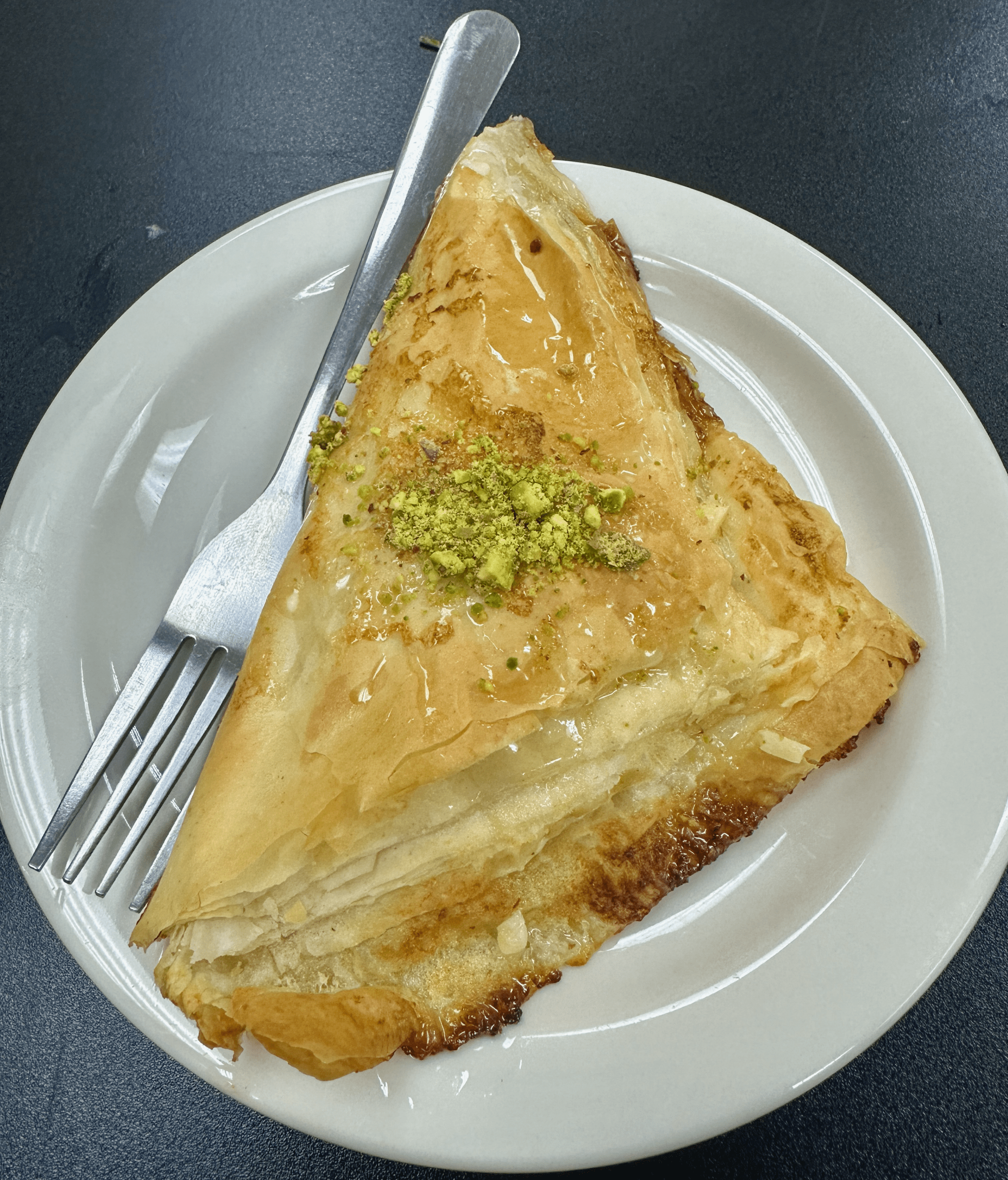
10 October 2025: For as long as memory serves me, my favorite Middle Eastern dessert has been pistachio baklava. Greek baklava (too sweet) doesn’t cut it. Middle Eastern baklava–whether topped with pistachios or walnuts–is much more balanced, not cloying. Sufyan introduced me to a heretofore untried dessert that may have supplanted pistachio baklava for my affections. That dessert is warbat (no, not Godzilla’s nemesis), a sweet, flaky, triangle-shaped Middle Eastern pastry. Layers of thin phyllo dough are brushed with ghee (clarified butter) or butter and filled with a creamy custard known as ashta. After being baked to a golden crisp, it is drenched in a fragrant sugar syrup then often garnished with crushed pistachios. It’s an outstanding desert!
For a taste of Jordan, this formerly precocious youngster can find some semblance of travel at Nora’s Cafe where Jordanian dishes are superb!
Nora’s Cafe
10700 Menaul Blvd., N.E. Suite B
Albuquerque, New Mexico
(505) 295-3853
Website | Facebook Page
LATEST VISIT: 10 October 2025
1st VISIT: 2 October 2025
# OF VISITS: 2
RATING: Very Good – Good to very good food; generally solid; delivers consistent quality, strong technique, and a comfortable, enjoyable dining experience
COST: $$
BEST BET: Appetizer Combo, Pita Bread, Lamb and Okra Soup, Arabic Tea, Beef Kabob Wrap, Tabouli, Knafeh, Pistachio Baklava, Special Gyro, Jordanian Mansaf, Warbat
REVIEW #1491
I ran into your blog while googling halal restaurants in Albuquerque. Thank you so much for highlighting small restaurants in the city! Looking forward to reading your other reviews