Mati Peruvian Restaurant – Albuquerque, New Mexico

In 2004, The Economist (a British weekly news publication) proclaimed that “Peru can lay claim to one of the world’s dozen or so great cuisines.” In 2005, Bon Appetit declared Peruvian “the next hot cuisine,” extolling its “vibrant ceviches, crispy, spiced rotisserie chickens and packed-with-flavor empanadas” then encapsulating its declaration with “this is one cuisine we could eat every day.”  A year later, at the world’s premier gastronomic forum, the International Summit of Gastronomy, Lima (the coastal nation’s capital city) was touted as the “gastronomic capital of the Americas.” In 2011, The Wall Street Journal also called Peruvian food “the next big thing” glossing that it “provides flavors that have the world’s top toques raving, experimenting and catching the next jet.”   The following year, BBC expressed the same “next best thing” notion.  In 2014, Conde Naste Traveler called Peru “the future of gastronomy.”  One year later, The Culinary Exchange expressed that “the world’s next global food trend is…Peruvian cuisine.”  A number of other online and print publications parroted that “next big thing” mantle. As an independent  observer of the culinary condition, I had to wonder “when will Peruvian food finally arrive as the “next big thing,” especially in Albuquerque which isn’t…

Pollito Con Papas – Albuquerque, New Mexico

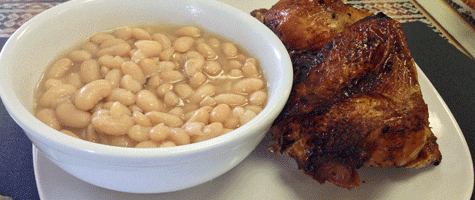
I think a rotisserie is like a really morbid ferris wheel for chickens. It’s a strange piece of machinery. We will take the chicken, kill it, impale it and then rotate it. And I’ll be damned if I’m not hungry because spinning chicken carcasses make my mouth water. I like dizzy chicken. – Mitch Hedberg Comedian Mitch Hedberg may have meant it in a funny vein, but it’s no joke that Americans are finding rotisserie chickens not only sexy and sumptuous, but convenient, flavorful and oh, so easy to prepare. The latter three were reasons most cited by consumers for liking rotisserie chicken. In 2015, the National Chicken Council survey estimated that 900 million rotisserie chickens are sold each year in the United States, a number that’s expected to exceed one billion by 2018. According to Lohud, a trade publication, nearly 700 million of those birds will be sold in supermarkets. At $5 a pop, that’s $3.5 billion in sales. Since 1980, the per capita consumption of poultry–and not just rotisserie chicken–in America has increased significantly. According to the U.S. Department of Agriculture and the National Chicken Council, Americans are eating more chicken than ever. The per capita consumption of…

Sara’s Pastries and Deli – Albuquerque, New Mexico (CLOSED)

Creator! You who give life to all things and who has made men that they may live happy and multiply. Multiply also the fruits of the earth, the potatoes and other food that you have That men may not suffer from hunger and misery. ~Traditional Incan Prayer As recently as 2010, Albuquerque–which rightfully takes great pride in its acceptance of cultural and culinary diversity–did not have a single Peruvian restaurant. Fast forward three years to March, 2013 and there are three restaurants showcasing to Duke City diners just a modicum of the tremendous diversity and deliciousness offered by Peruvian cuisine. Every one of the three is unique, each highlighting only a segment of the culinary offerings that make Peruvian cuisine one of the great cuisines of the world. More than perhaps any of the world’s great cuisines, Peruvian food is impossible to pigeonhole or stereotype. It is the original fusion cuisine, having absorbed culinary influences from streams of immigrants encompassing every great culinary culture and melding them with indigenous ingredients and dishes, many with Incan roots. As a result of this cultural and culinary fusion, the Guinness Book of Records recognizes Peru as the nation with the most local plates,…

Taste of Peru – Albuquerque, New Mexico (CLOSED)

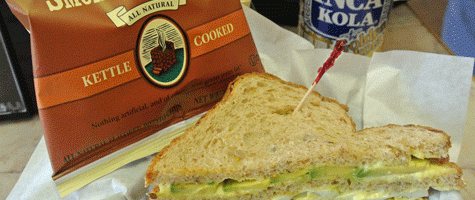
Early in 2013, the National Restaurant Association took the pulse of more than 1,800 professional chefs and nearly 200 professional bartenders with its annual “What’s Hot” culinary survey designed to predict restaurant menu trends for the coming year. Considered the definitive forecast of culinary inclinations, the survey’s “Ethnic Cuisines and Flavors” category was topped by Peruvian cuisine which is not only hot, it’s cool. It’s hip, swanky and trendy. It’s so “happening” that even New Mexico, which is sometimes years behind culinary trends, has embraced it. Since 2011, three Peruvian restaurants have launched in the Duke City. Peruvian cuisine is so diverse–recognized by the Guinness Book of Records as the nation with the most local plates, some 491 officially registered dishes in all–that there is very little cross-over among the three Duke City denizens of Peruvian food. The antecedent for hopefully several other Peruvian restaurants is the highly acclaimed Pollito Con Papas which, thanks to arguably the best rotisserie chicken in Albuquerque, had to triple its real-estate within a year of its 2011 launch. The most centrally-located of Albuquerque’s three Peruvian restaurants is Sara’s Pastries & Deli, ensconced in the increasingly familiar Journal Center Market Place launched in February, 2013.…

The Paradise Grill – Las Vegas, Nevada (CLOSED)

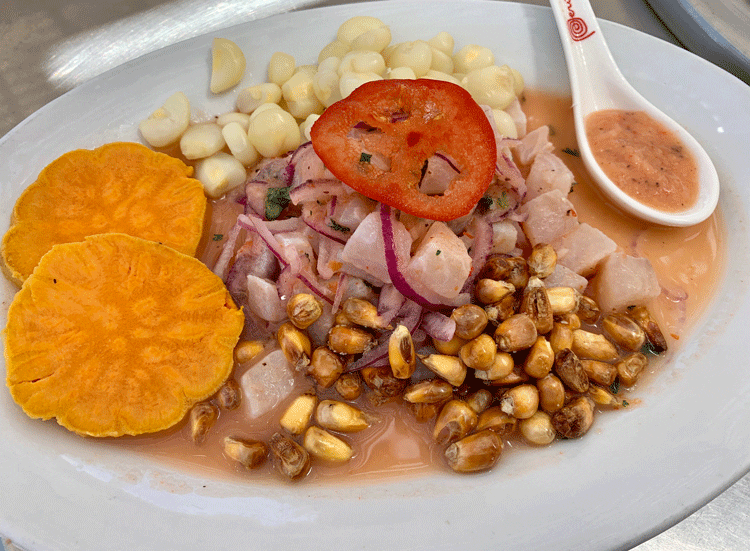
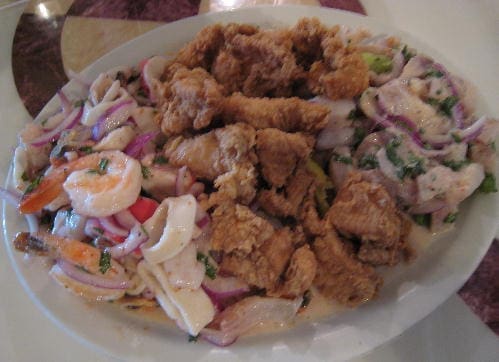
Americans spent several billion dollars a year on products touting their ability to provide fresh breath.  Ultrabrite toothpaste promises to “give your mouth sex appeal” while Colgate’s Oxygen toothpaste’s slogan is “Pure, Fresh, Clean.”  Fresh breath is so important to our culture that we even insist our pets have it. Milk Bone Dog Biscuits pledge to “freshen breath naturally” so of course, we buy that product in bulk for our four-legged children. Fresh breath, it seems, translates (at least on humans) to a “cool, minty sensation with no mediciny taste” if commercials are to be believed. It’s unlikely dogs would appreciate having minty breath, preferring instead something smelling with the aroma of rotted carcass.  So why this digression into the emphasis our culture places on fresh breath when this is supposed to be a review of a Peruvian restaurant in Las Vegas, Nevada. The answer can be found in one word–ceviche. The ceviche at the Paradise Grill is so fresh and invigorating that it will impart upon your mouth, a sensation of freshness that may last for hours. I’ve had ceviche on three continents and it has varied in quality and memorability. None has impressed itself on my taste buds…

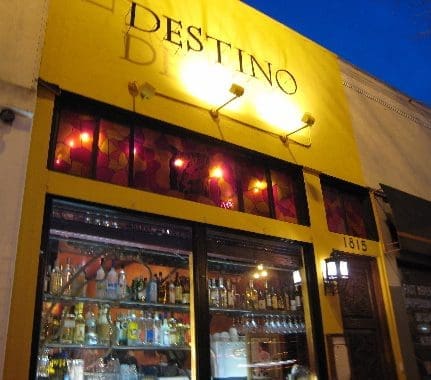
Destino Nuevo Latino Bistro – San Francisco, California (CLOSED)

In 2004, The Economist (a British weekly news publication) proclaimed that “Peru can lay claim to one of the world’s dozen or so great cuisines.” In 2005, Bon Appetit declared Peruvian “the next hot cuisine,” extolling its “vibrant ceviches, crispy, spiced rotisserie chickens and packed-with-flavor empanadas” then encapsulating its declaration with “this is one cuisine we could eat every day.”  A year later, at the world’s premier gastronomic forum, the International Summit of Gastronomy, Lima (the coastal nation’s capital city) was touted as the “gastronomic capital of the Americas.” What’s surprising is not that the culture-rich cuisine of a small, multi-ethnic nation rarely on the world’s stage received such acclaim, it’s that it took so long.  Peru’s culinary traditions, after all, began in pre-Columbian times. Peru was home not only to the oldest known civilization in the Americas (the Norte Chico civilization flourished as early as the 30th century BC) but later to the largest civilization in the Pre-Columbian Americas–the Incan empire. Immigration melded the culture and cuisine of the Spanish, Basque, African, Moorish, Sino-Cantonese, Japanese and in the 19th century, the Italian, French and British with Peru’s indigenous peoples, the descendents of the pre-Incas and Incas, to combine the…