Gold Street Caffe – Albuquerque, New Mexico (CLOSED)

When you’re alone and life is making you lonely You can always go – downtown When you’ve got worries, all the noise and the hurry Seems to help, I know – downtown Just listen to the music of the traffic in the city Linger on the sidewalk where the neon signs are pretty How can you lose? The lights are much brighter there You can forget all your troubles, forget all your cares So go downtown, things’ll be great when you’re Downtown – no finer place, for sure Downtown – everything’s waiting for you. Just a few years ago, the lyrics to Petula Clark’s January, 1965 number one single, would not have been used to describe Albuquerque’s downtown area. In fact, the downtown area was more ghost town than boomtown except for during weekday business hours and late night at bars. Even in September, 1998 when Sarah Brown launched the Gold Street Caffe in a historic building circa 1911, the notion that Albuquerque’s downtown would become a social, economic and cultural hub might have been met by skepticism save for the unwavering optimism of visionaries who recognized the area’s potential beyond its historic attachment to the Mother Road, Route 66.…

Duke’s Steakhouse – Albuquerque, New Mexico (CLOSED)

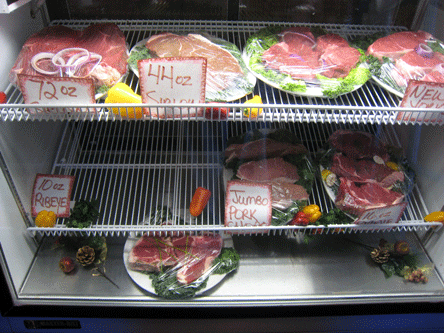
“Did you ever see the customers in health-food stores? They are pale, skinny people who look half dead. In a steak house, you see robust, ruddy people. They’re dying, of course, but they look terrific.” -Bill Cosby Bill Cosby probably didn’t have actor Robert Mitchum in mind when describing the type of people who visit steak houses. Heralded by movie critic Roger Ebert as “one of the greatest actors of all time,” the masculine Mitchum was certainly robust (evincing strength and vigorous health) and ruddy (inclined to a healthy reddish color often associated with outdoor life), but he wasn’t the type of he-man you might envision in a steak house. Presiding over a campfire, yes, but sitting down at a restaurant, no. Over an open flame, Mitchum would, of course, be grilling a sizzling, flame-kissed slab of thick, red beef destined to overfill his plate. There would be no vegetables in sight nor would you find a tablecloth, candles or soft music. With the rousing composition “Rodeo” playing in the background, Mitchum would be heard to say, “Beef. It’s what’s for dinner!” Largely through Robert Mitchum’s compelling voiceovers, the American Beef Council has been telling America beef is what’s for…

Lotus Cafe – Albuquerque, New Mexico (CLOSED)

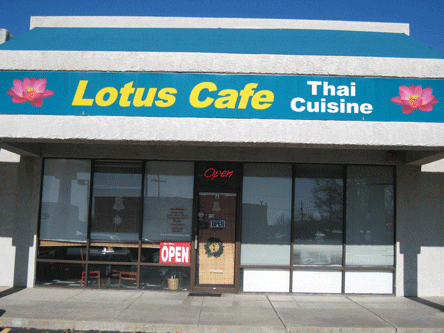
Balance. The Diné, or Navajo, of America’s Four Corners Region have a word for it: “hózhó.” The word embodies the idea of striving for balance and harmony along with beauty and order. Every aspect of Diné life–whether spiritual or secular–is connected to hózhó, maintaining balance between the individual and the universe and living in harmony with nature and the Creator. Balance. America’s favorite everyman philosopher Homer J. Simpson might define it as “a donut in each hand.” Obviously politicians discussing the budget should definite it as something unachievable, an ephemeral concept, a meaningless and baseless promise uttered simply to mollify their constituency. The dictionary might define it as a state of equilibrium. Balance. The underlying foundation of Thai cuisine, going back to Chinese influences as early as the 10th century, is to achieve a satisfying and exciting taste experience through the relationship between five fundamental tastes: sweet, salty, spicy, sour and bitter. Properly balancing these flavors is the true essence of Thai cooking. Each Thai dish generally has three or four of these flavors harmoniously interplaying with one another in a way that is not only delicious, but balanced. In most dishes, one flavor predominates with the other flavors being…

Coronado Grill – Bernalillo, New Mexico (CLOSED)

In 1540 while searching for the fabled seven Cities of Gold, Francisco Vasquez de Coronado camped with his soldiers near the ancient Pueblo of Kuaua on the western banks of the Rio Grande where the city of Bernalillo exists today. Coronado never did locate the mythical Cities, finding instead a thriving agricultural village inhabited since 1300. Only the partially reconstructed ruins of Kuaua (a Tiwa word for “evergreen”) remain today, but the “City of Coronado” still celebrates the Spanish explorer whose legacy has been somewhat tarnished by revisionist history. The conquistador’s namesake restaurant is situated just south of the ruins in a sprawling 5,000 square foot complex sitting on three acres overlooking the Rio Grande. For ambience, you can’t beat the spectacular Rio Grande riverside vistas, especially on a crisp autumn evening when the moon is coming up over the Sandias. It’s one of the most spectacular vantage points in the entire state for luminous lunar gazing. Weather permitting, diners can take advantage of the spectacular vistas by dining al fresco under a canopy of stars where they can breathe in New Mexico’s salubrious night air.  The exterior patio is a popular venue for parties and golfers alike.  From two…

Harla May’s Fat Boy Grill – Belen, New Mexico (CLOSED)

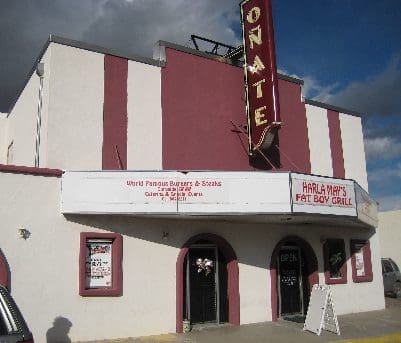
Many of us who grew up in small town America during the 60s sometimes pine for the more innocent days of our youth–the days before cable television gave us hundreds of channels (and nothing to watch) and video games became the only form of exercise (albeit, of their thumbs) our children get. Back then, the movie theater was the town’s cultural center. It was where small-town America congregated to see Hollywood blockbusters (about two years after they hit the big cities) as well as movies which introduced our innocents to the Hell’s Angels, Bruce Lee, Godzilla and campy Sonny and Cher movies. The small-town American theater in New Mexico also meant Cantinflas, the campesino once referred to by Charlie Chaplin as the greatest comedian in the world. It meant not only American “shoot ’em up” Westerns featuring rugged cowboys, rowdy rustlers, round-ups and home on the range, but the Mexican equivalent–movies featuring the exploits of charros, the traditional cowboys of central and northern Mexico. The small-town American theater was where boys and girls went to hold hands in the dark back in the days when “getting through the bases” took considerably longer than it does today. It truly was a…

Porky’s Pride Real Pit BBQ – Albuquerque, New Mexico (CLOSED)

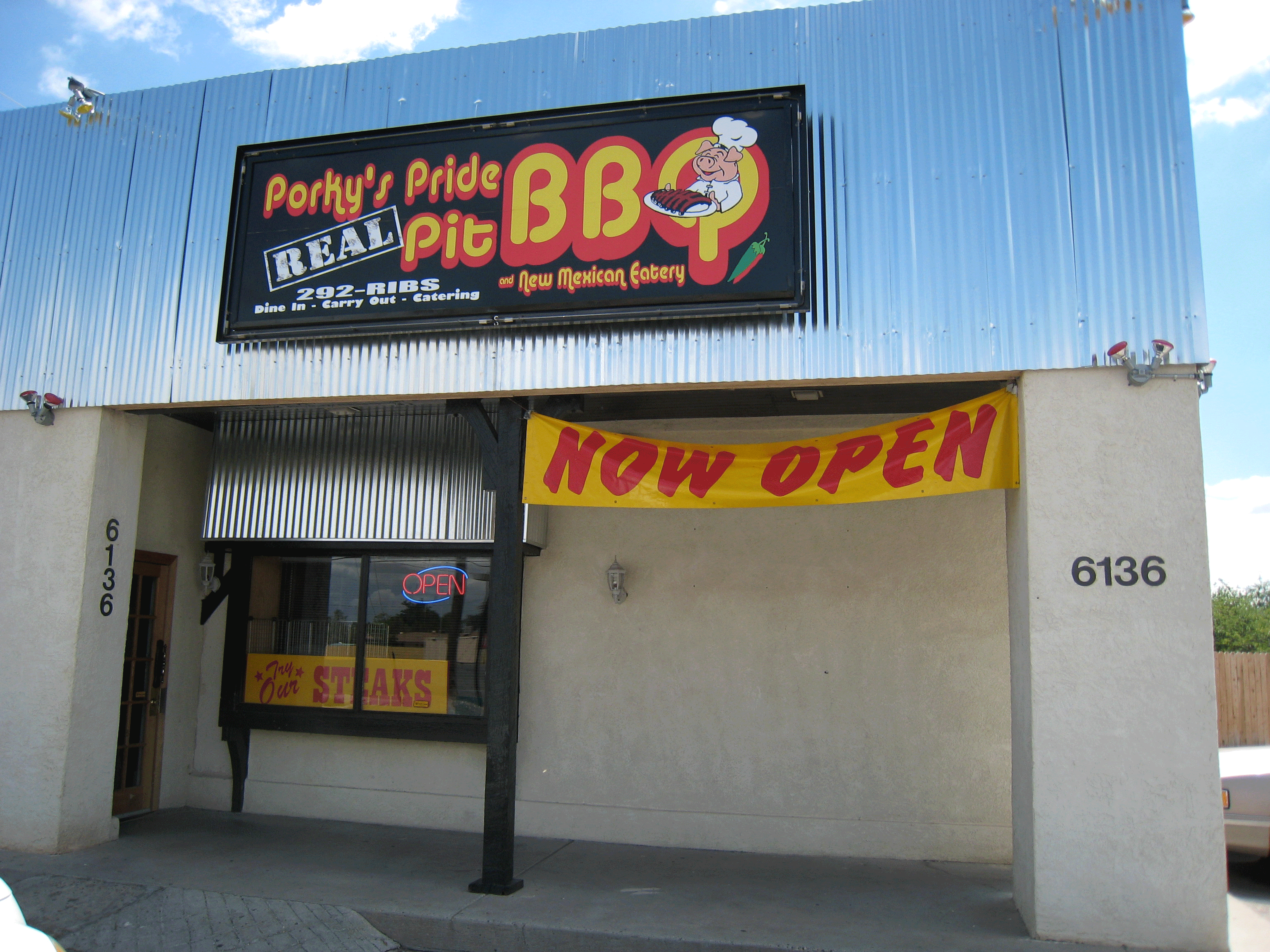
The genesis of America’s popular music–country, jazz and even rock and roll–is rooted in the soul and sounds of Mississippi Delta blues–sounds born in the disgraceful shadow of slavery and lyrics which echoed the grievous plight and painful lament of workers in plantations and fields.  It is a tribute to the resilience of a people that the music of their lament evolved over the centuries to bring succor, alacrity and pride to generations. Given poor quality meat, those plantation workers dug pits in the ground in which they cooked the poor cuts of pigs or meat they were allowed to raise. When emancipated, the pit masters introduced their prowess over the barbecue pit throughout the United States. The American epicenters of barbecue excellence–Texas, Memphis, Kansas City and the Carolinas–all owe their barbecue roots to the deep south. Today, the term “real pit barbecue” rarely refers to a big hole in the ground. A barbecue pit is almost always above ground in a steel “oven” in which meat revolves on racks until just right.  The pit master’s prowess is showcased in the way he or she deftly manipulates indirect heat and wood smoke to produce the inimitable flavor that has made…

Salsas Grill – Albuquerque, New Mexico (CLOSED)

Salsas Grill features outstanding cuisine served with a Guatemalan flair, style, grace and hospitality. Affable proprietors Olga and Sigfrido Paz and their daughter Angie have decorated the restaurant with colorful nick knacks (mostly bowls and plates adorned with fruits and vegetables) from their native Guatemala. They have decorated the menu with Mexican, Guatemalan and New Mexican favorites prepared exceptionally well and served with class. Sigrido attends to his customers with a polite demeanor and genuine warmth while Olga crafts her culinary creations. Salsas Grill is nestled on the west mesa, offering a spectacular romantic view overlooking the city of Albuquerque and the spectacular Sandia Mountain range to the east.  Its address is Coors, N.W., but that’s only because it’s most visible storefront faces Coors.  Visitors coming in from the west will generally exit off Coors and head west on Dellynne.  You’ll want to make an almost immediate left onto Mirador into what appears to be a residential enclave.  Salsas Grill is next door to a Domino’s Pizza store. Mexican muzak is piped through the restaurant’s sound system, helping to create a relaxing milieu in which hushed tones are appropriate for the close proximity of tables in the smallish mom and…

Kingfish Hall – Boston, Massachusetts (CLOSED)

“Endorse what you love.”  That’s the message NASCAR driver Tony Stewart delivers to Eric Estrada, Carrot Top and a host of other candidates the stature of which usually grace Dancing With The Stars and other dreadful reality shows.  If the television commercial is to be believed, what Stewart loves is Burger King, the fast food sponsor who supplanted Subway on the hood of his car and which is now paying for Stewart’s love. What it seems celebrities, including celebrity chefs, love most is having their names and smiling countenances visible to the general public and getting paid wheelbarrow’s full of money for the privilege.  Do you really believe Food Network glitterati Guy Fieri loves TGI Fridays or that Applebee’s can really execute Tyler Florence’s recipes?  Television commercials would have you believe that (then they’d also have you believe the myth about honest politicians, too). Some celebrity chefs not only “sell out” to the corporate cabal, they leave the chef work to someone else (an underpaid “executive” chef) and begin to proliferate the myth that is them by becoming restaurant impresarios.  It doesn’t take long before the celebrity chef’s name adorns the marquee of several restaurants, sometimes in several cities.  Sure…

Sportello – Boston, Massachusetts (CLOSED)

In its April, 2009 edition Saveur magazine feted “12 restaurants that matter,” profiling a dozen restaurants that “represent the best of dining in America today.”  Although that title may at first browse sound a bit condescending, the premise of the article was that restaurants are special places.  ”Everybody has to eat, but going out to eat is a choice.” The one choice of the Saveur sages which most intrigued me was a restaurant in Boston that had been open for less than one year, but which had already been drawing rave reviews.  It wasn’t those reviews that likely swayed the decision to name Sportello one of a distinctive dozen.  It was probably the execution of a concept under the masterful hands of a creative genius. Sportello is an Italian word for counter service and the restaurant is certainly based on that concept.  As a modern interpretation of the classic diner, Sportello has only a handful of traditional tables.  Most of the seating is on a serpentine counter that zigs and zags around the room like the “Don’t Tread on Me” flag of the American Revolution.  Padded stools in close proximity to one another mean there are no strangers here.  This…

Albuquerque Tortilla Company Family Restaurant and Carry Out – Albuquerque, New Mexico (CLOSED)

Fearful that her dim-witted and loose-lipped husband would tell everyone in the village his good fortune in having found three bags of gold, the woodcutter’s wife concocted a plan.  She had her husband buy her a one-hundred pound bag of flour and when he returned with the flour, she told him to lay down and rest for a while.  While her weary husband slept, the woman made tortillas from the entire one-hundred pound bag of flour, so many tortillas the stacks climbed to the ceiling.  She then carried the tortillas outside and threw them all over the ground. When the woodcutter woke up the next morning, he was amazed to find tortillas covering the ground.  His wife told him it must have snowed tortillas during the night.  When he wouldn’t believe her, she sent him to school to learn about the phenomena of snowing tortillas.  While in town, he blabbed far and wide about the bags of gold, something  that didn’t escape the notice of two robbers who showed up at his house demanding the gold. The woodcutter told the robbers that his wife had hidden the gold to which his wife retorted “what gold, I don’t know anything about…

Hurley’s Coffee, Tea and Bistro – Albuquerque, New Mexico (CLOSED)

“May you have food and raiment, a soft pillow for your head. May you be forty years in heaven before the devil knows you’re dead.” — An Irish Blessing Cynics who used to deride Irish food as the worst in the planet would have cautioned you to say a prayer before you ate it, but not necessarily in Thanksgiving for what you were about to receive.  For years the Emerald Isle has captured the imagination with its numberless shades of lush greens, smooth as silk whiskey, stout Guinness beer and poetry that can bring you to the depths of desolation or the heights of alacrity.  What the land of saints, sinners and poets had not, until recently, ever been known for, however, is its cuisine. Historically, just about the kindest things that were said about Irish food is that it was mundane and uninspired.  The stereotypical cavalcade of culinary mediocrity included boiled potatoes, boiled cabbage and boiled corned beef. That, as they say, is then.  Conscious of their beloved nation’s reputation, a new breed of creative Irish chefs (“wacky renegade cheese makers, people curing meat, exploring traditional Irish food ways, cooking well” in Anthony Bourdain’s words) has debunked the myth…