Middle Eastern Food & Kababs – Albuquerque, New Mexico (CLOSED)

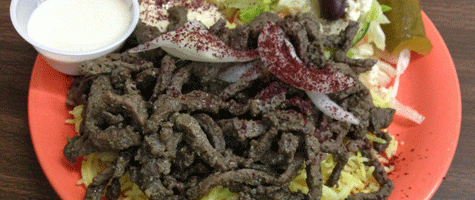
What do you do when you’ve just finished saving the world? Because warding off a vicious onslaught of alien invaders is bound to make you hungry, you just might have shawarma. That’s what the Avengers, Earth’s mightiest superheroes did. Lying on his back amidst the rubble of a demolished building after helping vanquish a phalanx of evil extraterrestrials, Iron Man doesn’t revel in victory or proclaim “We’re number one!” He asks his superhero colleagues “You ever try shawarma? There’s a shawarma joint about two blocks from here. I don’t know what it is, but I want to try it.” After an intense and lengthy fight scene, his seemingly innocuous statement breaks the tension and reminds viewers that after working hard, even superheroes deserve a well-earned meal. After credits have rolled, the entire Avengers team is shown assembled at the shawarma joint, most still attired in full superhero regalia. The battle weary Iron Man (Robert Downey, Jr.), Captain America (Chris Evans), The Hulk (Mark Ruffalo), Thor (Chris Hemsworth), Black Widow (Scarlett Johansson) and Hawkeye (Jeremy Renner) eat (and ostensibly enjoy) their shawarma while the restaurateurs go about the business of sweeping the floor and cleaning up. As the Avengers’ collective exhaustion…

Olive Branch Bistro – Albuquerque, New Mexico (CLOSED)

The depiction of a dove in flight with an olive branch in its beak is common in early Christian art and tradition. The dove symbolizes the Holy Spirit while the olive branch is seen as a symbol of peace. Christian tradition, as chronicled in Genesis 8:11, describes a dove carrying an olive branch to signal the cessation of flooding throughout the world after forty days and forty nights of rain: “And the dove came in to him in the evening; and, lo, in her mouth was an olive leaf pluckt off: so Noah knew that the waters were abated from off the earth.” Greek mythology mentions the olive branch numerous times, including during a tale of a competition between Athena, the goddess of the wisdom and Poseidon, the god of the sea. With both immortals vying to become the patron deity of Athens, the victor and recipient of the city itself would be determined by which of the immortals bestowed the city with the best gift. Poseidon stuck his massive trident into the ground to create a well of briny sea water, a fairly useless gift. The wise Athena then planted a simple yet infinitely more useful olive tree beside…

Anatolia Turkish & Mediterranean Grill – Albuquerque, New Mexico (CLOSED)

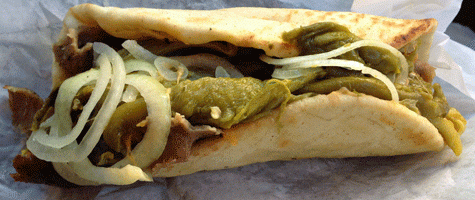
In the mid 80s when my Kim and I lived in rural, agrarian England, a “sandwich” meant one of three things: a warm, fresh floury bap with butter, Cheddar cheese and Branston’s Pickle from our favorite bakery in Lechlade; a grilled ham and cheese sandwich (with chips (fries), of course) from The Plough in Fairford; or a doner kebab from a jankety kebab house in Banbury. There just weren’t many other sandwich options (not to mention burgers and pizza) in the Cotswolds region of England where we lived and certainly no subs, grinders, torpedoes, po’ boys or hoagies. In fact, to our British hosts, the notion that “Yanks” had so many options and fillings for our sandwiches was sheer lunacy on the level of King George, III. Never mind that the bread-encased convenience food known as the “sandwich” was invented by Englishman John Montague, the Fourth Earl of Sandwich. Of the three sandwiches, the memories of all which still rekindle pangs of hunger, our favorite was the doner kebab. It was our special occasion sandwich, the extravagance of which we chose to partake on birthdays and anniversaries. It was the indulgence on which we splurged (we were very poor back…

Ali Baba – Albuquerque, New Mexico (CLOSED)

Legends recount that in his quest for immortality, Mesopotamian king Gilgamesh visited a tavern where a divine barmaid gave him the advise: “Eat and drink your fill, Gilgamesh, and celebrate day and night. Make every day a festival; day and night dance and play.” Because of the fecundity of their land, the people of Mesopotamia could indeed afford to eat, drink and be merry until they died–even if they were denied immortality. The rich culinary legacy of ancient Mesopotamia (modern-day Iraq) can be traced back more than 10,000 years when the comparatively lush and fecund land constituting the fertile crescent gave rise to the cradle of civilization. The availability of water and agricultural resources allowed some of the world’s earliest human civilizations to flourish from both a societal and technological perspective. This region is credited with the development of writing, glass, the wheel and the use or irrigation. Tablets found in ancient ruins throughout Iraq document recipes used in temple festivals, including a 3,700-year-old recipe for a meat pie baked in an unleavened crust. In what are essentially the world’s very first cookbooks, these tablets reveal a very large and gastronomically advanced civilization. A cuneiform script on 24 stone tables…

Yanni’s Mediterranean Bar & Grill – Albuquerque, New Mexico (CLOSED)

The now defunct Albuquerque Monthly magazine titled a May, 1995 article “Yanni Come Lately,” heralding the arrival of a new Greek restaurant on Nob Hill. More than a decade has elapsed since that article and Yanni’s Mediterranean continues to more than live up to the lofty accolades it has earned over the years. Yanni’s has been recognized by other national, regional and local publications for its outstanding cuisine. It has also earned the unwavering devotion of teeming masses who patronize the city’s best Mediterranean restaurant. In 1998, Gourmet magazine named Yanni’s a restaurant of distinction in the Southwest. Southwest Airline’s Spirit magazine has also proclaimed it a great restaurant for Greek food. More recently, readers of the Alibi voted Yanni’s as the best Greek restaurant in Albuquerque as well as the city’s very best restaurant overall in 2009. Considering the vast improvements in the city’s restaurant landscape since Yanni’s launch a decade and a half ago as well as Albuquerque’s propensity for embracing the newest kids in the block, that’s a tremendous accomplishment for what is becoming one of the city’s venerable institutions. In that time, more than Yanni’s reputation has grown. The restaurant now occupies much of a city…

Yasmine’s Cafe – Albuquerque, New Mexico

Never mind an Emmy.  If the Hollywood Reporter and the Huffington Post have their way, comedian Larry David might qualify for the Nobel Peace Prize.  That is if a 2011 episode of Curb Your Enthusiasm can do what diplomats and politicians have failed to do over the years.  In the episode, entitled Palestinian Chicken, Larry discovers a Palestinian restaurant that serves the tastiest chicken in Los Angeles.  The problem is that the restaurant is owned and operated by anti-Semitic Palestinians and Larry is Jewish.  Now, Larry could hardly be considered a peace-maker by any stretch of the imagination.  In fact, his lusty ardor for both the chicken and the restaurant’s proprietor, override his loyalty to Judaism and the local Jewish community.  The episode so impressed Alan Dershowitz, appellate adviser to O.J. Simpson’s defense team, that he sent a copy to Israeli Prime Minister Netanyahu with the suggestion that he invite Palestinian President Abbas over to watch it with him.  Dershowitz’s theory: “maybe if they both get a good laugh, they can begin a negotiating process.” Negotiating world peace over dinner isn’t exactly a novel concept.  A New York group named World Peace, One Falafel at a Time aims to bring…

Cafe Istanbul – Albuquerque, New Mexico

One of the most common responses given as to why people choose to retire in Santa Fe is “because it’s so different.” While it may be true that the “City Different” is different from where respondents came, some native New Mexicans like my buddy Mike Muller postulate that Santa Fe has become the “City Same.” He’s talking about the architectural standards and city ordinances whose uniformity threaten to make Santa Fe a model of adobe-hued homogeneity. Mike points out that Santa Fe’s boring “sameness” hasn’t quite caught up with Albuquerque which in comparison is the rebellious kid in oversized jeans with underwear exposed to Santa Fe’s straight-laced, Catholic uniform-attired school girl. For evidence he points out two architectural anomalies which would not make it in Santa Fe. One is the United Blood Services building whose sanguine facade can be seen a mile away. The other is the bright yellow building on Wyoming which houses Cafe Istanbul, a Mediterranean Grocery Store and Deli. In truth, Cafe Istanbul isn’t quite as bright today as it was in 2001 when Nick and Del Akkad launched their specialty store and deli. New Mexico’s bright sun has dulled the bright yellow somewhat, but it’s still…

Zorba’s Fine Greek Dining – Albuquerque, New Mexico (CLOSED)

“Tell me what you do with the food you eat, and I’ll tell you what you are. Some turn their food into fat and manure, some into work and good humor, and others, I’m told, into God.” ~Zorba the Greek The most obvious theme of the Nikos Kazantzakis novel Zorba the Greek is that life should be lived to its fullest–that its pleasures should be pursued with a lusty vigor.  The embodiment of that attitude was the eponymous, life-affirming protagonist Alexis Zorba whose unrestrained joie de vivre didn’t diminish with advancing geriatric progression.  If anything, Zorba’s exuberance and appetite for the pleasures of the flesh become more pronounced with age.  His passions were governed by his senses, not by social mores or even his own intellection.  In a sense Zorba’s attitude is encapsulated in Dionysus, the Greek god of the grape harvest, wine-making, wine, ritual madness and ecstasy.  In the pantheon of Olympian gods, Dionysus may have been the most “human,” a god subject to mortal traits of impetuousness, irrationality and emotionality.  His passions were expressed in such activities as dancing, drinking and eating.  If there was a Greek god of revelry, drunkenness and inebriation, it, too, would have been…

Sahara Middle Eastern Eatery – Albuquerque, New Mexico

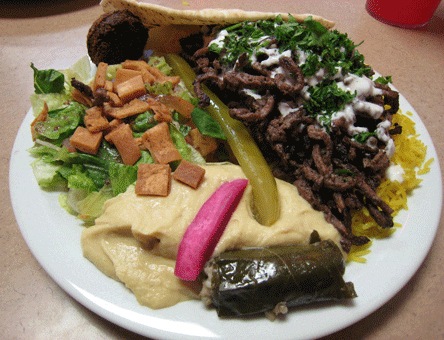
History has shown that cultures which thrived and advanced most rapidly are those which settled in arable areas rife with  natural resources.  The “Cradle of Civilization” where many of the earliest human civilizations evolved is in a seemingly unlikely region of the Middle East in which most of the land is too dry for farming.  In this largely desolate region lies a narrow strip of land known as  the “Fertile Crescent” because of its fecund soil and life-giving waters.  The Fertile Crescent lies in the ancient area stretching in an arc from the Nile to the Tigris and Euphrates, an area the Greeks of Biblical times called Mesopotamia which means “between the rivers.”  This historical region, which includes some of the very best farmlands in the world, includes parts of or the entirety of the modern day nations of Iraq, Syria, Israel, Lebanon and Jordan.  The Bible–from Genesis to the Gospels–overflows with references to the foods of the time as grown in this region. In Biblical times the most common and important foods were bread (the staff of life), olive oil (used instead of butter), milk and cheese from flocks of goats and sheep, vegetables (the most common of which…

‘O Eating House – Pojoaque, New Mexico (CLOSED)

Until the 1990s, Poeh (also known as the Pueblo of Pojoaque) lived up to its name. In Tewa, the traditional language of six of New Mexico’s eight northern Pueblos, “Poeh” means pathway. That’s all Poeh seemed to be–a pathway to somewhere else.  Located fifteen miles north of Santa Fe on U.S. 84/285, Poeh didn’t seem to draw a second glance from speeding motorists on their way to Taos.  That was the case until the 1990s when the late Poeh governor Jake Viarrial and other tribal visionaries led an economic renaissance that established thriving Pueblo businesses, including flourishing gaming operations. Today Poeh’s numerous tribal enterprises make it a model of prosperity and self-sufficiency. Its empire now includes the Cities of Gold casino, the Buffalo Thunder resort (New Mexico’s largest and most expensive resort), two hotels, two golf courses, a shopping center, a wellness center and a Santa Fe caliber fine-dining restaurant called Ó (pronounced “oh”) Eating House. The restaurant is named for the traditional corn grinding stone, perhaps the most essential of prehistoric cooking implements, at the center of traditional Pueblo kitchens.  Located just east of the Poeh Cultural Center and Museum, the Ó Eating House launched its new dining concept…

Charcoal Mediterranean Grill – Albuquerque, New Mexico (CLOSED)

If comedian Jeff Foxworthy was Armenian, his repertoire of one-liners might include such gems as, “You know you’re Armenian if you have philo dough, string cheese or See’s candy in your freezer.”  Or perhaps, “You know you’re Armenian if you serve hummus and tabbouleh with your taco chips.”  Then there’s the classic, “You know you’re Armenian if you shovel food on other people’s plates when they aren’t looking.”  Who can forget the oft-told “You know you’re Armenian if you think pilaf is one of the four food groups.” A quick Google of Armenian food will return results that reveal Armenian’s self-deprecating sense of humor regarding their culinary culture.  Search results will also show the culinary influence of the regions and countries neighboring the ancient nation of Armenia.   Wedged in  what has been one of the world’s most volatile–some would say unstable–regions, Armenia is at the crossroads between the Middle East, Asia. Minor and Europe.  During the course of its storied history, Armenia was invaded in succession by Persians, Byzantines, Mongols and Turks, all of whom left their mark on the cuisine. It’s a Middle Eastern cuisine punctuated with dishes that are very aromatic and flavorful.  It is a cuisine that is…