Quarters – Albuquerque, New Mexico (CLOSED)

Some of my friends accuse me of making my Web site a bully pulpit against chain restaurants and being a shameless “homer” when it comes to promoting locally owned and operated restaurants. I make no secret of my overwhelming preference for local restaurants, but never at the expense of a personal integrity which won’t allow me to pander to local restaurants which, in my honest opinion, don’t quite measure up. One such restaurant is the venerated Quarters–at least in terms of its barbecue. One of Duke City’s oldest and most revered barbecue joints, the Quarters is generally teeming with loyal patrons who will tell you that Quarters puts the ‘cue in Albuquerque. Now with three locations, including a sprawling edifice launched in 2004 on Albuquerque’s burgeoning West side, the Quarters shows no surcease in popularity. The Nellos family which owns and operates Quarters is practically royalty in Albuquerque, not only because of their popular restaurants, but because of their civic involvement and community-mindedness. The rib dinner, eight to ten pork spare ribs served with two sides, exemplifies what I don’t like about Quarters.  The ribs are dry despite being slathered with the tangy sauce.  That’s entirely two bad considering the…

Josh’s Barbecue – Santa Fe, New Mexico (CLOSED)

Perhaps indicative of the world becoming more broad-minded and accepting, “peasant food” (which usually includes traditional foods of specific regions) is now looked upon as a culinary art form in which skillful cooks are celebrated for employing the wisdom of the ages to prepare wonderful meals using inexpensive, generally home-grown, ingredients. In France, the term peasant food is actually translated as “food of the country” because it is usually associated with poor rural farmers.  In Laos, Vietnam and Thailand, peasant food is regarded as a visible tribute to the inherited knowledge culled by generations of peasant food producers honing the ideal cuisine of their regions. In the United States, three of the most obvious examples of down-home, regional peasant food are our own New Mexican cuisine, Louisiana Creole and of course, barbecue.  To generations, this is comfort food at its very best, the delicious bounty of a rustic life. Alas, as a commercial enterprise, barbecue restaurants often seem to perpetuate a bumpkinly stereotype.  The “template” seems to include red and white checkered cloth tablecloths adorning oak tables, cute ceramic pig figurines on the counters and country music blaring from a tinny stereo.  At the extreme end of this stereotype, you might…

Gale Street Inn – Mundelein, Illinois

It took 47 years and one visit to the Gale Street Inn to understand why sailing vessels are ascribed the feminine gender. According to a placard on a wall at the Gale Street Inn, a nautical themed restaurant in the Northwest Chicago suburb of Mundelein, a ship is called a she because “there’s always a great deal of bustle around her…because there’s usually a gang of men around…because she has waist and stays…because she takes a lot of paint to keep her looking good…because it’s not the initial expense that breaks you, it’s the upkeep…because she is all decked out…because it take a good man to handle her right…because she shows her topside, hides her bottom and, when coming into port, always heads for the buoys.” While that theory may have the same veracity as a used car salesman telling you the lemon you’re about to buy was owned by a little old lady who used it solely to go to church on Sundays, its presence on the wall may infer something about the Gale Street Inn. To the women in our dining party, the inference was that the restaurant reeks of masculinity–a contention further borne out by the massive…

Gates Bar B. Q. – Independence, Missouri

The cognoscenti seem to agree that the American epicenters of barbecue excellence are Texas, Memphis, Kansas City and South Carolina. In Texas, barbeque briquettes are burnished with beef–lean beef brisket celebrating the best in king cattle. At Memphis, they go hog wild at the pits for pulled porcine perfection. In South Carolina, the self-professed “cradle of American barbecue,” swine dining means pork smothered in a mustard-based sauce. Kansas City claims to put it all together with more than 100 barbecue restaurants, several of which have earned worldwide acclaim and celebrity. Traditionally, Kansas City barbecue is dry-rubbed, slow roasted over hickory and slathered with rich, sweetly tangy, medium spicy, tomato-based sauces that stick to the meat. Gates Bar-B-Q is a “City of Fountains” original, a family restaurant established in 1946 which has grown from a single store to a family of six modern restaurants (and growing) throughout the Kansas City metroplex. All Gates restaurants sport a unique red roof design and a marquee depicting a tuxedo attired butler who somewhat resembles Jeeves, one of the most recognized faces on the early Internet. The word bubble by the chapeau sporting butler on the marquee exhorts, “Hi, may I help you?” and it…

Porky’s Pride Real Pit BBQ – Albuquerque, New Mexico (CLOSED)

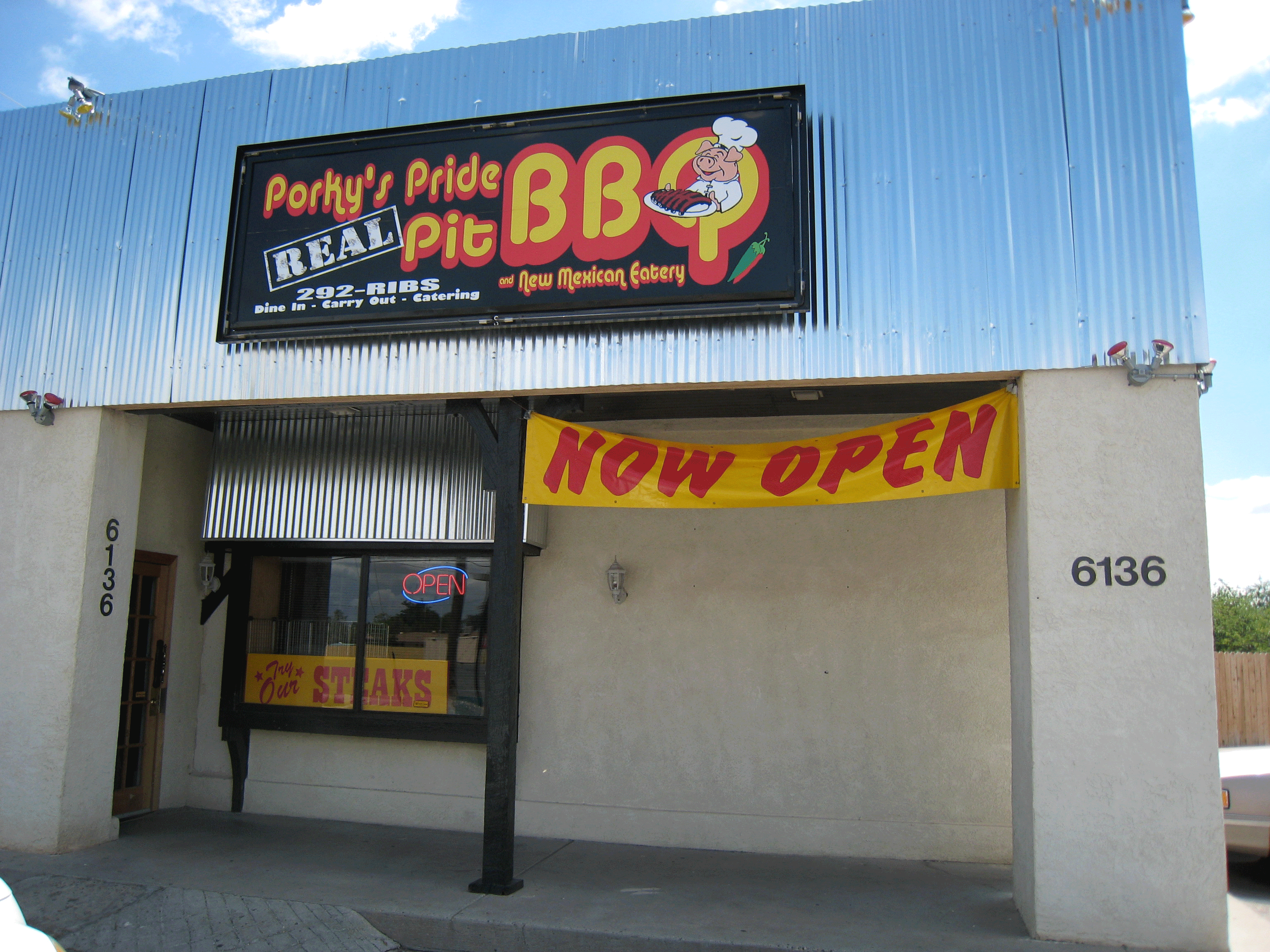
The genesis of America’s popular music–country, jazz and even rock and roll–is rooted in the soul and sounds of Mississippi Delta blues–sounds born in the disgraceful shadow of slavery and lyrics which echoed the grievous plight and painful lament of workers in plantations and fields.  It is a tribute to the resilience of a people that the music of their lament evolved over the centuries to bring succor, alacrity and pride to generations. Given poor quality meat, those plantation workers dug pits in the ground in which they cooked the poor cuts of pigs or meat they were allowed to raise. When emancipated, the pit masters introduced their prowess over the barbecue pit throughout the United States. The American epicenters of barbecue excellence–Texas, Memphis, Kansas City and the Carolinas–all owe their barbecue roots to the deep south. Today, the term “real pit barbecue” rarely refers to a big hole in the ground. A barbecue pit is almost always above ground in a steel “oven” in which meat revolves on racks until just right.  The pit master’s prowess is showcased in the way he or she deftly manipulates indirect heat and wood smoke to produce the inimitable flavor that has made…

Mad Max’s BBQ – Rio Rancho, New Mexico (CLOSED)

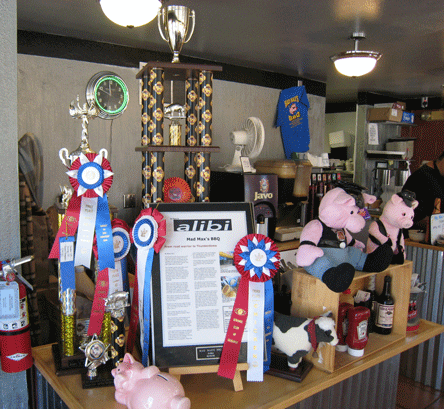
NOTE:  In March, 2010, Max and Fran Montano entered into a lease to buy agreement with an enthusiastic owner who continued to use the recipes which made Mad Max’s the very best barbecue in the Albuquerque area.  By September, 2010 the restaurant was closed.  Max and Fran will continue competing in competitions throughout the region and will also cater events.  They will be missed as much for their warmth and great humor as for their outstanding barbecue. Since the discovery of fire, man has viewed his domain as the great outdoors. The outdoors is from where man brought home the day’s victuals for early woman to prepare.  As the centuries progressed, descendents of troglodytic man (many of whom haven’t evolved much) have perceived cooking as a feminine affectation, taunting any other man who deigned to acquire culinary skills. In 1952, George Stephen invented the original Weber kettle grill and with his innovative design, sparked a backyard revolution that transformed man. As a result of the Weber grill, the XY chromosome complement was no longer a handicap (or more accurately, an excuse) for men throughout the world when it came to preparing meals for their families. With Stephen’s invention, grilling outdoors…

Johndhi’s BBQ – Albuquerque, New Mexico (CLOSED)

With the wafting aroma of smoked meats, Johndhi’s, a charming smokehouse restaurant on picturesque Rio Grande Boulevard welcomes you to Bar-B-Querque, a well-earned and time-tested sobriquet. Known as Geezamboni’s since its inception in 1988 until a name change in 2005, Johndhi’s is a North Valley institution popular all year round. Owned and operated by John Nellos of Albuquerque’s first family of barbecue (the philanthropic Nellos clan owns three Quarters restaurants in the Duke City), Johndhi’s has an ultra hip, mega casual feel to it that belies the converted home structure in which it sits.  The artsy ambience includes French posters, multi-hued Mexican ceramic masks and pictures adorning the walls.  Strewn about the restaurant’s many nooks and crannies are interesting accoutrements such as an antique telephone painted in colors I often saw on a hippie bus bound for the Hog Farm near Peñasco where I grew up.   The framed poster most appealing to foodies like me depicts Dagwood Bumbstead precariously perched on his tip-toes on a chair with his trademark, multi-story sandwich in one hand as he reaches for a jar of olives with the other. From the outside, Johndhi’s has the appearance of a family home.  There is no glaring, sensory-bombarding signage screaming at passers-by telling…

Honey Bear’s Barbecue – Phoenix, Arizona

Depending on the type of egg, the minimum temperature for frying an egg is said to be 144-158F and on scorching summer days in Phoenix, television news shows perennially traumatize visitors and tourists by frying an egg on the city’s sidewalks. If blistering heat is the reason the Phoenix area has so many outstanding barbecue restaurants, I’m all for Albuquerque’s temperature climbing a few degrees in the summer. The venerable Honey Bear’s Barbecue is easily equal to, make that superior to Hap’s Pit Barbecue which I had thought to offer the best barbecue in the greater Phoenix area. Honey Bear’s has been serving Memphis-style barbecue since 1986 when the proprietors launched the first of three Phoenix area restaurants.  In close proximity to the airport, it’s a popular destination for people flying in and out of Phoenix–and one of the few reasons I enjoy business trips to the Land of the Sun. Two slogans define the secrets to the restaurant’s success: “You don’t need no teeth to eat our meat” and “Put a little south in your mouth.” One word of caution about all the sandwiches at Honey Bear’s–the bread just isn’t resilient enough to hold all that flavor (and sauce). …

Buckingham Smokehouse Bar-B-Q – Las Vegas, Nevada (CLOSED)

Las Vegas has established itself as one of America’s, if not the world’s, preeminent dining destinations. Many of the world’s most famous and successful chefs have launched flamboyant restaurants that celebrate their self-aggrandizing greatness in magnificent pantheons of gustatory grandeur. Fortunately for true gastronomes who don’t worship exclusively at the tables of gastronomic glitterati, Las Vegas has also attracted its share of chefs with whom those of us of the common clay can identify–chefs who didn’t refine their skills at a snooty culinary institute but in the backyard on the family grill. With a recent influx of pit masters migrating to Las Vegas from America’s heartlands, Sin City may someday compete with Memphis, Kansas City, Texas and South Carolina as a bastion of barbecue. Witness: Mike “The Legend” Mills, a four-time world champion at “Memphis in May,” the most prestigious barbecue competition in the world chose Las Vegas as the site of his four Memphis Championship Barbecue restaurants. In recent years his restaurant has been a mainstay on the annual “Best of Las Vegas” awards. It’s been said that when it comes to Texas barbecue, all roads lead to the award-winning Salt Lick Barbecue restaurant in the tiny backwater town…

Tony Roma’s – Albuquerque, New Mexico (CLOSED)

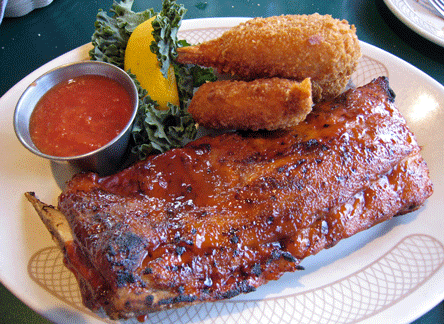
With more than 260 locations worldwide, Tony Roma’s can be found from Aruba to Venezuela and 25 countries in between. As of August 30th, 2005, one of the most famous barbecue chains in the world can also be found in Albuquerque where truly great barbecue is more scarce than precious, life-giving water. Alas, while the addition of Tony Roma’s may give the Duke City one more barbecue restaurant, it still does not have a great barbecue restaurant. Tony Roma’s claim to fame is its baby back ribs for which it helped make America go hog wild. This self-proclaimed “Famous for ribs” restaurant launched in 1972 in North Miami, Florida. We first experienced it in London, England in 1984 and last visited in Portland, Oregon in 1997. Underwhelmed might be a good summation of those visits and applies similarly to our inaugural visit to the Albuquerque franchise. We drove less than a mile from our home to Tony Roma’s and wish instead we had driven 35 miles or so further to Jake & Andre’s Rib House in Belen which offers a superior dining experience (emphasis on dining, not ambience) all the way around. The saccharine service provided by a transparently exuberant…

Super Smokers – Eureka, Missouri

Note: On January 6, 2006, The St. Louis Business Journal announced that Super Smokers closed unexpectedly. As it turns out, only one of the five St. Louis area restaurants remains open. This will add several miles to our trips to Chicago, but any detour that leads to outstanding barbecue is well worth it. St. Louis, Missouri isn’t widely recognized as one of America’s barbecue capitals as is cross-state barbecue bastion Kansas City, but perhaps it should be. St. Louis based Super Smokers may not just serve the best barbecue in the state, they have been certified as ‘cuing the very best pork in the world. The Super Smokers BBQ team has finished in the top ten in nine of twelve years competing at the World Barbecue Championship at Memphis in May, including a 2000 first place finish in the “whole hog” competition. Nicknamed “The Super Bowl of Swine,” Memphis in May is the largest pork barbecue event of its kind with more than 240 teams from all over the world participating. Meeting and exceeding the lofty quality standards and unwavering consistency required to win at the World Barbecue Championships has influenced the way Super Smokers conduct business at their St.…