Chilte – Phoenix, Arizona

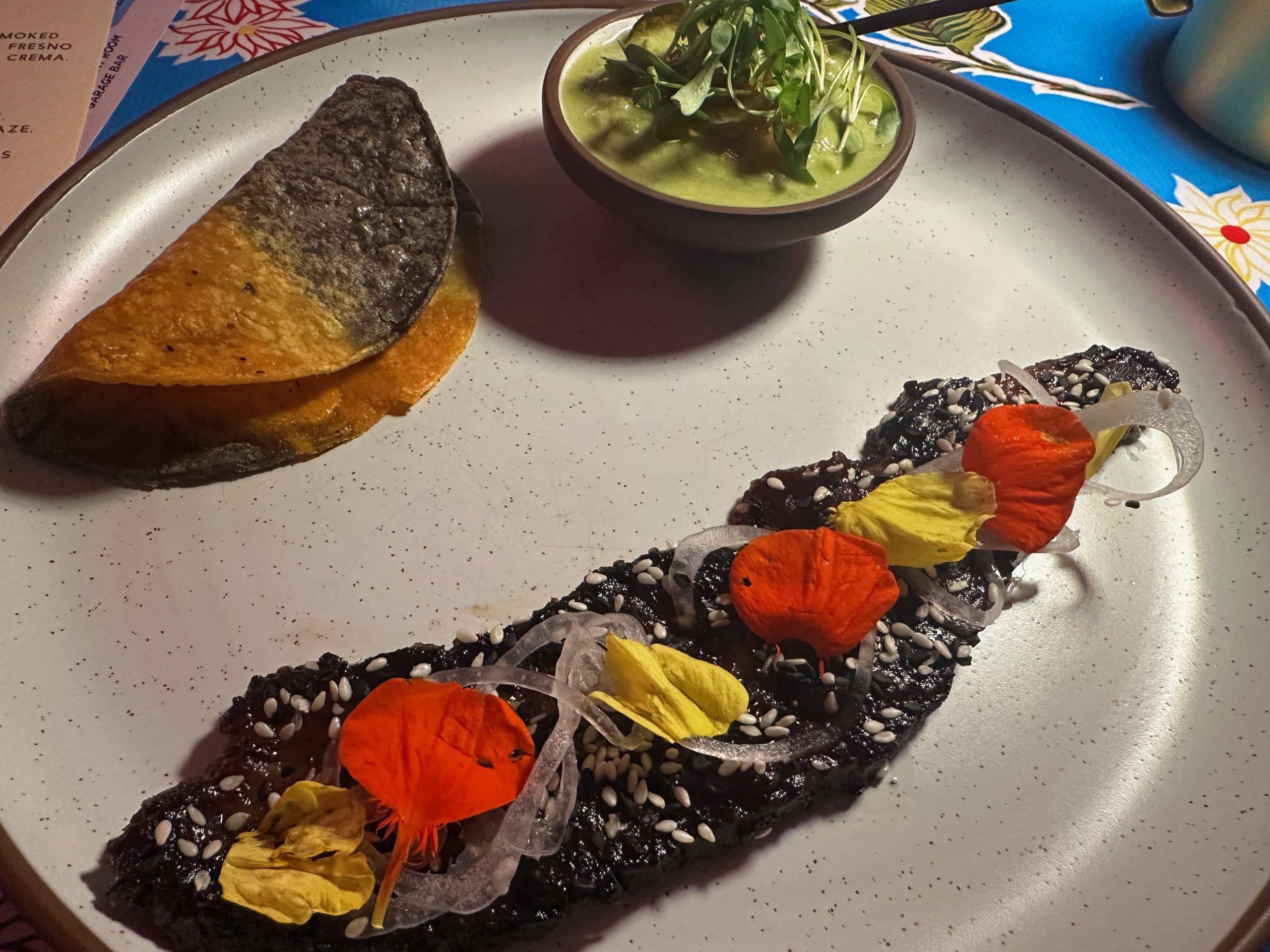
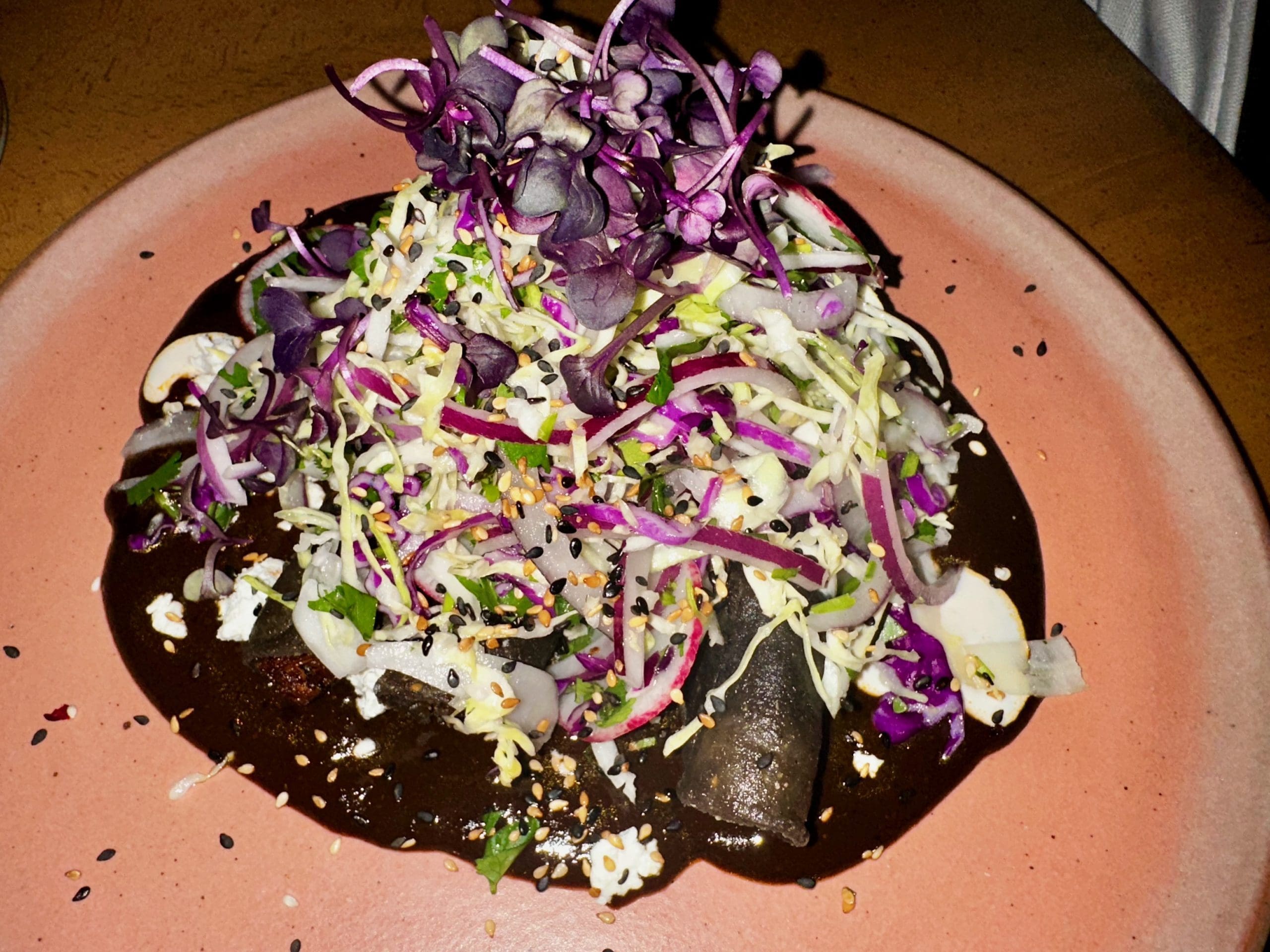
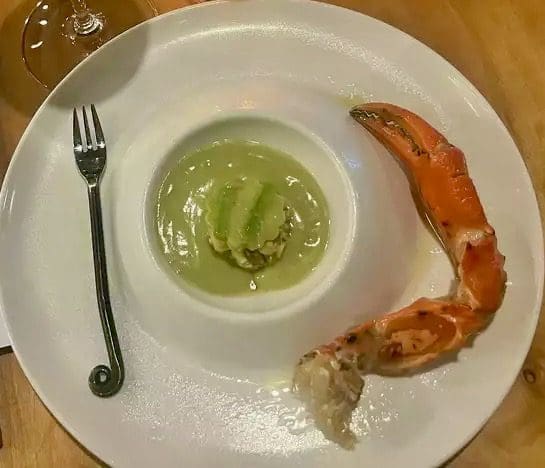
“Me Vale Madre.”  If you grew up speaking Spanish–or maybe just being around Spanish-speaking people–you probably know it’s a derrogatory term.  Essentially, even though the phrase inludes the Spanish term “madre” which means “mother,”  it’s telling someone you don’t give a fu…fudge.  “Me Vale Madre” is Chilte’s mantra.  It’s the restaurant staff basically saying “we don’t care that we don’t meet your conceptions of what Mexican food should be.  We’re going to do it our way.”  How can you not love that?  I asked our server to explain to my Kim what that mantra means and he gave us a polite, G-rated version that was as far from the truth as a political promise. Chilte’s website makes no bones about what it is and aspires to be: “Me vale is our mantra.  Representing unapologetic authenticity to ourselves and our mission.  Join us as we strive to inspire a new culture in the culinary industry by sourcing locally, cooking from the hert, mentoring one another and building a community through food.”  The website also waxes nostalgic about Chilte’s humble beginnings: “Two kids, a grill and a tortilla press walk into a farmers market….Chilte!  Starting in a  10X10 pop-up tent, we have…

Herencia – Albuquerque, New Mexico

When he founded Los Equipales in 1996, restaurant impresario Henrique Valdovinos admitted “I wouldn’t have tried this ten years ago, but I think people are ready for it.”  As recently as a quarter-century ago, two types of Mexican restaurants existed across the fruited plain.  Most common were those sharing reciprocal expectations with diners who expected and received such stereotyped “Mexican” food as fajitas; hard-shelled tacos filled with ground beef, cheese, lettuce and sour cream; chiles rellenos made with bell peppers and enough yellow cheese to clog a dinosaur’s arteries.  Denizens under the spacious skies didn’t know any better and enjoyed the watered down versions of the real deal.  This “Mexican” food became mainstream. The other type of Mexican food restaurants might best be catgorized as “Mexican restaurants for Mexican people.”  These restaurants didn’t offer “dumbed down” cuisine and were primarily (though not exclusively) frequented by scions of Montezuma.  Among those which caught on across dining demographics were mariscos restaurants offering Mexican seafood options.  None of the ubiquitous and mostly shuttered chains (Chi Chi’s, Don Pablo’s, Pancho’s, El Torrito, etal)  served seafood.   Mexican mom-and-pop restaurants began sprouting and having success by serving the foods enjoyed by Mexican families. When he launched…

Escondido – Santa Fe, New Mexico

“For nothing is hidden that will not be made manifest, nor is anything secret that will not be known and come to light.” ~Luke 8:17 “Escondido (which translates from Spanish to “hidden”) sure proves that Bible verse wrong,” I lamented as I cursed Google Maps for having led me to a nondescript residential neighborhood in Santa Fe.  Though not as execrable as the time Google Maps insisted I make a left onto a crude and rocky dry wash when trying to get to Kayenta, Arizona, I nonetheless took Google’s name in vain then followed my instincts.  Fortunately, crossing over Agua Fria onto another neighborhood shed light on my quandrary.   There in front of me was Escondido, the restaurant destination I sought.  I still won’t forgive Google Maps for having led me astray.  Unlike in horseshoes, close doesn’t count. True to its name, Escondido is well hidden–or at least off the well-beaten and well-eaten path.   What isn’t hidden is the reputation of Chef Fernando Ruiz, a formidable chef with a colorful past and an efulgent future.  His is a story sadly not oft repeated, a tale of determination when recidivism is the path others in his shoes might have taken.  At…

Mixtli – San Antonio, Texas

A quote attributed to Marcel Marceau, the French mime famous for his sad-faced clown, aptly describes my attempts at describing a meal at Mixtli: “Do not the most moving moments of our lives find us without words”  (not that being without words has ever stopped me). Life’s events often include moments which move you deeply and stir your very soul. My inaugural dining experience at Mixtli was not so profound and cathartic as to move me to drastically change my life, but it certainly prompted a stirring awakening as I experienced what was conceivably the best restaurant meal I’ve ever had. Several of the other effusive reviews I’ve written are mere hyperbole in comparison to what I’d like to say about Mixtli if I was skilled enough to do so. Mixtli is simply the best restaurant in which I’ve dined (yes, even better than Topolobampo).  It’s so far superior to other restaurants I previously thought were outstanding that I scaled down my ratings for many of them.  Mixtli is so much more than  a restaurant that serves a great meal.  It’s a restaurant that will give you a memorable and thoroughly enjoyable dining experience.  From start to finish, you’ll be…

Sobremesa Restaurant & Brewery – Albuquerque, New Mexico (CLOSED)

In June, 2021, Eater.com published a list of “the 21 Essential Restaurants in Albuquerque.” Unlike so many “clickbait” articles from national publications purporting to tell New Mexicans which restaurants across the Land of Enchantment serve the “best this” and the “best that,” the Eater feature was penned by Justin De La Rosa who actually knows this state very well.  In fact, in 2015 Justin earned a “Local Hero Award” from Edible New Mexico as “best food writer.” If you’re wondering what constitutes an “Essential Restaurant,” Eater’s erstwhile national critic Bill Addison defined the term to mean “indispensable to their neighborhoods, and eventually to their towns and whole regions,” to “ultimately become vital to how we understand ourselves, and others, at the table.”   In other words, restaurants accorded the “essential” designation by Eater are more than among the best restaurants in their town.  They are transcendent presences that feed the soul as well as the stomach. It’s a virtual certainty that Mary & Tito’swould make the list after having been named one of America’s 38 Essential Restaurants in 2018<.  It’s also no surprise that restaurants (Campo at Los Poblanos and Frenchish) helmed by multiple-time James Beard Foundation Chef of the Year…

La Zenita – Albuquerque, New Mexico

In his immortal play Romeo and Juliet, William Shakespeare used two lines to convey that the naming of things is irrelevant: “What’s in a name? That which we call a rose by any other name would smell just as sweet.”   My friends Bruce and Loren Plata like to remind me that in Hebrew, the name “Gil” represents a “small goat,” an animal that definitely doesn’t smell quite as fragrant as a rose.  My retort, of course, is that “goat” is an acronym for “greatest of all time.”  So, relevant or not, names do have meanings and can provide a lifetime of notoriety.   Most of us just hope our names aren’t something that can be made fun of. In Hebrew, the name “Zenita” means “gift of God.” Now, that’s one lofty name to aspire to.  Someone christened with that name would probably be expected to have pretty divine qualities. A restaurant bearing that name might be expected to serve food that’s heavenly. No, not manna and quail, but food that’s delicious and filling.  When I asked about the genesis of the name, the restaurant’s personable owner explained that the name is a play on two words.  First, it’s a…

Los Felix – Albuquerque, New Mexico (CLOSED)

As we strode into Los Felix on a windy Saturday in May, we espied a very attractive young lady pointing an extendable selfie stick at her face as she spoke a thousand words a minute.  “Great,” we figured “another self-absorbed Gen Xer sharing the mundane details of her day on social media.”  Boy were we wrong.  That young lady turned out to be Gaby Camez, a social media influencer who posts restaurant reviews on Facebook.  Gaby’s site, Comiendo Rico en Albuquerque, is a celebration of the Duke City’s Mexican restaurants. Even if you’re not fortunate enough to speak and understand Spanish, you’ll love her site, especially the enthusiasm and respect with which she treats a restaurant’s bounty.   When we got home, we (mostly me) listened to her review of Los Felix where I gleaned much of the information on this post.  Gaby addresses her listeners as “mi gente” (my people), a term of endearment for her listeners.  I don’t know if The Dude and I qualify yet as members of her gente, but I was flattered by her asking  if I’m Argentinian (apparently my accent gave me away.) Under the impression that “Felix” was the owner’s first name, I asked…

Birrieria Y Tacos Alex Tijuana Style – Albuquerque, New Mexico

If you’ve noticed an increase in the number of recent visits on this blog to Mexican restaurants, credit much of that to Pati Jinich, ebullient host of the James Beard Award-winning and Emmy nominated PBS series Pati’s Mexican Table   Although we record the Saturday airing of Pati’s Mexican Table, we don’t usually watch it until Sunday…right before lunchtime.  It’s no wonder, therefore, that what we’ve been craving for lunch is Mexican food. It’s nigh impossible not to be utterly charmed (if not outright besotted) by the lovely Pati Jinich.   Her huge likeability quotient is the byproduct of a genuine warmth and self-effacing humor which come across with her every thickly-accented utterance.  She’s down-to-Earth and genuine, taking absolute joy in  broadening and sharing her expansive knowledge about the colorful tapestry known as Mexican cuisine.  In every episode, Pati embarks on an educational and entertaining journey.  Each dish she encounters serves as a launching point into explorations of the rich and diverse history and culture of her country of birth. In season eight (episode 811), which aired in January, 2019, Pati explored Sinaloa, “Mexico’s Bread Basket,” which produces about 40% of the meat and produce consumed in all of Mexico.  Inspired…

El Chile Toreado – Santa Fe, New Mexico

Until 2008, the notion of gourmet culinary offerings being proffered by a mobile conveyance was unheard of.  Prior to then, food trucks were (often rightfully so) known as “roach coaches” or even worse “barf buggies.”  Roach coaches were an eyesore, a medium of last resort usually parked at construction sites, manufacturing plants, public parks or basic military training bases where captive trainees had no alternative.  Roach coaches were a pure convenience with no pretense to gourmet (or even good) cuisine.  Most of them hawked simple fare such as hot dogs and tacos as well as potato chips, cigarettes, candy and chewing gum. During the era of “convenience stores on wheels,” food trucks weren’t worried about building a brand.  Nor were they concerned with repeat business or customer loyalty. There was no such thing as social media at the time and there were no Yelp reviews. These unsightly vehicles (many with actual roaches in tow) were in business to serve a location for a short time period. After at construction job ended at one site, for example,  they would simply move onto the next profitable location and the process would continue.  These “convenience stores on wheels” served a purpose, but during…

La Guelaguetza – Albuquerque, New Mexico

“I am tenacious. And I love to eat.  I go into the field and see some delectable things they’re cooking, wild plants perhaps, and think, ‘Oh my God, I have to write about this.’ I just think it’s insatiable curiosity. To me, life is a continuous process of learning.” ~Diana Kennedy As an essayer of the Land of Enchantment’s culinary condition–primarily as it’s expressed by its restaurants–I’ve always marveled at the passion and appetite of Diana Kennedy who built a lifelong career by compiling, publishing and teaching indigenous Mexican recipes.   Just as Julia Child reduced the nuances and inflections of French cuisine and culinary techniques for home cooks, Diana introduced home cooks to highly developed, often centuries-old culinary traditions they didn’t even know existed.  Emanating largely from indigenous Mesoamerican cultures that predated Columbus, those culinary traditions might have been lost to time were it not for Diana Kennedy who wrote several classic books on authentic Mexican cooking. A case could easily be made that before Diana Kennedy, much of the fruited plain perceived Mexican food as some homogeneous combo plate brimming with rolled enchiladas topped with a brownish “sauce” just a shade darker than the refried beans on the plate;…

Mulas – Corrales, New Mexico

How many times have you heard an elected official referred to as a “jackass?”  In the village of Corrales, that term could conceivably not be used as a pejorative.  Every year during the last weekend of the Corrales Harvest Festival, a pet mayor is named.  If the newly elected mayor is unable to fulfill his or her duties, a pet mayor pro tem is named to assume the duties of the mayoral office.  Corrales has long prided itself on being a paragon of democratic values and inclusivity though the winning candidate is usually a dog or a horse.  In 2022, the winning candidate was a peacock and in 2020, it was  Chip, a five month old miniature donkey. Unlike human elections in which the legitimacy of campaign fund sources (and how those funds are used) is often in question, pet mayor elections are based on a tally of dollar-ballots cast for each.   Votes are one dollar each with ballot boxes available throughout the village.  Nor will you find candidates bad-mouthing one another or railing against fake media coverage.  Campaign slogans tend to be more friendly, too. In 2021, for example, Jewel, a Standard Poodle’s slogan was “The world needs…