Toltec Brewing Co. – Albuquerque, New Mexico (CLOSED)

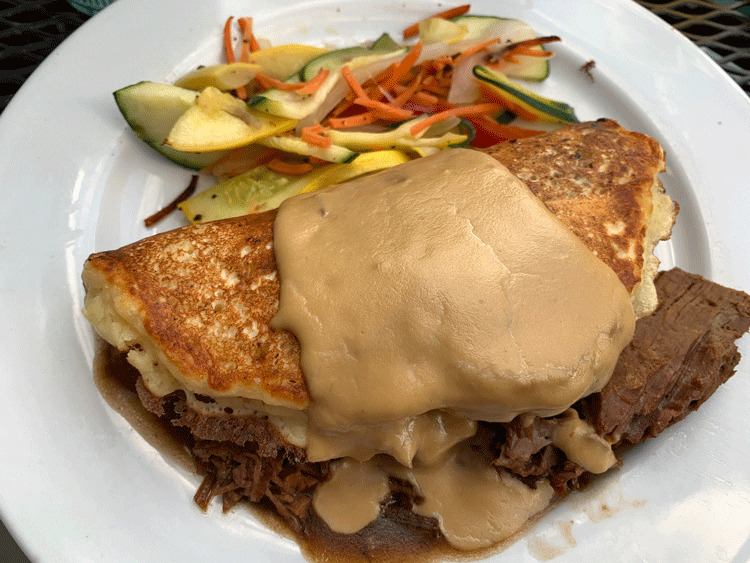
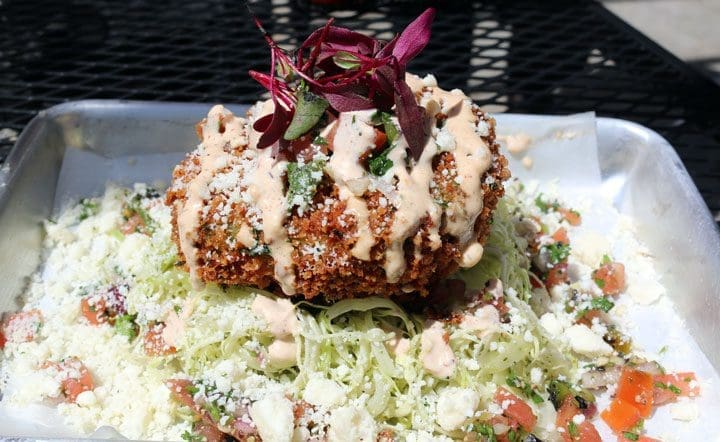
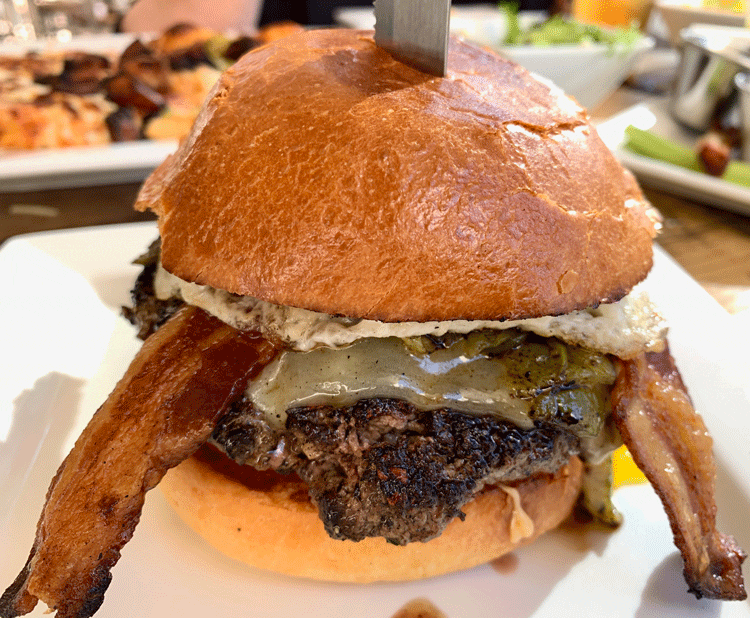
Vincent: And you know what they call a Quarter Pounder with Cheese in Paris? Jules: They don’t call it a Quarter Pounder with Cheese? Vincent: No, they got the metric system there, they wouldn’t know what the #%*&! a Quarter Pounder is. Jules: What’d they call it? Vincent: They call it Royale with cheese. Jules: Royale with Cheese. What’d they call a Big Mac? Vincent: Big Mac’s a Big Mac, but they call it Le Big Mac. ~Pulp Fiction 265 “f-bombs,” copious racist slurs, torrents of extreme language and some of the most weighty dialogue ever spoken in an American movie. That was Quentin Tarantino’s 1994 apotheosis Pulp Fiction, a low-brow pastiche the cognoscenti consider one of the most quotable movies ever made. The clever banter and witty repartee between hitmen Vincent Vega (John Travolta) and Jules Winnfield (Samuel L. Jackson) is particularly memorable. It was their dialogue which introduced this review. It was what immediately came to mind when I espied the “Royale” on the “Breaking Bread” section of Toltec Brewing Co.’s menu. While no self-respecting gastronome would ever order a Quarter Pounder…er, Royale with cheese in Paris (or anywhere else, but especially not in Paris), Toltec’s Royale is…

Shamrock Brewing Co. – Pueblo, Colorado

When my friend David Wagner, author of the spell-binding Rick Montoya Italian mysteries, invited us to dinner at the Shamrock Brewing Co. in his hometown of Pueblo, Colorado, I quickly leapt to the conclusion that Shamrock just might be the inspiration for O’Shea’s Irish Pub, the favorite gathering spot for Rick Montoya and other English-speaking expats living in Rome.  I pictured “a decor that could best be described as mid-century modern, that century being the seventeenth” with wood being the dominant feature.  My picture included a “professional tavern owner” with an appropriated name, maybe something like Guido Shamrock, would preside over the place. Shamrock wasn’t much like O’Shea’s.  Thankfully, it wasn’t much like contemporary Irish pubs across the fruited plain either.  You know the type:  the de rigueur Irish name (O’Casey, O’Brien, O’MyGod), tacky green paint with decorative leprechauns leaping around, super-cooled Guinness and lots of that good old-fashioned Irish craic (an old Gaelic term referring to the lively essence of the pub experience).  It’s gotten so bad Irish pubs have become a parody of stereotypes, prompting  some Europeans to denounce them as “the McDonald’s of the pub trade.”     In terms of look, feel and attitude, Shamrock may not…

1933 Brewing Co. – Rio Rancho, New Mexico (CLOSED)

“Why don’t they pass a constitutional amendment prohibiting anybody from learning anything? If it works as well as prohibition did, in five years Americans would be the smartest race of people on Earth.” ~Will Rogers “I’ll drink to that.”  Such was the rampant sentiment with which Americans welcomed the repeal of the notorious 18th Amendment to the U.S. Constitution, which had prohibited “the manufacture, sale, or transportation of intoxicating liquors…”  For more than a decade Prohibition had not only wrought dramatic increases in alcoholism and crime, it had created a lucrative black market for liquor.  Gangsters such as Al Capone and thousands of bootleggers across the fruited plain basically fulfilled American demand for intoxicating liquor with a supply of unregulated, often lethal alcohol.  Franklin Roosevelt, made the repeal of Prohibition integral to his campaign platform, calling Prohibition a “complete and tragic failure.” Roosevelt made good on his campaign promises, culminating in the 21st Amendment to the U.S. Constitution which repealed Prohibition in 1933. In a proclamation declaring the repeal, Roosevelt urged Americans to “drink responsibly” and “… not bring upon themselves the curse of excessive use of intoxicating liquors, to the detriment of health, morals and social integrity.” In the…

Steel Bender Brewyard – Albuquerque, New Mexico

“Sometimes you want to go Where everybody knows your name And they’re always glad you came You want to be where you can see The troubles are all the same You want to be where everybody knows your name.” ~Theme Song From Cheers Just another banal, meaningless television show jingle?  Think again.  Urban sociologist Ray Oldenburg might even argue that the Cheers theme song exemplifies his concept of “third place.”    In 1989, Oldenburg published That Good Place in which he introduced the concept of third place into the lexicon.  Third place refers to places where people spend time between home (‘first’ place) and work (‘second’ place).  Third places are, according to Oldenburg, locations where we, as social beings, exchange ideas, have a good time, and build relationships.  Moreover, third places are face-to-face, not virtual (online).  They’re the hangout spot or “home away from home” that provides an essential and welcoming zone that’s not home and not work.  Third places cultivate essential social experiences in the company of like-minded people…ostensibly who know your name and are glad you came. In terms of design as well as functionality, a third place must be set up as an inviting hangout spot for…

Starr Brothers Brewing – Albuquerque, New Mexico

Poets, musicians and authors have long rhapsodized about the loyalty of dogs, the most faithful and loving companions anyone can have. Their love is unconditional, their loyalty boundless. They’re truly man’s best friend. Poets, musicians and authors obviously didn’t know Chato, the sleek and powerful best friend to the Dominican nuns who taught generations of Peñasco’s best and brightest at St. Anthony’s (my alma-mater). No matter where they drove in their ancient rattletrap of a car, Chato sprinted along to ensure their safety. When the nuns raffled off that car to raise money for the purchase of a newer, more reliable vehicle, Chato suddenly changed his lifelong residence from the convent to the home of the new car owners…..and everywhere that car went, Chato was sure to go. In his own way Chato demonstrated the loyalty for which dogs are renowned, albeit to a car instead of to his people. Among people–who tend to be the most fickle and disloyal of creatures–studies have repeatedly shown that beer is one of the things about which we as consumers tend to be most loyal. According to a Nielsen (and you thought they only did television ratings) study conducted in 2015, 48% of…

Tap That – Albuquerque, New Mexico (CLOSED)

In my review of the Corrales Bistro Brewery, you were introduced to “Le Cochon,” a self-professed God’s gift to women, lady killer, playboy, seducer, Lothario and otherwise philanderer nonpareil. To my knowledge, Le Cochon is still plying his cheesy pick-up lines on women and getting his face slapped a plenty in the Boston area. He would undoubtedly giggle like the school girls of his dreams at the Albuquerque taproom named “Tap That” which dispenses libations by the ounce. In its original context, the term “tap that” simply meant putting a spigot on a keg of beer or ale so that its contents can be drawn out. As with so many seemingly innocuous terms, chauvinists like Le Cochon have made “tap that” subject to double entendre (open to two interpretations, one of which is risqué or indecent). Cerevisaphiles understanding the intended connotation of the term probably won’t giggle, but they’ll get just as excited at the prospect of tapping into a keg or six. Shortly after finding a vacant table in the dog-friendly patio at the back of Tap That, an eager server began very enthusiastically to explain the taproom’s unique-to-Albuquerque concept. There was so much elan in his delivery that…

Desert Valley Brewing – Albuquerque, New Mexico (CLOSED)

Every time a new brewery launches in the Duke City, aficionados of quaffing ales, lagers and stouts celebrate another venue where they can slake their thirsts. The media, on the other hand, always seems to ask one question: “Is Albuquerque approaching a “saturation point?,” meaning can the market sustain another brewery. Cerevisaphiles will tell you this is just an alarmist “sky is falling” media seeing the (beer) glass overfull and creating yet another sensational headline. In any event, the answer seems to be a resounding no. In that respect, Duke City brewing trends mirror those of other cities throughout the fruited plain. There are more craft breweries operating today than at any point in the fruited plain’s glorious history–about a thousand more than the previous all-time high set in the mid-1870s. Within a decade after the Civil War there were some 4,000 breweries operating in America, serving a population of plus-or-minus 45-million. That’s an astounding one brewery for roughly 11,000 people. With 5,000 breweries operating across the fruited plain as of the end of 2016, the number of breweries as a proportion of the population is one brewery per 65,000 people based on a population of 325-million. If the same…

Boxing Bear Brewing Company – Albuquerque, New Mexico

In the 2008 Will Ferrell comedy Semi-Pro which centers on a fictional professional basketball team, there’s a scene in which Ferrell’s character wrestles with a grizzly bear at halftime of a game. While young viewers might find this scene preposterous, if not unbelievable, some of the more geriatrically advanced among us might remember when such promotions actually took place–usually at rural county fairs where members of the audience were offered money if they could last a few minutes with a wrestling or boxing bear. Bears who were forced into pugilism or grappling were typically de-clawed, de-fanged, fitted with a muzzle and often even drugged. Despite these disadvantages, the 600- to 800-pound Ursidae could easily defeat anyone who stood before them. Most matches lasted less than a minute (longer than George Costanza lasted in the Festivus Day feats of strength wrestling match with his dad). Although enthusiasm for bear wrestling and boxing has waned with the rise of animal rights, a barbaric subculture still exists which gets its jollies from watching animals fight. Boxing Bear Brewing Company’s logo-slash-mascot depicts a bear walking on all fours, a red boxing glove covering its right front paw. Both the brewery’s motto–beer with a punch–and…

Second Street Brewery – Santa Fe, New Mexico

Having served as a judge at many competitive culinary events, it’s always baffled me just how much disparity there usually is between the judges’ choices and the people’s choices. In almost a decade of having had the privilege of judging at the Roadrunner Food Bank’s annual Souperbowl event in Albuquerque, for example, there’s only been one instance in which judges and the general public agreed on the winning soup. That transpired in 2015 when the Ranchers Club of New Mexico‘s Chimayo Red Chile Pork was a consensus “best in show.” More often than not, few (if any) of the top three soups in the judges’ estimation show up among the people’s top three choices. It’s the same in virtually every culinary competition in which you’ve got judges’ choice and people’s choice awards. So, why the significant difference of opinion? The easy answer is that judges have some level of experience judging food, maybe more refined palates than the general public and perhaps even a modicum of culinary training. Based on my experience, however, judges are often a mix of culinary experts (usually critics) and local celebrities (usually media and public officials), all with varied levels of experience and culinary expertise.…