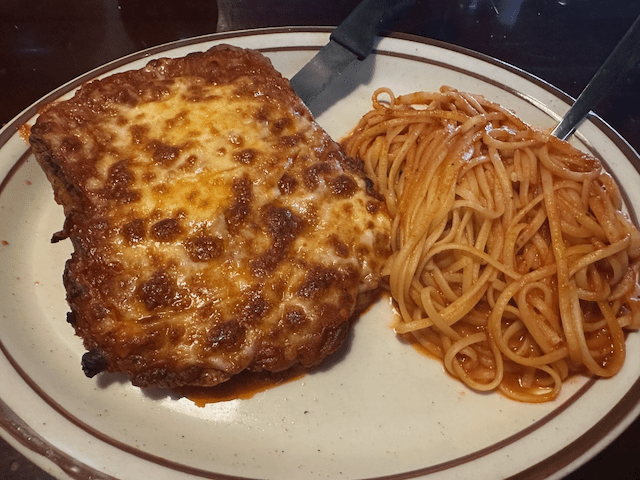
Guido’s Chicago Meat & Deli – Scottsdale, Arizona

For years now, my Kim and I have largely eschewed American television, especially its sophomoric, lowbrow and “meant for voyeurs” reality shows.  We’ve been increasingly gravitating to an almost exclusive viewership of British television which we’ve found to be meant for grown-ups rather than children.  British television programs offer a sophistication direly absent in American programming.  British programs tend to be more substantive, refined and of much higher quality than their American counterparts.  That assessment applies to mysteries, comedies, dramas and even commercials. The final nail in the coffin for American television were two absolutely unwatchable reality shows:  The Kardashians and Jersey Shore.  Both showcase obnoxious, self-aggrandizing and vacuous characters with no redeeming characteristics.  The Jersey Show, for example, made celebrities of four loud, foul-mouthed, hypersexual Italian Americans who self-style as “guidos” and “guidettes.”  Never mind that “guido” (slang for a working-class urban Italian-American) is widely perceived by Italian-Americans as a pejorative word, like “spic” or “wop.” It’s a very unflattering stereotype. Lest you think we lowered ourselves to watch such detritus, we caught a promotion for the series which bragged about gathering the “hottest, tannest, craziest guidos” and assembling them at a beach resort where all would be laid…

Pullano’s Pizza & Wings – Glendale, Arizona

Several years ago during a fund-raising effort, Albuquerque’s PBS television station KNME aired a program called “Sandwiches That You Will Like.”   The documentary was produced by the exceptionally talented Rick Sebak of Pittsburgh station WQED.  The entertaining travelogue featured delicious sandwiches (and the folks who make and enjoy them) served by shops, stands and diners from across the USA. This program originally aired in 2002, also the year a companion book titled Sandwiches That You Will Like was published.  The book was written by fabulous food author Becky Mercuri. I was well aware of most of the sandwiches showcased in the documentary and the book.  There were several, however, I had not tried.  The most intriguing sandwich to me was the “Beef on Weck” from Schwabl’s in West Seneca, New York, just outside of Buffalo.  Schwabl’s claims to have invented the beef on weck.  The segment on the beef on weck featured Becky Mercuri, one of my very favorite food authors.  Becky’s enthusiasm for the sandwich was so heartfelt and genuine that I wanted to visit Buffalo to sample one (or ten) of them.  Moreover, I hoped to share a few beef on weck sandwiches with Becky. What, you ask,…

GELATO DOLCE VITA & ITALIAN GROCER – Mesa, Arizona

“La Grassa” (The Fat One) is the nickname of Bologna, Italy.  While that sobriquet may seem unflattering, Bologna bears it with honor.  This city in the north-central region of the country is considered the “gastronomic heart of Italy,” a place where food is an art form and a passion.   This may be best exemplified by one of the foods born in Bologna.  I’m talking, of course, about gelato.  Throughout “Lo Stivale” (the boot, a nickname bestowed upon Italy because the shape of the peninsula resembles a high-heeled boot) gelato is revered.  Not surprisingly, Bologna is not only the home of Italy’s oldest university (and the oldest in the western world), but home to Carpigiani, “Gelato University.” Mesa, Arizona is the home of two of Carpigiani’s distinguished alumni.  Both Walter Bergamaschi and Marti Printy, founders of the Gelato Dolce Vita attended the Gelato University.   Having grown up in Bergamo, about two-and-a-half hours from Bologna, they have been around superior gelato all their lives.  In 2010, they launched Gelato Dolce Vita (literally “Gelato Sweet Life) in Mesa.  At the time there were only two gelato shops in Phoenix.  Ice cream shops dominated the market.  In time, customers began to appreciate the difference…

Richie B’s – Albuquerque, New Mexico

If you’ve ever wondered why New Yorkers fold their pizza slices in half lengthwise (aka the “fold hold”) and if you’ve ever attributed that practice to Big Apple quirkiness, you owe it to yourself to visit Richie B’s, a New York-style pizzeria on Unser in the Duke City’s Northwest quadrant. Now, the Albuquerque metropolitan area has plenty of claimants to New York-style pizza, but can you name a single one in which you’ve actually HAD to utilize the fold hold to eat a slice? New Yorkers have mastered the fold hold because true New York-style pizza is thin-crusted and cut into wide slices (usually wider than your face) which taper down to a perfectly pointed (and invariably “floppy”) bottom. I’ve seen friends and colleagues employ the fold hold simply to double the amount of pizza they can consume in one bite (then wonder why they finished off their pizza twice as fast). I’ve also seen them utilize “The Travolta” method—layering one slice on top of another and eating both simultaneously—again, to double the amount of pizza in each bite. I’ve also seen the more “civilized” (or haughty) among us (Former New York City Mayor di Blasio should have been impeached…

Chicago Pizza Kitchen – Albuquerque, New Mexico

There is A LOT to see at the Chicago Pizza Kitchen (CPK).  My Chicago born-and-bred bride loved the framed photographs of the Windy City’s incomparable skyline and distinct architecture.  Bulls and Bears fans (not a reference to the stock market) will enjoy perusing photos and banners of Chicago’s sports teams.  Students of the age of chivalry will gravitate to the restaurant’s northern-most corners where knights in shining armor (literally) stand guard.  Military veterans like me will reminisce about our own experiences in service to our country as we peruse the photos depicting the military service of Chicago Pizza Kitchen’s owners.  Some of us will linger longest at the POW-MIA table, one of the most poignant and thought-provoking sights at any Duke City restaurant. Contemplating the meaning behind the POW-MIA table setting can bring you to tears, especially if you served or had family in the armed forces.  A POW-MIA table has only one place setting, representing the frailty of one prisoner, alone against his or her suppressors.  Fittingly the table is set close to the dining room entrance.  There are a number of other symbols displayed on the table which military veterans will appreciate. Some of my brothers-in-arms (including my own…

Tula’s Kitchen (Pan American) – Albuquerque, New Mexico

“Pizza makes you a hero in the eyes of your kids. “Daddy got pizza!” You are higher status walking in the door with a pizza than if you were returning from a war with a Purple Heart.” ― Jim Gaffigan, Dad Is Fat Virtually since its inception, Dion’s Pizza has been a beloved Albuquerque staple–as much a Duke City institition as the Albuquerque International Balloon Fiesta, the Sandia Peak Tramway and the Albuquerque Isotopes.   Denizens of the Duke City love Dion’s, a prolific purveyor of pulchritudinous pies since 1978.  With thirteen locations in Albuquerque alone as well as several others throughout the state, Dion’s pizza has become a mainstay not only at the family home, but at business functions.  It’s not only dads who become heroes when they ferry this pizza home.  Every boss thoughtful and savvy enough to bring Dion’s to a party or meeting is instantly regarded as a great boss.   Great pizza will do that for you. Ironically, founders Jon Patten and Bill Scott didn’t set out to create New Mexico’s most dynastic and beloved pizza place.  After purchasing a small place called New York Pizza, Jon and Bill began to carry out the plans of turning the pizzeria…

Kaktus Brewing Company – Bernalillo, New Mexico

Most of us have known a wine snob or two. You know the type. They refer to themselves as oenophiles, a fancy way of saying “connoisseur or lover of wines.” They believe themselves to possess refined palates and won’t drink a wine that isn’t as cultured as they are. Even then, they first have to check the color and opacity of the wine. Then they twirl their glass for ten minutes or so before sticking their nose into the glass (like anteaters at an ant hole) and sniffing the wine noisily. They then proudly proclaim the wine has notes of oak, berries or butter. Their next step is to gargle with the wine, sloshing it between their cheeks and gums before finally imbibing of its delicate flavors and proclaiming it worthy. In recent years, another adult beverage snob has arisen to give oenophiles some competition in the haughtiness department. They’re called “cerevisaphiles,” a term that refers to beer enthusiasts. Cerevisaphiles turn their nose up at Pabst Blue Ribbon and other “pedestrian swill.” As with their oenophile counterparts, the cerevisaphiles pride themselves on their discerning palates. They will drink no beer before or after its time and are careful to note…

FAT OLIVES – Flagstaff, Arizona

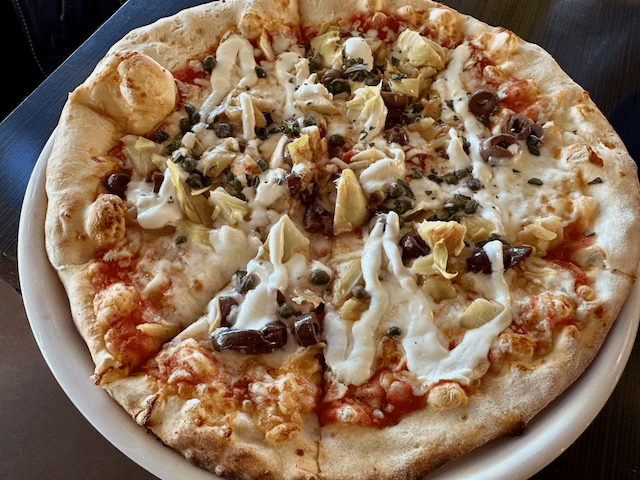
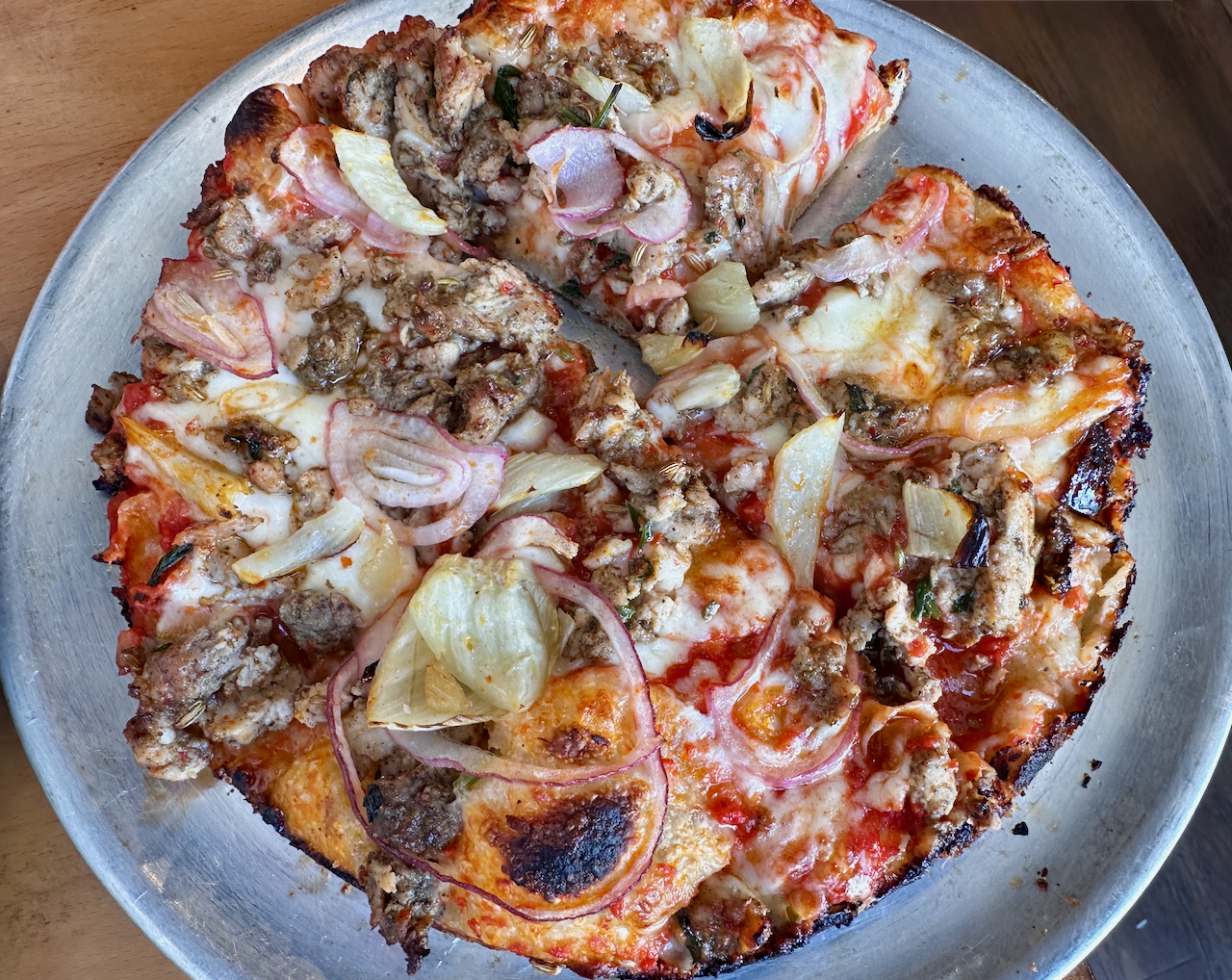
Several years and a couple of tons ago, my friend “Macho” Mike Moretti and I were the type of trenchermen that all-you-can-eat Chinese restaurants feared so much they established strict time limits.  When a German restaurant on San Mateo offered a free dessert to any diner who could finish a gargantuan combination plate, we easily surmounted the challenge and asked for seconds.  Perhaps our most impressive culinary conquest transpired when Pizza Inn offered a “order one pizza, get the next size free” deal.  We ordered an extra large pizza and a large pizza then polished them off.  That was the last time I ever finished at least an entire pizza (about ten acres of pie) by myself.  That is, the last time until my Kim and I paid an inaugural visit to Fat Olives in Flagstaff, Arizona. No ordinary pizza will you find at Fat Olives.  The pizza for which I scaled the heights of gluttony placed third in the International Pizza Expo in 2014.  That event hosts the largest assembly of pizzaiolo in the world.  Its prestigious pizza-making competition in North America, if not the world.  Third place places Fat Olives in rarefied air.  Furthermore, Fat Olives is a…

Trail Rider – Cedar Crest, New Mexico

During the prehistoric and dark ages when I went to school, we were taught a song called “The Bear Went Over The Mountain.”  When that wandering ursus got to the other side of the mountain, all he could see was the other side of the mountain.  Ostensibly, this song recalls a bear’s fruitless journey to see what lies beyond.  It symbolizes the endless nature of life’s constant undertakings, the continuous, sometimes futile, effort in life to find something beyond the current experience.  Now, that’s the allegorical meaning of the song.  In literal terms, a bear (or anyone of us) going over the Sandia Mountains won’t see the same sights or have the same experiences we have in the Albuquerque side of the mountain. I joked with Joe, the extraordinary baker at Trail Rider, that most of the people who live on the morning side of the mountain (eastern slope) are old hippies.  “Except for us,” he clarified, noting my recent Opie Taylor haircut and his own closely shorn coiffure.  Having grown up within easy walking distance of “The Hog Farm,” a hippie commune in Llano, New Mexico, I know a lot of old hippies.  It’s always amused me how many…

Gold Street Pizza – Albuquerque, New Mexico

Get Smart, a comedy television series which aired from 1965 to 1970 showcased the exploits of Don Adams as Maxwell Smart, a secret agent for CONTROL, a secret government counter-espionage organization. CONTROL’s nemesis was KAOS an international organization of evil bent on world domination.  The head of the Asian arm of KAOS was a man called “The Claw,” who had a large mechanical claw in place of a left hand.  The claw was magnetic, allowing him to pull phones, guns, and other metal objects toward him. Stereotypically, he couldn’t pronounce the letter L , which made Maxwell Smart think his name was “The Craw” and not the “The Claw.”  Every time Max makes this mistake, The Claw corrects him saying, “Not the Craw, the Craw!” During the second episode of the series, Smart was kidnapped by The Claw. In an attempt to communicate his whereabouts to the chief of CONTROL, Smart engaged a communication device on his watch.  The ensuing exchange was hilarious: Smart: “I suppose you think you’ve got me buried in this backroom in this building on Commonwealth and 8th Streets.” The Claw: “Not 8th Street, Mr. Smart, F Street.” Smart: “Oh yes, F Street.” The Claw: “And…

Joe’s Italian Restaurant – Farmington, New Mexico

Is it disingenuous for restaurants to label themselves with titles and sobriquets they don’t quite (or at least not quite honestly) live up to?  (Politicians do it all the time, so why not restaurants?) Is it pretentious and haughty to use labels with which English-speaking diners might be impressed even though we don’t know what they mean?  Is it instead great marketing, a clever way to increase the number of guests?   It’s something I actually ponder when visiting Italian restaurants.  For example, when our friend Greg Hamilton introduced us to “Joe’s Restaurant” in Farmington, I momentarily wondered if it could possibly be good considering its humble name. Far too many Italian restaurants label themselves as trattorias, osterias and tavolas.  Not knowing what those labels mean, many of us are impressed, believing those terms must signify much more than an “ordinary” restaurant.  In truth, a trattoria is just a type of informal Italian restaurant known for its traditional, home-style, and regional cuisine served in a relaxed, family-like atmosphere).  An osteria is a simple Italian establishment traditionally focused on serving wine and light snacks, similar to a wine bar or pub.  A tavola calda (literally “hot table”), is an Italian cafeteria-style establishments…