La Cantina at Casa Sena – Santa Fe, New Mexico

In the dark ages of 1979 when the world wasn’t nearly as connected as it is today, the British Broadcasting Corporation (BBC) ruled the airwaves throughout the United Kingdom just as it had since its founding in 1922. Young listeners complained that the monopoly of control had forged a monotony in programming. For Yanks like me, however, the so-called “monotony” provided the most interesting diversion. In perhaps trying to appeal to listeners of all demographics with a one-size-fits-all approach, the BBC’s programming didn’t seem to make any sense…at least by American standards. My own musical tastes tend to be very eclectic, but the BBC sometimes stretched eclectic beyond logical sense. One of my favorite examples of the “diversity” of the BBC’s music programming was a succession of songs that included True Love by Bing Crosby, Werewolves of London by Warren Zevon and If I Said You Had A Beautiful Body by the Bellamy Brothers. This example of the BBC’s programming was antithetical to that of American radio stations which then and now subscribe to fairly predictable programming formats. Country music stations will play country music, Oldies music stations will play oldies and so forth. Never the twain (not Shania) shall…

La Plazuela at La Fonda – Santa Fe, New Mexico

History and Hollywood have glamorized the Colt 45 revolver as the “gun that tamed the West.” Known as the “Peacemaker,” the .45 caliber pistol was used by all the famous lawmen and cowboy heroes of the old West. Wyatt Earp used the Colt 45. So did Wild Bill Hickok and Buffalo Bill Cody. It was often the deciding factor in the unrelenting battle of good and evil, the means by which law and order were established in a frontier in which chaos reigned. Many aficionados of the Wild West would never list a genteel English emigrant named Fred Harvey in the company of Earp, Cody and the other rugged gun-toting legends. Recent history, however, has begun to recognize his contributions to the civilization of the frontier West. Harvey was, by no means, a man who (in the vernacular of Hollywood) “let his gun do his talking for him.” He was a restaurateur by trade and his contributions were in bringing good food at reasonable prices to the Old West. He served it in clean, elegant restaurants, introducing a touch of refinement and civility to an untamed frontier. As the Santa Fe railroad moved across the west, Harvey Houses opened every…

Cafe Pasqual’s – Santa Fe, New Mexico

Pasqual Baylon’s devotion to the Mass and the Holy Eucharist was so fervent that when assigned kitchen duty, angels had to stir the pots to keep them from burning.  It’s ironic therefore that San Pasqual is the recognized patron saint of Mexican and New Mexican kitchens, a beloved saint whose smiling countenance in the form of various art forms graces many a kitchen, including Katharine Kagel’s kitchen in the world famous Cafe Pasqual, one of Santa Fe’s most popular restaurants. Cafe Pasqual is a very small cafe with seating for only 50 patrons sitting in very close quarters. Prospective diners place their names on a waiting list then typically wait half an hour or more to be seated, usually longer if they want a “private” table (where you’re still elbow-to-elbow with your neighbors). Quicker seating is usually available if you’re willing to share space in the large community table where you can break bread with diners from all walks of life. Located one block southwest of the plaza in the heart of downtown, the split-level dining room is one of the most colorful venues in the City Different with a festive ambience that includes multi-hued, hand-painted Mexican tiles and murals.…

Casa Chaco – Albuquerque, New Mexico (CLOSED)

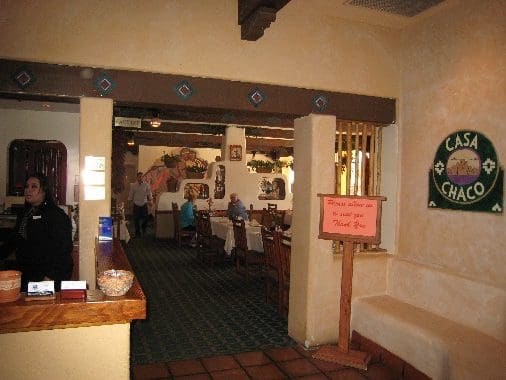
In A.D. 850, the ancient Anasazi began building the pueblos archaeologists posit were the hub of an ancient culture inhabited in its heyday by more than 5,000 people. By A.D. 1000, Chaco Canyon was the flourishing heart of religious and governmental life for an advanced culture that has since been assimilated by Native American pueblos dotting the Rio Grande valley. Using remote sensing technology, archaeologists discovered roads radiating from Chaco Canyon like the spokes of the wheel, connecting the canyon with almost 100 Chacoan outliers. In modern-day Albuquerque, the rambling Hilton hotel has also become a hub of activity (more than 27,000 square feet of flexible meeting space) and like Chaco, is on the intersection of heavily traversed thoroughfares. It’s perhaps only fitting that one of its two signature restaurants is named for the “ancient ones.” Casa Chaco is tastefully decorated with Native American art, including the full regalia of Indian women and children. On some nights, the dining experience at Casa Chaco is further enhanced by the mellifluous presence of Hector Pimental and the soothing stylings of his guitar. Similar to the Rancher’s Club, its sister Hilton restaurant, Casa Chaco places you in the lap of luxury with attentive…

Peppers – Albuquerque, New Mexico (CLOSED)

True to the restaurant’s name, Peppers chefs play tribute to chiles and peppers so ubiquitous to New Mexico cooking. In many of their creations, they incorporate New Mexico green and red chile, chipotle, Chimayo red chile, Habañero, Serrano, Pepperonici and red and green bell peppers (a chile icon denotes all items in which chiles or peppers are used in the preparation). Despite the often clever use of chiles and peppers, Marriot’s signature restaurant suffers from inconsistency that has kept us from patronizing this Pueblo themed restaurant more often. Among the items we’ve enjoyed most is the hot spinach and artichoke dip served in a sour dough bowl with red, blue and gold tortilla chips. The salads are bounteous and the salad dressings are innovative, particularly the thick honey mustard dressing. Peppers version of this party favorite is among the best we’ve found in Albuquerque. Ditto for the crème brulee, a wonderfully light dessert done exceptionally well. Peppers specialties include a steak and enchiladas combination in which an eight ounce sirloin and three enchiladas fill your plate. The enchiladas, in particular, are pretty good in a city where everyone knows good enchiladas. Not so good are the fajitas which–contrary to conventions–are…

Plaza Cafe – Santa Fe, New Mexico

Just as with people, a city is best defined by its heart. For Santa Fe, that would be its historic Plaza which has been, for much of four centuries, the city’s hub of commerce, culture and government. The Plaza is at the confluence of El Camino Real (the Spanish Royal Road from Mexico City), The Old Pecos Trail and the Santa Fe Trail. These historic transportation routes made settlement possible and facilitated trade and commerce. Today the Plaza is comprised of numerous shops, museums and restaurants surrounding a central park lined with towering shade trees. Because many of its buildings have changed little since Spanish colonial times, the Plaza is listed on the National Registry of Historic Places. The city’s oldest restaurant, the Plaza Cafe which has been serving Santa Fe since 1918, is on the southwestern side of the quadrant which comprises the Plaza. As it approaches its centennial, the Plaza Cafe remains one of the city’s most popular dining destinations, sought out by locals and tourists alike. The 2006 edition of the New Mexico Blue Book published by the Secretary of State’s office documents that in 1947, the Plaza Cafe was purchased by Dionysi Razatos, a Greek immigrant…