El Guero Canelo – Tucson, Arizona

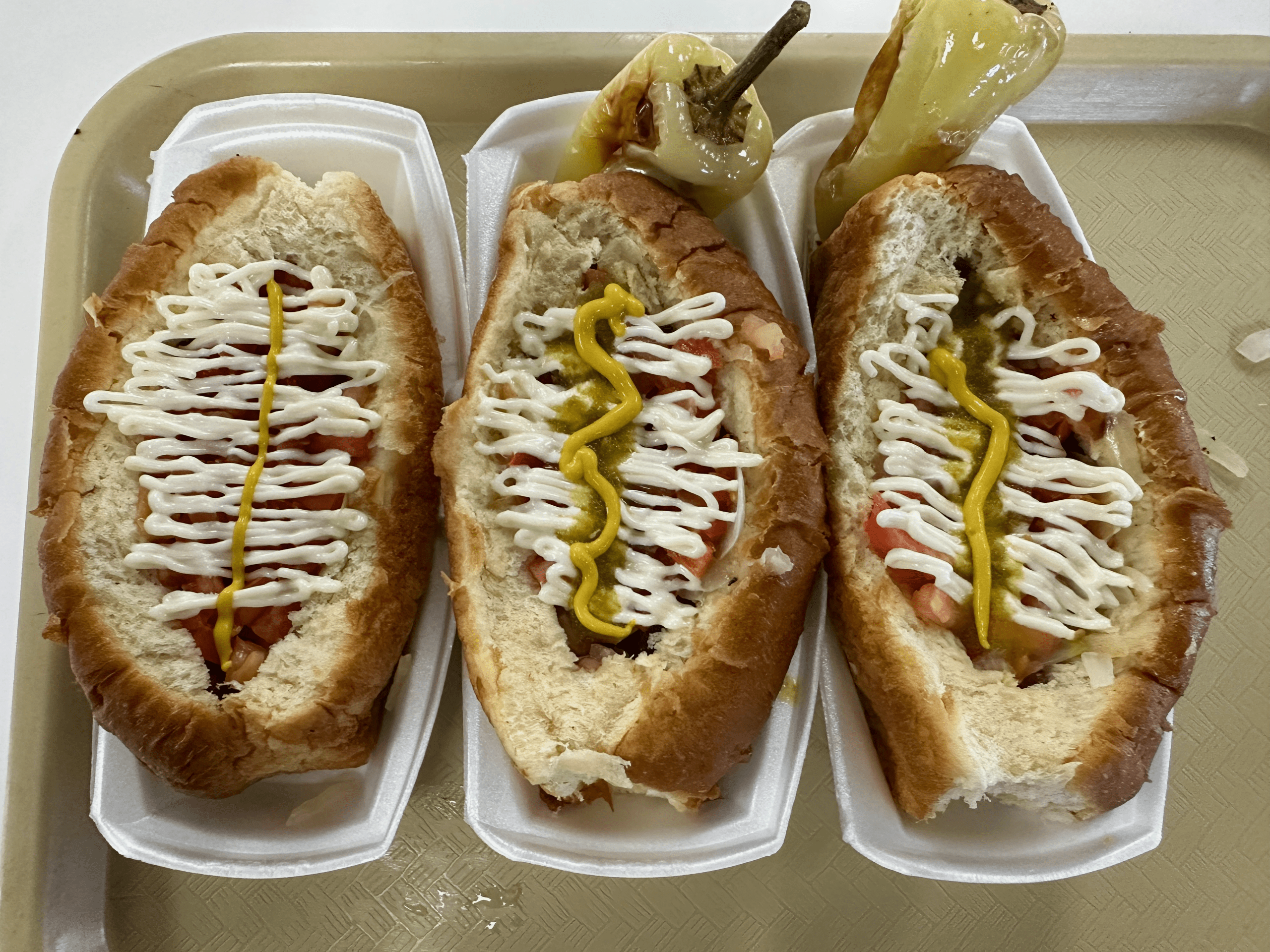
If asked to participate in a word association exercise, any well-traveled foodie undergoing psychoanalysis would find it easy to name the first food that comes to mind when a city is mentioned: Philadelphia – the Philly cheesesteak sandwich; Boston – baked beans; Chicago – Italian beef sandwiches; San Francisco – sourdough bread; Milwaukee – butter burgers; San Antonio, New Mexico – green chile cheeseburgers.  You get the point.  Some foodies might not know that Philadelphia is the birthplace of liberty, but they know about Geno’s and Pat’s King of Steaks and their decades-long battle for Philly cheesesteak supremacy. You might find it strange that seemingly pedestrian foods would be the defining cuisine of burgeoning cosmopolitan cities, historically significant metropolises and tiny hamlets in the desert, but it’s not solely foodies who associate foods with places. Anthropologist Maribel Alvarez of the University of Arizona says the “quintessential food of Tucson” is the Sonoran hot dog, explaining that instead of taking guests to high-end restaurants, locals will bring their out-of-towners to one of the city’s purveyors of Sonoran hot dogs. Hot dogs, like baseball and barbecue, aren’t exclusively the domain of Americans any more.  In fact, they never were. Before you call…

Salsa Brava – Flagstaff, Arizona

As the feminine form of “bravo,” brava translates from Spanish and Italian to “well done,” “excellent,” or “good.” Brava is often used to praise a female performer, often in conjunction with or preceding requesting an encore for a performance well executed.  Stemming from Italian and Spanish, brava can also be used to mean brave, angry or fierce.  I’m one of those Hispanic gents who expects…make that demands, salsa to be fierce and angry.  I want my salsa to bite me back, to reenforce through its potency and piquancy that pain is a flavor.  That’s especially true when a Mexican restaurant sports the audacious name “Salsa Brava.” Salsa Brava is a perpetual “best of the city” award-winner in Flagstaff.  It’s been earning “best Mexican” and “best salsa” accolades for the entirety of its nearly four decades years serving “The City of Seven Wonders.”  My hopes were that one of those seven wonders was indeed Salsa Brava’s eponymous salsa.  Make that salsas.  Shortly after you’re seated, your server will ferry to your table three salsas and a basket of chips.  The three salsas are a classic pico de gallo (mild), fire roasted-tomato chipotle (medium), and a pineapple/habanero (spicy).  Salsa is complimentary, increasingly…

El Agave Mexican Restaurant – Rio Rancho, New Mexican

Even the teetotalers among us recognize the importance of agave in the production of tequila and mescal.   What most of us may not fully appreciate is  agave’s diverse cultural and culinary significance, particularly in Mexico.  For example, the drought-resistant succulent plant has been used in medicinal treatments such as treating wounds, digestive ailments, and even as a remedy for coughs and sore throats.  It’s a source of natural sweetener and a healthier alternative to refined sugars.  Restaurants in Mexico use it to prepare salsas, marinades, desserts and even some traditional dishes.  Agave even plays a prominent role in indigenous cultures where it’s revered and valued.  Many of us use it to xeriscape our yards throughout the Southwest. Since October, 2017, foodies in the City of Vision have recognized another type of agave for which to be grateful.  That would be El Agave, a delightful family-owned-and-operated Mexican restaurant.  If you haven’t seen El Agave during your own peregrinations in Rio Rancho, that’s because it’s recessed about a block from heavily trafficked Rio Rancho Blvd., the city’s main north-south drag.  Worse, it’s esconced in the Lujan Plaza, a timeworn shopping center that’s seen better days.  El Agave occupies a corner space diagonally…

Rotiseria Y Taqueria Alcantara – Albuquerque, New Mexico

According to the Bureau of Labor Statistics, grocery prices have vaulted up 29% since February 2020.  Indeed, an Associated Press survey conducted in 2025 revealed that “the cost of groceries has become a major source of stress for just over half of all Americans — outpacing rent, health care and student debt.”  Very, very few grocery items have proven themselves inflation-proof.  Among those rare items is Costco’s rotisserie chicken which has remained the same price for years.  That consistently low price is a major reason Costco sells  more than 100-million ready-to-eat chickens each year. The obvious question when you peruse the menu at Rotiseria Y Taqueria Alcantara is “can a rotisserie chicken at a hole-in-the-wall restaurant possibly be six times as good as a Costco chicken?.”  Do the math.  “Six times” is just about how much more a whole rotisserie chicken at this Mexican restaurant on Isleta costs.   For the $28, you’ll pay for one chicken, you can actually buy almost six rotisserie chickens at Costco.  You’re probably wondering if the $28 rotisserie chicken is gilded in golden plumage.  Or perhaps, you’re pondering whether that chicken was pampered with a carefully managed diet of nutrient-rich grains like kobi beef cattle…

Dogos VIP – Albuquerque, New Mexico

Thanks largely to a 1974 Chevrolet commercial and its catchy tune, the phrase “As American as baseball, hot dogs and apple pie” has purportedly defined what Americans hold most sacrosanct.  Never mind that hot dogs are derivative of European sausages, they’re inextricably part of the fabric of the fruited plain. The National Hot Dog and Sausage Council (yes, there is such a thing) estimates that Americans eat seven billion hot dogs (so it’s not just me) during the unofficial summer season which runs from Memorial Day weekend through Labor Day. That’s 818 hot dogs per second and more than a third of the hot dogs eaten per year! July 19th has been designated National Hot Dog Day, but a case could easily be made that there are actually two days in which the not-so-humble hot dog is celebrated in America.  The second day, of course, is the 4th of July when Nathan’s Famous Hot Dogs sponsors its annual Hot Dog Eating Contest, the premier competitive event for gurgitators.  It’s no surprise that  several locations under the spacious skies have declared themselves the “hot dog capital of the world.” It may have started in 1999 when former New York City Mayor…

Arriba Shihuahua – Albuquerque, New Mexico

“How do they get away with using the name “Shihuahua” instead of Chihuahua,” I pondered, noting to myself that wokeism and cultural sensitivities have declared offensive virtually any term that  is perceived to diminish a culture or an individual (that perception usually being in the eye of the offended).  Surely, the National Mexican-American Anti-Defamation Committee would take umbrage at that name, much as it did more than fifty years ago when Frito Lay introduced the Frito Bandito.  For those of you not geriatrically advanced enough to remember the Frito Bandito, he was a cartoon mascot who spoke broken English and robbed people of their Fritos corn chips, a reference to the “Mexican bandit” stereotype in Western movies. As if to reinforce my point about people becoming easily offended, Arriba Shihuahua had to respond to a Yelp reviewer’s one-star rating: “We would like to clarify some things. The channels we put on TV do not aim to polarize or discriminate anyone’s political beliefs, but rather serve to entertain customers. (The news was actually a request from a customer.) We’re sorry if it offended you in any way. However, we do not appreciate our personal beliefs being automatically assumed and being disrespected for…

Fiesta Azul Tequila House Mexican Kitchen – Albuquerque, New Mexico

TIM WALZ: “I have white guy tacos.” VP KAMALA HARRIS: “What does that mean? Like, mayonnaise and tuna? What are you doing?” TIM WALZ: “Pretty much-ground meat and cheese.” VP KAMALA HARRIS:  “Do you put any flavor in it?” TIM WALZ:  “Uh, no.  Black pepper is the top of the spice level in Minnesota, ya know” A promotional  video featuring the Democratic Presidential nominee sharing a funny exchange with her Vice Presidential pick revealed the latter’s “Midwestern tastes” which include a “white guy taco.”   Analysis of America’s voting preferences has been done for virtually every demographic category save perhaps the “taco vote.”   Sadly, in the world of politics even a video elicits rancor and outrage when it depicts candidates behaving like normal people a having  normal conversation.  I hope you don’t take umbrage at this introduction to my post. If there’s one thing American idealogues–conservatives and liberals–should not be divided about, it’s our mutual love of tacos.  As a Hispanic white guy pretty much incapable of being offended, I myself used the term “white guy Mexican food” for years.   In fact, I used terms that were much more disparaging.  Imagine having been weaned on New Mexican food and being sent…

Taco Santo – Albuquerque, New Mexico (CLOSED)

NOTE:  In July, 2025, Taco Santo ceased operating as a taqueria, reverting back to Holy Burger, long one of the city’s most popular burger joints. Jay Rayner, one of my very favorite restaurant critics and authors, has an inimitable gift for luring readers with reviews that go far beyond describing food.  His review of Santo Remedio, a Mexican restaurant in London, is one such example, starting with his astute   observation about the debate between authenticity and verisimilitude in culinary culture: “All too often in the food world, the war of expertise becomes a lumbering battle between the Real Thing and the Good Stuff. The Real Thingers have knowledge and experience on their side. They’ve eaten dishes in their place of origin, when you have not. By contrast, all the Good Stuffers have is enthusiasm. They don’t care whether these Korean chicken wings are as they would be in downtown Seoul. All that matters is that they taste good.” Raynor’s “the real thing” is represented by purists and traditionalists who have not only eaten dishes in their place of origin, but in the manner in which those dishes were originally created.  The “good stuff” is represented by chefs seeking not to emulate…

ELEMI – El Paso, Texas

My friend Steve Coleman, owner of the well-written and impeccably researched Steve’s Food Blog has become quite a culinary anthropologist.  Not only does he provide his readers with comprehensive reviews of restaurants throughout the fruited plain, he explores the genesis of the foods he writes about.  One of his passions is to define what constitutes El Paso style Mexican cuisine–its provenance and the cultural role that cuisine has played over the generations.  As he’s discovered, El Paso style Mexican style is still evolving and redefining itself.  Some of that has occurred organically as other cultures have influenced dynamic changes.  Evolution has also been forged by the rediscovery of ancient ingredients and cooking techniques, some of which may once have been traditional. To Steve’s dismay, El Paso’s restaurant scene doesn’t seem to garner the type of adulation and respect accorded to more voguish and dynamic Texas cities such as Austin, Dallas and Houston.  It’s disconcerting to him that even when El Paso restaurants and chefs are nominated for James Beard awards, those restaurants make it no further than the semi-finals.  Steve has traveled extensively throughout Texas and is familiar with the culinary offerings at the chic, anointed cities.  In his estimation,…

Taconeta – El Paso, Texas

The meme below purports to show where the highest quality of tacos in Texas can be found.    Study the map and you’ll get the impression the meme’s creator believes tacos are “nonexistent” throughout about half of the Lone Star State.  That includes the Dallas-Fort Worth metroplex as well as all of West Texas.   Most of what the meme’s creator believes are the Lone Star State’s “best tacos” can be found only in San Antonio and the South Texas Plains as well as in portions of the Texas Hill Country.  A “best tacos” designation is also accorded to the El Paso area. There is, of course, no official sanctioning of this (or any other) Texas Taco Map.  It’s just someone’s opinion, perhaps someone well traveled and conversant in the exploration of taco greatness.  Much more highly regarded and as close-to-official as it comes is Texas Monthly Magazine’s “50 Best Tacos in Texas” listing.   Compiled by the Magazine’s “Taco Editor” Jose Ralat, who traveled around 14,000 miles, from Amarillo to Brownsville and El Paso to Texarkana, it actually validates that great tacos are to be found throughout the state.  Contrary to the Texas Taco Map, great  tacos aren’t the exclusive source…

Nixta Taqueria – Austin, Texas

Man cannot live on barbecue alone–not even in Austin, Texas where the world’s very best barbecue is to be found.  To limit one’s self to barbecue–as transformative as it may be–is to deprive yourself of some of the best Mexican food and best fried chicken in the known world.  Though the primary purpose of my week-long visit to the City of the Violet Crown was to visit Michelin starred barbecue restaurants, to have done so have been “going deep,”  exploring just one segment of the Central Texas culinary Utopia.  “Going wide” meant exploring options beyond barbecue–options such as some of the aforementioned Mexican food joints for which Austin is renowned. At the very top of my list was Nixta Taqueria which was ranked tenth among the 50 best tacos in Texas.  That compilation was put together by Texas Monthly’s “Taco Editor” Jose Ralat who “traversed the state from the Rio Grande Valley to the Panhandle to find the most superb tacos and taquerias.”  Along the way, he discovered that “More than ever, chefs, cooks, and taqueros—often Mexican immigrants or first-generation Mexican Americans—are crafting nostalgic dishes from their blended cultures and incorporating native Texan ingredients.”  He calls the movement “New Tejano.”…