Clay Pot Restaurant – Albuquerque, New Mexico

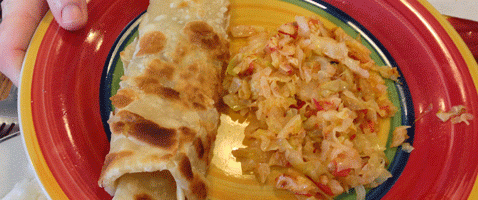
“This stuffing of food in your fellow diners’ face is called gursha, and that’s what you do to show your affection and respect. Try this at the Waffle House some time and prepare for awkwardness.” ~Anthony Bourdain, Season 6 of Parts Unknown Eating Ethiopian cuisine involves eating with your hands. That can also be said about eating pizza, sandwiches, tacos, gyros and a number of other foods common to the American palate. But what about being fed from someone else’s hand?  In Ethiopia, that practice is called gursha.  Gursha is a term for the Ethiopian tradition of hand-feeding a bite of food, wrapped in injera, to someone else as a gesture of love, friendship, and respect. It signifies hospitality, often extended to guests or loved ones, with larger bites symbolizing a stronger bond.  Bourdain noted that hospitality is a way of living in the “Land of Origins” (signifying  Ethiopia’s status as a cradle of humanity and civilization): “Here, as in much of Ethiopia, Muslims and Christians live side by side. … It’s a peculiar history of peaceful coexistence here, of which Ethiopians are quite proud. .” In the handful of times I’ve dined at Ethiopian restaurants, I’ve never been compelled to engage…

JAMBO CAFE – Santa Fe, New Mexico

Growing up in the 60s–the dark ages before the Internet was even a glimmer in Al Gore’s eyes and google–then spelled “googol”– represented an very large number (currently being approached by build back better spending)–even precocious children like me derived most of our knowledge of Africa from National Geographic magazines and Tarzan movies. We thought Africa was one large monolithic country comprised solely of stark, expansive deserts or lush, mysterious jungles. Africa’s indigenous people, we believed, had to compete for food with lions, tigers and hyenas, oh my. Though Africa was called “the Dark Continent,” it was truly our knowledge which was in the dark, obfuscated by stereotypes and misconceptions. The 1966 debut of Star Trek helped eliminate some of those stereotypes with the introduction of communications officer Lieutenant Uhura, a stunning black woman from the United States of Africa who spoke Swahili. By the time Disney’s The Jungle Book premiered in 1967, I had learned enough about Africa to know that save for in zoos, you couldn’t find a tiger in the entire continent. In the intervening years since the naivete of my youth, I’ve also learned that Africa is comprised of 53 very distinct and autonomous nations and…

The Safari Grill – Albuquerque, New Mexico (CLOSED)

“The wild dogs cry out in the night As they grow restless longing for some solitary company I know that I must do what’s right Sure as Kilimanjaro rises like Olympus above the Serengeti I seek to cure what’s deep inside, frightened of this thing that I’ve become.” ~ Africa by Toto Shrouded in mist and steeped in myth and mystery, Mount Kilimanjaro attracts visitors from all over the world. Often called “the roof of Africa,” the towering, snow-capped, conically-shaped mountain is the crown jewel of the United Republic of Tanzania. At 19,340 feet, the magnificent freestanding peak commands the skies, looming over the plains of the bushveld savannah like a majestic sovereign keeping vigilant watch over her people. Majestic as it may be, Mount Kilimanjaro is far from Tanzania’s sole travel destination. The country boasts of dozens of beautiful white sandy beaches such as those found in the island of Zanzibar. A number of national parks, conservation areas and game reserves allow visitors to get up close and personal with lions, leopards, elephants, cheetah, giraffes, zebras, jackals and thousands of migratory birds. Tanzania is also one of Africa’s most popular safari destinations. Now, safaris need not entail hunting animals…

Karibu Cafe – Albuquerque, New Mexico (CLOSED)

During the dry season in Africa, the protective shade of majestic trees casting their cooling shadows are prized–and not only for their impressive and assiduous statures. For generations, the “palaver tree” has served as a meeting place in which the community comes together to discuss issues of common interest, listen to stories and resolve problems and conflicts. Unlike many of the conference room melees…er, meetings of contemporary work life, meetings under the palaver tree are conducted with the utmost of mutual respect and trust. The palaver tree is a symbol of peace and reconciliation, symbolizing the spirit of acceptance and compromise. Much of village life—weddings, rituals and rites, and sharing of news—takes place under the palaver tree. Among Swahili speaking people, visitors to the palaver tree are greeted with the salutation “karibu” which translates to English as “welcome.” Under the palaver tree, the contribution of each member is welcome, driven by a common search for what is real, true and good. While the concept of the palaver tree may not be alive and well in Albuquerque, you’ll find the welcoming spirit of the palaver tree at a restaurant in the Northeast Heights. Fittingly known as the Karibu Café, it serves…

Talking Drums – Albuquerque, New Mexico (CLOSED)

“There is strength in Africa. Not the crushing brute strength of the bull elephant. Nor the rigid, unyielding strength of the Kilimanjaro. But a calm, enduring strength, the kind of abiding strength that will not waiver in the face of adversity, loss or hardship. It is the quiet strength of the African woman.” Quiet strength. That uplifting affirmation, inscribed on a framed poster, hangs on a wall at Talking Drums, Albuquerque’s very first African restaurant. It provides inspiration to and could have been written about Toyin Oladeji, the risk-taking proprietor, chef and daring entrepreneur who’s betting the Duke City is ready for the incomparable cuisine of her homeland. Toyin (who’s mistakenly called Toni so often, she goes by that name) already provides one niche service, owning and operating the only African store in New Mexico and Arizona. Her Zenith African Caribbean Market has been serving the area with groceries, clothing, beauty products, arts and crafts for more than a decade. In launching Talking Drums, she’s filling another niche. The name Talking Drums is derived from a prominent method of communication throughout West Africa, especially during festive occasions and in Africa there is nothing more festive than sharing foods. West Africa…

Kasbah Mediterranean – Albuquerque, New Mexico (CLOSED)

Sweeping cobwebs from the edges of my mind Had to get away to see what we could find Hope the days that lie ahead Bring us back to where they’ve led Listen up to what’s been said to you Would you know we’re riding on the Marrakech Express Would you know we’re riding on the Marrakech Express All on board that train – Crosby, Stills & Nash For decades, Hollywood has portrayed the ancient Moroccan city of Marrakech as a venue in which mystery and intrigue can be found along every narrow street and behind every sharp turn, a place of fantasy where fire-eaters, sword-swallowers and snake charmers perform–a city with a dizzying array of food stalls, richly adorned palaces and alleyways crowded traditional shops in which intricately woven tapestries and brass works dazzle the eyes. Alfred Hitchcock certainly exploited those characteristics in his suspenseful 1956 thriller The Man Who Knew Too Much where middle class Americans played by Jimmy Stewart and Doris Day vacationing in Marrakech find themselves embroiled in a nefarious plot to assassinate an ambassador after their son is kidnapped. The movie has me on the edge of my seat every time I watch it, as much…

Rafiki Cafe – Albuquerque, New Mexico (CLOSED)

“Let us break bread and celebrate our diversity.” ~Desmond Tutu Peruvian cuisine…been there, done that!  Moroccan meals…that’s so yesterday.  Persian food…it’s had its day.  Pan Asian dining…erstwhile eating.  Never mind Italian regional cuisine and Spanish tapas.  Once fresh and nouveau, they’re now practically prehistoric.  Who would have thought ten years ago that the Duke City would become so cosmopolitan, so open to multicultural culinary elements from all over the world?  Who would have guessed that cuisine once considered exotic and alien would become just another welcome part of the culinary climate? In contemporary times fashioned by an interconnected world, a community of intrepid diners in Albuquerque has become very receptive and accepting of new foods. We embrace diversity, craving adventurous eating and won’t hesitate to try anything new. In fact, we sometimes prefer to try something new than to return to something we’ve already experienced. We rarely order the same thing twice. Leave the aversion to change and to trying new things to the “chain gangs,” those diners who find comfort in the mundanity of chain restaurants. One of the exotic cuisines which has recently gained a foothold in the Duke City culinary scene is African cuisine though that term…

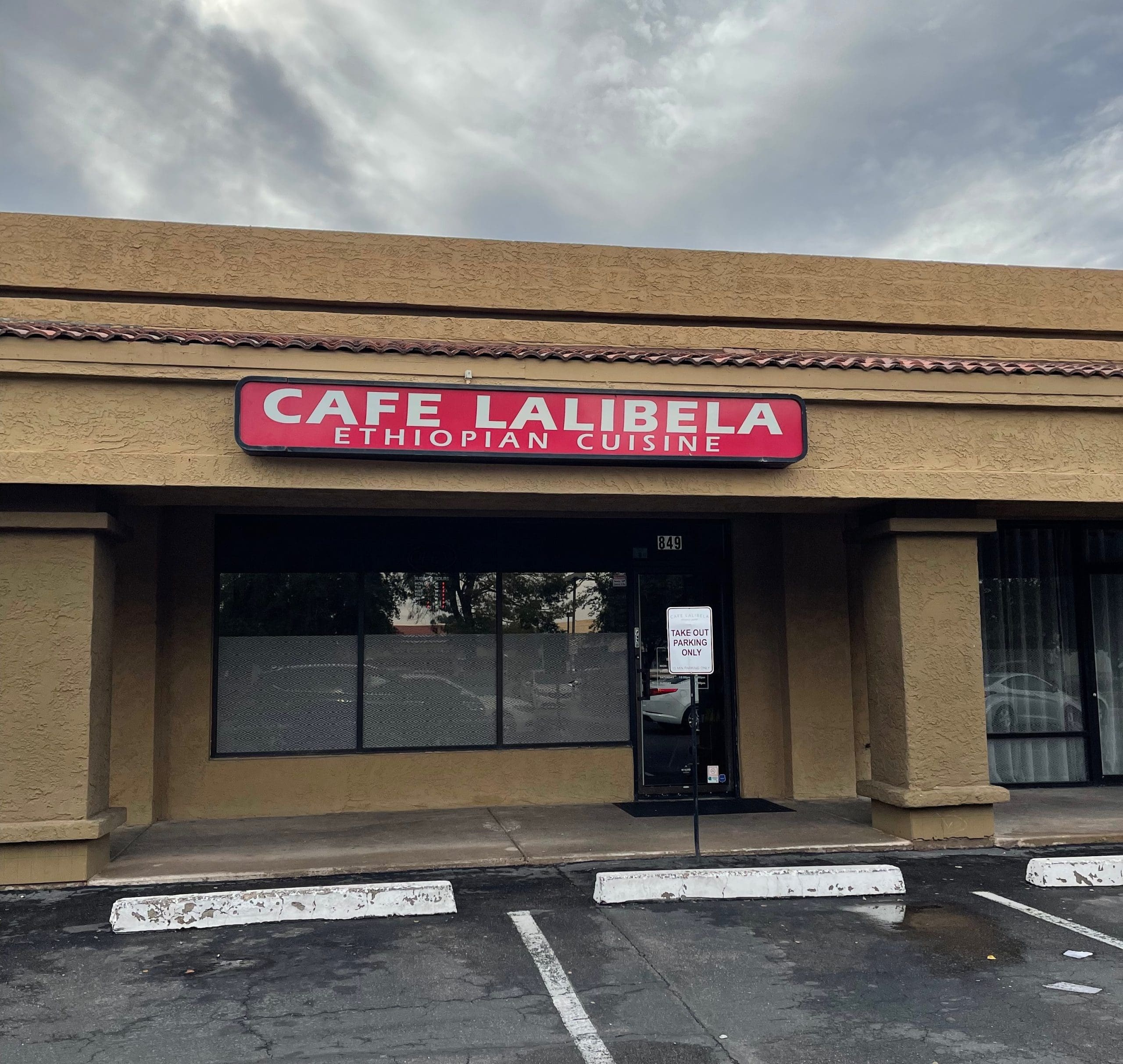
Cafe Lalibela – Tempe, Arizona

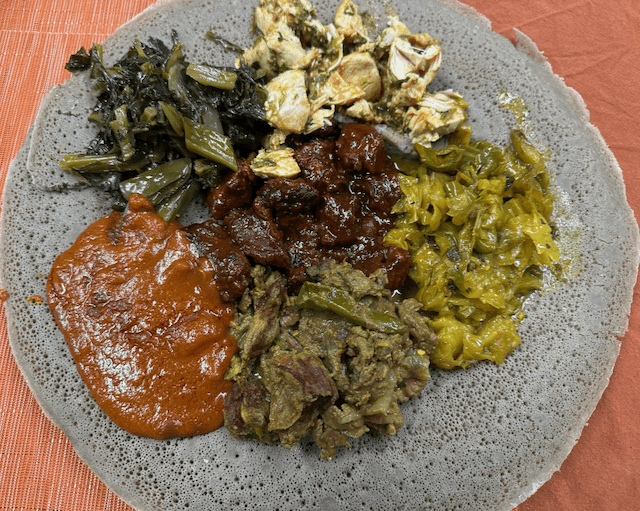
One of the first things that caught my attention during a 2006 visit to Cafe Lalibela were beautiful, brightly painted depictions of revered Christian events such as Christ carrying the yew hewn cross to Calvary. The art shouldn’t have surprised me. Ethiopia’s (especially the city of Lalibela’s) historical ties to Christianity span several centuries. Lalibela, the city for which the restaurant is named, is one of modern Ethiopia’s holiest cities and a center of pilgrimage for much of the country. With a population of very nearly 100% Ethiopian Orthodox Christian, Lalibela is renown worldwide for its monolithic churches built during the reign of 13th century monarch Saint Lalibela for whom the city is named. The names of several places in the modern town and the general layout of the monolithic churches themselves are said to mimic names and patterns observed by Saint Lalibela during the time he spent as a youth in Jerusalem and the Holy Land. Cafe Lalibela serves both vegetarian and non-vegetarian dishes, garnering several accolades (including Best Vegetarian restaurant in Phoenix by New Times magazine) for its unique cuisine. For me, it was more important that my vegan friend and colleague Karen enjoyed her introduction to Ethiopian…