Zea Rotisserie & Grill – Albuquerque, New Mexico (CLOSED)

Our first visit to Zea followed the day after it was savaged by an erstwhile Albuquerque Journal restaurant critic, but any trepidation we might have had quickly dissipated when we were greeted enthusiastically at the hostess station by Betty, the luminous former waitress at the incomparable and much missed (to this day, I dream of its timbale tuna) Nouveau Noodles restaurant in Tijeras. At Nouveau, Betty was a whirling dervish of perpetual motion and the restaurant’s consummate ambassador. As warm and effusive a waitress as you’ll find anywhere, Betty’s unabashed enthusiasm for Nouveau’s cuisine was evident in her flowingly eloquent descriptions of the restaurant’s menu items–polysyllabic descriptions which she peppered with adjectives synonymous with fabulous. We trusted her recommendations and appreciated the personable and attentive service she lavished upon us. After seating us at Zea, she cautioned against any pre-conceived notions we might have about chain restaurants, indicating this one was was different. She explained that Zea was founded in New Orleans in 1997 and that its founders’ goal is to celebrate the cultural phenomenon that is eating and drinking for the sheer pleasure of it (sounds like my kind of people). There are currently five Zea locations in the…
Cafe Cornucopia – Bisbee, Arizona

The Hollywood stereotype of restaurant critics paints them rather unflatteringly as condescending misanthropes to be feared. Those stereotypes would have you believe restaurant critics are eager to pounce on and expose the slightest imperfection.  Armed with pedantic palates and polysyllabic vocabularies overflowing with unfavorable adjectives, critics are painted as joyless beings whose quest it is to impart their misery on the restaurants they evaluate.  To the critic, the exemplar is French cuisine and everything else is so much schlock to be disdained. Consider the 1988 movie Mystic Pizza in which a snobbish restaurant critic renown for his “make or break” reviews deigned to visit a pizza parlor of all places.  With a stern countenance and belittling attitude, he based his entire review on having sampled little more than one bite.  Ostensibly his palate was sophisticated enough to render a verdict on the pizza after a minuscule sample. Even the restaurant critics on animated features tend to be snotty. The aptly named Anton Ego from the delightful 2007 Pixar movie Ratatouille may have summed it up best: “In many ways, the work of a critic is easy.  We risk very little yet enjoy a position over those who offer up their work…

Chef’s Bistro – Albuquerque, New Mexico (CLOSED)

It’s been called the “Harvard of cooking schools” and has been credited with having “changed the way Americans eat” by no less than the James Beard Foundation. World-reknowned French chef Paul Bocuse calls it “the best culinary school in the world.” It has trained more than forty-thousand culinary professionals and counts among its distinguished alumni such Food Network luminaries as Tony Bourdain, Anne Burrell, Cat Cora, Sara Moulton and Todd English. In the culinary world, the Central Intelligence Agency is known as “the other CIA.” The CIA is the Culinary Institute of America (CIA), a not-for-profit culinary school which confers Associate of Occupational Studies (A.O.S.) degrees in either Culinary Arts or Baking and Pastry Arts. Students don’t just receive hands-on training, they spend over 1,300 hours in the kitchen or bakeshop. At its Hyde Park campus, the CIA operates five public restaurants in which students acquire experience in both back-of-the-house kitchen and front-of-the-house management skills. A degree from the CIA doesn’t just open doors to exciting possibilities, it confers upon its graduates credentials that are universally respected throughout the vast culinary community. The CIA also offers a three-tiered American Culinary Federation (ACF) certification entitled Pro Chef, each tier recognizing skills…

Cafe Green – Albuquerque, New Mexico (CLOSED)

Brunch is the best of two worlds–not quite breakfast and not quite lunch, but the best of both. It’s a leisurely weekend repast which makes you feel you’re getting away with something, as if you’re defying your mom’s mandate not to have dessert before the main entree. The feeling that you’re getting away with something delightfully illicit is reenforced as you lap up mimosas and Bloody Marys as fast as the wait staff can bring them to you. Brunch even allows you to get away with laziness at least once a year when you have the excuse to drag mom to a restaurant where she and countless other moms can be pampered on their special day. Americans have loved brunch since the 1930s when, according to culinary historians, passengers on transcontinental train rides would disembark in Chicago for a late morning meal in between trains. It wasn’t until after the second war to end all wars that brunch became popular on Sundays. Apparently the promises made in foxholes (where there are no atheists) were quickly forgotten because after World War II, there was a precipitous decline in the number of churchgoers across the fruited plain. Instead, Americans began to sleep…

Independence Grill – Albuquerque, New Mexico (CLOSED)

NOTE: The Independence Grill became another casualty of the economy, shuttering its doors on Sunday, March 14th, 2010. Below this review is a photo retrospective of some of the many things which will be missed about this terrific restaurant. On January 6, 1941 as President Franklin Delano Roosevelt closed his state of the union address to Congress, he described his vision for a better way of life through what he considered the four essential human freedoms: freedom to worship, freedom from fear, freedom from want and freedom of speech. Those four freedoms, now widely considered the central tenets of modern American liberalism, inspired a set of Four Freedoms paintings by Norman Rockwell, the most famous and successful commercial artist of the time. The Four Freedoms are depicted on framed Rockwell prints in the foyer at Independence Grill. In an age in which the patriotism of candidates for political office is called to question by opposing candidates, there is no question as to where Jerry Wright stands on the matter of loving his country. Jerry is the proprietor of the Independence Grill which he launched on Monday, November 16th, 2008, several months after closing the Great American Steakhouse, my favorite Albuquerque…

The Black Olive Wine Bar & Grill – Rio Rancho, New Mexico (CLOSED)

Perhaps in time, the Albuquerque-Rio Rancho metropolitan statistical area will be thought of in much the same vein as America’s two most famous “twin city” metroplexes–Dallas-Fort Worth and Minneapolis-Saint Paul. Don’t be surprised if Rio Rancho winds up being the Dallas to Albuquerque’s Fort Worth, the Minneapolis to Albuquerque’s Saint Paul. People have been selling Rio Rancho short for a long time, but that’s starting to change. By 1980, the end of its first decade in existence, the fledgling city which in 1970 didn’t even have a measurable population by U.S. Census standards had more than 10,000 residents. Ten years later, census reports showed the “little city which could” had grown to more than 32,000 residents and had become the sixth most populous city in the state. Rio Rancho added another 20,000 residents by the millennium. 2007 population estimates now indicate Rio Rancho has supplanted Santa Fe as the third largest city in the Land of Enchantment with nearly 76,000 residents calling the City of Vision home. Rio Rancho residents who once traversed a two-lane road down the hill to Albuquerque to do their shopping, partake of entertainment and dine at a variety of restaurants offering a diversity of cuisine…

Gold Street Caffe – Albuquerque, New Mexico (CLOSED)

When you’re alone and life is making you lonely You can always go – downtown When you’ve got worries, all the noise and the hurry Seems to help, I know – downtown Just listen to the music of the traffic in the city Linger on the sidewalk where the neon signs are pretty How can you lose? The lights are much brighter there You can forget all your troubles, forget all your cares So go downtown, things’ll be great when you’re Downtown – no finer place, for sure Downtown – everything’s waiting for you. Just a few years ago, the lyrics to Petula Clark’s January, 1965 number one single, would not have been used to describe Albuquerque’s downtown area. In fact, the downtown area was more ghost town than boomtown except for during weekday business hours and late night at bars. Even in September, 1998 when Sarah Brown launched the Gold Street Caffe in a historic building circa 1911, the notion that Albuquerque’s downtown would become a social, economic and cultural hub might have been met by skepticism save for the unwavering optimism of visionaries who recognized the area’s potential beyond its historic attachment to the Mother Road, Route 66.…

The Pink Adobe – Santa Fe, New Mexico

Culinary historians credit the advent of the modern Santa Fe fine dining scene to a painter who moved to Santa Fe shortly after World War II to join the burgeoning art community. Having to support herself and a young daughter, Rosalea Murphy turned to something else at which she excelled–the culinary arts. As with most rags to riches success stories, Rosalea did not immediately set the Santa Fe dining scene on its ear, but then this wasn’t the “City Different” now widely recognized as a tourist Mecca. Good things take time. Great things take longer. When she first launched the restaurant she christened the Pink Adobe after the hue of its facade, her humble menu consisted solely of French onion soup and apple pie. As her business grew, so did her menu. She added “Pink Dobeburgers” to the menu and sold them for twenty-five cents each. Chicken enchiladas followed suit, the first of several New Mexican specialties she would add to the menu. Eventually her Pink Adobe became the first restaurant in Santa Fe to serve seafood, then a novelty in what was, in her words, “a lazy, sleepy town.” By the 21st century, the ambitious menu featured variety unlike…

Introducing the New Mexico Green Chile Cheeseburger Trail

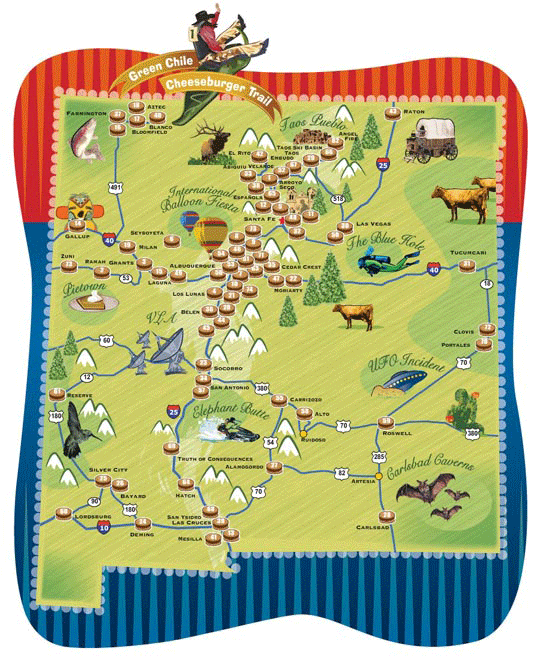
To New Mexicans, there is nothing as thoroughly soul-satisfying and utterly delicious as our ubiquitous green chile cheeseburger.  We have a fierce pride in that most simplistic, but explosive, flavor-blessed union of a thick, juicy beef patty grilled over an open flame or sizzled on a griddle then blanketed in cheese and topped with taste bud awakening, tongue tingling, olfactory arousing green chile. New Mexicans throughout the Land of Enchantment’s 33 counties celebrated July 22nd, 2009 with the gusto normally reserved for a Lobo or Aggie victory.  We basked in the glory of one of our own upstanding citizens vanquishing an audacious interloper from New York City in a green chile cheeseburger “throwdown.”  On that fateful summer day, the Food Network aired for the first time, the tasty triumph of the Buckhorn Tavern’s Bobby Olguin over “Iron Chef” Bobby Flay.  Our chests swelled with pride as the Food Network confirmed what all of us know–when it comes to the green chile cheeseburger, New Mexico is the best in the world. In recognition of Olguin’s victory, Governor Bill Richardson declared Friday July 24, 2009 “Buckhorn Tavern Day.” “Congratulations to the Buckhorn Tavern and its owner Bobby Olguin for the impressive victory…

Harla May’s Fat Boy Grill – Belen, New Mexico (CLOSED)

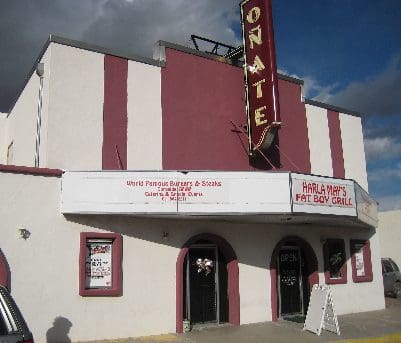
Many of us who grew up in small town America during the 60s sometimes pine for the more innocent days of our youth–the days before cable television gave us hundreds of channels (and nothing to watch) and video games became the only form of exercise (albeit, of their thumbs) our children get. Back then, the movie theater was the town’s cultural center. It was where small-town America congregated to see Hollywood blockbusters (about two years after they hit the big cities) as well as movies which introduced our innocents to the Hell’s Angels, Bruce Lee, Godzilla and campy Sonny and Cher movies. The small-town American theater in New Mexico also meant Cantinflas, the campesino once referred to by Charlie Chaplin as the greatest comedian in the world. It meant not only American “shoot ’em up” Westerns featuring rugged cowboys, rowdy rustlers, round-ups and home on the range, but the Mexican equivalent–movies featuring the exploits of charros, the traditional cowboys of central and northern Mexico. The small-town American theater was where boys and girls went to hold hands in the dark back in the days when “getting through the bases” took considerably longer than it does today. It truly was a…

Porky’s Pride Real Pit BBQ – Albuquerque, New Mexico (CLOSED)

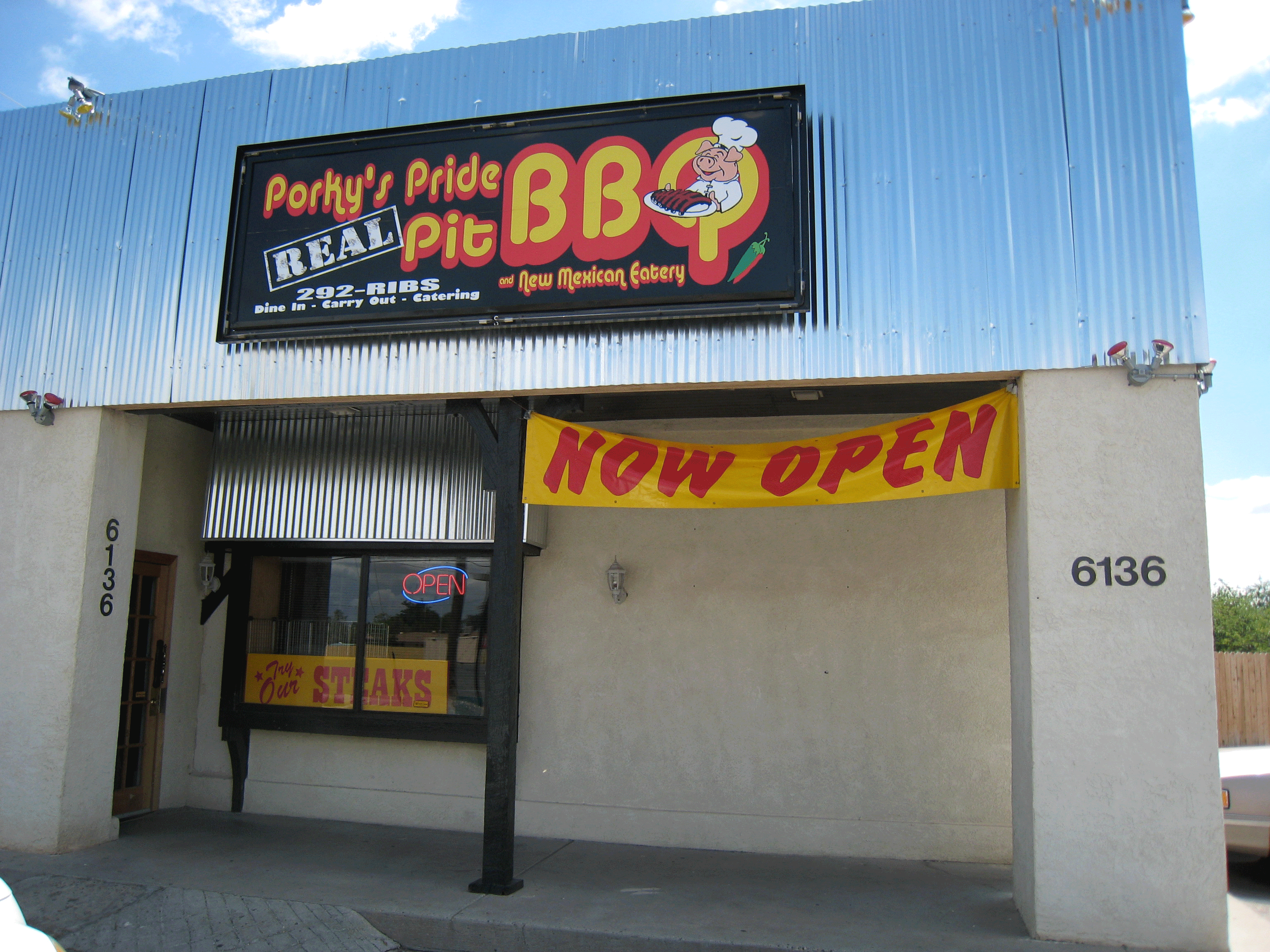
The genesis of America’s popular music–country, jazz and even rock and roll–is rooted in the soul and sounds of Mississippi Delta blues–sounds born in the disgraceful shadow of slavery and lyrics which echoed the grievous plight and painful lament of workers in plantations and fields.  It is a tribute to the resilience of a people that the music of their lament evolved over the centuries to bring succor, alacrity and pride to generations. Given poor quality meat, those plantation workers dug pits in the ground in which they cooked the poor cuts of pigs or meat they were allowed to raise. When emancipated, the pit masters introduced their prowess over the barbecue pit throughout the United States. The American epicenters of barbecue excellence–Texas, Memphis, Kansas City and the Carolinas–all owe their barbecue roots to the deep south. Today, the term “real pit barbecue” rarely refers to a big hole in the ground. A barbecue pit is almost always above ground in a steel “oven” in which meat revolves on racks until just right.  The pit master’s prowess is showcased in the way he or she deftly manipulates indirect heat and wood smoke to produce the inimitable flavor that has made…