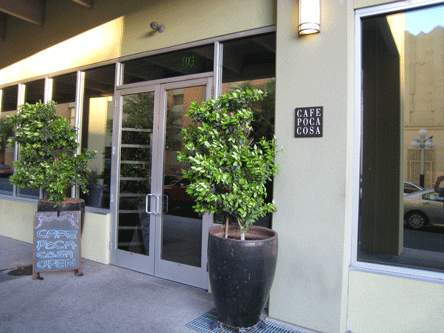
Cafe Poca Cosa – Tucson, Arizona (CLOSED)

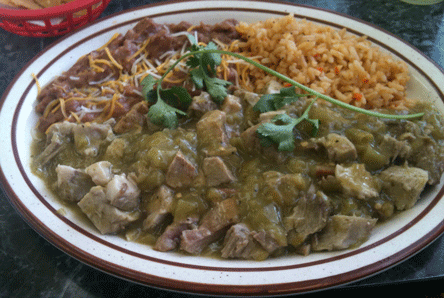
Stereotypes would have you believe English food and Mexican food are at the opposite end of the spectrum from one another…as different as day and night.  Those stereotypes paint English food as bland and unimaginative while Mexican food is depicted as spirited and exciting.  That makes it deliciously ironic that perhaps the foremost authority on Mexican food is an adventurous English woman named Diana Kennedy.  In 1957, she moved to Mexico and has spent most of her life since researching and documenting the culinary history of Mexican cuisine. For her inestimable contributions to the documentation of regional Mexican cuisine, the government of Mexico awarded her the “Order of the Aztec Eagle” award, the Mexican equivalent of knighthood while Queen Elizabeth herself dubbed her “Member of the British Empire,” an award of similar distinction.  Once described in The Seattle Times as “the diva of doing it right,” Diana Kennedy champions authenticity in technique and ingredients and she’s a stickler for precision. The late Craig Claiborne, pioneering food critic for the New York Times, once described Mexican cuisine as “peasant food raised to the level of high and sophisticated art,” an apt description of how Diana Kennedy elevated the cuisine of her adopted…

Chef’s Bistro – Albuquerque, New Mexico (CLOSED)

It’s been called the “Harvard of cooking schools” and has been credited with having “changed the way Americans eat” by no less than the James Beard Foundation. World-reknowned French chef Paul Bocuse calls it “the best culinary school in the world.” It has trained more than forty-thousand culinary professionals and counts among its distinguished alumni such Food Network luminaries as Tony Bourdain, Anne Burrell, Cat Cora, Sara Moulton and Todd English. In the culinary world, the Central Intelligence Agency is known as “the other CIA.” The CIA is the Culinary Institute of America (CIA), a not-for-profit culinary school which confers Associate of Occupational Studies (A.O.S.) degrees in either Culinary Arts or Baking and Pastry Arts. Students don’t just receive hands-on training, they spend over 1,300 hours in the kitchen or bakeshop. At its Hyde Park campus, the CIA operates five public restaurants in which students acquire experience in both back-of-the-house kitchen and front-of-the-house management skills. A degree from the CIA doesn’t just open doors to exciting possibilities, it confers upon its graduates credentials that are universally respected throughout the vast culinary community. The CIA also offers a three-tiered American Culinary Federation (ACF) certification entitled Pro Chef, each tier recognizing skills…

Cafe Green – Albuquerque, New Mexico (CLOSED)

Brunch is the best of two worlds–not quite breakfast and not quite lunch, but the best of both. It’s a leisurely weekend repast which makes you feel you’re getting away with something, as if you’re defying your mom’s mandate not to have dessert before the main entree. The feeling that you’re getting away with something delightfully illicit is reenforced as you lap up mimosas and Bloody Marys as fast as the wait staff can bring them to you. Brunch even allows you to get away with laziness at least once a year when you have the excuse to drag mom to a restaurant where she and countless other moms can be pampered on their special day. Americans have loved brunch since the 1930s when, according to culinary historians, passengers on transcontinental train rides would disembark in Chicago for a late morning meal in between trains. It wasn’t until after the second war to end all wars that brunch became popular on Sundays. Apparently the promises made in foxholes (where there are no atheists) were quickly forgotten because after World War II, there was a precipitous decline in the number of churchgoers across the fruited plain. Instead, Americans began to sleep…

Independence Grill – Albuquerque, New Mexico (CLOSED)

NOTE: The Independence Grill became another casualty of the economy, shuttering its doors on Sunday, March 14th, 2010. Below this review is a photo retrospective of some of the many things which will be missed about this terrific restaurant. On January 6, 1941 as President Franklin Delano Roosevelt closed his state of the union address to Congress, he described his vision for a better way of life through what he considered the four essential human freedoms: freedom to worship, freedom from fear, freedom from want and freedom of speech. Those four freedoms, now widely considered the central tenets of modern American liberalism, inspired a set of Four Freedoms paintings by Norman Rockwell, the most famous and successful commercial artist of the time. The Four Freedoms are depicted on framed Rockwell prints in the foyer at Independence Grill. In an age in which the patriotism of candidates for political office is called to question by opposing candidates, there is no question as to where Jerry Wright stands on the matter of loving his country. Jerry is the proprietor of the Independence Grill which he launched on Monday, November 16th, 2008, several months after closing the Great American Steakhouse, my favorite Albuquerque…

Barry’s Oasis – Albuquerque, New Mexico (CLOSED)

I don’t know if there’s any veracity to the adage “don’t trust a skinny chef,” but one thing is for certain. Albuquerque has been trusting a very grumpy chef to prepare excellent meals for more than a quarter century. That grumpy chef is the irascible Barry Schuster, serving great cuisine in Albuquerque since 1979. One of the first things you see when you walk into the restaurant is a caricature of a somewhat younger Barry. Scrawled below his countenance are the words “grumpy chef.” Barry cultivates the image of a surly curmudgeon, but underneath that gruff exterior lies a heart of gold, a hospitality professional who wanders from the kitchen to check in on his guests and engage them in discourse. He continues to come to work day-after-day instead of enjoying a well-deserved retirement. Okay, maybe he’s not exactly an avuncular fellow, but he really does care that his patrons enjoy their dining experiences at his eponymous restaurant. He’s got a great sense of humor and his witty repartee will enhance your experience. The banter between Barry and his nearly as churlish waiter Richard Lopez is particularly entertaining. Richard has been with Barry for more than a decade. The two…

Frattellis – Rio Rancho, New Mexico

In New York City, pizza by the slice is as ubiquitous as towering skyscrapers. Many of the city’s nearly 3,000 pizzerias serve pizza by the slice. Most have been doing so since the end of WWII when recently returned American veterans who served in Italy craved the sliced pizza they had enjoyed during their service. Heck, in the Big Apple, you can even find pizza by the slice proffered by sidewalk vendors. At about two bucks a slice, it’s usually pretty decent thin-sliced pizza blanketed with cheese. A widespread presence doesn’t mean the practice is universally approved of. The other school of thought snubs its nose at the thought of serving by the slice, the triangle-shaped, tomato sauced pie Americans consume at the rate of 100 acres a day. Many traditionalists, particularly artisan Pizzaiolis with coal-burning oven pedigrees disdain the practice of pizza by the slice, scoffing that the practitioners of this sacrilege have reduced the art of pizza making to a fast-food assembly-line pretense. While several pizzerias in the Albuquerque metropolitan area serve pizza by the slice, the lack of historical ties to the genesis of America’s pizza might be the reason you don’t hear the slice versus no…

Paul’s Monterey Inn – Albuquerque, New Mexico (CLOSED)

The year was 1971. Albuquerque’s population had reached a quarter of a million. The San Juan-Chama project, a system of diversion structures and tunnels for trans-mountain movement of water from the San Juan River Basin to the Rio Grande Basin, was completed. The area’s three military installations: Kirtland, Manzano and Sandia Bases merged under Air Force jurisdiction. Civil unrest was in the air in pastoral Roosevelt Park where a riot ensued that saw more than 130 arrested and more than 2,000 armed men called in to quell the situation. Albuquerque ballooning pioneer Sid Cutter took his first balloon flight. Paul’s Monterey Inn opened on Juan Tabo. Four decades later Paul’s Monterey Inn continues to serve the Duke city with a menu that hasn’t changed much, if at all, in lo these many years. While the menu may not have changed, times have. In the 70s, longer cooking times to avert potential diseases resulted in the the most popular degree of preparation for steak being anywhere from medium to well-done. Today, aficionados of steak prefer shorter cooking times so that their favorite slabs of beef retain more juice and flavor. In the 1970s, thick, hazy clouds of cigarette smoke permeated virtually…

The Black Olive Wine Bar & Grill – Rio Rancho, New Mexico (CLOSED)

Perhaps in time, the Albuquerque-Rio Rancho metropolitan statistical area will be thought of in much the same vein as America’s two most famous “twin city” metroplexes–Dallas-Fort Worth and Minneapolis-Saint Paul. Don’t be surprised if Rio Rancho winds up being the Dallas to Albuquerque’s Fort Worth, the Minneapolis to Albuquerque’s Saint Paul. People have been selling Rio Rancho short for a long time, but that’s starting to change. By 1980, the end of its first decade in existence, the fledgling city which in 1970 didn’t even have a measurable population by U.S. Census standards had more than 10,000 residents. Ten years later, census reports showed the “little city which could” had grown to more than 32,000 residents and had become the sixth most populous city in the state. Rio Rancho added another 20,000 residents by the millennium. 2007 population estimates now indicate Rio Rancho has supplanted Santa Fe as the third largest city in the Land of Enchantment with nearly 76,000 residents calling the City of Vision home. Rio Rancho residents who once traversed a two-lane road down the hill to Albuquerque to do their shopping, partake of entertainment and dine at a variety of restaurants offering a diversity of cuisine…

Gold Street Caffe – Albuquerque, New Mexico (CLOSED)

When you’re alone and life is making you lonely You can always go – downtown When you’ve got worries, all the noise and the hurry Seems to help, I know – downtown Just listen to the music of the traffic in the city Linger on the sidewalk where the neon signs are pretty How can you lose? The lights are much brighter there You can forget all your troubles, forget all your cares So go downtown, things’ll be great when you’re Downtown – no finer place, for sure Downtown – everything’s waiting for you. Just a few years ago, the lyrics to Petula Clark’s January, 1965 number one single, would not have been used to describe Albuquerque’s downtown area. In fact, the downtown area was more ghost town than boomtown except for during weekday business hours and late night at bars. Even in September, 1998 when Sarah Brown launched the Gold Street Caffe in a historic building circa 1911, the notion that Albuquerque’s downtown would become a social, economic and cultural hub might have been met by skepticism save for the unwavering optimism of visionaries who recognized the area’s potential beyond its historic attachment to the Mother Road, Route 66.…

Duke’s Steakhouse – Albuquerque, New Mexico (CLOSED)

“Did you ever see the customers in health-food stores? They are pale, skinny people who look half dead. In a steak house, you see robust, ruddy people. They’re dying, of course, but they look terrific.” -Bill Cosby Bill Cosby probably didn’t have actor Robert Mitchum in mind when describing the type of people who visit steak houses. Heralded by movie critic Roger Ebert as “one of the greatest actors of all time,” the masculine Mitchum was certainly robust (evincing strength and vigorous health) and ruddy (inclined to a healthy reddish color often associated with outdoor life), but he wasn’t the type of he-man you might envision in a steak house. Presiding over a campfire, yes, but sitting down at a restaurant, no. Over an open flame, Mitchum would, of course, be grilling a sizzling, flame-kissed slab of thick, red beef destined to overfill his plate. There would be no vegetables in sight nor would you find a tablecloth, candles or soft music. With the rousing composition “Rodeo” playing in the background, Mitchum would be heard to say, “Beef. It’s what’s for dinner!” Largely through Robert Mitchum’s compelling voiceovers, the American Beef Council has been telling America beef is what’s for…

Lotus Cafe – Albuquerque, New Mexico (CLOSED)

Balance. The Diné, or Navajo, of America’s Four Corners Region have a word for it: “hózhó.” The word embodies the idea of striving for balance and harmony along with beauty and order. Every aspect of Diné life–whether spiritual or secular–is connected to hózhó, maintaining balance between the individual and the universe and living in harmony with nature and the Creator. Balance. America’s favorite everyman philosopher Homer J. Simpson might define it as “a donut in each hand.” Obviously politicians discussing the budget should definite it as something unachievable, an ephemeral concept, a meaningless and baseless promise uttered simply to mollify their constituency. The dictionary might define it as a state of equilibrium. Balance. The underlying foundation of Thai cuisine, going back to Chinese influences as early as the 10th century, is to achieve a satisfying and exciting taste experience through the relationship between five fundamental tastes: sweet, salty, spicy, sour and bitter. Properly balancing these flavors is the true essence of Thai cooking. Each Thai dish generally has three or four of these flavors harmoniously interplaying with one another in a way that is not only delicious, but balanced. In most dishes, one flavor predominates with the other flavors being…