Gates Bar B. Q. – Independence, Missouri

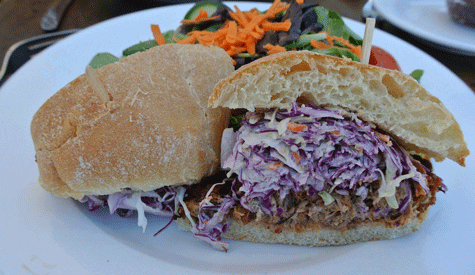
The cognoscenti seem to agree that the American epicenters of barbecue excellence are Texas, Memphis, Kansas City and South Carolina. In Texas, barbeque briquettes are burnished with beef–lean beef brisket celebrating the best in king cattle. At Memphis, they go hog wild at the pits for pulled porcine perfection. In South Carolina, the self-professed “cradle of American barbecue,” swine dining means pork smothered in a mustard-based sauce. Kansas City claims to put it all together with more than 100 barbecue restaurants, several of which have earned worldwide acclaim and celebrity. Traditionally, Kansas City barbecue is dry-rubbed, slow roasted over hickory and slathered with rich, sweetly tangy, medium spicy, tomato-based sauces that stick to the meat. Gates Bar-B-Q is a “City of Fountains” original, a family restaurant established in 1946 which has grown from a single store to a family of six modern restaurants (and growing) throughout the Kansas City metroplex. All Gates restaurants sport a unique red roof design and a marquee depicting a tuxedo attired butler who somewhat resembles Jeeves, one of the most recognized faces on the early Internet. The word bubble by the chapeau sporting butler on the marquee exhorts, “Hi, may I help you?” and it…

The Squeeze Inn – Roseville, California

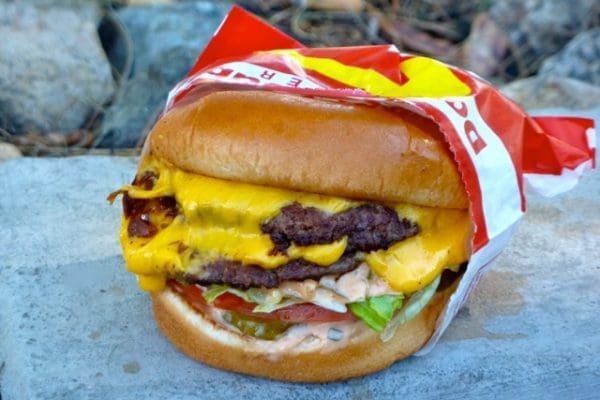
Tried to amend my carnivorous habits Made it nearly seventy days Losin’ weight without speed, eatin’ sunflower seeds Drinkin’ lots of carrot juice and soakin’ up rays But at night I’d had these wonderful dreams Some kind of sensuous treat Not zucchini, fettucini or Bulgar wheat But a big warm bun and a huge hunk of meat Cheeseburger in paradise (paradise) Heaven on earth with an onion slice (paradise) Not too particular not too precise (paradise) I’m just a cheeseburger in paradise ~Jimmy Buffett Just what is a cheeseburger in paradise?  In his top 40 song Cheeseburger in Paradise, Jimmy Buffett seems to infer that a cheeseburger in paradise can be any cheeseburger you consume after depriving yourself, or as he put it, “after trying to amend your carnivorous habits.”  There’s much truth in this.  Every dieter with whom I’ve spoken admits that what they dream about most after any period of deliciousness deprivation are cheeseburgers.  Cheeseburgers are, after all, America’s most popular, arguably most delicious, fast food offering. In Buffett’s case, the cheeseburger in paradise was inspired by a boating excursion on the azure waters of the Caribbean.  While sustaining himself on peanut butter and canned foods, he fantasized…

Chuck’s Restaurant – Placerville, California

In 2009, James Beard Award-winning food journalists Jane and Michael Stern published a terrific tome entitled 500 Things to Eat Before It’s Too Late. Despite the ominous (some might say fatalistic) name, the book is actually a celebration of the best dishes that are unique to this country. The Sterns, who have been focusing on quirky All-American food haunts since 1977, describe in delicious detail, the best dishes proffered at roadside stands, cafes, street carts throughout the fruited plain.  It’s a marvelous tribute to those dishes that are uniquely American. As encompassing as the book is, it could not possibly have included every single culinary rarity and singularly distinctive dish.  Leave it to my friend Barbara Trembath to lead me to a uniquely American dish that the Sterns did not mention.  When she found out about my business trip to the Sacramento area, Barbara encouraged me to stray from the well-beaten, well-eaten paths to the local favorites and to drive nearly one-hundred miles east to experience culinary history.  She urged me to try what she described as potentially the “dodo bird of food,” a “rare American original that’s in danger of becoming extinct.”  She had me at “hello.” The dish…

Cafe Cornucopia – Bisbee, Arizona

The Hollywood stereotype of restaurant critics paints them rather unflatteringly as condescending misanthropes to be feared. Those stereotypes would have you believe restaurant critics are eager to pounce on and expose the slightest imperfection.  Armed with pedantic palates and polysyllabic vocabularies overflowing with unfavorable adjectives, critics are painted as joyless beings whose quest it is to impart their misery on the restaurants they evaluate.  To the critic, the exemplar is French cuisine and everything else is so much schlock to be disdained. Consider the 1988 movie Mystic Pizza in which a snobbish restaurant critic renown for his “make or break” reviews deigned to visit a pizza parlor of all places.  With a stern countenance and belittling attitude, he based his entire review on having sampled little more than one bite.  Ostensibly his palate was sophisticated enough to render a verdict on the pizza after a minuscule sample. Even the restaurant critics on animated features tend to be snotty. The aptly named Anton Ego from the delightful 2007 Pixar movie Ratatouille may have summed it up best: “In many ways, the work of a critic is easy.  We risk very little yet enjoy a position over those who offer up their work…

Cafe Poca Cosa – Tucson, Arizona (CLOSED)

Stereotypes would have you believe English food and Mexican food are at the opposite end of the spectrum from one another…as different as day and night.  Those stereotypes paint English food as bland and unimaginative while Mexican food is depicted as spirited and exciting.  That makes it deliciously ironic that perhaps the foremost authority on Mexican food is an adventurous English woman named Diana Kennedy.  In 1957, she moved to Mexico and has spent most of her life since researching and documenting the culinary history of Mexican cuisine. For her inestimable contributions to the documentation of regional Mexican cuisine, the government of Mexico awarded her the “Order of the Aztec Eagle” award, the Mexican equivalent of knighthood while Queen Elizabeth herself dubbed her “Member of the British Empire,” an award of similar distinction.  Once described in The Seattle Times as “the diva of doing it right,” Diana Kennedy champions authenticity in technique and ingredients and she’s a stickler for precision. The late Craig Claiborne, pioneering food critic for the New York Times, once described Mexican cuisine as “peasant food raised to the level of high and sophisticated art,” an apt description of how Diana Kennedy elevated the cuisine of her adopted…

BK Carne Asada & Hot Dogs – Tucson, Arizona

Every region across the fruited plain seems to have its iconic foods–incomparable dishes that define the area because they’re prepared better in that region than anywhere else.  Though there may be many capable practitioners in the preparation of these beloved and celebrated regional favorites, invariably there are restaurants with legitimate claims to superiority–stand-outs which, by virtue of consistent excellence over time, have earned acclaim from savvy locals and pundits. When these paragons of mastery in the iconic cuisine are in close proximity to one another, spirited disputes generally ensue among locals as to which restaurant’s rendition truly reigns above all others.  The City of Brotherly Love, for example, becomes a dysfunctional family when proponents of its eponymous Philly Cheesesteak sandwich get together to debate the supremacy of either Pat’s King of Steaks or Geno’s.   To a lesser and certainly more civil extent, New Mexicans will dispute who makes the better green chile cheeseburger–the venerable Owl Cafe or the relative upstart, Manny’s Buckhorn Tavern. The premise of the Travel Channel’s Food Wars program is to settle rivalries among those most celebrated of local favorites, pitting “the nation’s most famous culinary rivals against one another for a final showdown, where a blind…

Steve’s House of Pizza – Bedford, Massachusetts

Memories Pressed between the pages of my mind Memories Sweetened through the ages just like wine Quiet thoughts come floating down and settle softly to the ground Like golden autumn leaves around my feet I touch them and they burst apart with sweet memories – The Lettermen, 1969 Memory–our ability to recall information, personal experiences and processes–isn’t always reliable or necessarily as sweet as The Lettermen might have you believe.  Memory has, in fact, been shown to be very fallible.  Studies have concluded that memories are often constructed after the fact and that they’re often based as much, if not more, on our emotional state at the time as they are the actual experience being committed to memory. While stationed at Hanscom Air Force Base, I had so many tuna grinders (what New Englanders call subs) from Steve’s House of Pizza in nearby Bedford, Massachusetts, that my great friend Paul Venne told me I’d soon grow gills.  While my friends and colleagues were bingeing on Big Macs and wolfing down Whoppers, weekly (at least) visits to Steve’s sustained me. Leaving Massachusetts I pined for those grinders for more than twenty-years.  Could a simple grinder really have been as good as…

Mario’s Italian Restaurant – Lexington, Massachusetts

“People think Chef Boyardee is a great man. I think he’s nothing but a pasta hater. What true lover of pasta could turn it into mush and shove it in a can? That’s not pasta. That’s just plain wrong.” ~ Author Unknown Chef Boyardee and I go way back.  As mentioned (hopefully not ad-nauseam) on this blog, my arcadian upbringing in Northern New Mexico did not include a lot of Italian food–or at least the real stuff.  The first pizza my brothers and sisters ever had was way back in the dinosaur days before there was a Pizza Hut around every corner and a Tombstone pizza in every freezer.  It was courtesy of Chef Boyardee and it came in a box with pizza flour mix in a hermetically sealed bag, a can of grated cheese and a can of “true Italian sauce from chef’s own recipe.” Chef Boyardee pizza didn’t “make our faces light up” when we saw “America’s favorite pizza–Chef Boyardee pizza“–slide out of the oven as it did the family depicted on the commercials.  It looked like a strange, oversized tortilla slathered with tomato sauce.  If possible, it actually tasted worse than it looked.  Perhaps because of the…

Mabel’s Lobster Claw Restaurant – Kennebunkport, Maine

What comes to mind when you think of lobster?  A rare treat or special event meal?   A delicacy?  Would you believe some cultures still consider lobster “the cockroach of the sea?”  There’s a scientific basis for that.  Neither fish nor mammal, lobsters are arthropods, closely related to the lowly insect.  Like the insect, lobsters belong to the invertebrate (lacking a backbone or spinal column) family. Today you have to pay dearly for an excellent lobster meal, but that hasn’t always been the case.  Lobsters were once so abundant that Native Peoples used them as fish bait and fertilizer.  According to early Colonists in the Plymouth, Massachusetts area, lobsters sometimes washed up on the beaches in piles two feet high.  It was hard to get gustatorily excited about something so common.  It’s conceivable that lobsters of exaggerated proportions may not only have been frightening, but tough to eat considering they supposedly grew to forty pounds or more. As such, in Colonial New England, they were considered poverty food and were served to servants, slaves, children and prisoners.  Children bringing lobster sandwiches to school were considered the poor kids (similar to the children who came to school with tortilla sandwiches instead of…

The Clam Shack – Kennebunkport, Maine

The late George Plimpton was a pioneering journalist who garnered much of his acclaim from competing in professional sporting events then recording the experience from an amateur’s standpoint.  From pitching against the National League prior to an All-Star baseball game to quarterbacking the Detroit Lions in an intrasquad scrimmage, Plimpton momentarily lived the dream of every would-be professional athlete. Today, it seems every network and cable channel has a competing reality show in which an unabashed combatant or group of contestants undertake unsavory jobs–such as bullfighter or oil driller–for which they are wholly unqualified.  The Discovery channel even has a show in which a poor sap “exposes the grimy underbelly of America’s dirtiest jobs.”  Participants in these reality shows run the gamut–from risking life and limb to almost certain humiliation. It came as no surprise when the Food Network announced its 2009 launch of its own job related reality show.  On “Will Work for Food” host Adam Gertler travels across the fruited plain trying out different jobs in the food industry for a day.  The show calls for him to do literally learn every job in the world of food.  The good-natured Gertler has had jobs in which he’s had…

Maine Diner – Wells, Maine

How do you know when a restaurant has really made it?  Is it when that restaurant is recognized by national publications as one of the very best diners in the country?  Or when celebrities go out of their way to dine at its tables?  Is it when more than five-million people have been warmly welcomed at its doors?  When neither rain, nor sleet nor the most stern and frigid of Maine winters can dissuade visitors? The Maine Diner has achieved all of this and so much more.  Richly deserving of all the accolades bestowed upon it, the telltale sign that it’s made it–at least from a pop culture perspective–is when it’s recognized as the restaurant after which Flo’s Offshore Diner is patterned.  If you’ve never heard of Flo’s Offshore Diner, it might be because the Albuquerque Journal isn’t one of the 700 newspapers across America in which Non Sequitur is syndicated. Non Sequitur is simply one of the most creative and honored comic strips in syndication today, winner of four National Cartoonists Society divisional awards, the most prestigious accolade in cartooning.  It is creator Wiley Miller’s vehicle for sharing his wry observations about the absurdities of everyday life.  There are…