El Modelo – Albuquerque, New Mexico

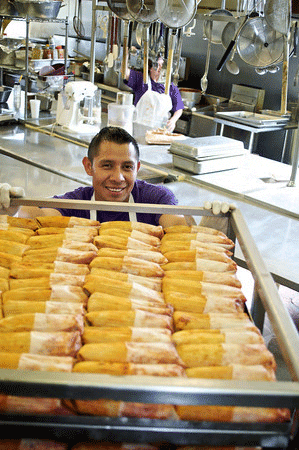
Growing up in the 60s in a bucolic village in Northern New Mexico, we had no idea about such things as political correctness and multi-culturalism. It would be decades before the ascendency of the “woke” movement.  My friends included descendents of Montezuma, scions of the Spanish explorers, Native Americans from a nearby Pueblo and even a few “white” kids.  None of us really thought about things like “inclusion” and “diversity.”  We lived it! Being kids, there was naturally a lot of good-natured name-calling and teasing, but even when tempers flared, I can’t recall racial stereotype-based derogatory terms ever used in anger.  We thought nothing of teasing the “rich” white kids about their “white as them” Rainbo bread sandwiches and they retorted in kind with insults about the “poor” kids and their chicharones and chile engorged tortillas. We were teased that “Mexican” (then a collective term for all Hispanics) children received tamales for Christmas so they would have something to open on Christmas morning.  Rather than think it offensive and racist, we laughed and tried to one-up with something better. It wasn’t until years later that we found out we were supposed to be offended by race-based stereotypes and insults.  It brought…

Crab House at Pier 39 – San Francisco, California

Every town has them–the touristy attractions every out-of-town visitor wants to hit and locals avoid like a Lobo basketball team coached by Ritchie McKay. To visitors, these attractions represent what your town is all about and nothing you tell them will dissuade them from thinking so.  After all, your local Chamber of Commerce paints these attractions as “can’t miss” and “absolutely must see.” Generally packaged with these touristy attractions are  dining destinations that promise to deliver authentic local flavor–the cuisine de culture so to speak. In Albuquerque that generally means a meal at a New Mexican restaurant–usually one with the stereotypical accoutrements that more closely represent Old Mexico than New Mexico. Invariably, in the Duke City those package deal restaurants feature cuisine whose red chile has the piquancy of Chef Boyardee tomato sauce and its green chile, the heat equivalent of a bell pepper.  An authentic experience?  Hardly, but many out-of-town visitors wouldn’t have a clue. To most first-time visitors, a San Francisco vacation or business trip would be incomplete without a trek to the storied Pier 39 and a meal at one of its seafood restaurants.  Never mind that locals will try to talk you out of it.  Most…

Stop And Eat Drive In – Española, New Mexico

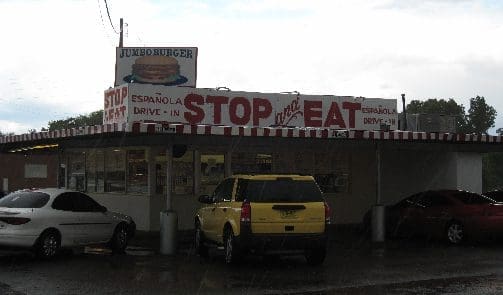
Stop And Eat–Although it seems this 50s style drive-in has always been at its Paseo De Oñate location, it hadn’t yet opened in 1598 when don Juan de Oñate led his expedition of Spanish colonists to the east bank of the Rio Grande near its confluence with the Chama River. That’s where they founded San Gabriel, New Mexico’s first capital at a site close to present day Española, home of the Stop And Eat restaurant. While Stop And Eat might sound like a mandate, it’s really more of a strong suggestion that will visit your brain every time you drive by this restaurant. All it takes is one visit and you’ll be hooked. This 50’s style drive-in not only has an inviting name, it’s got an inviting location on a busy intersection. It’s also got an inviting menu replete with delicious fast food New Mexico style. It’s one of a dying breed, a drive-in under whose canopy you can park your car, walk to an order window to place your order and wait to be called over a loudspeaker. Stop And Eat features the type of Americana roadfood atmosphere Michael and Jane Stern like so it’s no surprise that this…

Mariscos Costa Azul – Santa Fe, New Mexico

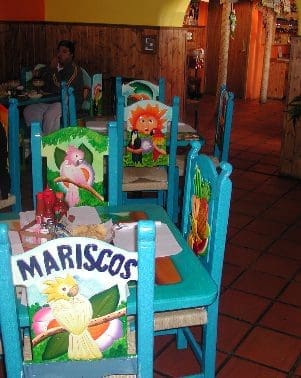
Costa Azul…The Blue Coast…the name evokes images of pristine sandy beaches, translucent blue waters, lush verdant jungles and brightly plumed birds. For Santa Fe diners, the name may also evoke involuntary salivation and pangs of hunger which can be quelled only by the incomparably fresh and delicious mariscos (seafood) at one of the City Different’s best Mexican restaurants, Mariscos Costa Azul. For years, the word “mariscos” was synonymous with Santa Fe’s two Mariscos La Playa restaurants, about which the New York Times wrote, “Yes, even in landlocked Santa Fe, it’s possible to find incredibly fresh and well-prepared seafood served in big portions.” The two Mariscos La Playa restaurants–jointly owned by cousins Nora Lopez and Jose Ortega–were perennial reader’s poll winners of the Santa Fe Reporter‘s annual “best seafood” and “best Mexican restaurant” categories. In early 2006, the two cousins parted ways with the Ortega family renaming the south-side restaurant Mariscos Costa Azul. The restaurant is awash in a veritable spectrum of color, particularly of soothing azure shades the color of Mexico’s Pacific coastal waters. Many of the intricately carved chairs feature a hazel-eyed sun peeking out from behind verdant hills. Others of the tightly woven twine chairs include colorfully painted…

El Paragua – Española, New Mexico

If small businesses are the backbone of American commerce, then the good old-fashioned lemonade stand is the spinal cord.”  That sagacious metaphor (for which I unfortunately cannot take credit) is an apt description for how El Paragua transcended its humble beginnings to become one of the culinary crown jewels of Northern New Mexico. In 1958, the Atencio brothers, two precocious entrepreneurs growing up in the enchanting Española valley did the old-fashioned lemonade stand one better.  They built a stand in which they sold their mother’s tacos and tamales.  The stand’s overhanging roof provided respite from the rain, hence the name “El Paragua” or “the umbrella.”  By 1965, the Atencio boys’ business was booming and the family home was transformed into a sit-down restaurant in which hungry patrons could partake of all of Mama Atencio’s culinary magic. Today El Paragua is a dining destination that has achieved worldwide acclaim.  Dr. N Scott Momaday, the UNM educated (Bachelor’s degree) Pulitzer Prize winner wrote a glowing review for the New York Times.  The restaurant’s walls are papered with reviews from such industry standard publications as Gourmet, Bon Appetit and Sunset magazine as well as numerous newspapers. El Paragua’s decor combines the varying influences…

Boba Tea Company – Albuquerque, New Mexico

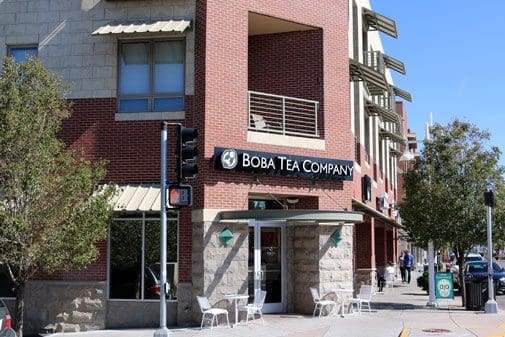
On June 7, 2005, the launch of Albuquerque’s first made “you suck” acceptable in polite vernacular. Long a pop culture term of mock derision, “suck” refers, in this case, to the drawing in of liquid refreshment by creating a vacuum in the mouth. More specifically, it refers to the act of sucking through an oversized straw, the tea, milk tea, hot tea, slush and smoothie beverages at the Boba Tea Company. The Boba Tea Company is the brainchild of Vi and Hoa Luong, the enterprising duo which made Cafe O one of the city’s best restaurant launches (and lunches) in 2004. Wanting to create a “Starbucks for the younger generation” the Luongs have revolutionized tea drinking with a quantum departure from high tea tradition made fashionable in England. Boba tea certainly does that. Tracing its roots back to Taiwan in the early 1980s, boba tea is derived from the starch of the cassava root, a type of sweet potato. The bottom of each boba tea cup (plastic, not china) is lined with gooey, gelatinous globules that seem to inherit the flavor of the drink. If you’re not a connoisseur of exotic teas, you can partake of boba slushes, as refreshing…

Shogun Japanese Restaurant – Albuquerque, New Mexico

It stands to reason that what is conceivably one of Albuquerque’s best sushi restaurants is named for the Shogun, the title accorded the supreme ruler of Japan for about eight centuries. What most people may not realize, however, is that sushi originated in China as a method to preserve fish by pickling and fermentation. Sushi, as we know it today, began to take form in the 18th century Japan when seafood vendors wrapped fish with seaweed and rice as an edible and decorative package which ultimately evolved into the roll (maki) style. The nigiri style, consisting of a piece of fish on a bed of rice, originated in Tokyo sometime later. Sushi’s integration into the American culture began in the 1970s and today there are over 5,000 sushi restaurants in the United States. In my 48 years on planet Earth, I’ve sampled probably 30 to 40 different sushi restaurants and won’t pretend to be an expert, but can say unequivocally that Albuquerque’s Shogun is among the very best I’ve ever had and may be in a class by itself in Albuquerque. The wasabi colored walls are the first indication that this restaurant is something special. Then there’s the sushi bar,…

Texas Reds – Red River, New Mexico

Note: On Wednesday, November 3rd, 2004 Texas Reds burnt to the ground, but like a Phoenix, it has been rebuilt, albeit no longer as a two story monolith on Red River’s main street. In 2006, Texas Red’s also launched a second Colfax county restaurant, this one in Eagle Nest. What does the alpine village of Red River in the picturesque Moreno Valley have in common with San Marcos, Texas, the beautiful gateway to the Texas Hill Country? Aside from both being heavily populated by Texans, they both can boast of a Texas Reds restaurant. The original Texas Reds has been a Red River dining destination serving generous portions of friendly service and old west ambience since Thanksgiving, 1967. With an overdone touristy atmosphere that includes checkerboard tablecloths, wooden planked floors and the perfunctory peanuts you can toss on the floor, Texas Reds is a carnivore’s paradise. Its old west saloon is at ground level while the dining rooms are upstairs. While it’s true that dining at nearly 9,000 feet makes the food seem to taste better and your appetite more robust, it’s also true that Texas Reds proffers one of the very best steaks in New Mexico. Charbroiled in butter,…

Kimchy Cabana – Niles, Illinois

To the unenculturated, the pungent emanations of Korean kimchy (pickled and fermented cabbage) are malodorous and offensive to the olfactory senses. To the Korean people, however, kimchy is so much more than a national dish; it’s a family treasure handed down from one generation to another over the millenniums. The influx of Korean war brides following the Korean War and beyond has meant the gradual introduction into the American mainstream of kimchy and other Korean culinary arts. Having experienced Korean cuisine from coast to coast, it has always impressed me to find Korean food remarkably consistent–usually at least good and often excellent. Kimchy Cabana certainly ranks with the best I’ve had yet. Our inaugural dining experience was made even better because we shared our meal with two of Niles’ finest law enforcement officials, my brother-in-law Chuck and his commander, true gentlemen for whom the badge truly represents integrity and dedication to the public. Our meal started with the traditional Korean family meal offering of small dishes featuring spicy and pickled vegetables. Most Korean restaurants alternate these vegetables on a daily basis but always include kimchy which is typically the eye-watering star of the show. Every vegetable tantalized our taste buds…

Gino’s East of Chicago – Lake Zurich, Illinois

Ostensibly no one knows more about a city’s best dining destinations than the taxi drivers who ferry famished fares there…or at least, that’s the theory. The original Gino’s East was founded in 1966 by taxi drivers who lured away the pizza chef at Chicago’s Pizzeria Uno and started their own pizzeria. Gino’s East now relies on those taxi drivers for those precious and essential word of mouth referrals when passengers inquire as to the best pizzeria in a city of outstanding pizzerias. Once a year, the original Gino’s East rewards cabbies for those referrals by giving them a free personal pan pizza. That’s just a little bit of marketing genius, but in a blue collar city, slick marketing isn’t good enough; you’ve also got to make a blue collar pizza–a thick, hearty pizza with a generous application of traditional ingredients. The fru-fru pizzas they serve in California with their line-up of sushi, avocado and celery genre ingredients just don’t cut it. With a deep dish pizza that just may be the city’s best, Gino’s East has branched out in recent years and can now be found in the burbs, including the northwestern village of Lake Zurich. There’s no graffiti on…