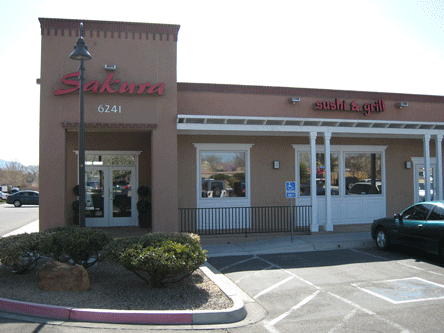
Sakura Sushi & Grill – Albuquerque, New Mexico

In describing “food porn,” The New Yorker once wrote, “The point is to get very close to what you are filming, so close that you can see an ingredient’s “pores” which then triggers some kind of Neanderthal reflex.  If you’re flicking from channel to channel and come upon food that has been shot in this way, you will be hardwired as a human being to stop, look, and bring it back to your cave.” Madison Avenue, which is virtually synonymous with advertising, recognizes the impact food porn has on the American consumer.  That’s why we’re bombarded with television commercials and magazine ads depicting spectacular displays of visually stimulating, sleek and sexy, glorious deliciousness–food not only as edible art, but as a medium that elicits a carnal response. Perhaps no modern medium utilizes food porn more effectively than the Food Network whose programming seems tailored to arouse a salivatory response and a lascivious desire to eat.  Its veritable pantheon of celebrity chefs recognizes that the appeal to viewers (who obviously can’t smell or taste their creations) is in the way food looks on a plate–its colors, symmetry and design patterns. Perhaps the most visually appealing moment on any Food Network program…

The Pink Adobe – Santa Fe, New Mexico

Culinary historians credit the advent of the modern Santa Fe fine dining scene to a painter who moved to Santa Fe shortly after World War II to join the burgeoning art community. Having to support herself and a young daughter, Rosalea Murphy turned to something else at which she excelled–the culinary arts. As with most rags to riches success stories, Rosalea did not immediately set the Santa Fe dining scene on its ear, but then this wasn’t the “City Different” now widely recognized as a tourist Mecca. Good things take time. Great things take longer. When she first launched the restaurant she christened the Pink Adobe after the hue of its facade, her humble menu consisted solely of French onion soup and apple pie. As her business grew, so did her menu. She added “Pink Dobeburgers” to the menu and sold them for twenty-five cents each. Chicken enchiladas followed suit, the first of several New Mexican specialties she would add to the menu. Eventually her Pink Adobe became the first restaurant in Santa Fe to serve seafood, then a novelty in what was, in her words, “a lazy, sleepy town.” By the 21st century, the ambitious menu featured variety unlike…

Ruben’s Grill – Albuquerque, New Mexico

During the Mexican Revolution of 1910, many women joined the army both in response to the tremendous need for their service, but also to accompany their husbands, many of whom were conscripted into service. Traveling with the revolutionary armies, it was often the role of women to forage for food and cook meals. As much as possible, the women who followed the armies tried to provide a homey meal experience complete with tablecloth, decorative plates and vases for flowers. As soldaderas, their contributions to the Mexican Revolutionary were not limited to “traditional” roles of the time–serving as caregivers and as cooks. Many women distinguished themselves on the battlefield and are today remembered in such songs as La Adelita. It was a bit of a disappointment not to see any of these women celebrated on the sunflower colored walls of Ruben’s Grill, a popular Northeast Heights Mexican restaurant whose walls are adorned with black and white posters of the heroes of the Mexican Revolution. My favorite of the lot is a “Wanted” poster issued in 1916 by the Columbus, New Mexico chief of police who offered a $5,000 reward for the capture of Francisco “Panco” Villa. History will recall that the…

El Charritos – Albuquerque, New Mexico

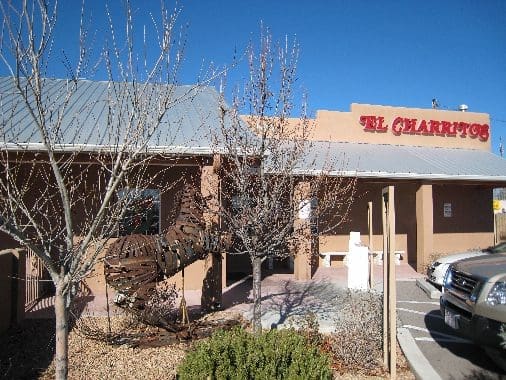
New Mexico born Hispanics of my generation grew up watching not only American “shoot ’em up” Westerns featuring rugged cowboys, rowdy rustlers, round-ups and home on the range, but the Mexican equivalent–movies featuring the exploits of charros, the traditional cowboys of central and northern Mexico. Despite my admiration for the charros of the cinema, it took more than 20 years before my first visit to a restaurant named for the dashing Mexican horsemen who were equally adept with a lasso as they were with a gun. I had driven past the Central Avenue location of El Charritos for years, first when it was on the south side of Central then after it moved across the street to a modern, capacious building. What a mistake! El Charritos has the authenticity I crave from New Mexican food–red chile unadulterated by cumin, chile rellenos with a bite and tamales in which the pork isn’t overwhelmed by masa. Mexican music fills the commodious dining room whose walls are festooned with the art of Roberto Perea. My introduction to El Charritos came in the form of the El Charrito Super Combination: one enchilada filled with melted cheese, one ground beef taco, one pork tamale and…

El Rancho – Gallup, New Mexico

In the 1930s and 1940s, sometimes considered the halcyon days of Western movies, the Four Corners region was the site of many cinematic classics, quite a few featuring battles between the cavalry and “misplaced” American Indians.  Never mind that the Cheyenne and the Sioux actually lived hundreds of miles (and several states) away, the region’s dramatic topography was a perfect backdrop for cowboy conflicts with these Midwestern Indians. Besides that, Navajo “actors” were plentiful.  Producers would attire them in war bonnets, arm them with lances and hand them scripts in which they would invariably succumb to the “righteous might” of the charging cavalry. One movie, John Ford’s classic Cheyenne Autumn, featuring Navajo actors pretending to be Cheyenne, has an almost cult following in Navajo country. Navajo members watching the movie today roar with laughter when Cheyenne leaders speak in Navajo, supposedly discussing treaties and tribal needs.  What the Navajo actors in the film really said in somber tones generally concerned the size of the colonel’s privates (not the ones who march) or some equally disrespectful or bawdy double-entendre. When filming took place in Navajo country close to Gallup, New Mexico, the stars found a temporary home at the El Rancho Hotel,…

Popeye’s Chicken & Biscuits – Albuquerque, New Mexico

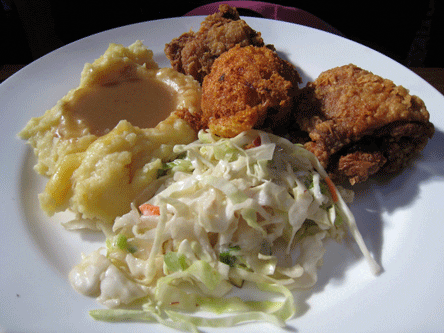
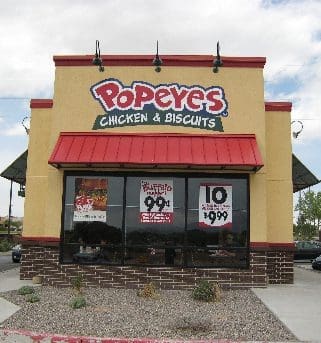
Shortly after Louisiana and Mississippi were ravaged by Hurricane Katrina, one of the local television stations in South Louisiana actually aired an interview with a woman from New Orleans. The interviewer was a woman from a Boston affiliate, so she asked the interviewee how such total and complete devastation of the churches in the area had affected their lives.  The woman replied,” I don’t know about all those other people but we get our chicken from Popeye’s.” The look on the interviewer’s face was priceless.  That anecdote rings with truism Contrary to the images the name might conjure, Popeye’s is not a nautical themed restaurant which serves spinach.  That might be why the restaurant’s full appellation is “Popeye’s Chicken & Biscuits.”  In reality, Popeye’s is named for the irascible character Popeye Doyle from the movie “The French Connection.”   It is the brainchild of restaurant impresario Al Copeland who founded the New Orleans style poultry palace in 1972 after a failed venture featuring mild, Southern-fried chicken. New Orleans style chicken is imbued with the exciting, spicy flavor about which Cajuns are passionate.  In our eight years of living in Mississippi, we rarely dined at Popeye’s, preferring local alternatives with even more…

A&W All American Food – Rio Rancho, New Mexico

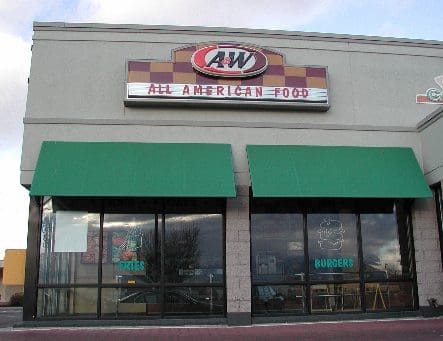
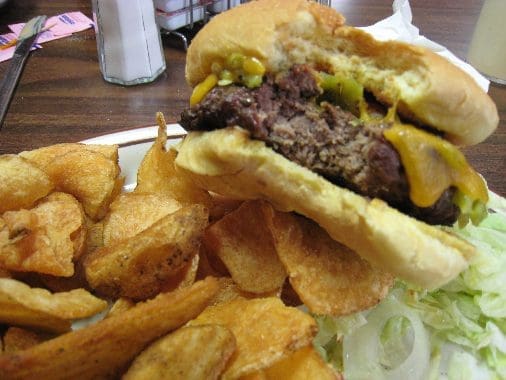
Family trips bore out the fact that my parents had saintly patience as their six kids sat in the back seat of the station wagon and belted out, “Let’s all go to A&W. The food’s just great at A&W.” As kids, we pestered our parents with Madison Avenue jingles for every fast food restaurant we knew. A&W was our favorite–and for good reason. In the 60s, before McDonalds began to dominate the fast food genre, A&W was THE drive-up restaurant in which to dine with more than 2000 locations across the country. Today, A&W has been relegated in some places to sharing space with gas stations and convenience stores. It also received a reprieve of sorts when purchased by the Pepsi restaurant subsidiary which also owns KFC, Pizza Hut and Taco Bell. A&W and Long John Silvers were recent acquisitions and in Rio Rancho as in other locations across the fruited plain, they share space. In the 60s, A&W’s family concept included burgers named for every family demographic–the papa burger, mama burger, teen burger, baby burger and even a grandpa burger. The Rio Rancho location serves several “deluxe” burgers with the deluxe bacon double cheeseburger and deluxe cheeseburger being my…