CubaMex – Albuquerque, New Mexico

Because Columbus sailed the ocean blue in 1492 and a succession of Spanish explorers followed suit, you might expect that Spanish cuisine would have proliferated across the new world.  Instead, Spanish discoveries included indigenous cooking techniques and ingredients that forever altered the way scions of Spain ate. At the time of conquest, the European diet was principally comprised of bread, olive oil, olives, “meat,” and wine.   The “new world”–Mexico in particular–was rich, fecund, and replete with such crops such as beans, pumpkins, chilies, avocados, tomatoes, cocoa, cotton, tobacco, corn, and cassava, foods that could not be found in Mother Spain. All the territories explored and conquered by the Spaniards had their own bounty of unique and delicious culinary offerings.  Because traditional Spanish foods were an ocean away, it made sense the Spaniards would adopt indigenous foodstuff.   Many of those foods were ultimately introduced to the European continent.  It was the advent of eating not just for survival, but for pleasure.  To some extent, the vast variety of new ingredients and techniques were also shared among conquered lands.  Solely from the perspective of culinary diversity and deliciousness, it was a win-win.  The uniqueness of foods among such Spanish-held territories…

El Molcajeton – Albuquerque, New Mexico

Molcajetes have become so commonplace on many a Mexican restaurant’s decor that we sometimes forget molcajetes are the traditional Mexican version of the mortar and pestle…that they have both form and function.  As we gawk in admiration at the symmetry and fine craftsmanship of a well-made molcajete, we don’t always reflect on the fact that throughout Mexico and some parts of the Estados Unidos molcajetes are still used to crush and grind spices and to prepare guacamole, moles and salsas.  In restaurants and homes in which molcajetes are used for their intended functional purpose, the guacamole, moles and salsas created within them are said to taste better, much better. As James Beard Award-Winning Writer and Chef Patti Jinich says “A wonderful thing about molcajetes, is that since they are so porous they have a remarkable memory. They store within them, the essences, oils, smells and flavors of all that has been served or made in them. Maybe that’s why it is said that molcajetes season with time and use. Maybe that’s also why it is said that making a sauce or rub or paste in a molcajete makes it taste better.”  Patti’s theory has credibility.  The rough surface of molcajetes…

Foodtopia – Albuquerque, New Mexico

When a restaurant with the curious name “Foodtopia” surfaced in 2022, long-suffering readers of Gil’s Thrilling… probably realized an etymology lesson would soon be in order.   If the suffix “topia” intrigued you as much as it did your grandiloquent blogger, hang on.  First, a review of what we all know.  Utopia is “a seemingly perfect society, one without flaws, where everyone is content and conflict and strife are unknown.”  One example of a Utopian society is the movie Zootopia in which animals live in harmony and lions sing kumbaya with antelope.  More common than movies about Utopian societies are movies and literature about dystopia, “societies that are either extremely chaotic or extremely authoritative, a hellish place where most people suffer.”  No, it’s not your place of employment, but rather something like Planet of the Apes or George Orwell’s 1984. The common element in these two opposite societal types is the suffix “topia,”  a Greek word meaning “a place with specified characteristics.”  An imaginary society with both good (Utopian) and bad (Dystopian) features might be called a “mixtopia.” Some posit an imaginary place where everything (especially the government) is as bad as it can be.  Fittingly, the term for this…

El Charlatan – Socorro, Texas (CLOSED)

Everyone should have a friend like Steve Coleman, the erudite owner of Steve’s Food Page. Not only is he a great guy and a lot of fun to spend time with, he’s a superb host and tour guide.  During a two-day sojourn to “El Chuco,” Steve not only showed us the sights, he gave me a much-needed lesson about history New Mexico and Texas share.  He explained that during the Pueblo Revolt of 1680, members of the Isleta Pueblo in New Mexico were displaced to El Paso along with Oñate and the Spaniards.  Today, descendants of those Native Americans reside in a Native American Pueblo in the Ysleta section of El Paso just about three miles from El Charlatan, our dining destination.  We were looking forward to Steve ferreting us through the historic El Paso Mission Trail, a nine-mile route representing a segment of El Camino Real de Tierra Adentro (Royal Road of the Interior), the historic trail that ran from Mexico City to Santa Fe.  Alas, unseasonably fierce winds (another commonality New Mexico and Texas share) obfuscated our view of the churches as we drove past (at least one of) them.  On the Fujita Scale, a measure of wind speed,…

The Last Call – Albuquerque, New Mexico (CLOSED)

NOTE:  Shortly after the Last Call shuttered its doors, Cali Burrito Co. launched at the same familiar location. Its grand opening day was 1 December 2023. “Ah, but after the sunset, the dusk and the twilight, when shadows of night start to fall. They roll back the sidewalk precisely at ten and people who live there are not seen again.” ~John Denver: Saturday Night In Toledo Albuquerque has a reputation of being a town which “rolls up the sidewalk,” an expression used to describe towns where businesses close up early and night life is very limited (translation: bars close early).  The Land of Enchantment’s liquor laws mandate that bars close at 2AM, an hour apparently considered “too early” by those who describe the Duke City as a sleepy town.  As someone who considers it a late evening when we stay up to watch the opening skit on Saturday Night Live, terms such as “rolling up the sidewalk” and “last call” have very little personal relevance.  But there was a time… If you’re expecting salacious details of my debauched youth, you’ll be disappointed to learn my personal experiences with “last calls” were mostly as a designated driver for friends who often…

Los Olivos – Albuquerque, New Mexico

For many New Mexicans, Durango, Colorado is much more familiar than Durango, Mexico.  In truth, however, Mexico’s Durango may actually have more historical significance and ties to the Land of Enchantment than its like-named resort town in Colorado.  That’s especially true for the Catholic Churches of New Mexico. Episcopal jurisdiction for the Catholic church in New Mexico was placed in 1797 under the stewardship of the Bishop of Durango. New Mexico remained part of the Diocese of Durango until 1850 when Pope Pius IX created the Vicariate Apostolic of New Mexico and appointed Father Jean Baptiste Lamy as its first Bishop.  Yes, that’s the same Father Jean Baptiste Lamy on whom Wila Cather’s Death Comes For the Archbishop is based. Durango, Mexico was also a significant “paraje” (stopping point) along the The Camino Real de Tierra Adentro (Royal Road of the Interior Land), the 1,590 mile road between Mexico City and San Juan Pueblo (Ohkay Owingeh), New Mexico. During the 17th Century, the area between the villas of Durango and Santa Fe also came to be known as “the Chihuahua Trail.”   It’s a vast understatement to declare that Santa Fe’s reliance on El Camino Real was crucial to the…

Cocina Madrigal – Phoenix, Arizona

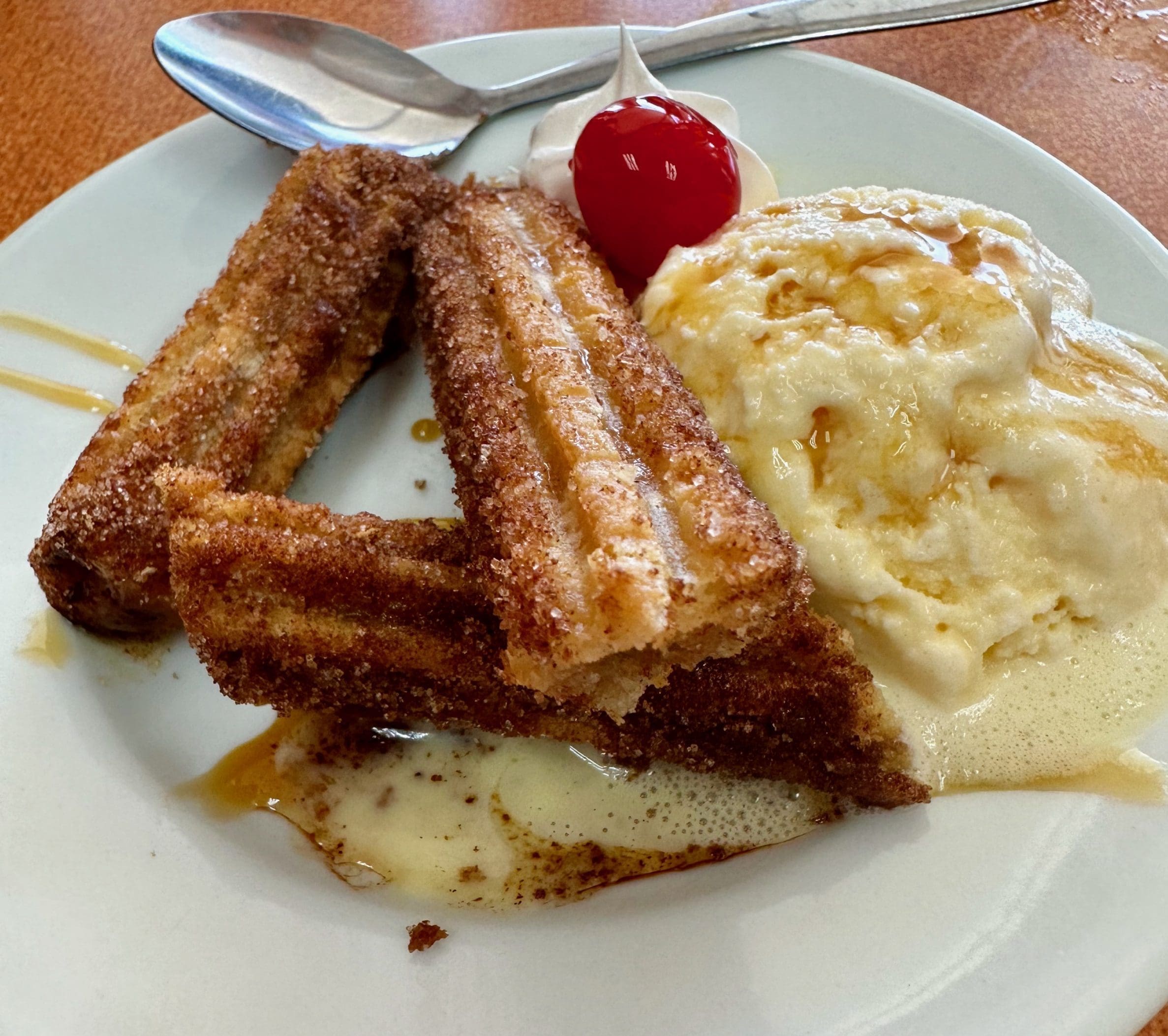
Number one in the entire country.  Highest rated from about 90-million restaurant reviews. Topping Yelp’s 9th annual list of the top 100 restaurants in the United States for 2022 is “Cocina Madrigal, a “father-and-son-owned eatery serving Oaxaca fundido and beef birria enchiladas to lucky residents of Phoenix, Arizona (who’ve responded with more 5-star reviews than we can count).”  Cocina Madrigal wasn’t on the list of restaurants we planned on visit during our annual visit to the Valley of the Sun, but how often is the opportunity presented to dine at THE top restaurant in the entire country.  Besides, the menu promised Hatch green chile on several entrees and appetizers. Yelp noted “Attracting a diverse crowd to downtown Phoenix, Chef Leo Madrigal’s restaurant is comfortable and warm but not overly fancy. His menu is full of flavors from Oaxaca and his Mexico City birthplace, with favorites that include a grilled-romaine salad and fall-apart beef birria enchiladas. Make sure you leave room for dessert, and order the warm Churros with Crème Anglaise and caramel sauce.”  Yelp also indicated Cocina Madrigal is known for: “Making everything from scratch, from tacos and enchiladas to the fresh-as-can-be salsa.”  A lot of restaurants make everything from scratch.  We were…

La Santisima – Phoenix, Arizona

Gustavo Arellano, the brilliant writer behind the Ask A Mexican column (and even better book by that title) was remarkably quick with a disarming retort that diffused controversy with humor.  One example is when a reader–perhaps hoping to ingratiate himself to Arellano–wrote Ask A Mexican: “I don’t go to many Mexican restaurants—not because of the stereotypes but because the food is usually watered down to fit the taste buds of gabachos. In a future column, Arellano provided a response appropriate to the point.”Your sad story is one experienced by many Mexicans who travel through the parts of this country that wabs have just begun to colonize, but it’s not unique to us: New Yorkers always bemoan the quality of bagels everywhere outside of Brooklyn, and San Franciscans simply won’t eat burritos not folded in their famed Mission District. I will argue, however, that Mexican cuisine is more whitewashed than others.” Boy could we relate!  During our travels over my Air Force career, we encountered a phalanx of inauthentic “Mexican restaurants” comparable to Taco Bell, an eatery we wouldn’t frequent if you put a gun to our heads.  That was to be expected in such states as Mississippi, Louisiana, Massachusetts, Connecticut  but certainly…

Ale’s Cakes – Albuquerque, New Mexico (CLOSED)

Hypocrisy thy name is Gil. “For someone who whined so much about a one-hour (each way) commute to work, you’re willing to drive a hundred miles for lunch” my Kim lamented.  Our lunch destination wasn’t nearly a hundred miles away, but when you’re hungry it probably seems that way.  It would have seemed even further had we traversed the entirety of the street in which our intended restaurant is located. In fact, from its starting point to its terminus, that drive would truly have seemed interminable through all its winding and congested permutations. The street of which I speak is Albuquerque’s own Coors Blvd, otherwise known as New Mexico State Road 45.  According to Wikipedia, Coors Blvd is 22,918-miles long…er, make that 22.9-miles long though it does seem painfully longer than that (especially when you’re hungry).  Coors meanders parallel to the Rio Grande from the Southern boundary of Rio Rancho through Albuquerque and onto Isleta Pueblo.  It takes significantly longer to drive this route than it took the Mexican conquistadores to walk the Camino Real. Thank goodness for I-25 and Rio Bravo Blvd which shortened the length of our drive.  As we wended our way south on Coors, my Kim…

Taqueria Los Amigos – Albuquerque, New Mexico (CLOSED)

“On a dark desert highway, cool wind in my hair Warm smell of colitas, rising up through the air” ~Hotel California, The Eagles in 1977, when the Eagles’ immortal rock anthem Hotel California was released as a single, most radio hits clocked in at about three minutes.  Three minutes is just about as long as Hotel California’s hauntingly compelling intro and the legendary guitar-duet-slash-duel-slash-musical-conversation between Don Felder’s double-necked Gibson EDS-1275 and Joe Walsh’s Fender Telecaster. The high voltage, era-defining song with its intensely intricate instrumental work, soaring harmonies and enthralling lyrics make Hotel California an iconic indictment of the dark underbelly of the American dream and its excesses. Hotel California’s allegorical, introspective lyrics alone make it one of the most widely speculated songs in rock history.  Studies of those lyrics have resulted in numerous interpretations of the song.  Among the most widely contemplated lyrics surround the song’s first stanza: “warm smell of colitas rising up the air.”  At least three vastly different definitions of colitas exist.  Among the most common misinterpretations is one replete with sexual innuendo–specifically that colitas is sexual slang meaning “little tails.”  In Mexican slang, colitas also refers to cannabis. In numerous interviews, Don Felder has clarified…

Tarasco (Formerly The Whole Enchilada) – Albuquerque, New Mexico (CLOSED)

Perhaps because I was away from the Land of Enchantment for much of my Air Force career, one of my favorite bloggers has long been Lisa Fain, the James Beard award-winning “Homesick Texan.”   Like me, Lisa longed for home during the two decades she lived in New York City.  Like me, Lisa returned to her home state, the call of family, friends, bluebonnets, and Tex-Mex luring her back.  Also like me, Lisa is fiercely proud of the cuisine of the state she calls home.  Much of the enjoyment I derive in reading about her favorite foods is in noting the (sometimes vast) differences in foods just across the border.  Take for example cheese enchiladas which she calls “the essence of Tex-Mex.” \She describes them as “a plate of rolled corn tortillas stuffed with orange, oozing cheese, floating in puddles of brown-chili gravy. Yes, that kind of cheese enchilada. The Tex-Mex kind.”  What makes Tex-Mex cheese enchiladas so special to her is the chili gravy which Lisa describes as “a mash-up between flour-based gravy and Mexican chile sauce. It’s a smooth and silky substance, redolent with earthy cumin, smoky chiles and pungent garlic. It’s not fiery, as it was originally…