Blog

Cafe Phenix – Santa Fe, New Mexico (CLOSED)

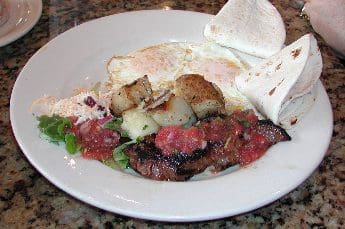
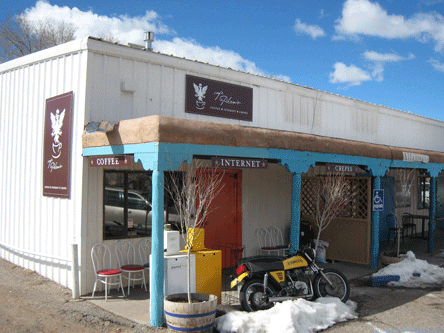
“A mythical bird that never dies, the Phoenix flies far ahead to the front, always scanning the landscape and distant space. It represents our capacity for vision, for collecting sensory information about our environment and the events unfolding within it. The Phoenix, with its great beauty, creates intense excitement and deathless inspiration.” – Feng Shui Master Lam Kam Shuen, The Feng Shui Handbook It’s only appropriate that a cozy little restaurant named Cafe Phenix would be part and parcel of a neighborhood revitalization effort being spearheaded by a close-knit community of artists. Much like the advent of Soho, a New York City neighborhood regenerated by a community of Bohemian artists and activists, Santa Fe’s “Triangle District” is emerging as a destination for dining and a sense of community. Geographically defined as the triangle formed by St. Francis Drive, St Michael’s Drive and Cerrillos Road, the Triangle District is the antithesis of Santa Fe style and its Anasazi inspired adobe facade. In fact the Triangle District seems to be an architectural hodgepodge of neo-industrial warehouse structures, studios, cafes and galleries. It does not fit the stereotypical Santa Fe template that seems to preternaturally draw so many seekers to “The City Different.”…
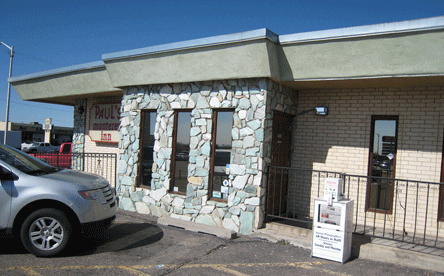
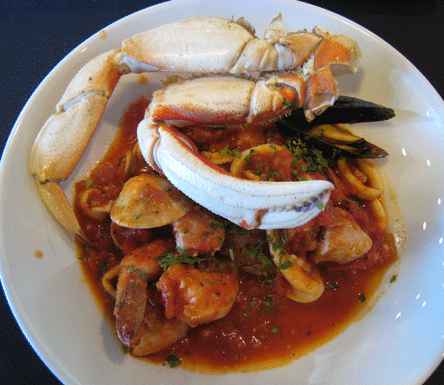
Paul’s Monterey Inn – Albuquerque, New Mexico (CLOSED)

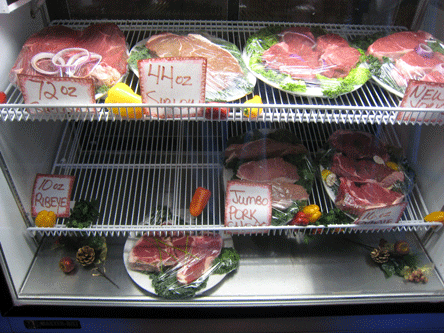
The year was 1971. Albuquerque’s population had reached a quarter of a million. The San Juan-Chama project, a system of diversion structures and tunnels for trans-mountain movement of water from the San Juan River Basin to the Rio Grande Basin, was completed. The area’s three military installations: Kirtland, Manzano and Sandia Bases merged under Air Force jurisdiction. Civil unrest was in the air in pastoral Roosevelt Park where a riot ensued that saw more than 130 arrested and more than 2,000 armed men called in to quell the situation. Albuquerque ballooning pioneer Sid Cutter took his first balloon flight. Paul’s Monterey Inn opened on Juan Tabo. Four decades later Paul’s Monterey Inn continues to serve the Duke city with a menu that hasn’t changed much, if at all, in lo these many years. While the menu may not have changed, times have. In the 70s, longer cooking times to avert potential diseases resulted in the the most popular degree of preparation for steak being anywhere from medium to well-done. Today, aficionados of steak prefer shorter cooking times so that their favorite slabs of beef retain more juice and flavor. In the 1970s, thick, hazy clouds of cigarette smoke permeated virtually…

The Black Olive Wine Bar & Grill – Rio Rancho, New Mexico (CLOSED)

Perhaps in time, the Albuquerque-Rio Rancho metropolitan statistical area will be thought of in much the same vein as America’s two most famous “twin city” metroplexes–Dallas-Fort Worth and Minneapolis-Saint Paul. Don’t be surprised if Rio Rancho winds up being the Dallas to Albuquerque’s Fort Worth, the Minneapolis to Albuquerque’s Saint Paul. People have been selling Rio Rancho short for a long time, but that’s starting to change. By 1980, the end of its first decade in existence, the fledgling city which in 1970 didn’t even have a measurable population by U.S. Census standards had more than 10,000 residents. Ten years later, census reports showed the “little city which could” had grown to more than 32,000 residents and had become the sixth most populous city in the state. Rio Rancho added another 20,000 residents by the millennium. 2007 population estimates now indicate Rio Rancho has supplanted Santa Fe as the third largest city in the Land of Enchantment with nearly 76,000 residents calling the City of Vision home. Rio Rancho residents who once traversed a two-lane road down the hill to Albuquerque to do their shopping, partake of entertainment and dine at a variety of restaurants offering a diversity of cuisine…

Gold Street Caffe – Albuquerque, New Mexico (CLOSED)

When you’re alone and life is making you lonely You can always go – downtown When you’ve got worries, all the noise and the hurry Seems to help, I know – downtown Just listen to the music of the traffic in the city Linger on the sidewalk where the neon signs are pretty How can you lose? The lights are much brighter there You can forget all your troubles, forget all your cares So go downtown, things’ll be great when you’re Downtown – no finer place, for sure Downtown – everything’s waiting for you. Just a few years ago, the lyrics to Petula Clark’s January, 1965 number one single, would not have been used to describe Albuquerque’s downtown area. In fact, the downtown area was more ghost town than boomtown except for during weekday business hours and late night at bars. Even in September, 1998 when Sarah Brown launched the Gold Street Caffe in a historic building circa 1911, the notion that Albuquerque’s downtown would become a social, economic and cultural hub might have been met by skepticism save for the unwavering optimism of visionaries who recognized the area’s potential beyond its historic attachment to the Mother Road, Route 66.…

Cecilia’s Cafe Featured on Travel Channel’s Chow Down Countdown

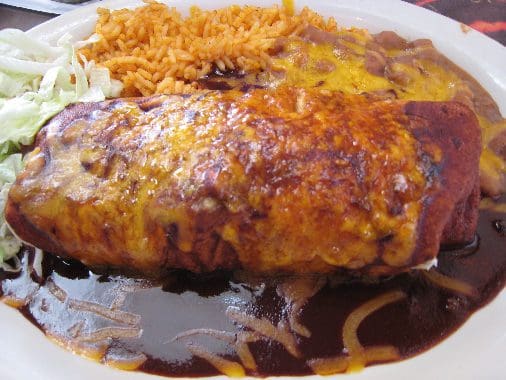
In January, 2010, the Travel Channel traveled from coast to coast to uncover the 101 tastiest places to chow down–“joints serving some of the biggest and best dishes of deliciousness around.” Calling it the “most definitive and appetizing countdown food fanatics have ever seen,” the show featured five one-hour specials that transported viewers “on a non-stop, coast-to-coast, mouthwatering tour of the 101 absolute best places to get your grub on in the country.” The list was “certified by the people who know best — the locals!” Only one New Mexico restaurant made the list, but it’s a great one worthy of recognition. At number 45 on the chow down countdown was Cecilia’s Cafe, a downtown Duke City institution. The program described Cecilia’s as “where they serve up New Mexican food so messy not even a stack of napkins won’t help.” The description aptly describes the Fireman’s Burrito, “a burrito bursting with so many mouthwatering and mind-blowing fillings, they serve it with a side of…apron.” The Travel Channel gave it a “four-napkin” rating. This behemoth burrito was created by Cecilia Baca at the behest of two local firemen Cecilia describes as “characters” who came into the restaurant famished and asked for…

Mary & Tito’s Recognized as an American Classic

The pinnacle of achievement in the culinary world. That’s what a James Beard Foundation award signifies. Deemed “the Oscars of the food world,” by Time magazine, The James Beard Foundation Awards are the country’s most coveted honor for chefs; food and beverage professionals; broadcast media, journalists, and authors working on food; and restaurant architects and designers. Considered the “Dean of American Cookery,” Beard established a legacy of culinary excellence and became a household name to generations of home cooks and professional chefs. Today, the James Beard Foundation, a national not-for-profit organization is dedicated to celebrating, preserving, and nurturing America’s culinary heritage and diversity in order to elevate the appreciation of our culinary excellence. In January, 2010, Mary & Tito’s was announced as the 2010 recipient of the Foundation’s “America’s Classics Award,” a prestigious accolade honoring “a restaurant with timeless appeal, beloved in its region for quality food that reflects the character of its community. The establishment must have been in existence at least 10 years and be locally owned; preferably it is also informal and moderately priced.” Each year, only five America’s Classic Awards are bestowed. So that honorees can make arrangements to attend, the America’s Classics Award is the…

Duke’s Steakhouse – Albuquerque, New Mexico (CLOSED)

“Did you ever see the customers in health-food stores? They are pale, skinny people who look half dead. In a steak house, you see robust, ruddy people. They’re dying, of course, but they look terrific.” -Bill Cosby Bill Cosby probably didn’t have actor Robert Mitchum in mind when describing the type of people who visit steak houses. Heralded by movie critic Roger Ebert as “one of the greatest actors of all time,” the masculine Mitchum was certainly robust (evincing strength and vigorous health) and ruddy (inclined to a healthy reddish color often associated with outdoor life), but he wasn’t the type of he-man you might envision in a steak house. Presiding over a campfire, yes, but sitting down at a restaurant, no. Over an open flame, Mitchum would, of course, be grilling a sizzling, flame-kissed slab of thick, red beef destined to overfill his plate. There would be no vegetables in sight nor would you find a tablecloth, candles or soft music. With the rousing composition “Rodeo” playing in the background, Mitchum would be heard to say, “Beef. It’s what’s for dinner!” Largely through Robert Mitchum’s compelling voiceovers, the American Beef Council has been telling America beef is what’s for…

Lotus Cafe – Albuquerque, New Mexico (CLOSED)

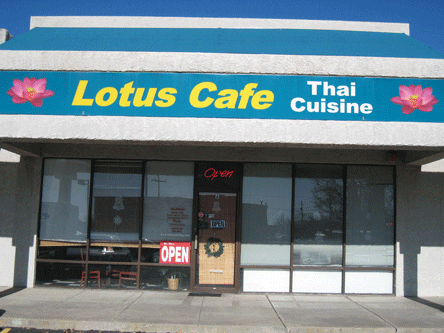
Balance. The Diné, or Navajo, of America’s Four Corners Region have a word for it: “hózhó.” The word embodies the idea of striving for balance and harmony along with beauty and order. Every aspect of Diné life–whether spiritual or secular–is connected to hózhó, maintaining balance between the individual and the universe and living in harmony with nature and the Creator. Balance. America’s favorite everyman philosopher Homer J. Simpson might define it as “a donut in each hand.” Obviously politicians discussing the budget should definite it as something unachievable, an ephemeral concept, a meaningless and baseless promise uttered simply to mollify their constituency. The dictionary might define it as a state of equilibrium. Balance. The underlying foundation of Thai cuisine, going back to Chinese influences as early as the 10th century, is to achieve a satisfying and exciting taste experience through the relationship between five fundamental tastes: sweet, salty, spicy, sour and bitter. Properly balancing these flavors is the true essence of Thai cooking. Each Thai dish generally has three or four of these flavors harmoniously interplaying with one another in a way that is not only delicious, but balanced. In most dishes, one flavor predominates with the other flavors being…

The Pink Adobe – Santa Fe, New Mexico

Culinary historians credit the advent of the modern Santa Fe fine dining scene to a painter who moved to Santa Fe shortly after World War II to join the burgeoning art community. Having to support herself and a young daughter, Rosalea Murphy turned to something else at which she excelled–the culinary arts. As with most rags to riches success stories, Rosalea did not immediately set the Santa Fe dining scene on its ear, but then this wasn’t the “City Different” now widely recognized as a tourist Mecca. Good things take time. Great things take longer. When she first launched the restaurant she christened the Pink Adobe after the hue of its facade, her humble menu consisted solely of French onion soup and apple pie. As her business grew, so did her menu. She added “Pink Dobeburgers” to the menu and sold them for twenty-five cents each. Chicken enchiladas followed suit, the first of several New Mexican specialties she would add to the menu. Eventually her Pink Adobe became the first restaurant in Santa Fe to serve seafood, then a novelty in what was, in her words, “a lazy, sleepy town.” By the 21st century, the ambitious menu featured variety unlike…

Coronado Grill – Bernalillo, New Mexico (CLOSED)

In 1540 while searching for the fabled seven Cities of Gold, Francisco Vasquez de Coronado camped with his soldiers near the ancient Pueblo of Kuaua on the western banks of the Rio Grande where the city of Bernalillo exists today. Coronado never did locate the mythical Cities, finding instead a thriving agricultural village inhabited since 1300. Only the partially reconstructed ruins of Kuaua (a Tiwa word for “evergreen”) remain today, but the “City of Coronado” still celebrates the Spanish explorer whose legacy has been somewhat tarnished by revisionist history. The conquistador’s namesake restaurant is situated just south of the ruins in a sprawling 5,000 square foot complex sitting on three acres overlooking the Rio Grande. For ambience, you can’t beat the spectacular Rio Grande riverside vistas, especially on a crisp autumn evening when the moon is coming up over the Sandias. It’s one of the most spectacular vantage points in the entire state for luminous lunar gazing. Weather permitting, diners can take advantage of the spectacular vistas by dining al fresco under a canopy of stars where they can breathe in New Mexico’s salubrious night air.  The exterior patio is a popular venue for parties and golfers alike.  From two…

Introducing the New Mexico Green Chile Cheeseburger Trail

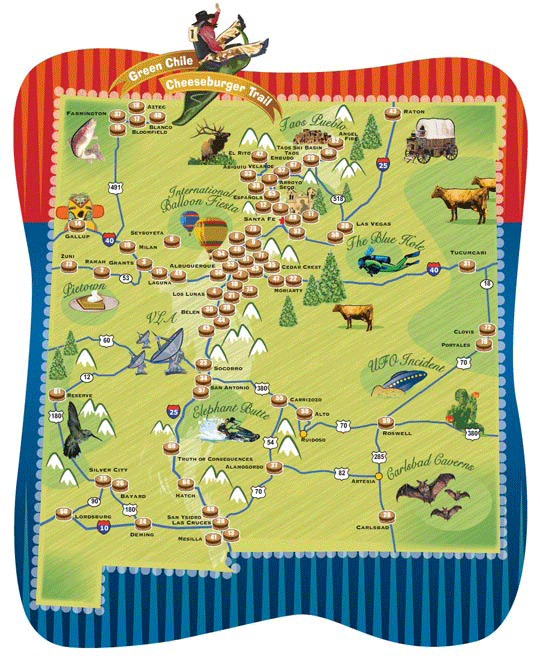
To New Mexicans, there is nothing as thoroughly soul-satisfying and utterly delicious as our ubiquitous green chile cheeseburger.  We have a fierce pride in that most simplistic, but explosive, flavor-blessed union of a thick, juicy beef patty grilled over an open flame or sizzled on a griddle then blanketed in cheese and topped with taste bud awakening, tongue tingling, olfactory arousing green chile. New Mexicans throughout the Land of Enchantment’s 33 counties celebrated July 22nd, 2009 with the gusto normally reserved for a Lobo or Aggie victory.  We basked in the glory of one of our own upstanding citizens vanquishing an audacious interloper from New York City in a green chile cheeseburger “throwdown.”  On that fateful summer day, the Food Network aired for the first time, the tasty triumph of the Buckhorn Tavern’s Bobby Olguin over “Iron Chef” Bobby Flay.  Our chests swelled with pride as the Food Network confirmed what all of us know–when it comes to the green chile cheeseburger, New Mexico is the best in the world. In recognition of Olguin’s victory, Governor Bill Richardson declared Friday July 24, 2009 “Buckhorn Tavern Day.” “Congratulations to the Buckhorn Tavern and its owner Bobby Olguin for the impressive victory…