El Chile Toreado – Santa Fe, New Mexico

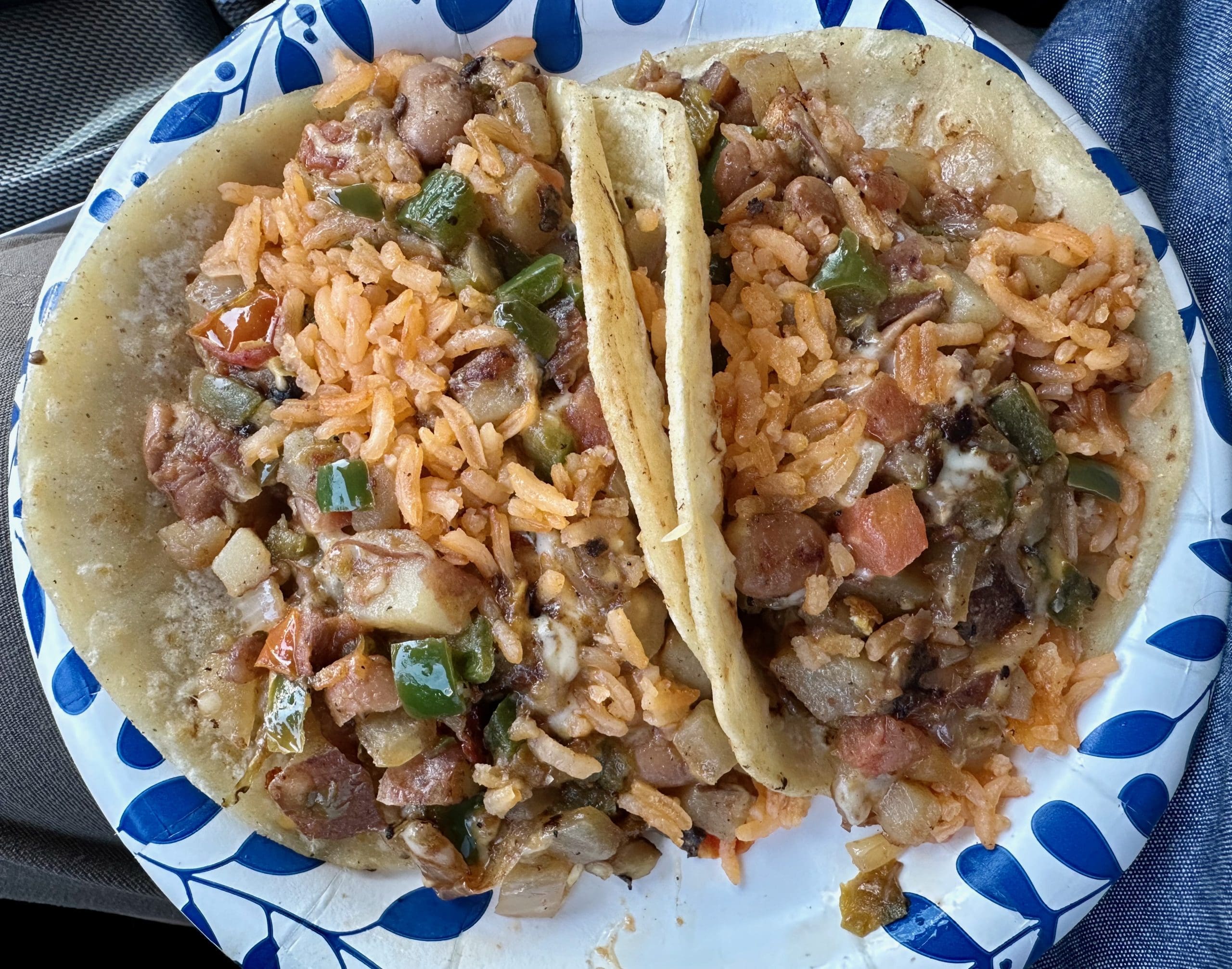
Until 2008, the notion of gourmet culinary offerings being proffered by a mobile conveyance was unheard of.  Prior to then, food trucks were (often rightfully so) known as “roach coaches” or even worse “barf buggies.”  Roach coaches were an eyesore, a medium of last resort usually parked at construction sites, manufacturing plants, public parks or basic military training bases where captive trainees had no alternative.  Roach coaches were a pure convenience with no pretense to gourmet (or even good) cuisine.  Most of them hawked simple fare such as hot dogs and tacos as well as potato chips, cigarettes, candy and chewing gum. During the era of “convenience stores on wheels,” food trucks weren’t worried about building a brand.  Nor were they concerned with repeat business or customer loyalty. There was no such thing as social media at the time and there were no Yelp reviews. These unsightly vehicles (many with actual roaches in tow) were in business to serve a location for a short time period. After at construction job ended at one site, for example,  they would simply move onto the next profitable location and the process would continue.  These “convenience stores on wheels” served a purpose, but during…

On The Flip – Albuquerque, New Mexico

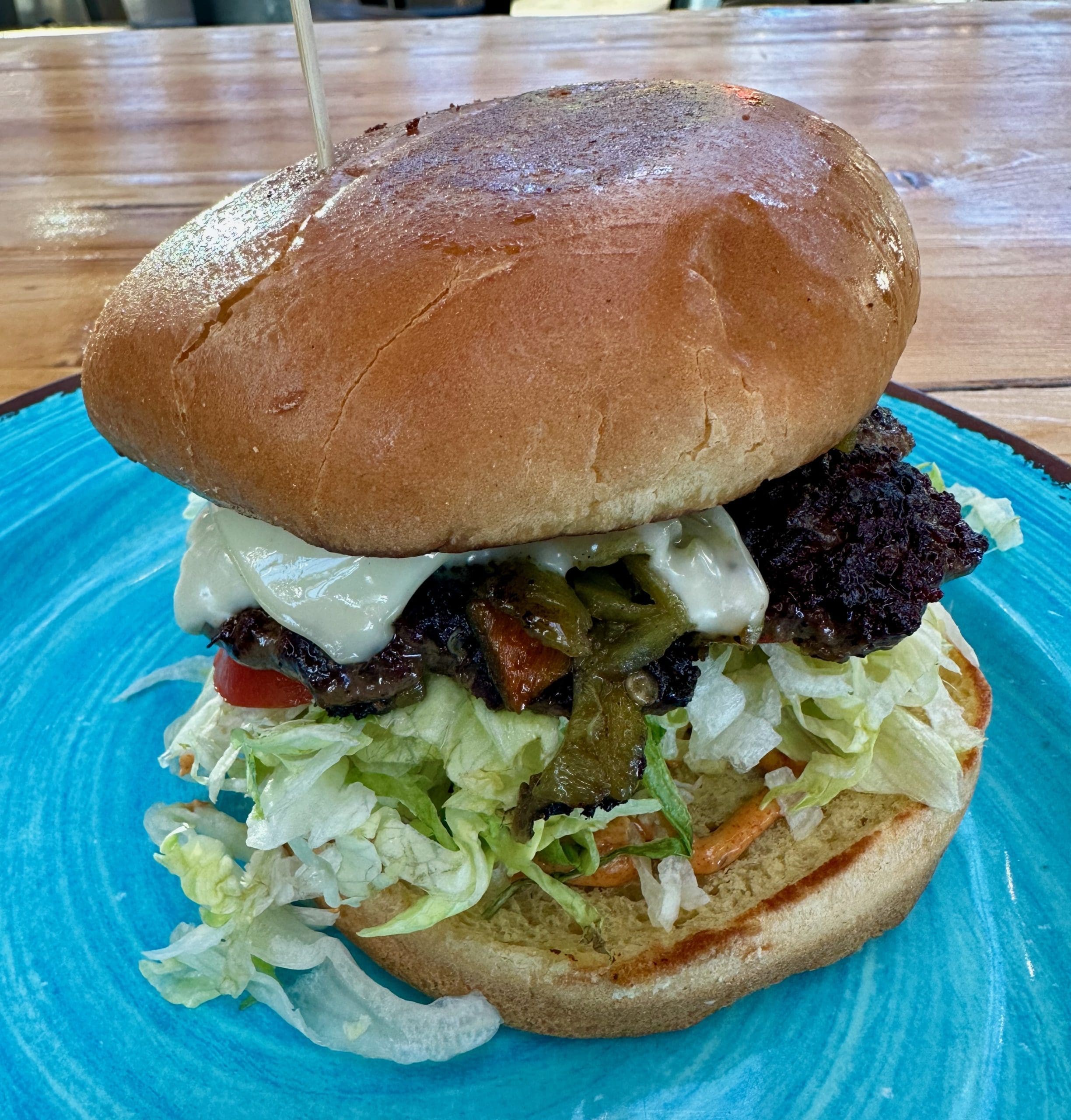
Though I pride myself on having a sesquipedalian vocabulary, very often pop culture vernacular escapes me.  Even food memes borne of pop culture are well over my head.  If you’re familiar with or use such terms as “good soup,” “cheugy,” “phone eats first,” “glizzy” and “caviar bump,”  you must be from the Gen Z generation.  Were I to use these terms, it would make me seem like a patronizing old fossil trying to be cool. During a December, 2023 visit to the Tin Can Alley, my Kim and I came a restaurant with a curious name neither of us could comprehend.  We quickly dismissed the notion that “On The Flip” had something to do with Albuquerque drivers extending their middle fingers in a salute denoting that other drivers are number one.   We then agreed the name has something to do with food that’s flipped.  Pancakes maybe.  Burgers probably. It turns out On The Flip is subtitled “beach grub perfected.”  My first experience with beach grub came in Massachusetts where beach grub consisted of lobster rolls, fried clams and tuna grinders.  In Mississippi beach grub was oysters, shrimp and crab.  None of these sumptuous seaside favorites–perfected or otherwise–appear on On…

Burger Bro’s – Albuquerque, New Mexico

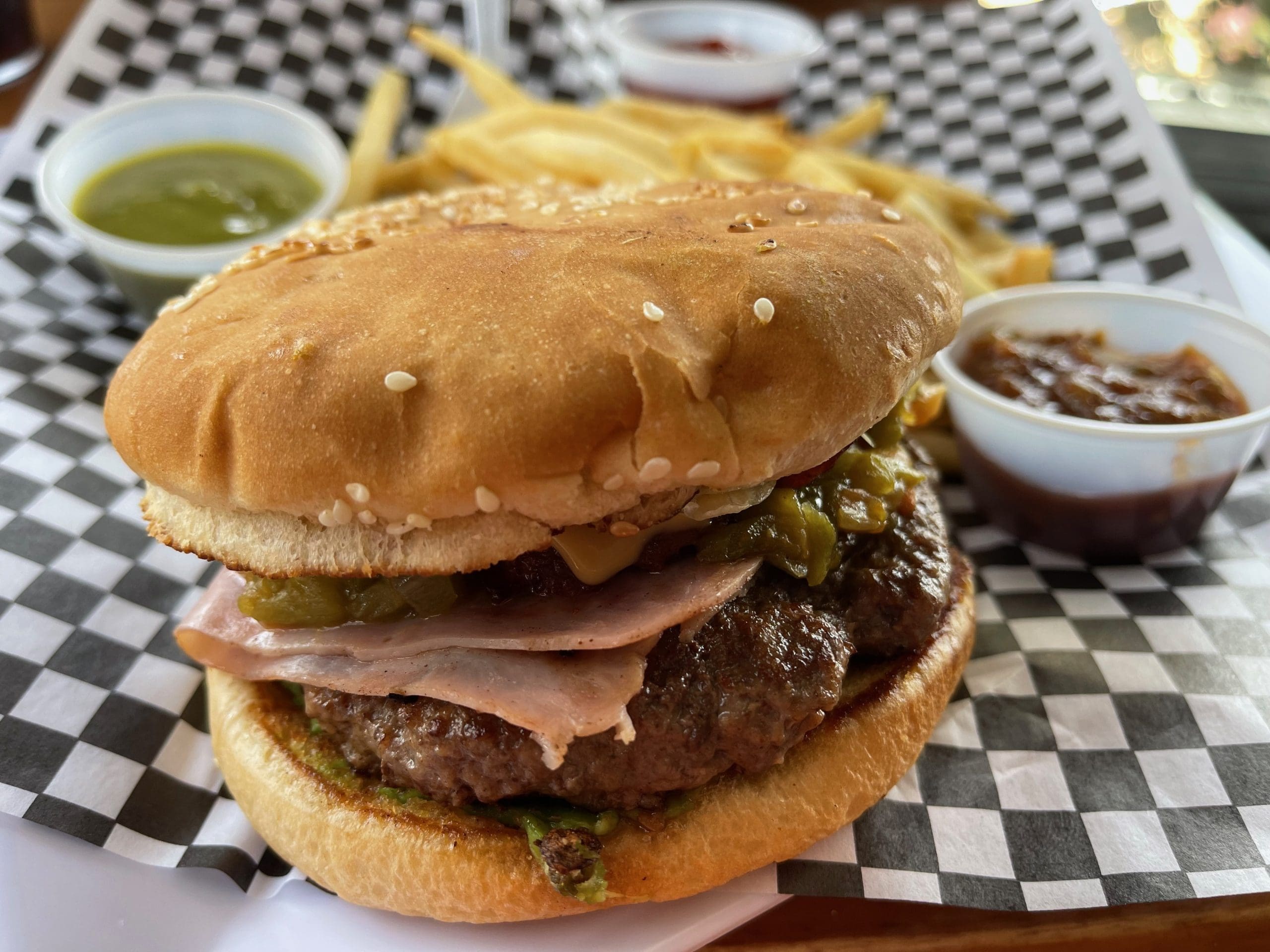
Such advanced human traits as complex symbolic expression, art as an aesthetic visual form and elaborate cultural diversity emerged mainly during the past 100,000 years or so.  That’s more than four-million years after humans gained the ability to walk on two legs. By comparison, the ubiquitous All-American burger has evolved in the blink of time.  Most culinary historians believe the burger as we know it today was invented somewhere between 1885 and 1904. Even most of us who have lived three or more decades have seen significant changes in the burger.  Many of those changes have occurred during the 21st century–the last twenty years or so. Think about it.  For the most part, the predominant burger many “seasoned” eaters across the fruited plain enjoyed until recent years was relatively unadorned save for the burger’s essential and defining elements: a soft, toasted bun (sesame seed buns were popularized by the Golden Arches in the 60s); sweet, vine-ripened tomatoes; crisp, cool, crispy lettuce; a smear of pungent yellow mustard; maybe some chopped white onions and in the middle of it all, a juicy, seasoned all-beef patty.  To be sure, additional ingredients–cheese in the 1920s or 1930s and in New Mexico, green chile in the 1940s–eventually…

Los 6 Hermanos – Bernalillo, New Mexico

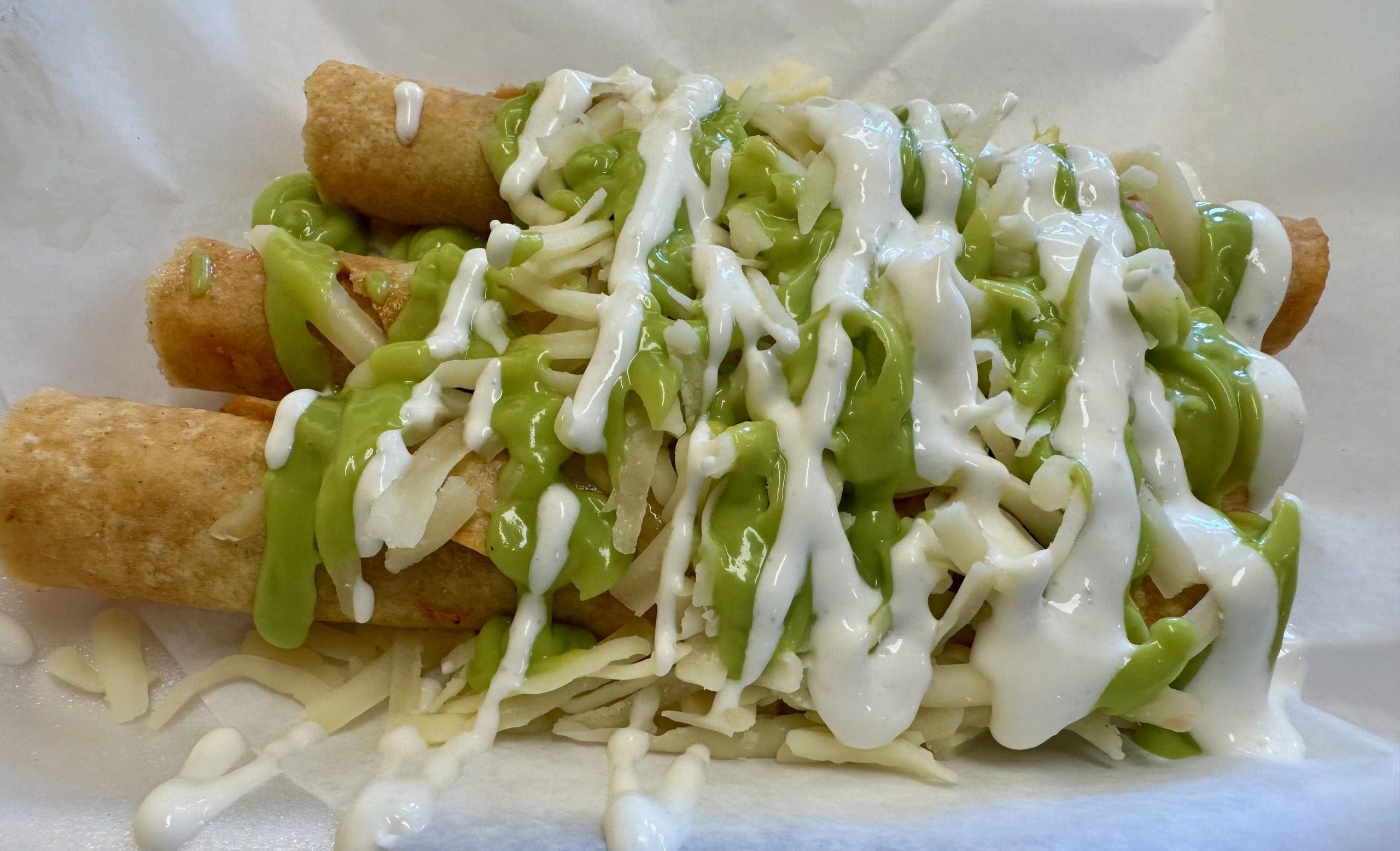
Once upon a time (how many of you remember when seemingly all ancient fables and stories began with these four words?) there was a family of six Chinese brothers, each with a unique and amazing power. One of the brothers committed an infraction against Chinese law and was sentenced to death by the emperor. By asking for one last night at home the brothers were able to take each others place and thwart the king’s executioner’s attempt to kill them.  Eventually the executioner ran out of ways to run the execution and had to call it off. There are no cuentos or corridos, sagas or stories in Mexico involving six siblings imbued with exceptional abilities.  In fact, just about the most remarkable fact about “seis hermanos” is the number of small villages in the Land of Montezuma with that name.  On 23 February 2019, 6 Hermanos Fresh Mexican Kitchen opened its doors on Camino Del Pueblo in Bernalillo.  Not surprisingly, the restaurant is named for a family of six brothers who share ownership and cooking duties.  It’s not just another Mexican restaurant.  There are more than six reasons it’s a special place. One of the more than six reasons this…

The Skillet – Las Vegas, New Mexico

A man comes home after a long day.  His wife then hits him in the back of the head with a frying pan.  He clutches his head in pain asking her, “Honey why? Why did you do that?” She answers, “When I was doing your laundry I found a receipt in your pocket with a woman’s name on it.” He responds, “That’s why you hit me? Honey, Mary-Ann is a horse I bet on.  That’s the receipt for my bet.” She accepts that and apologizes and they make up.  Next week the same thing happens. He comes home and is struck in the back of his head with a frying pan. The husband asks, “AGAIN? You hit me in the head with a frying pan again, why?!”  The wife looks at him and says, “Your horse called.” Believe it or not, in the 50s and 60s (long before my time), wives bashing their husbands on their heads with frying pans passed for humor.  Banner Graphic confirms this gallows humor trend: “The image of an angry woman hitting her uncooperative husband over the head with a frying pan is usually a cartoonishly laughing matter.  After all, it’s a staple of comic…

El Bruno Restaurante Y Cantina – Albuquerque, New Mexico

At about 75 miles each way, Cuba, New Mexico is almost equidistant between Albuquerque and Farmington. Regardless of starting point, the drive to and from Cuba is one of the Land of Enchantment’s most spectacular. A preponderance of scenic vistas and an otherworldly, multi-hued topography make the drive a sightseer’s delight. The stratification of multi-hued earthen layers, will remind you of colorful Navajo sand paintings while hulking hoodoos (columns or pillars of bizarre shape caused by differential erosion on rocks of different hardness) will inspire awe, none more so than the nipple shaped Cabezon Peak, a dramatic 7,785 foot volcanic formation that commands the skies. I must admit that most of my enjoyment of those incomparable vistas has been on the return trip from Cuba. For some reason, I always seem to be in a hurry to get there with a single-mindedness of purpose only a seeker with a yen to be sated can truly understand. In my quest to fulfill that longing, I’ve even resorted to corrupting the innocent, once convincing my friend Sandy that her new Prius could reach speeds of over 100 miles-per-hour on the long, straight stretches of U.S. Highway 550. So what would drive two…

¡Ay Mi Mexico! – Albuquerque, New Mexico

One syllable, one word, one simple expression…yet there probably is no more expressive interjection,  heart-rending cry or honest exclamation in the Spanish language than the simple word “Ay.” This–one of the most  diminutive among all words–can say and mean so much.  Depending on the context, “Ay” is used to express such emotions as: <happiness: think “¡Ay, Chihuahua” when Despicable Me patriarch Gru espies a black villain suit he covets; surprise: ¡Ay, Cabron! what are you doing home in the middle of the day?; exasperation: ¡Ay, Que Lastima! <pain or dismay: Bart Simpson’s ¡Ay, caramba!” when he saw his parents having sex. The versatility of “ay” is virtually unparalleled (though you can usually tell what meaning or mood a speaker is ascribing to that oh, so simple and powerful expression). Informally, “ay” may preface other words in place of curse words in order to make a phrase sound less harsh.  In essence “¡Ay, caramba!” and “¡Ay, Chihuahua!” are Mexican equivalents of “oh, shoot,” “darn” or “shucks.”  Perhaps the most famous use of the term is in the immortal Mexican song Cielito Lindo whose refrain exhorts “Ay, ay, ay, ay, canta y no llores.”  Some English dictionaries translate this as “oh, oh,…

El Molcajeton – Albuquerque, New Mexico

Molcajetes have become so commonplace on many a Mexican restaurant’s decor that we sometimes forget molcajetes are the traditional Mexican version of the mortar and pestle…that they have both form and function.  As we gawk in admiration at the symmetry and fine craftsmanship of a well-made molcajete, we don’t always reflect on the fact that throughout Mexico and some parts of the Estados Unidos molcajetes are still used to crush and grind spices and to prepare guacamole, moles and salsas.  In restaurants and homes in which molcajetes are used for their intended functional purpose, the guacamole, moles and salsas created within them are said to taste better, much better. As James Beard Award-Winning Writer and Chef Patti Jinich says “A wonderful thing about molcajetes, is that since they are so porous they have a remarkable memory. They store within them, the essences, oils, smells and flavors of all that has been served or made in them. Maybe that’s why it is said that molcajetes season with time and use. Maybe that’s also why it is said that making a sauce or rub or paste in a molcajete makes it taste better.”  Patti’s theory has credibility.  The rough surface of molcajetes…

Foodtopia – Albuquerque, New Mexico

When a restaurant with the curious name “Foodtopia” surfaced in 2022, long-suffering readers of Gil’s Thrilling… probably realized an etymology lesson would soon be in order.   If the suffix “topia” intrigued you as much as it did your grandiloquent blogger, hang on.  First, a review of what we all know.  Utopia is “a seemingly perfect society, one without flaws, where everyone is content and conflict and strife are unknown.”  One example of a Utopian society is the movie Zootopia in which animals live in harmony and lions sing kumbaya with antelope.  More common than movies about Utopian societies are movies and literature about dystopia, “societies that are either extremely chaotic or extremely authoritative, a hellish place where most people suffer.”  No, it’s not your place of employment, but rather something like Planet of the Apes or George Orwell’s 1984. The common element in these two opposite societal types is the suffix “topia,”  a Greek word meaning “a place with specified characteristics.”  An imaginary society with both good (Utopian) and bad (Dystopian) features might be called a “mixtopia.” Some posit an imaginary place where everything (especially the government) is as bad as it can be.  Fittingly, the term for this…

No Te Rajes – Rio Rancho, New Mexico

As the eldest of six, I had the wonderful blessing of having spent more time with our dad than my siblings did.  Dad was the embodiment of the term “gentle man,” a patient mentor and nurturing exemplar of how to be a father and friend.  During our many outings, dad always had the radio tuned to KDCE, “The Station That’s All Heart” out of Espanola.  KDCE played the New Mexican and Mexican songs dad grew up with and loved.  Among his favorites (frequently on KDCE’s repertoire) was Ay Jalisco No Te Rajes by Jorge Negrete. It became one of my favorites, too. The song title made absolutely no sense to me because the term “rajes” comes from the verb “rajarse” which means to “crack” or “split.”  Dad explained that colloquially, “no te rajes” means “don’t back out” or “don’t chicken out.”  He assured me the song was basically a love song to the Mexican state of Jalisco.  He also told me it was the theme song to the 1941 Mexican movie of the same name, based on a novel by the same name.  If you think I’m a wealth of information, you should have met my dad, one of the…

Rex’s Hamburgers – Albuquerque, New Mexico

From 1988 through 2005, Rex’s Hamburgers stood practically alone in offering Duke City consumers an alternative to the homogeneous gobble-and-go offerings of deep-pocketed fast-food chains like McDonald’s, Burger King and Wendy’s. Rex’s earned and retained the hearts of Albuquerque diners for nearly 20 years. During its halcyon days, it garnered the long defunct’s Abq magazine’s “Best of Albuquerque” honors for several consecutive years. The reason Duke City patrons were so loyal to Rex’s was because Rex’s was at the diametric extreme opposite of the chain restaurants. Whether ensconced in a strip mall or housed in a single tenant edifice, Rex’s offered real sit-down service at a relaxed and reasonable pace. Moreover, it served hamburgers the way they are intended to be prepared. That means they started with real meat, never frozen, formed into a ball and flattened on the griddle with a spatula then allowed to cook slowly to retain the beef’s natural juiciness. Unlike at the Golden Arches, you never had to wonder what filler was used in Rex’s all-beef patty. It was always 85 percent lean and 15 percent fat, the time-tested optimum balance for optimum flavor. It was always served hot and with only the freshest of…