Coda Bakery – Albuquerque, New Mexico

JP, my former boss at Intel used to pride himself on consistently working “half days.” If you’re thinking you’d like a job where you work only four hours a day, you’ve misinterpreted his definition of “half days.” To him, half days is a literal term meaning twelve hours a day. When most of us are done for after only nine or ten hours, he was just starting what he called his “second shift.” Very few of us have the stamina, initiative and especially the passion for what we do to work “half days.” I know restaurateurs for whom half days (or longer) are standard six or seven days a week. Because they spend so much time in their restaurants tending to the care and feeding of others, they tend not to eat there–when they make time to eat. On their rare days off or when they’re able to make time for a quick escape, they like to visit their fellow restaurateurs, not necessarily to check up on the competition, but to be pampered and fed well. Some restaurateurs would make great restaurant critics though they do tend to be overly “honest” when describing direct competitors, restaurants which serve the same…

Banh Me & You – Albuquerque, New Mexico

According to The Tanner Food Group, a a food consultancy focused on international trade, industry preparedness and regulatory activities, there are now nearly 8,000 Vietnamese restaurants stateside.  Food Scientist Michael Murdy, founder of robustkitchen.com attributes the  popularity of Vietnamese food to the “wide range of flavors and textures associated,” specifying that “the combination of sour, sweet, savory, and spicy flavors, as well as the use of fresh herbs and vegetables, makes Vietnamese food particularly attractive to people.” From among the nearly 8,000 Vietnamese restaurants on this side of the pond, it’s a good bet many of their menus are graced with banh mi, the sandwich melding French and Vietnamese flavors and techniques.  I first encountered the banh mi during one of many trips to the Santa Clara-San Jose area courtesy of Intel.  With a significant Vietnamese population, the area was teeming with restaurants, most generally serving pho and other wondrous delights from Vietnam.  At the time (mid 1990s), the San Jose area was starting to see Vietnamese bakeries opening up mostly in areas frequented by Asian populations.  Among them was Lee’s Sandwiches, maybe the first to showcase the banh mi. Lee’s Sandwiches has suffixed its corporate name with “International” and…

SAIGON CITY – Albuquerque, New Mexico

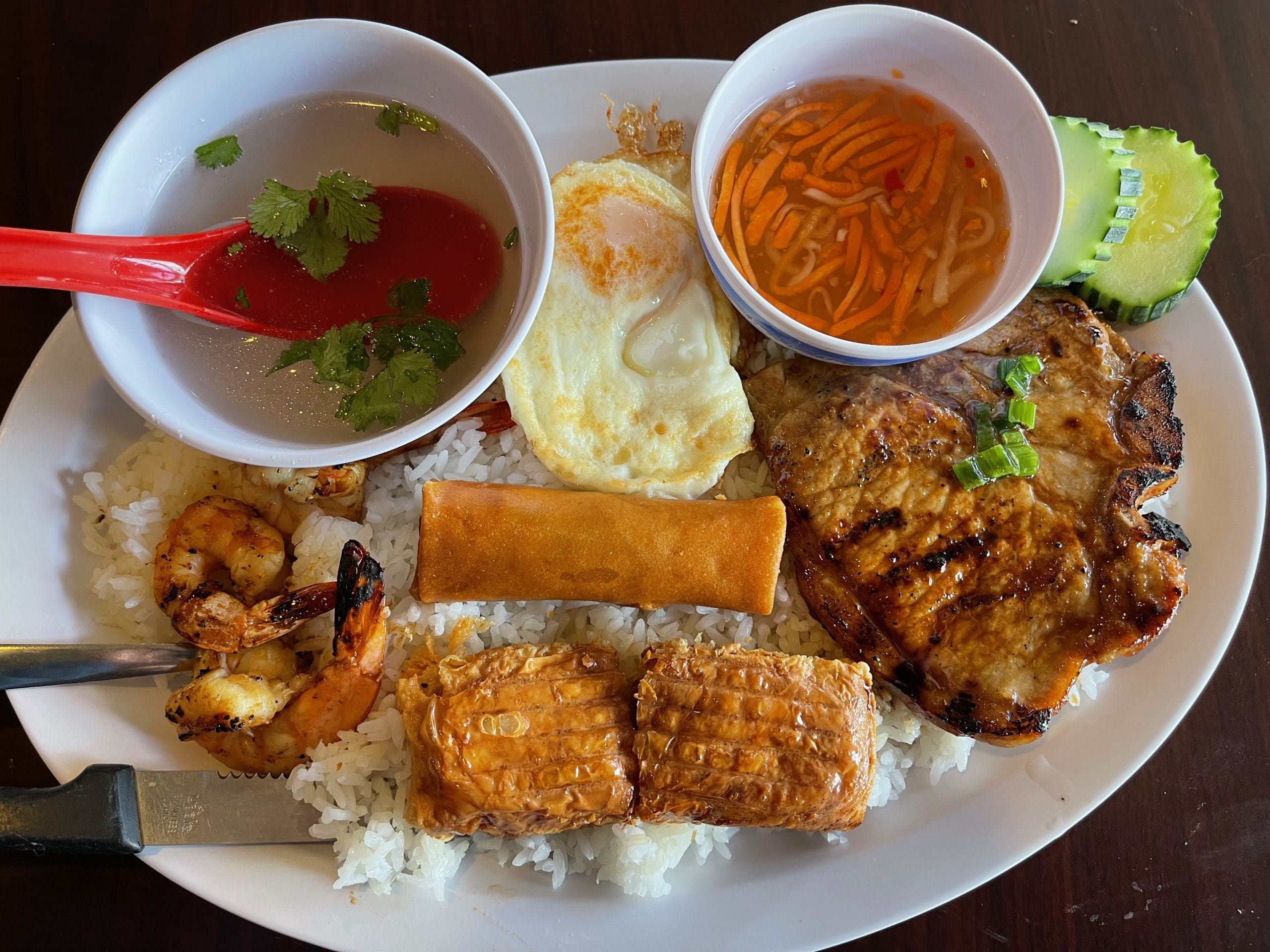
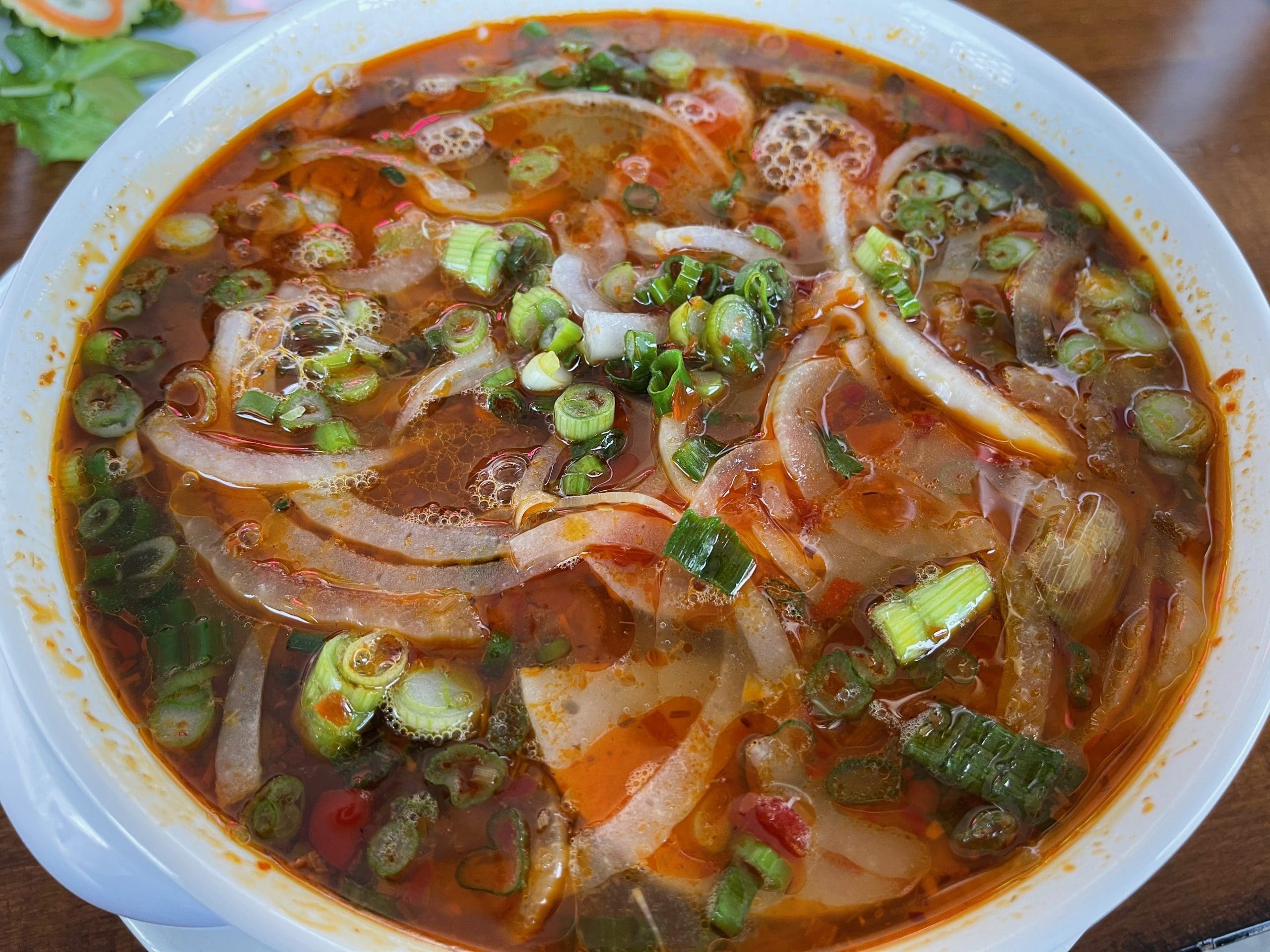
NOTE:  Saigon City shuttered its doors on 31 October 2025 to allow the owners to take a much-needed vacation.  It reopened on 12 January 2026.  During the time away, Shawn negotiated an extension to the lease which will keep Saigon City at its familiar location.  For that, regulars at this outstanding Vietnamese restaurant are elated. My brother in blogging Ryan Cook describes his first day in Vietnam: “So, my first stop in Vietnam was the capital, Hanoi. My honest first impressions… what the hell have I let myself in for. Seriously…The roads are chaos! The ride from the airport to the hostel was basically 40 minutes of holding my breath and cringing. How someone wasn’t killed in front of my eyes was a miracle! However, this is something you later don’t even bat an eyelid at after a day or two. Throughout the country, the roads are all complete lawless chaos…BUT it works! Everyone is so insane on the road, the chaos works. I did not see a single accident in my entire journey – thank God!” “What the hell have I let myself in for” was precisely my sentiment each of the four times I visited Saigon Far East…

Le Bakery – Albuquerque, New Mexico

“What colonialism does is cause an identity crisis about one’s own culture.” ~Lupita Nyong’o Academy Award Winning Actress Much as we might believe geopolitics has no place in a food blog, food and geopolitics are undeniably intertwined.  Perhaps nowhere is that more evident than in the history of Vietnam.  In the 17th Century, France began a trade relationship with Vietnam.  Two centuries later, France began the colonization of Vietnam.  For six decades, France ruled over the Southeast Asian country, essentially relegating the indiginous population to second-class status, if not servitude. During this time, French influence spread across Vietnamese cuisine, architecture, culture, art and cuisine – an influence which continues to live on across the country today. The French influence on Vietnam’s culinary culture included the introduction of  new ingredients and cooking techniques that blended with local flavors. Perhaps the most famous fusion sprang from the iconic baguette. While mostly similar,  the Vietnamese style of baguette is made with rice flour instead of wheat flour, giving it a wholly distinct flavor and texture. Baguettes are the canvas on which one of one of the most famous Vietnamese dishes worldwide are constructed: banh mi. These magnificent sandwiches contain a combination of grilled…

Pho Ginger – Albuquerque, New Mexico

The Cultural Atlas reveals one aspect of Vietnamese life that is readily apparent to those among us well acquainted with Albuquerque’s Vietnamese restaurant families:  “Family is the most important aspect of life in Vietnam. It is much more interdependent and tight-knit than what many Western cultures are familiar with. The cohesiveness and health of the family unit is often a main imperative. The “family unit” itself generally includes a larger nexus of relationships. Aunts, uncles, grandparents and other extended relatives often have very close relationships and provide a central support system.” During our time in the Land of Enchantment, we’ve seen just how interdependent and tight-knit Vietnamese families are.  We’ve also experienced how warm and welcoming those families are.  We consider James and Thu Nguyen at Cafe Dalat among our very favorite restaurateurs.  Same with Vicki Truong at SaiGon.  Sean and Kim, the genial proprietors of Saigon City, treat us like family.  Visiting their restaurants is like going home and catching up with relatives we actually like–a lot!  Aside from the obvious, one commonality among these three restaurants is that family either works in them or has their own restaurant in town. When we walked into Pho Ginger on Juan…

Viet Taste – Albuquerque, New Mexico

In the “gobble and go” pace of contemporary American life, it’s sometimes difficult to remember what you ate during your last meal, much less recall the sensory experience of that meal.  When that happens to true gourmands, they will actively seek a memorable dining experience in which all five senses are invoked. One of the best restaurants in Albuquerque in which to have such a sensory experience is almost any Vietnamese restaurant. One such example is Viet Taste which opened on April 4, 2007.  Even more than most Vietnamese restaurants, Viet Taste exemplifies comprehensive eating, the most sublime form of Vietnamese cooking and eating. This style of eating involves all five senses. In comprehensive eating, you eat with your eyes first. It’s important that all dishes be attractively presented with a diversity of colors and forms. Plating is almost an art form and Vietnamese wait staffs have a penchant for eye-pleasing arrangements. Everything on your plate is where it should be for optimum harmony and appearance. The balance of color, texture and appearance should give diners pause to reflect on how great everything looks. It also helps that at Viet Taste, the ambiance is soothing and attractive. This is one…

Leona Banh Mi – Albuquerque, New Mexico

“I’m not allowed in the Vietnamese sandwich shop anymore. They decided to banh mi for life.” During an ice-breaker at what promised to be a stressful project planning meeting, all participants were asked to stand up and describe their favorite childhood Christmas gift. For the most part, favorite gifts conformed to gender stereotypes. Male colleagues waxed fondly about GI Joe action figures (don’t ever call them dolls), Star Wars Lego sets and their first bike. Females in our group described Barbie dolls, playhouses and cabbage patch kids. Then it was my turn. “My favorite Christmas gift as a child,” I explained “was a dictionary.” Copious groaning ensued though for some reason no one was surprised. As a child for whom English was a second language, my first dictionary was a good friend, one consulted frequently when reading my other favorite tome, the encyclopedia. Yeah, I was a weird kid. Perhaps because it was so ponderous and not a few gazillion bytes of information floating around some ethereal concept called the cloud, the dictionary was much more uncool back then. It was also much more mysterious and stodgy. No one seemed to know how new words were added from year-to-year (I…

Spring Rollin’ – Albuquerque, New Mexico

Reclusive American poet Emily Dickinson insisted a light exists in spring that’s not present at any other time of year. If you’ve ever spent a winter in the Northern Hemisphere at a latitude of 42° or more, you know what it’s like to long for that light. You can relate to the irritability and restlessness of having fewer than eight hours of sunlight during winter months. You know what it’s like to head to work in the dark and return home in the dark. You know the confinement of cabin fever when persistent rain or snow keep you indoors for prolonged periods of time. If you’ve experienced long, dark winters, you celebrate the return of spring. In northern climates, the advent of spring is celebrated as a return to warmer weather, new growth and increased daylight. While most countries celebrate spring festivals a couple of weeks after the much loathed Daylight Savings Time, China’s Spring Festival (better known as the Chinese New Year) begins somewhat earlier. Generally falling on a day between January 21st and February 20th in the Gregorian calendar, this spring festival is the grandest festival in China. China’s spring festival is a seven-day long holiday in which…

Don Tortas – Albuquerque, New Mexico

A survey of 2,000 Americans conducted by French’s Mustard in celebration of National Sandwich Day (November 3, 2021) revealed that 66-percent of Americans put between three and six condiments on their sandwiches, 44-percent of respondents believe condiments belong on both buns while 57-percent believe the most important part of a sandwich is the meat.  French’s poll revealed the cheesesteak is the most popular sandwich in America followed by the hamburger (which many people would argue is not a sandwich), barbecue pulled-pork sandwich, Italian and Reuben.  Had the survey polled Americans as to what sandwiches were on the ascent–those growing quickest in popularity–two sandwiches would have risen to the top. Both of those sandwiches owe their genesis to French colonial rule.  First is the banh mi, a culinary fusion of two cultures: France and Vietnam.  A banh mi is an airy, crunchy French-styled baguette stuffed with a combination of meats, vegetables and other condiments. A melange of different textures and temperatures, bánh mì has an off-the-chart flavor profile: salty, sour, savory, sweet, and aromatic all simultaneously! As it has grown to become a staple in Vietnamese cuisine, so has its versatility.  Banh mi can be enjoyed for breakfast, lunch, dinner, as…

Pho Bar – Rio Rancho, New Mexico

“In food, as in death, we feel the essential brotherhood of man” – Vietnamese Proverb Western sensitivities cause even those among us who consider ourselves gustatorily open-minded to utter an “ick” or two at what is culinarily acceptable–even considered delicious–in other cultures. Some of us would recoil in disgust at the notion of eating grilled dog, roasted cat, grain-fed mice, beating cobra heart, soft-boiled fetal duck or silk caterpillars, but these are dishes an official Vietnam culture site considers “something special” when skilfully cooked. What the watered down American palate often considers disgusting may, in fact, have deep cultural underpinnings, some of the aforementioned “delicacies” even gracing the tables of royalty. Oftentimes things Americans consider inedible creepy crawlies are eaten for the sake of survival. The diversity of our planet is such that what is delicious, disgusting, edible or delicious often has powerful cultural, socioeconomic and religious connotations, all of which evoke visceral reactions. Among Hindus who regard cows as sacred creatures, the ubiquitous American hamburger can be very offensive. Many Hindus are very careful to avoid the meat aisle where the “dead animals” are kept. Until rather recently, many Chinese nationals wouldn’t dream of consuming cheese, the thought of…

Bamboo Grill – Albuquerque, New Mexico (CLOSED)

In his 30s, curmudgeonly London food critic Jay Rayner who’s been called the “enfant terrible (literally “terrifying child) of the gastronomic scene,” came to the realization that he hated hangovers more than he hated being drunk.  During a visit to a Vietnamese restaurant in London, he achieved an epiphany:  “huge steaming bowls of a deeply aromatic beef broth called pho, bobbing with slivers of meat and wide rice noodles – would prove a perfect cure. The head pain would ease. The pitch and roll of the stomach would steady. A gentle, soft comfy cloud of well being would descend. And all this for not very much money at all.” A 2017 article from the travel experts of Lonely Planet also believes pho is “an excellent hangover cure.”  In fact, pho appears first on a list of personal tips on how to survive a hangover on the road.  The article’s editor expounded further: “The broth rehydrates, the sodium gives you a little pick-me-up, and the freshly cooked beef adds protein in wafer-thin slices (which is all I can usually stomach in this state).”   The article concludes: “Even an image of a steamy bowl of pho can cure that headache for…