Al Trompo Mexican Grill – Albuquerque, New Mexico

Comaraderie, brothers-in-arms, esprit-de-corps, commitment, dedication…Unless you’ve served your country in the armed forces of the United States, these terms probably don’t mean much.  For those of us who did serve–proudly, gallantly, nobly–these terms mean everything.  They’re not just a call to arms; they’re our code of conduct.  They’re the way we carry ourselves.  They denote our commitment to one another, the importance of taking care of our own.   The uniforms worn by the select and exceptional men and women  signify the call to duty–the ideals, and the shared title of being an American and believing in all that means.  More than any other factor, it’s those ideals that truly bind servicemen and women together, across all five branches. Our brotherhood–that inexorable bond–doesn’t mean we’re not competitive with one another. Fierce rivalries exist among the five branches. We’ve been known to throw down with brothers-in-arms in defense of our particular branch. We rib one another good-naturedly with insults and derrogatory terms.  That’s what brothers and sisters do.  Our familial skirmishes and disses are ours exclusively.  If you didn’t serve, you won’t be invited to participate.  Like good families are, we’re mostly respectful and proud of our brothers-in-arms.  We thank one another…

Perea’s Tijuana Bar & Restaurant – Corrales, New Mexico

The curious appellation “Tijuana Bar” dates back to the 1920s when the 18th amendment to the Constitution established Prohibition in the United States during the period 1920 to 1933. Because Prohibition forbade the sale of alcoholic beverages, many Americans got their alcohol illegally or they went to Mexico. Tijuana was a popular vacation and honeymoon destination and it happens to be where Teofilo C. Perea, Sr. and his bride honeymooned in the 1920s. The newlyweds visited a bar called the “Tijuana Bar” and decided then and there to use that name should they ever open a bar. Bureaucracy being what it is, once a license to dispense alcohol is issued, it’s very difficult to change the name on the license–hence Tijuana Bar. It fits. Housed in one of the oldest buildings in Corrales, a 200 year plus old structure constructed of “terrones” or thick slabs of earth rather than adobes, Perea’s Tijuana bar & Restaurant doesn’t subscribe to the notion that all food served in Corrales has to be of high-brow fru-fru variety. In fact, for outstanding home-cooked New Mexican food, Perea’s is one of a handful of restaurants vying for “best restaurant” in the Duke City area. In my…

Ramona’s Mexican Cafe – Albuquerque, New Mexico

“No one who cooks, cooks alone. Even at her most solitary, a cook in the kitchen is surrounded by generations of cooks past, the advice and menus of cooks present, the wisdom of cookbook writers.” ~Laurie Colwin, Novelist Watch virtually any episode of Kitchen Nightmares and you might just be convinced that families can’t possibly work together in a restaurant.  Kitchen Nightmares, one of Gordon Ramsay’s eight-hundred or so television shows, is rather formulaic–Ramsay spends a week with a failing restaurant in an attempt to revive the business.  Almost invariably, the failing restaurant is owned and operated by a family.  Almost invariably, the drama falls just short of Homer strangling Bart.  Arguments on Kitchen Nightmares are loud and intense.  Copious tears are shed.  Predictably, the sagacity and sangfroid of Saint Ramsay brings sanity to the family fray and the family joins him in a rendering of kumbaya. Contrast a visit to a Kitchen Nightmares restaurant with a visit to Ramona’s Mexican Cafe and the only drama you might experience is the internal conflict of trying to figure out what to order from a terrific menu.  Ramona, the matriarch of the Chavira Y Valles family, runs the kitchen with her sons.…

Sazon Con Amor – Bernalillo, New Mexico

The Broadway musical Rent taught us that a year is comprised of “five hundred twenty five thousand six hundred minutes.”   Instead of measuring the length of a year “in daylights, sunsets, midnights, cups of coffee, inches, miles, laughter or strife,” Rent encouraged us to measure a year in life in seasons of love.  Not surprisingly, Seasons of Love (a song from the musical from which the italicized lyrics originated) came immediately to mind when we espied Sazon Con Amor, a food truck (that’s mobile kitchen to you, Bob) parked on Highway 550 in Bernalillo. Sazon Con Amor translates from Spanish to “Seasoning With Love,” but that was close enough to Rent’s definitive song to trigger a day-long earworm.  It also prompted me to ruminate on the many times chefs have expressed that the secret ingredient in their cooking is love, but until discovering Sazon Con Amor, we’ve never heard of any chef bragging about seasoning with love.  It’s not just semantics either.  Cookbooks refer to seasoning as “the herbs, spices and herb-spice mixes used during the preparation of food”  (by  contrast, condiments consist of ingredient combinations (often including spices) added by a diner at the point of consumption).  It would be…

El Chile Toreado – Santa Fe, New Mexico

Until 2008, the notion of gourmet culinary offerings being proffered by a mobile conveyance was unheard of.  Prior to then, food trucks were (often rightfully so) known as “roach coaches” or even worse “barf buggies.”  Roach coaches were an eyesore, a medium of last resort usually parked at construction sites, manufacturing plants, public parks or basic military training bases where captive trainees had no alternative.  Roach coaches were a pure convenience with no pretense to gourmet (or even good) cuisine.  Most of them hawked simple fare such as hot dogs and tacos as well as potato chips, cigarettes, candy and chewing gum. During the era of “convenience stores on wheels,” food trucks weren’t worried about building a brand.  Nor were they concerned with repeat business or customer loyalty. There was no such thing as social media at the time and there were no Yelp reviews. These unsightly vehicles (many with actual roaches in tow) were in business to serve a location for a short time period. After at construction job ended at one site, for example,  they would simply move onto the next profitable location and the process would continue.  These “convenience stores on wheels” served a purpose, but during…

Burger Bro’s – Albuquerque, New Mexico

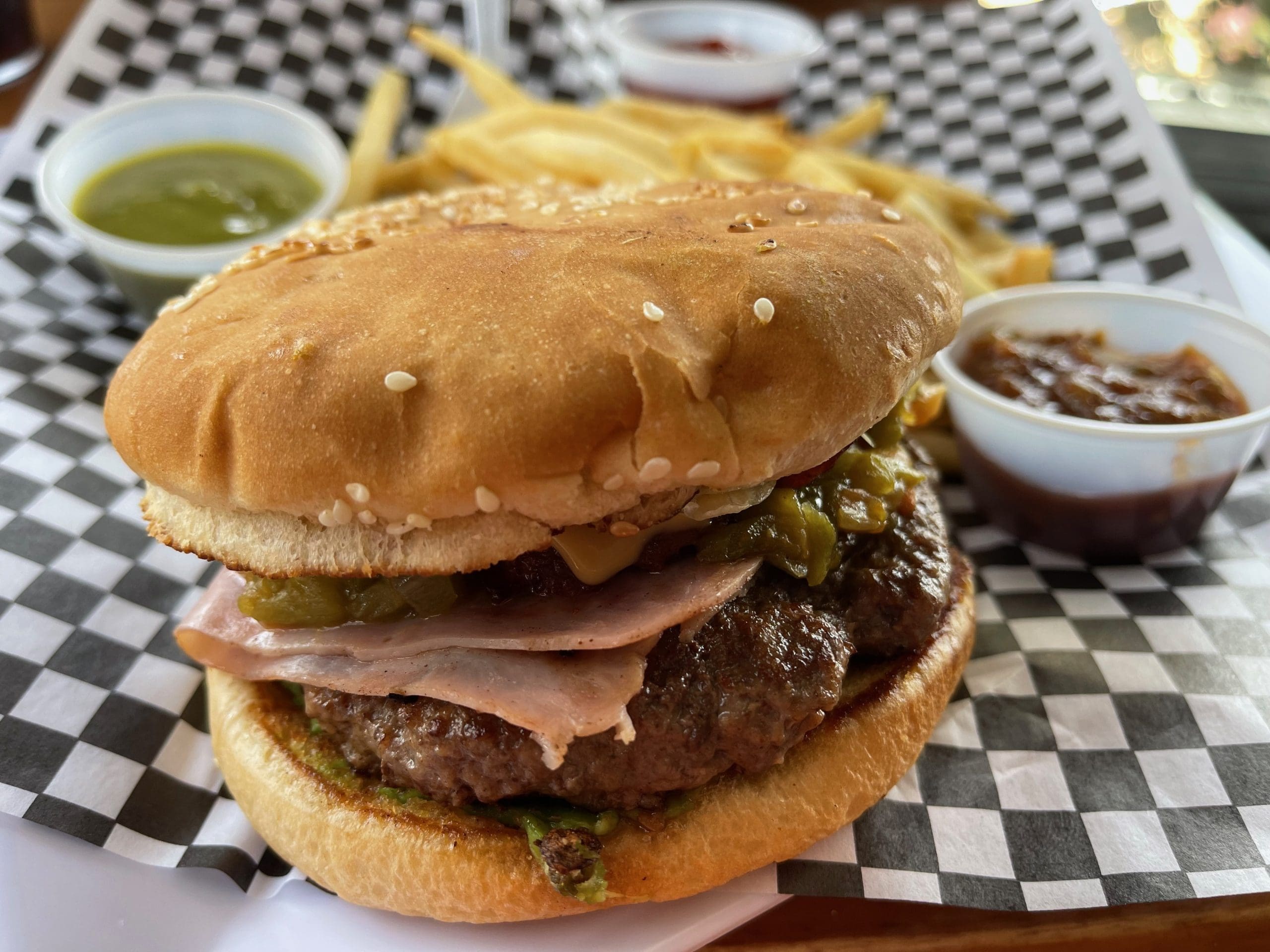
Such advanced human traits as complex symbolic expression, art as an aesthetic visual form and elaborate cultural diversity emerged mainly during the past 100,000 years or so.  That’s more than four-million years after humans gained the ability to walk on two legs. By comparison, the ubiquitous All-American burger has evolved in the blink of time.  Most culinary historians believe the burger as we know it today was invented somewhere between 1885 and 1904. Even most of us who have lived three or more decades have seen significant changes in the burger.  Many of those changes have occurred during the 21st century–the last twenty years or so. Think about it.  For the most part, the predominant burger many “seasoned” eaters across the fruited plain enjoyed until recent years was relatively unadorned save for the burger’s essential and defining elements: a soft, toasted bun (sesame seed buns were popularized by the Golden Arches in the 60s); sweet, vine-ripened tomatoes; crisp, cool, crispy lettuce; a smear of pungent yellow mustard; maybe some chopped white onions and in the middle of it all, a juicy, seasoned all-beef patty.  To be sure, additional ingredients–cheese in the 1920s or 1930s and in New Mexico, green chile in the 1940s–eventually…

Los 6 Hermanos – Bernalillo, New Mexico

Once upon a time (how many of you remember when seemingly all ancient fables and stories began with these four words?) there was a family of six Chinese brothers, each with a unique and amazing power. One of the brothers committed an infraction against Chinese law and was sentenced to death by the emperor. By asking for one last night at home the brothers were able to take each others place and thwart the king’s executioner’s attempt to kill them.  Eventually the executioner ran out of ways to run the execution and had to call it off. There are no cuentos or corridos, sagas or stories in Mexico involving six siblings imbued with exceptional abilities.  In fact, just about the most remarkable fact about “seis hermanos” is the number of small villages in the Land of Montezuma with that name.  On 23 February 2019, 6 Hermanos Fresh Mexican Kitchen opened its doors on Camino Del Pueblo in Bernalillo.  Not surprisingly, the restaurant is named for a family of six brothers who share ownership and cooking duties.  It’s not just another Mexican restaurant.  There are more than six reasons it’s a special place. One of the more than six reasons this…

Tap N Taco – Rio Rancho, New Mexico

Imagine Marty McPlata, a 17 year old Rio Rancho High School student who gets transported back in time seven years to 2015. With the help of his mad scientist friend Bill Resnikoff, he makes his way back to the future to the year from which he left–2022.  Significant changes and burgeoning growth have transpired in the City of Vision since he left.  Among one of the improvements by subtraction is the absence of one of the city’s three Burger King restaurants, a multi-national chain he drove past only because it was on the way to Corrales. Marty smiled at the thought that Burger King’s incredibly creepy, big-headed mascot may finally driven away all of the “home of the Whopper’s” customers.  That realization hit Burger King CFO Josh Kobza in 2011: “We got rid of the creepy king character that tended to scare away women and children.”  Gone, Marty thought, are the gold and red colors of Burger King’s logo, ironically the same colors used by McDonald’s.  Gone, too, is the empty parking lot.  On some days only the drive-up window seemed to have customers. While the iconic, standardized shape of the familiar Burger King restaurant remains, the building is now…

El Rey Del Pollo – Albuquerque, New Mexico

My environmentally-conscious, Prius-driving friend Bruce “Sr. Plata” Silver has a much smaller carbon footprint than that carbon credit-trading hypocrite Al Gore.  No environmental activist would ever condemn Sr. Plata for fouling the air and water with a large amount of greenhouse gas emissions. Instead, he leaves large “al carbon fingerprints,” the finger-licking kind you get from frequenting restaurants which specialize in pollo al carbon, chicken prepared over charcoal. Pollo al carbon has spoiled Sr. Plata. He craves those juicy, spatchcocked, golden-skinned birds speckled with black char, chicken so meaty and delicious it makes store-bought rotisserie chickens look positively anorexic in comparison. Who can blame Sr. Plata?  Made well, pollo al carbon is absolutely addictive. “Finger-licking good” might be a cliche, but there’s truth to this one particular cliche as it applies to al carbon. Over the years, Albuquerque’s Mexican restaurants haven’t exactly been beacons of light pointing the way for seekers of pollo al carbon to sate their maws with full repast.  Certainly not like Sr. Plata’s birthplace of Los Angeles where you can’t toss the leg bone of a chicken without hitting another poultry place.  During our culinary excursions, Sr. Plata and I thought we had discovered the motherlode…

Taco Bus – Albuquerque, New Mexico

Perhaps no mobile conveyance in the Land of Enchantment has ferried as many interesting people on as many colorful journeys as the “Road Hog,” the psychedelic bus which shuttled its passengers from Haight-Ashbury to Woodstock to Llano Largo, New Mexico. The Road Hog’s 1969 arrival in Llano Largo heralded the start of the “summer of the hippie invasion” as The Taos News called it. There unwashed masses settled into a Utopian agrarian commune they called the Hog Farm. The Road Hog with its familiar duck hood ornament and Grateful Dead-style tie-dyed design became a common sight in Peñasco, my childhood home.   Everyone–from sanctimonious adults to horny teenagers–visited the Hog Farm.  The former feigned shock and outrage at the audacity of the hippies frolicking in their altogether.  The latter gaped in astonishment at the nubile nymphs parading a boldness exceeding the rather benign porn of the time.  By road, our home was several miles away from the Hog Farm.  By hiking over the river, through the woods and up the hills behind our home we could easily walk to the Hog Farm.  My friends and I grabbed many an eyeful and a good education in anatomy and biology every time we…

Antojitos Lupe – Bernalillo, New Mexico

Gustavo Arellano, the brilliant and hilarious author of Ask a Mexican, an erstwhile syndicated satirical weekly newspaper column published mostly in weekly alternative papers, used to be one of my go-to sources of entertainment and information, particularly regarding our common and beloved Spanish lexicon. His inimitable wit and perspective is amusing and enlightening. Take for example his translation of the word “antojitos.” in an article published in his then parent newspaper, the Orange County Weekly, Arellano observed that “the Spanish menu entry antojitos translates as “appetizers,” but the expression connotes more than mere snacks. It derives from the noun antojo, which describes the cravings unique to pregnant women. Antojitos, then, is “little cravings,” and Latinos know that their before-the-main-meal bites should be so appetizing that expectant females snarl at husbands to seek these delights at ungodly hours.” Expectant mothers snarling! Ungodly hours! Obviously antojitos should be good enough to elicit the type of carnal response usually reserved for something more than special…something great. One could surmise that in a sense, antojitos are the Mexican equivalent of dim sum, but where antojitos translates to “little cravings,” dim sum translates to “a bit of heart” or “heart’s delight.” In either case, Mexicans are…