NM Rodeo Burgers – Rio Rancho, New Mexico (CLOSED)

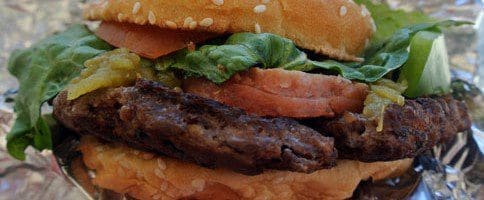
“Traveling with the rodeo It’s the only life I’ll ever know I started in New Mexico Must have been a thousand years ago.” ~Lyrics to “Ride ‘Em Cowboy” by Paul Davis Although my friends and I were all fairly accomplished horse riders in the svelte and carefree days of our youth, Peñasco didn’t have a high school rodeo team so we couldn’t show off our skills in the arena of competition. Instead we entertained ourselves with such non-sanctioned “rodeo” events as hand-fishing for bottom-feeding suckers and tossing them into a chicken coop where a frenzied take-away melee would ensue with feathers and fish entrails flying. We also enjoyed tossing wet bailing wire into electrical wires overhead. if done right, the bailing wire returned to earth a smoldering ashen heap reminiscent of snake fireworks. Risking life and limb with thousands of volts of electrical current was child’s play compared to riding rambunctious young bulls who would invariably toss us to the ground with impunity. My days of bull riding ended when a recalcitrant bull was spooked by a horse who aimed a kick at my flank, leaving me no recourse but to jump off into a fresh, fetid pile of horse…

El Comedor De Anayas – Moriarty, New Mexico (CLOSED)

For years, one of the Land of Enchantment’s most renowned launching pads for political campaigns and careers has been Moriarty’s El Comedor De Anayas, a venue in which political power brokering has long been transacted over hot coffee and New Mexican food. Anyone and everyone who’s aspired to political office has held court at this venerable institution which translates from Spanish to “Dining Room of the Anayas.” Launched in 1953 (one year before Moriarty was incorporated), El Comedor has long been the home away from home for two dynastic Torrance county political powerhouse families–the Anayas and the Kings, progenitors of two governors, a state treasurer, an attorney general, a land commissioner, state legislators, university regents and virtually every other local office of which you can conceive. Framed and signed photographs of the many political glitterati to have stumped at the famous restaurant during their time on the rubber chicken circuit are on display at a wall of fame (shame or infamy, might be more apropos in some cases) just off the dining room. The smiling countenances of Governors Toney Anaya, Bruce King, Jerry Apodaca, David Cargo, Bill Richardson, Gary Johnson and others share space with broad-toothed photographs of Jimmy Carter…

El Norteño – Albuquerque, New Mexico (CLOSED)

No Mexican restaurant in Albuquerque has a pedigree that approaches that of El Norteño, a venerable elder statesperson in the Duke City’s burgeoning and constantly evolving Mexican restaurant scene. El Norteño has been pleasing local diners for more than a quarter of a century as evinced by its perennial selection as the city’s “Best Mexican” restaurant. Respondents to the Alibi’s annual “best of” poll accorded El Norteño that coveted accolade against increasingly more formidable competition every year for seven consecutive years. Launched in 1986 by Leo and Martha Nuñez, El Norteño is an Albuquerque institution, a Mexican restaurant which can’t be pigeonholed for serving the cuisine of one Mexican state or another. That’s because El Norteño offers traditional Mexican specialties while staying true to the Land of Enchantment, using only peppers grown in New Mexico. In 1993, Monica Manoochehri and her husband Kamran took over the restaurant, maintaining the exceptional standards established by her parents. As consistently excellent as it has been, El Norteño became one of those restaurants even its most loyal patrons may have begun to take for granted. We all knew it was in a class by itself with incomparable cuisine; warm, friendly service and a homey…

Zinc Wine Bar & Bistro – Albuquerque, New Mexico (CLOSED)

Albuquerque’s Nob Hill district largely owes its emergence as the city’s first “suburb” to Route 66, the great Mother Road which carried Americans westward. Because of Route 66, the Nob Hill area has been, since before World War II, a thriving residential community replete with restaurants, motels, a modern movie theater, pharmacies and restaurants. Today it remains the city’s cultural heart and, thanks to the preservation of Route 66 era architecture, retains much of the charm that captivated west bound sojourners. New tenants such as Zinc Wine Bar & Bistro which launched in 2003 hold court in well preserved brick buildings and seem completely at home. Antique mirrors, distressed wood floors, stained glass and warm colors coalesce with intoxicating aromas to make this classy bistro one of the city’s best launches (and lunches) of the new millennium. The French rotisserie, visible from the main floor and the open mezzanine above, turns out some of the best meals in the city. While considered a premium fine dining destination, Zinc’s generous portions are comparatively value priced–your bill may approach three figures, but you’ll feel you got your money’s worth. Meals are well paced with appetizers and entrees brought to your table at…

Patricia’s Cafe – Albuquerque, New Mexico

For nearly twenty years–from 1954 to 1972–newspaper, magazine, radio and television advertisements for Winston cigarettes deliberated whether American smokers wanted good grammar or good taste. This was in response to catchy jingles (and if you’re over 40, get ready for an ear worm) claiming that “Winston tastes good like a cigarette should.” Grammarians took umbrage with the solecism, arguing that the word “as” was more appropriate than the word “like.” From 1974 to 1991 the advertising world introduced another vexing debate: “tastes great” or “less filling.” To entice “Joe Sixpack”‘ to Lite Beer from Miller, television ads featured retired athletes, coaches and celebrities in spirited debate as to the primary benefit of the less caloric, but ostensibly still great-tasting alternative. Using the term “light” instead of “diet” appealed to the two-fisted drinkers seeking to avoid the metamorphosis of their six-pack abs into a keg-shaped beer belly. For much longer than the advertising world has manufactured good-natured debates intended ultimately to sell a product, residents of and visitors to the Land of Enchantment have been asked to declare their preference for “red or green.” So much so that several years ago, a state legislator submitted a resolution to declare “red or…

Delish – Albuquerque, New Mexico (CLOSED)

Rachael Ray may be the most reviled celebrity cook or chef on network and cable television. While adoring fans admire her perkiness and down-to-earth approachability, it’s those traits grumpy detractors (including other celebrity chefs and food writers) seem to find most offensive. Well, that and the way she punctuates sentences with one of her many trademark catchphrases. Entire blogs are dedicated to disparaging her use of “Rachael Rayisms” with heated discussions revolving around the most annoying of her cutesy (or not so very much, depending on your perspective) catchphrases. It’s a true testament to her popularity that one of those catchphrases was selected for inclusion on the 2007 edition of the Oxford American College Dictionary. Thanks largely to the effervescent phenom, EVOO (short for extra-virgin olive oil) is now officially part of the American lexicon. In a list of the seven most annoying Rachael Rayisms compiled by the Huffington Post, EVOO ranked only seventh for “annoyingness.” At the top of the list as the most cringe-worthy catchphrase was “yummo” (which has been used on this blog three times and no, I’m not a Rachael Ray clone). When Mary Ann Spencer, a long-time friend of this blog, told me about a…

Nicky V’s Neighborhood Pizzeria & Patio – Albuquerque, New Mexico (CLOSED)

Just when you think you’ve seen it all and you think nothing else can possibly been done to exploit the versatility in pizza, something comes along which surprises you. One such example is the “make your own pie” proposal by the entrepreneurial Kramerica Industries, a proposal which prompted extensive water cooler discussions. Flamboyant CEO Cosmo Kramer envisioned a pizzeria in which “we give you the dough, you smash it, you pound it, you fling it in the air; and then you get to put your sauce and you get to sprinkle it over your cheese, and they–you slide it into the oven.” His attempts at securing funding falter over a dispute as to whether cucumbers can be pizza toppings. The aforementioned scenario transpired in an episode of Seinfeld, the “show about nothing.” While the “make your own pie” concept has some fundamental flaws (people shoving their arms into a 600-degree oven), it does illustrate one of the few things that haven’t actually been done with pizza in the United States. Nicole “Nicky” Villareal didn’t have any uncommon business model in mind when she and her husband set out to launch Nicky V’s Neighborhood Pizzeria & Patio. She wanted a true…

Bouche – Albuquerque, New Mexico (CLOSED)

Career paths do not always unfold as stereotypes might dictate. Heavily recruited out of Mission, Texas, a high school football hotbed, Frans Dinklemann, a 6’6″ 241-pound defensive end, signed with the University of New Mexico where his Lobo teammates included perennial National Football League (NFL) All-Pro Brian Urlacher. By his senior year, Frans had grown to 6’7″ and 270 pounds and moved to the offensive line where he set the team weight room record for offensive linemen with a 33-inch vertical leap. The stereotype of the offensive lineman is of a brutish behemoth heavy on brawn and light on brain, a misanthrope with very little personality or charisma. In his inimitable manner, Hall of Fame NFL coach and longtime television analyst John Madden stereotypes the offensive lineman as a “big ol’ mean and nasty guy who tries to knock the snot out of the guy across from him.” With these stereotypes, you might surmise that after his Lobo career ended, Frans Dinklemann would become a nightclub bouncer or pursue some other similar profession requiring muscle and mass. Coach Madden, however, also pointed out that offensive linemen tend to be neat and precise, to be polite and have well-ordered lockers. This…

The Spot Cafe – Corrales, New Mexico (CLOSED)

Big Bang Theory wunderkind Sheldon Cooper has a spot he describes as the “singular location in space around which revolves my entire universe.” That spot is the left side of his couch, a location he has placed “in a state of eternal dibs.” In scientific terms, Sheldon relates his spot as “a single point of consistency in an ever-changing world.” His attachment to that one spot borders on obsession, but he’s not the only television character that possessive of his spot. In television comedies, characters have always had their favorite spots and show little tolerance for anybody who tries to sit in them. Cheers barflies Norm Peterson and Cliff Claivin had their favorite bar stools. Jerry Seinfeld, George Costanza and Cosmo Kramer always sat at their favorite table at Monk’s Diner. Heaven help anyone who sat on Archie Bunker’s favorite chair, the most famous and only one of the aforementioned spots on display at the Smithsonian Museum of American History in Washington, D.C. Television personalities are often based on and mimic real life characters. As such, it will be interesting to see what Corrales resident will develop an attachment to a favorite spot at its newest eatery (as of May,…

Magdalena Cafe – Magdalena, New Mexico (CLOSED)

In 1863 during the height of the Civil War, soldiers on leave from Fort Craig staked claims to silver strikes in the Magdalena Mountains. Within a few years, the boom towns of Kelly and Magdalena had sprung up, eventually achieving a population surpassing even Socorro, the county seat. The first veins of metal ore given up by the rocky promontories were lead and zinc, but ultimately silver became the principal source of wealth. With the arrival of the railroad in 1884, Magdalena became a rowdy frontier mining town and one of the Southwest’s largest cattle shipping centers with its stockyards processing thousands of cattle and sheep. Magdalena became known as the “Trails End” because the spur line which originated in Socorro had its terminus in the town named for the likeness of Mary Magdalene on a nearby slope. The railroad transported cattle, sheep, wool, timber and wool. It also transported carloads of ore to a smelter outside of Socorro. No vestiges of the railroad remain, but it’s easy to imagine how spectacular the 20 meandering miles from Socorro to Magdalena must have been by train. That’s because Highway 60 approximates the route of the railroad line nicknamed “the elevator” because…

Gen Kai Japanese Restaurant – Albuquerque, New Mexico (CLOSED)

In Japan, ramen is so revered that diners line up, sometimes for hours, at ramen houses for homemade noodles tangled with such ingredients as dried fish, pork and chicken. Connoisseurs make pilgrimages to a popular ramen museum in Yokohama, not the only museum dedicated to ramen, by the way. If you’re wondering how the ramen noodle product you purchased as a collegiate at the rate of ten bricks for ten dollars warrants such reverence and respect, you’re in the right ballpark, but not in the right seat. Although extremely popular throughout Japan where you can find it even in vending machines, it’s not the ubiquitous low-brow instant ramen found in Styrofoam packages which warrants such adulation and enthusiasm. That adulation is reserved for ramen which is fresh and handmade with rich, creamy, opaque broths lovingly tended for hours, if not days. It is the consummate comfort food in the Land of the Rising Sun. In fact, comparing instant ramen to the ramen found in restaurants is akin to comparing the burger on a McDonald’s Happy Meal to a wagyu steak at a posh steakhouse. While the packaged ramen is ready in an instant, it’s teeming with sodium and suspect-sounding ingredients.…