Japengo Sushi – Albuquerque, New Mexico (CLOSED)

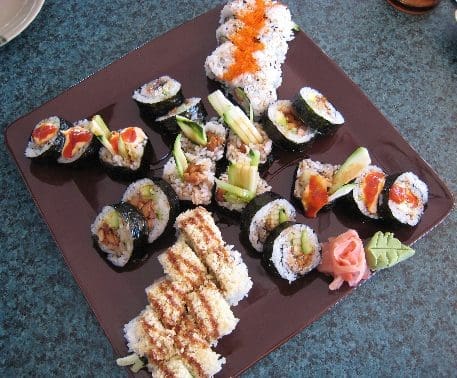
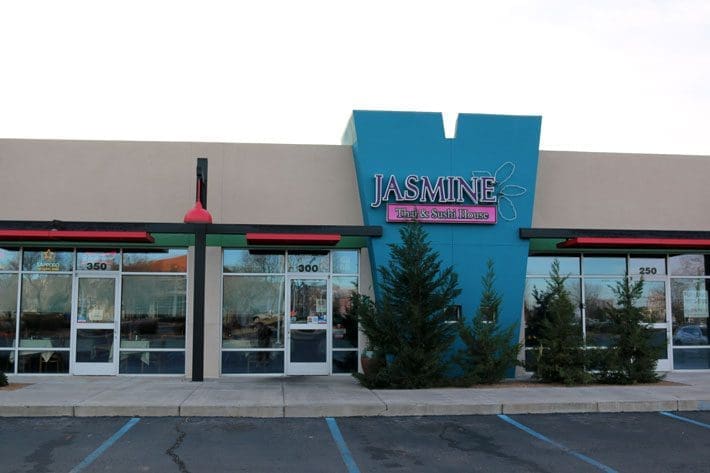
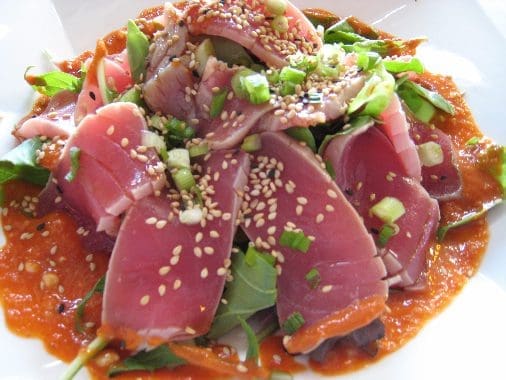
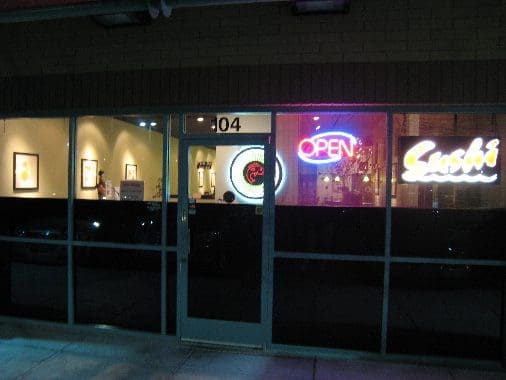
The Chinese philosophy of yin and yang posits a dualistic universe in which both sides of opposite forces are each part of a whole and work together. Examples include good and bad, male and female, light and dark and positive and negative. These opposing forces are equal and necessary for harmony. A dualistic nature is what we uncovered at Japengo Sushi–in this case the opposites being truly sensational, saucy salads and sushi sadly at the level of mediocrity. Launched in August, 2004, Japengo is one of the very best restaurants on what has become restaurant row just off I-25–despite the sushi. Its proximity to the Century Rio 24 movie theater has made it a popular dining destination among movie goers. The quality and freshness of ingredients will make it a destination to which I’ll return. Japengo might best be categorized as contemporary Japanese with a slight fusion Asian twist. Its relatively minimalist decor is modern, almost industrial. The wait staff is courteous and professional. The menu includes an array of traditional Japanese entrees (such as noodle bowls topped with tempura or chicken) as well as dishes which push the envelope insofar as tradition. Plating is pleasing to the eye and…

Sushi Eye – Tempe, Arizona (CLOSED)

To Western diners used to restaurant ambience defined by an effusive, sensory bombarding, over-the-top flamboyance, many Japanese restaurants feel stark and barren in comparison. That austerity is actually by design. The Buddhist teaching of “wabi” which means “quiet of tranquility” posits a non-attachment to material things. Wabi values the ability to make the most of starkness and poverty by cherishing the subtle beauty found only in a very simple environment. In some sushi restaurants, the minimalist decor is not much more than functional and and nearly as raw as sashimi. Lighting is subtle, perhaps even romantic. The ambience seems to inspire hushed tones and an almost reverent mood, in some cases almost as if you’re at a Buddhist temple. That’s the concept of wabi. In wabi fashion, the not quite wasabi colored walls at Sushi Eye are relatively stark, festooned with but a few framed images. The restaurant’s activity center and heart, the sushi bar, is more brightly illuminated. A single neko cat, symbolizing good luck, sits on that bar. Sushi Eye is situated in a nondescript Tempe strip mall practically next door to the Fascinations Superstore where sensual shopping can precede sushi sampling if you’re so inclined. It opened…

Rice ‘N Roll – Bernalillo, New Mexico (CLOSED)

The 1970s have been characterized by writer Tom Wolfe as the “Me Decade” and derided by cynics as the “Disco Era.” It was an era of contrasts: the national crisis of confidence described by President Jimmy Carter as a “malaise” and the ubiquitous yellow smiley face; the melodic, velvety stylings of the Carpenters and the edgy, funky beat of disco; an explosion of copycat fast food chain restaurants and the introduction of innovative fusion cuisine in many contemporary restaurants. Fusion cuisine is the inventive combination of diverse, sometimes disparate culinary traditions, elements and ingredients to form an entirely new genre. In large metropolitan areas, particularly in California, the fusion of different cuisines became commonplace. Restaurants featuring the melding of French and Chinese cuisine were especially popular. Still other restaurants had their own ideas as to what constituted fusion cuisine. The now defunct Maverick Cafe in San Antonio, Texas, became famous for their “East Meets West” dining concept. It wasn’t so much a fusion of cuisines as it was the plating of different cuisines (Mexican and Chinese) on the same salver. The very best lemon chicken I’ve ever had, in fact, was at the Maverick Cafe in 1994, served in a…

Neko Sushi – Albuquerque, New Mexico (CLOSED)

In 1968, Mexico City played witness to one of the most overt and controversial political statements ever issued during the modern Olympic Games when African American athletes Tommie Smith and John Carlos extended their right arms upward and clenched their gloved fists in a black power salute. During our inaugural visit to Neko Sushi in the Sun Country Plaza, we couldn’t help but remember the famous civil rights protest when we espied two ceramic Maneki Neko (beckoning cat) figurines on a shelf. The Maneki Neko, a common Japanese sculpture believed to give its owner good luck, depicts a cat beckoning with an upright raised paw (which supposedly attracts money). The pose is eerily and innocently similar to that of Tommie Smith and John Carlos during the medal ceremony. Obviously there’s absolutely no relationship between two infamous Olympic athletes and a symbolic cat, but there’s definitely a reason the popular Japanese cat figurine has a prominent place in a sushi restaurant–and it’s not just because the owner wants good luck. The owner’s name is Cathy (“Cat” for short) Punya and “Neko” is the Japanese word for cat. Cathy is a restaurant impresario with three other restaurants in the Duke City. Her…

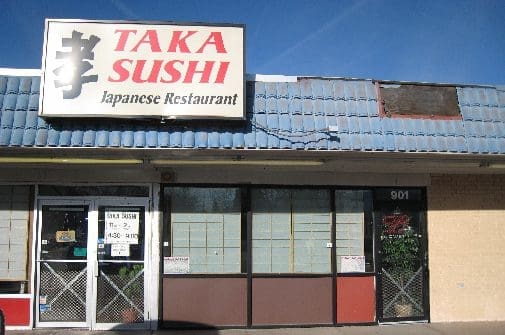
Taka Sushi – Albuquerque, New Mexico (CLOSED)

Just as you shouldn’t judge a book by its cover, you shouldn’t judge a restaurant by its exterior facade…or even its interior for that matter A good example of this is Taka Sushi, a venerable Japanese restaurant on the city’s southeast quadrant. From the outside, Taka Sushi lacks the polish and veneer of its competitors, appearing more like a remnant of the 1960s with dated paint and austere signage. It isn’t much better when you step inside. Clutter (or “casual and homey” as Scott Sharot called it in his terrific tome New Mexico Chow), not feng shui, seems to define the restaurant’s decorating style. Leave the spit and polish to trend followers who are impressed with over-the-top flamboyance (can you say Azuma and Samurai). For terrific Japanese food, you can’t do much better than Taka Sushi, never mind that it isn’t stylish or cool. Taka Sushi is a long-time Duke City favorite that we didn’t discover until 2006 thanks to my multiple-time re-read of the aforementioned New Mexico Chow guide which continues to introduce us to off-the-beaten path treasures we might otherwise neglect. It’s a must-have resource for all New Mexico diners. Stepping into Taka Sushi has one similarity to…

Eurasia Bistro & Sushi Bar – Albuquerque, New Mexico (CLOSED)

In an ideal world, the culinary connotation of the term “Eurasia” would be a fusion of the distinct cuisines of both continents available all under one roof under which culinary adventurers would be like Venetian explorer Marco Polo tasting all the Silk Road has to offer. We should have realized that while the continents of Europe and Asia may be connected as a land mass (certainly not geopolitically), an Albuquerque restaurant featuring the cuisine of both continents is still far too novel a concept. While Eurasia turned out to be a misnomer, this contemporary Japanese restaurant may turn out to be one of the better, albeit more expensive restaurants launched in 2005. Situated on the site of the now defunct Minato restaurant (closed in October, 2004), Eurasia is, in almost every way, a radical departure its predecessor. Where Minato facilitated dining intimacy (including tatami rooms for private dining), Eurasia features an open dining room painted in a serene pallet. Two ceiling panels on either side of the industrial ductwork showcase the twinkling of the night sky on an ebony canvas (although nothing can compare to the night skies in Northern New Mexico.) While Eurasia’s menu may be considered traditional, it…

Azuma Sushi & Teppan – Albuquerque, New Mexico

Unfulfilled promise, unrealized potential, what should have been, what could have been–these are among the most tragic sentiments of any vernacular. For the most part, those were also the sentiments echoing through our minds while and after we dined in one of the Duke City’s most serene and attractive Japanese restaurant settings. We should have known better. Azuma is owned by the same gentleman who owns Albuquerque’s two China Star buffets, the Sam’s Club (with apologies to the Walton family) of Chinese buffets. China Star features sprawling troughs of nearly every conceivable Chinese food item in existence at a ridiculously low price that speaks volumes about the quality of the food. Azuma is “eye candy,” a beautiful establishment that may leave you agape at the realization it once housed a Black Eyed Pea restaurant. Unfortunately, as with many gorgeous women, attractive packaging doesn’t always translate to inner beauty, or in the case of Azuma, great food. Our meal started off in grand fashion with a leafy salad graced by an orange ginger dressing my dining companions and I agreed was indeed something special. It melded sweet, savory and tangy flavors in a harmonious fashion that enlivened a fairly typical lunch…

Shogun Japanese Restaurant – Albuquerque, New Mexico

It stands to reason that what is conceivably one of Albuquerque’s best sushi restaurants is named for the Shogun, the title accorded the supreme ruler of Japan for about eight centuries. What most people may not realize, however, is that sushi originated in China as a method to preserve fish by pickling and fermentation. Sushi, as we know it today, began to take form in the 18th century Japan when seafood vendors wrapped fish with seaweed and rice as an edible and decorative package which ultimately evolved into the roll (maki) style. The nigiri style, consisting of a piece of fish on a bed of rice, originated in Tokyo sometime later. Sushi’s integration into the American culture began in the 1970s and today there are over 5,000 sushi restaurants in the United States. In my 48 years on planet Earth, I’ve sampled probably 30 to 40 different sushi restaurants and won’t pretend to be an expert, but can say unequivocally that Albuquerque’s Shogun is among the very best I’ve ever had and may be in a class by itself in Albuquerque. The wasabi colored walls are the first indication that this restaurant is something special. Then there’s the sushi bar,…