The Paleta Bar – Bernalillo, New Mexico

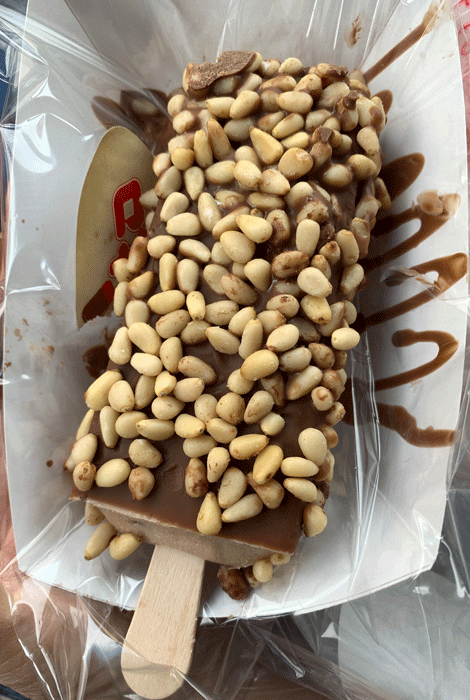
A few decades ago, Mad Magazine (or was it Cracked) published a two-panel cartoon depicting a couple of gringo turistas visiting Mexico on a stifling summer day.  On the first panel, one turista tells the other that he heard Mexican Coke is much stronger than Coke bottled across the border in the states.  When the second turista opens the bottle, a fizzy carbonated explosion knocks down a bird flying overhead…proving, of course, that Mexican Coke is definitely stronger (not to mention better tasting). Even a camel would get thirsty in Mexico on a sweltering July day when temperatures flirt with the century mark and there are no cacti in sight to provide shade.  No matter how thirsty that infernal dry heat may leave you, don’t ever try to down an entire Mexican Coke in one swig.  My sole attempt at doing so left me convulsing and writhing like a wounded beast, thrashing out and roaring in pain.  After that, I swore off Mexican “soft” drinks–and since everyone knows that you don’t drink the water in Mexico, I had to find a delicious alternative to slake my thirst and ward off heat in Mexico.  Fortunately, Mexico is the birthplace of paletas,…

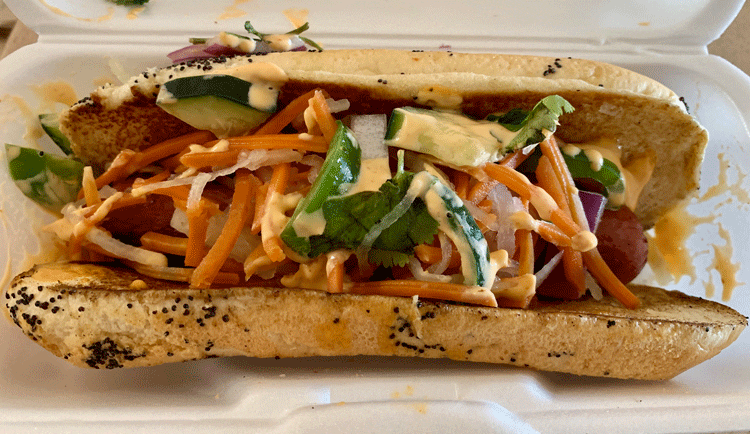
Urban Hotdog Company – Albuquerque, New Mexico

Fat kids, skinny kids, kids who climb on rocks Tough kids, sissy kids, even kids with chicken pox love hot dogs. Armour Hot Dog Commercial, 1960s Advertising standards in the 1960s were quite a bit more lax than they are today. In today’s culture of American political correctness and woke idealogy, there’s no way an earworm-inspiring jingle such as the Armour Hotdog commercial would ever see the light of day, but back then it helped sell a lot of hot dogs. Even in the 1960s, Armour’s savvy ad agency undoubtedly understood the influence children had on the family’s food consumption budget. In addition to catchy jingles designed to appeal to children, Armour’s advertising agency enticed children with prizes to be had for a monetary pittance and a coupon cut out from the back of a package of its hot dogs. Not even parents were immune from Madison Avenue’s charms. They were swayed by assurances that hot dogs were actually good for children because they were “made from lean meat” and were “protein rich.” The 1963 United States census reported the production of 1.11 billion pounds of frankfurters and wieners, constituting thirty percent of all sausages made that year. Two years…

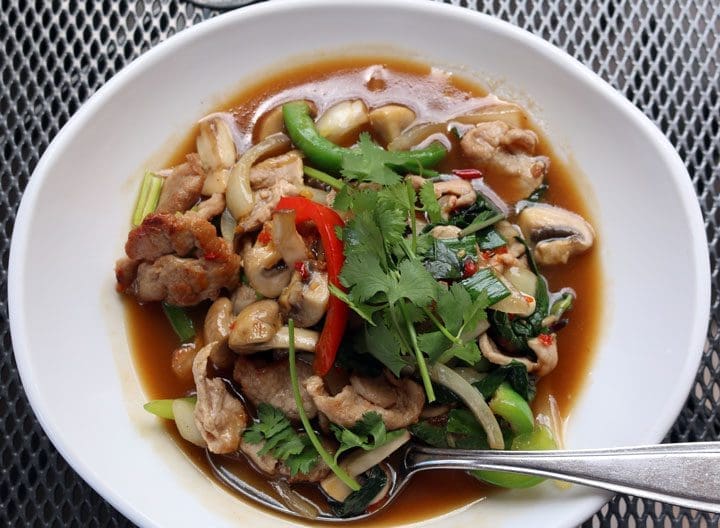
Thai Kitchen – Albuquerque, New Mexico

“There is no good meat that their stupid cooks do not spoil with the sauce they make. They mix with all their stews a certain paste made of rotten prawns…which has such a pungent smell that it nauseates anyone not accustomed to it.” No, that’s not a review published by a disgruntled diner on Zomato or Yelp. Nor is it Gil describing a chile dish to which liberal amounts of cumin were added. This scathing indictment was written in 1688 by Gervaise, a Catholic missionary from France. It was his tactless way of describing a Siamese meal at a diplomatic function he attended. Much has changed since Gervaise disparaged and insulted the cuisine of what is today Thailand, the only Southeast Asian country never to have been colonized by a European power. Gervaise, who would probably attribute the failure to conquer Thailand to the food, was probably not the first and he certainly wasn’t the only person to have criticized Thai food, but few have expressed it with such derision. Gervaise would no doubt be very surprised to discover how popular Thai food has become in the three centuries since his unsavory encounter. Thai food ranked sixth in a recent…

Philly Steaks – Albuquerque, New Mexico

“I love the dignity in the name Philadelphia, but at heart, we’re Philly.” ~Lisa Scottoline New York Times Best-Selling Author “There are a couple of things you should know about Philadelphia,” my friend Vladimir “Speedy” Gonzalez told me before my first visit to the City of Brotherly Love. “First, Philadelphians are not rude. We may be blunt and direct, but that’s just passion.” Passion? I always thought he was a grouch. “Second,” he added, “you’ve got to know the process for ordering a Philly cheesesteak when you visit Pat’s King of Steaks. If you don’t, you’ll be sent to the end of the line.” Sure enough, the Pat’s counterman didn’t appreciate my typical twenty questions ordering approach and sent me back to the end of the line, halfway around the block. Apparently what Vladimir called passion is pretty pervasive in Philadelphia. There are dozens of examples of that passion in sporting events, including a notorious 1968 event in which Eagles fans booed and pelted Santa Claus with snowballs. There are also plenty of non-sporting examples. In 1998, the Pennsylvania Public Utility Commission, which oversees taxis, mandated etiquette classes for the city’s cab drivers. Cynics called it “cabbie charm school” and…

Albuquerque City Limits – Albuquerque, New Mexico

“It’s when I reach the city limits that my sense of security ends and my sense of adventure begins.” ~Anthony T. Hincks Author: Verbs in Storyland Why is it the term “city limits” conjures the same type of trepidation today that very early (before the Third Century BC) explorers must have felt when they thought the Earth was flat and if they navigated too far west, they’d fall off the edge of the map?   Why is it Hollywood has consistently portrayed the area just beyond city limits as either a dystopian wasteland or a bastion of lawless libertinage?  For that matter, why do so many “inner city” Duke City dwellers believe the city limits is too far a distance to travel for a good meal? Think I’m kidding?  When I told friends and colleagues about having discovered one of the state’s very best green chile cheeseburgers in the South Valley, their typical reactions were “only you would go that far for a burger” and “why didn’t you just go a little further and eat at The Owl.”   You’d think I had trekked to South America, not the South Valley.  You’d think I had risked life and limb.  Perhaps the South Valley…

New Mexico Beef Jerky Company – Albuquerque, New Mexico

The internet is replete with compilations abounding in truth and humor entitled “You Know You’re From New Mexico When…” Perhaps most resonating in factuality are the items which depict just how much New Mexicans value their culinary traditions. For example, you know you’re from New Mexico when: your favorite breakfast meat is sliced fried bologna; you buy green chile by the bushel and red chile by the gallon; most restaurants you go to begin with ‘El’ or ‘Los’; you have an extra freezer just for green chile; you think Sadie’s was better when it was in a bowling alley; and you can order your Big Mac with green chile. Even if you’ve lived in the Land of Enchantment for only a short time, several items on that short list will ring with veracity for you. If you’re a lifelong resident, however, the list may get your dander up a bit because, conspicuous by their absence, are sacrosanct New Mexican foods and culinary traditions we treasure. We would add to the list, you know you’re from New Mexico when: your trail mix consists of pinon and carne seca and instead of popcorn, your home movie nights consist of eating chicharrones in…

O Ramen – Albuquerque, New Mexico

“Food, like a loving touch or a glimpse of divine power, has that ability to comfort.” ~Norman Kolpas According to most online definitions, the term “soul food” defines the cuisine associated with African-American culture in the southern United States. In wide use since the 1960s, the term originated and came into heavy use with the rise of the civil rights and black nationalism movements. Though still most widely associated with the African-American culture, over the years “soul food” has become synonymous with basic, down-home cooking, especially of comfort foods…and as Cracked magazine puts it, soul food is “the real reason why white people like Cracker Barrel.” While the term “soul food” has, by definition, been culturally limiting and exclusive, in recent years the term has been broadened to include other cultures, albeit with a prefixed qualifier. In 2011, for example, New Mexico Magazine’s celebration of the Land of Enchantment’s “best eats” included the category “New Mexican soul food.” It was a declaration that New Mexican cuisine can also feed and nurture the soul. When my friend and culinary kindred spirit Nikko Harada used the term “Japanese soul food” to describe the food at O Ramen, it brought a broad smile…

Tesuque Village Market – Tesuque, New Mexico

The most successful Indian revolt in North American history occurred on August 10th, 1680. On that day, more than 8,000 warriors from the various Native American pueblos in New Mexico put aside deep historical differences and banded together to drive the Spaniards from their ancestral lands. This event is celebrated each year in Tesuque Pueblo. Tesuque Pueblo played an integral role in the rebellion. Two Tesuque runners were dispatched by pueblo leaders to enlist support for the revolt. The runners carried knotted deer hide cords to the various pueblos, each knot signifying a day. On each successive day, one knot was untied. When the final knot was untied it signified the day of attack.The annual celebration of this event includes a relay run reenacting the famous run. Runners depart from Tesuque plaza carrying a knotted cord made of yucca and an ear of corn. The yucca cord symbolizes the spirit of the people and the ear of corn their physical body. It is an inspiring event. Led by Diego Jose de Vargas, the Spanish returned to New Mexico in 1692 and within a year regained full political control of New Mexico. Their return marked a significant change in Spanish policy…

The Safari Grill – Albuquerque, New Mexico (CLOSED)

“The wild dogs cry out in the night As they grow restless longing for some solitary company I know that I must do what’s right Sure as Kilimanjaro rises like Olympus above the Serengeti I seek to cure what’s deep inside, frightened of this thing that I’ve become.” ~ Africa by Toto Shrouded in mist and steeped in myth and mystery, Mount Kilimanjaro attracts visitors from all over the world. Often called “the roof of Africa,” the towering, snow-capped, conically-shaped mountain is the crown jewel of the United Republic of Tanzania. At 19,340 feet, the magnificent freestanding peak commands the skies, looming over the plains of the bushveld savannah like a majestic sovereign keeping vigilant watch over her people. Majestic as it may be, Mount Kilimanjaro is far from Tanzania’s sole travel destination. The country boasts of dozens of beautiful white sandy beaches such as those found in the island of Zanzibar. A number of national parks, conservation areas and game reserves allow visitors to get up close and personal with lions, leopards, elephants, cheetah, giraffes, zebras, jackals and thousands of migratory birds. Tanzania is also one of Africa’s most popular safari destinations. Now, safaris need not entail hunting animals…

Viet’s Pho – Albuquerque, New Mexico

“”Vietnam. It grabs you and doesn’t let you go. Once you love it, you love it forever.” ~ Anthony Bourdain Most of us have never been to Vietnam. It’s possible, maybe likely, that most of us will never make it to Vietnam…at least not in a corporeal state. That’s an important distinction because for years, we’ve already been visiting Vietnam. We’ve been magically transported to Vietnam every time Anthony Bourdain visited. Bourdain had the rare ability to develop intimate connections with the cultures and people he encountered in his travels then translate those connections into expressive and relatable narratives. He was a gifted raconteur whose rare honesty, lack of pretense, irreverent sense of humor and self-deprecating humility came across so endearingly empathetic. His evocative descriptions of exotic foods and cultures expanded our imaginations and allowed us to marvel and wonder about the world we know so little about. Because of him, many of us fell in love with Vietnam. Not its food. We already loved that. Because of Bourdain, we fell in love with the Vietnamese culture and its people. During one of his many memorable visits to Vietnam, Bourdain gushed, “It’s so delicious, I feel like an animal.” That’s…

P’Tit Louis Bistro – Albuquerque, New Mexico (CLOSED)

“If you are lucky enough to have lived in Paris as a young man, then wherever you go for the rest of your life, it stays with you, for Paris is a moveable feast.” –Ernest Hemingway I’ve often wondered if Ernest Hemingway would have felt at home in Taos during the “roaring twenties,” a period of dynamic artistic, societal and lifestyle upheaval. Instead of communing with the Taos Society of Artists and other inspired Bohemian minds, Hemingway spent much of the decade in Paris, a city whose own liberal attitudes attracted poets, painters and writers from throughout the world. Paris was a vibrant city which drew many expats from the so-called “lost generation” of cynical young people disillusioned with the materialism and individualism prevalent in society at the time. Paris was not only a relatively inexpensive city in which to live, unlike America it did not have a prohibition against alcohol. The American expatriates–F. Scott Fitzgerald and Gertrude Stein among them–would gather at cafes to discuss their work and drink until their money ran out. Much of Hemingway’s most productive writing, in fact, took place in cafes which he visited with his characteristic blue notebooks, pencils and a pocket knife…