David Burke’s Primehouse – Chicago, Illinois (CLOSED)

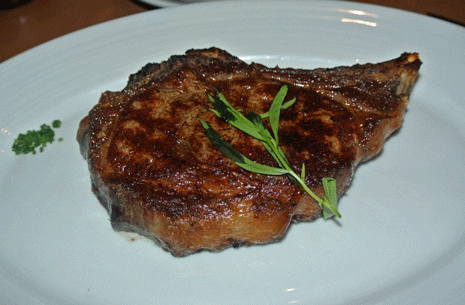
By day, my friend James Sorenham was an architect of his business group’s data warehouse and business intelligence strategies.  By night and on weekends, James was a gentleman farmer tending to a small herd at his Broke Again ranch outside Portland, Oregon.  James took immense pride in raising prized beef cattle and kept his colleagues apprised of their progress through his weekly status reports.  Alas, his writing skills weren’t in the same zip code as his data management skills so when he reported that he had “personally inseminated sixteen cows,” he got teased mercilessly about his deviant bestial activities. The fact that David Burke is the first chef to own his own bull means “personal insemination” of beef cattle can best be left to the bovine persuasion.  That leaves Chef Burke to follow his passions as one of America’s most pioneering chefs and self-proclaimed chef, artist, entrepreneur and inventor.  The New York-based Burke is a practitioner of culinology, a revolutionary approach to food that blends technology and the culinary arts.  By experimenting with interesting ingredients and cooking techniques, he has developed such culinary innovations as an edible bacon candle which can be lit, smelled and eaten.  His innovative style translates…

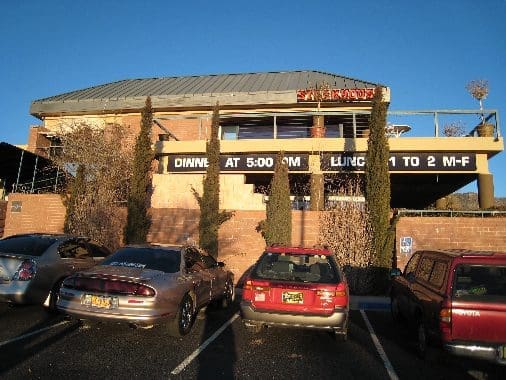
The Town House Restaurant – Albuquerque, New Mexico (CLOSED)

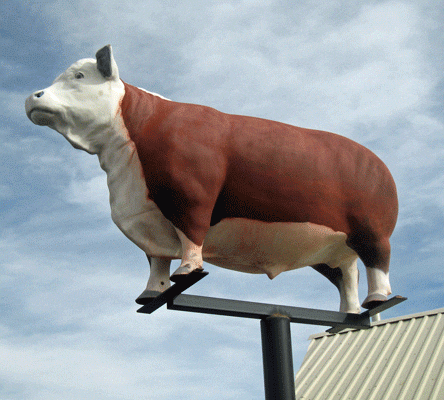
America’s highway system expansion which began in the 1930s not only “shrank” America, it introduced the entertaining, educational–some might say bizarre–phenomenon of the roadside attraction.  Entrepreneurs competed with each other to create gawk-inspiring, curiosity motivating, must-see-to-believe attractions to snare the attention of motorists and motivate them to part with some of their money.  Neon lights festooned Route 66 while fiberglass and concrete statues became part-and-parcel of America’s highways and byways.  This was true roadside art which became a part of the fabric of Americana, albeit a kitschy tradition fading with the passage of time (which aptly describes many of the statues themselves).  Among the most famous statuary art are life-sized fiberglass statues of stocky steers (corpulent cows and beefy bulls, if you prefer) which became the symbol of steakhouses along the motorways and byways.  Ironically, this statuary was not designed for use as symbology for restaurants.  In the 1950s, Bob Prewitt, a manufacturer of fiberglass trailers created life-sized fiberglass animals to prove the trailers were large enough to accommodate the real thing.  Soon the manufacture of animals became the primary focus of his business.  He created almost as many types of animals as Noah took on board his ark.  The…

Marcello’s Chophouse – Albuquerque, New Mexico (CLOSED)

Steak–even the word conjures stereotypes of power brokers in suits and ties. There’s just something about sizzling, flame-kissed beef that seems to appeal to the wheelers and dealers and movers and shakers among us. Steak may just be the ultimate power food!  That power is also wielded in the ultimate thumbing of the nose at vegetarians when carnivores emphasize that they didn’t claw their way to the top of the food ladder only to eat vegetables. Vegetarians may retort that steak is antithetical to a healthful lifestyle. To carnivores, however, it’s not as important that steak may not be good for you as it is that steak is oh so good. Meat lovers emphasize that there is nothing like a perfectly prepared steak! As a 1995 episode of Seinfeld illustrated, steak is also not just a guy thing anymore. When Jerry took a blind date to the Old Homestead Steakhouse, he admitted “I’m not really that much of a meat eater” to which his date replied “You don’t eat meat? Are you one of those…” Questions about his masculinity persisted when she ordered a porterhouse medium rare and Jerry had a salad. Some of our neighbors take their steak more…

Vernon’s Speakeasy – Los Ranchos De Albuquerque, New Mexico

After one year from the ratification of this article the manufacture, sale, or transportation of intoxicating liquors within, the importation thereof into, or the exportation thereof from the United States and all territory subject to the jurisdiction thereof for beverage purposes is hereby prohibited. The Eighteenth Amendment to the Constitution ushered in the era of Prohibition in the United States, an era was to last from 1920 through 1933.  Only liquors used for religious purposes were excluded.  Because alcohol was declared illegal by the Congress, bootleggers and distributors of illicit alcohol thrived.  There was no shortage of enthusiastic scofflaws willing to run afoul of the law in order to enjoy intoxicating beverages.  One of the most popular milieus in which alcohol was served was the speakeasy. A speakeasy was generally either a restaurant or a bar to which patrons gained admission by knocking on a door and uttering a secret password.  Once inside, patrons were treated very well in a swanky ambiance that may have included elaborate floor shows, fine dining and live entertainment.  Speakeasies flourished throughout the United States. Vernon’s Speakeasy (formerly known as Vernon’s Hidden Valley Steakhouse), no longer one of the Albuquerque area’s best kept secrets, celebrates…

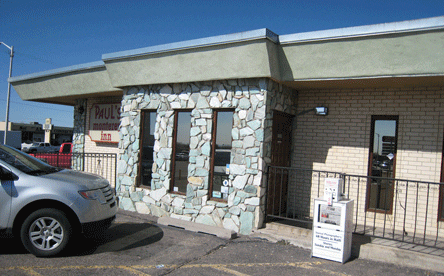
Paul’s Monterey Inn – Albuquerque, New Mexico (CLOSED)

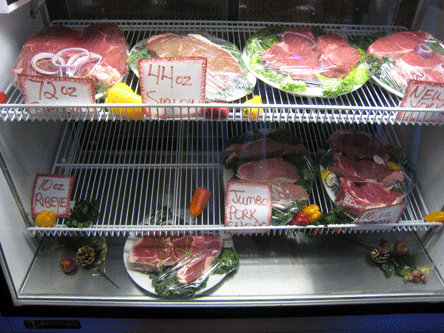
The year was 1971. Albuquerque’s population had reached a quarter of a million. The San Juan-Chama project, a system of diversion structures and tunnels for trans-mountain movement of water from the San Juan River Basin to the Rio Grande Basin, was completed. The area’s three military installations: Kirtland, Manzano and Sandia Bases merged under Air Force jurisdiction. Civil unrest was in the air in pastoral Roosevelt Park where a riot ensued that saw more than 130 arrested and more than 2,000 armed men called in to quell the situation. Albuquerque ballooning pioneer Sid Cutter took his first balloon flight. Paul’s Monterey Inn opened on Juan Tabo. Four decades later Paul’s Monterey Inn continues to serve the Duke city with a menu that hasn’t changed much, if at all, in lo these many years. While the menu may not have changed, times have. In the 70s, longer cooking times to avert potential diseases resulted in the the most popular degree of preparation for steak being anywhere from medium to well-done. Today, aficionados of steak prefer shorter cooking times so that their favorite slabs of beef retain more juice and flavor. In the 1970s, thick, hazy clouds of cigarette smoke permeated virtually…

Duke’s Steakhouse – Albuquerque, New Mexico (CLOSED)

“Did you ever see the customers in health-food stores? They are pale, skinny people who look half dead. In a steak house, you see robust, ruddy people. They’re dying, of course, but they look terrific.” -Bill Cosby Bill Cosby probably didn’t have actor Robert Mitchum in mind when describing the type of people who visit steak houses. Heralded by movie critic Roger Ebert as “one of the greatest actors of all time,” the masculine Mitchum was certainly robust (evincing strength and vigorous health) and ruddy (inclined to a healthy reddish color often associated with outdoor life), but he wasn’t the type of he-man you might envision in a steak house. Presiding over a campfire, yes, but sitting down at a restaurant, no. Over an open flame, Mitchum would, of course, be grilling a sizzling, flame-kissed slab of thick, red beef destined to overfill his plate. There would be no vegetables in sight nor would you find a tablecloth, candles or soft music. With the rousing composition “Rodeo” playing in the background, Mitchum would be heard to say, “Beef. It’s what’s for dinner!” Largely through Robert Mitchum’s compelling voiceovers, the American Beef Council has been telling America beef is what’s for…

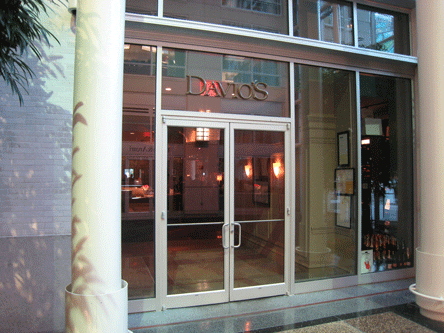
Davio’s Northern Italian Steakhouse – Boston, Massachusetts

“When I talk about a great dish, I often get goose bumps. I’m like, whoa, I’ll never forget that one. The Italians are just like that. It’s not all about food. It’s part of the memory.” ~Mario Batali When discussing my upcoming trip to Boston with Dave Hurayt, it evoked a nostalgic sentiment in a fellow gastronome whose opinion on food I respect.  As a graduate student matriculating at one of the fine universities in the “Cradle of Modern America,” Dave knew where his priorities lay.  Academic pursuits aside, Dave’s priorities included discovering the best restaurants in Boston, a pursuit I engaged in myself when living there from 1977-1979. One of Dave’s favorite Boston restaurants was Davio’s which he describes as being “as perfect as anything you’re likely to find here or in italy, Boston having some of the best Italian restaurants this side of Napoli.”  Dave remembered the pasta as “floating off the plate” and “incredibly lovely,” “as good as anything I ate in Italy.”  All rousing endorsements, indeed, but what sold me on a visit to his favorite Italian restaurant were his comparisons to an Italian grandmother’s cooking.  When someone evokes the “grandma sphere” you’ve got to listen.…

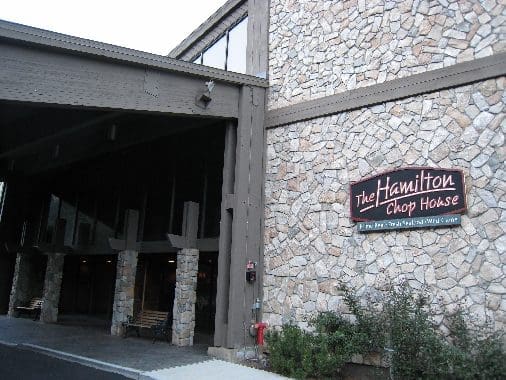
The Hamilton Chop House – Durango, Colorado (CLOSED)

The Land of Enchantment with its 121,356 square miles of deserts, mesas, rivers, mountains, forests, cities and villages is the fifth largest state in the country.  In 2007, Albuquerque’s KOAT television station began a recurring series in which the station treated its viewers to an aerial perspective of many of the communities in its viewing area.  That unique bird’s eye view perspective was captured from Sky 7, the station’s news helicopter. In 2008, the station expanded its coverage, sending news anchor and New Mexico native Royale Dá skyward once again to show viewers the challenges faced by the communities featured on the series and how they are dealing with those challenges.  Royale was joined by city leaders from throughout the viewing area who boarded Sky 7 to share what makes their communities so special. One of the few cities visited in 2008 outside of New Mexico’s borders was Durango, Colorado, long a part of KOAT’s viewing area.  During the aerial tour of the city, Durango’s Director of Planning and Community Development Greg Hoch indicated that Durango actually has more restaurants per capita than the city of San Francisco. With a population of nearly 750,000 people, the city of San Francisco numbers just about 2,700 restaurants within its boundaries, giving…

Great American Steakhouse – Albuquerque, New Mexico (CLOSED)

Since the nineteenth century, land and cattle companies have been established throughout the west to buy, sell and lease land for grazing and breeding beef cattle. During years of ample water, high beef prices and fortuitous grace, profits are generally high. While most Albuquerque urbanites might not know or concern themselves with the history of cattle raising in the old west, they do know and appreciate great steak. For years they’ve been patronizing the Great American Land and Cattle Company on Tramway and Indian School. Starting in 2006, they won’t be able to do so. That’s because the restaurant has undergone a name change, one that better reflects the restaurant’s culinary fare (and I suspect prevents any confusion with the Texas Land And Cattle Company, a chain restaurant.) There’s another reason Albuquerque’s Great American Land and Cattle Company has changed its name to Great American Steakhouse. Jerry Wright, the restaurant’s affable co-owner once promised his mother that salad would never grace the menu at the Great American Land and Cattle Company (more about that salad later). The addition of salad to the menu is just one of the many changes at Albuquerque’s very best steakhouse. The Great American Steakhouse now…

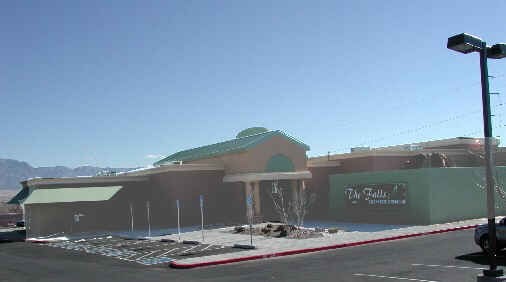
The Falls – Albuquerque, New Mexico (CLOSED)

New Mexico has been gilded with incomparable scenic beauty and an abundance of sunshine. Cerulean skies graduate in depth of color the higher above the horizon your eyes climb, interrupted only by velvety smooth red-rock outcrops and snow-capped mountains. Fiery sunsets and brilliant sunrises give the illusion that God just threw a bucket of paint into the sky while processions of wispy cloud formations provide the promise of much needed rain as they sweep past the parched escarpment. A vibrant and diverse topography provides striking contrasts in terrain. It’s easy to focus on the many reasons New Mexico truly earns the sobriquet “the Land of Enchantment.” “Glass is half empty” folks might argue that New Mexico has been “shortchanged” when it comes to water-based enchantment and would point out that “waterfall” in our blessed state means that the water falls only on occasion and in parsimonious amounts. The rest of us would retort that sometimes less is more and cite as evidence, the volcanically formed and preternaturally beautiful Soda falls in the Jemez River valley. Sometimes man creates what God didn’t provide. In November, 2006, the Falls Steakhouse launched in a new edifice just about as far northwest as you…

Rio Chama Steakhouse – Santa Fe, New Mexico

The murky Rio Chama meanders through the high plateaus of northwestern New Mexico surrounded by multi-colored sandstone cliffs reminiscent of Georgia O’Keefe’s landscape paintings in which colors seem to defy nature. The ambiance at the Rio Chama Steakhouse is of muted earth tones and subdued Southwestern patinas. Exquisite elegance is in evidence throughout the restaurant as this truly fine dining establishment exudes class and wealth. Serving prime and choice dry aged steaks, chops and seafood, this high-end and classy establishment has garnered accolades since its inception–Cocinita Magazine’s Critics’ Choice Award in 2001 and the Santa Fe Reporter Readers’ Choice award for best new restaurant in 2001 and 2002. It is the sister restaurant to Santa Fe restaurants La Casa Sena and the Blue Corn Cafe as well as Albuquerque’s Chama River Brewing Company, all properties of Santa Fe Dining, the restaurant company owned by Santa Fe art dealer and developer Gerald Peters. We don’t always concur with pundits and their salivating effusion, but after our inaugural visit to the Rio Chama Steakhouse, we began to evangelize on its behalf with the passion of a fiery preacher. Subsequent visits have proven this isn’t a “one hit wonder.” An excellent lunch, brunch…