Blog

Woodman’s of Essex – Essex, Massachusetts

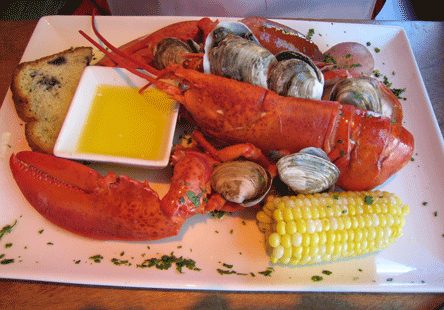
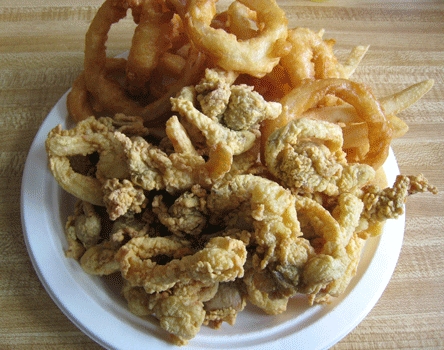
If you can imagine what New Mexico would be like without green chile or the South without barbecue, you can understand what New England would be without fried clams.  Like our beloved green chile, fried clams are an iconic food, so much so that they are almost synonymous with states like Maine and Massachusetts in which they are harvested and sold.  It’s almost a wonder the license plate mottos in at least one of those two states isn’t “The Fried Clam State.” As with our cherished chile, fried clams have a distinctive, unforgettable flavor that not everybody “gets.”  Similar to chile, those who love fried clams are usually ensnared at first bite by this distinctly delicious delicacy.  Like green chile, they are positively addictive and have a flavor that once enjoyed imprints itself indelibly upon your taste buds and your memories. There is some dispute as to the progenitor of fried clams.  They were on the menu at Boston’s hallowed Parker House in 1865 though there is no indication if they were deep-fried or batter-dipped.  The Parker House is already credited with having invented Boston Cream Pie and Parker House Rolls, so posterity doesn’t seem to mind that someone else…
Union Oyster House – Boston, Massachusetts

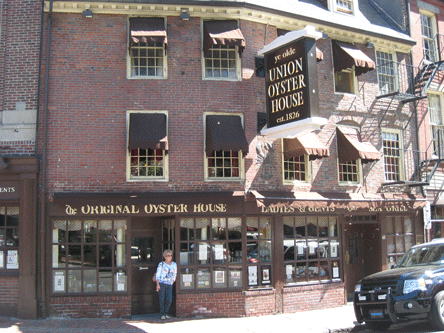
The Union Oyster House, in continuous operation since 1826, is not only the oldest restaurant in Boston, it’s the oldest restaurant in continuous service in America.  In fact, it’s housed in a building which predates the American Revolution.  Union Street in which it is situated was laid out in 1626 and while there are no municipal records documenting the Oyster House’s construction, there is more than anecdotal evidence that it was built as early as the 1710s. A major landmark for more than a quarter millennium, the Union Oyster House is not officially one of the sixteen nationally significant historic sites that comprise the Freedom Trail, a 2.5 mile red-brick walking trail that leads you through treasured American landmarks.  Still many regard it on nearly equal stature as the unique collection of museums, churches, meeting houses, burying grounds, a ship and historic markets that recount the story of the American Revolution and which comprise the Freedom Trail.  In fact, no excursion along the Freedom Trail would be complete without a slight detour to the Union Oyster House. Originally named the “Atwood and Bacon Oyster House” after its founding owners, it was launched when an oyster obsession swept across the colonies.…

Davio’s Northern Italian Steakhouse – Boston, Massachusetts

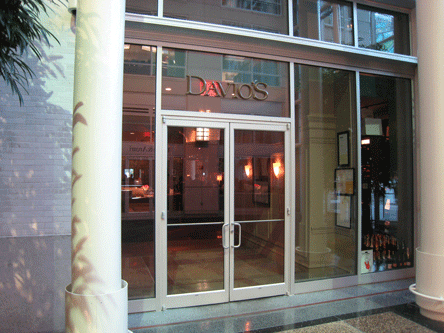
“When I talk about a great dish, I often get goose bumps. I’m like, whoa, I’ll never forget that one. The Italians are just like that. It’s not all about food. It’s part of the memory.” ~Mario Batali When discussing my upcoming trip to Boston with Dave Hurayt, it evoked a nostalgic sentiment in a fellow gastronome whose opinion on food I respect.  As a graduate student matriculating at one of the fine universities in the “Cradle of Modern America,” Dave knew where his priorities lay.  Academic pursuits aside, Dave’s priorities included discovering the best restaurants in Boston, a pursuit I engaged in myself when living there from 1977-1979. One of Dave’s favorite Boston restaurants was Davio’s which he describes as being “as perfect as anything you’re likely to find here or in italy, Boston having some of the best Italian restaurants this side of Napoli.”  Dave remembered the pasta as “floating off the plate” and “incredibly lovely,” “as good as anything I ate in Italy.”  All rousing endorsements, indeed, but what sold me on a visit to his favorite Italian restaurant were his comparisons to an Italian grandmother’s cooking.  When someone evokes the “grandma sphere” you’ve got to listen.…

Mike’s Pastry – Boston, Massachusetts

Ralph Waldo Emerson, the founder of the Transcendentalist movement of the 19th century, called America the “Utopian product of a culturally and racially mixed “smelting pot.”  Melting pot rapidly became one of the most frequently used metaphors for describing America.  The term describes the fusion of different nationalities, ethnicities, religions and cultures to form a new, ostensibly better community, a heterogeneous whole. Implicit in the term melting pot is the way ingredients in the pot combine so as to subord (but not lose entirely) their discrete identities, yielding a final product with a more uniform flavor and consistency, but which is distinctly different from the original components.  It’s the reason Italian neighborhoods in America have some semblance to, but aren’t exactly like their tight-knit counterparts in the mother country. It’s the reason Italian food in America bears an unmistakable likeness to Italian food in the old country, while being discernibly different. It’s a tribute to the miracle of Democracy called America that entire cultures can integrate into the whole while retaining proud vestiges of their past.  One such example is Boston’s North End, sometimes called “Little Italy,” a vibrant and thriving neighborhood replete with restaurants, most of them Italian. Boston’s…

Kingfish Hall – Boston, Massachusetts (CLOSED)

“Endorse what you love.”  That’s the message NASCAR driver Tony Stewart delivers to Eric Estrada, Carrot Top and a host of other candidates the stature of which usually grace Dancing With The Stars and other dreadful reality shows.  If the television commercial is to be believed, what Stewart loves is Burger King, the fast food sponsor who supplanted Subway on the hood of his car and which is now paying for Stewart’s love. What it seems celebrities, including celebrity chefs, love most is having their names and smiling countenances visible to the general public and getting paid wheelbarrow’s full of money for the privilege.  Do you really believe Food Network glitterati Guy Fieri loves TGI Fridays or that Applebee’s can really execute Tyler Florence’s recipes?  Television commercials would have you believe that (then they’d also have you believe the myth about honest politicians, too). Some celebrity chefs not only “sell out” to the corporate cabal, they leave the chef work to someone else (an underpaid “executive” chef) and begin to proliferate the myth that is them by becoming restaurant impresarios.  It doesn’t take long before the celebrity chef’s name adorns the marquee of several restaurants, sometimes in several cities.  Sure…

Sportello – Boston, Massachusetts (CLOSED)

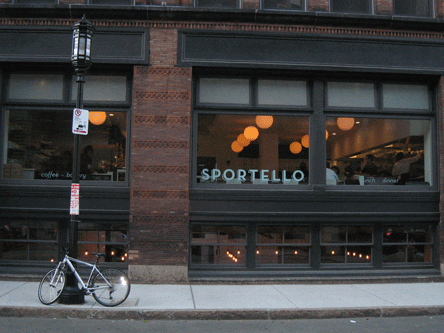
In its April, 2009 edition Saveur magazine feted “12 restaurants that matter,” profiling a dozen restaurants that “represent the best of dining in America today.”  Although that title may at first browse sound a bit condescending, the premise of the article was that restaurants are special places.  ”Everybody has to eat, but going out to eat is a choice.” The one choice of the Saveur sages which most intrigued me was a restaurant in Boston that had been open for less than one year, but which had already been drawing rave reviews.  It wasn’t those reviews that likely swayed the decision to name Sportello one of a distinctive dozen.  It was probably the execution of a concept under the masterful hands of a creative genius. Sportello is an Italian word for counter service and the restaurant is certainly based on that concept.  As a modern interpretation of the classic diner, Sportello has only a handful of traditional tables.  Most of the seating is on a serpentine counter that zigs and zags around the room like the “Don’t Tread on Me” flag of the American Revolution.  Padded stools in close proximity to one another mean there are no strangers here.  This…

Gil’s Thrilling Blog Marks One-Year Anniversary

Very well,” replied the editor-in-chief. “Dine somewhere else to-day and somewhere else to-morrow. I wish you to dine everywhere, — from the Astor House Restaurant to the smallest description of dining saloon in the City, in order that you may furnish an account of all these places. The cashier will pay your expenses.” With that mandate, the editor-in-chief of the New York Times dispatched an uncredited gentleman on what might well be the very first restaurant review published not only in America’s largest metropolitan newspaper, but perhaps throughout the country.  The date was January 1, 1859. Today, nearly every major American newspaper employs a restaurant critic to critique the area’s restaurants and present their objective assessments in an eloquent and creative manner.  Though they work very hard to conceal their identities, the very best restaurant critics become part of the fabric of the community and are able to influence dining decisions based solely on their words. The advent of the Internet has made it possible for anyone to become a restaurant critic when compelled to share their opinions.  Sites such as Urbanspoon and Yelp allow the general public to share their impressions of their dining experiences and while there certainly is strength in…

Albuquerque Tortilla Company Family Restaurant and Carry Out – Albuquerque, New Mexico (CLOSED)

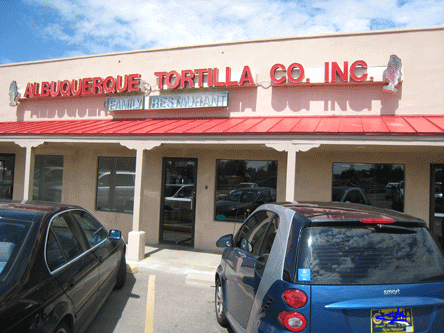
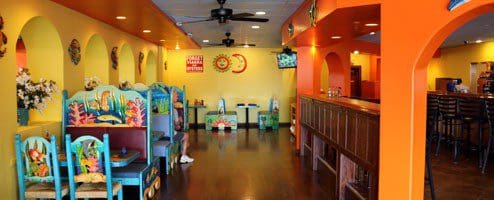
Fearful that her dim-witted and loose-lipped husband would tell everyone in the village his good fortune in having found three bags of gold, the woodcutter’s wife concocted a plan.  She had her husband buy her a one-hundred pound bag of flour and when he returned with the flour, she told him to lay down and rest for a while.  While her weary husband slept, the woman made tortillas from the entire one-hundred pound bag of flour, so many tortillas the stacks climbed to the ceiling.  She then carried the tortillas outside and threw them all over the ground. When the woodcutter woke up the next morning, he was amazed to find tortillas covering the ground.  His wife told him it must have snowed tortillas during the night.  When he wouldn’t believe her, she sent him to school to learn about the phenomena of snowing tortillas.  While in town, he blabbed far and wide about the bags of gold, something  that didn’t escape the notice of two robbers who showed up at his house demanding the gold. The woodcutter told the robbers that his wife had hidden the gold to which his wife retorted “what gold, I don’t know anything about…

Hurley’s Coffee, Tea and Bistro – Albuquerque, New Mexico (CLOSED)

“May you have food and raiment, a soft pillow for your head. May you be forty years in heaven before the devil knows you’re dead.” — An Irish Blessing Cynics who used to deride Irish food as the worst in the planet would have cautioned you to say a prayer before you ate it, but not necessarily in Thanksgiving for what you were about to receive.  For years the Emerald Isle has captured the imagination with its numberless shades of lush greens, smooth as silk whiskey, stout Guinness beer and poetry that can bring you to the depths of desolation or the heights of alacrity.  What the land of saints, sinners and poets had not, until recently, ever been known for, however, is its cuisine. Historically, just about the kindest things that were said about Irish food is that it was mundane and uninspired.  The stereotypical cavalcade of culinary mediocrity included boiled potatoes, boiled cabbage and boiled corned beef. That, as they say, is then.  Conscious of their beloved nation’s reputation, a new breed of creative Irish chefs (“wacky renegade cheese makers, people curing meat, exploring traditional Irish food ways, cooking well” in Anthony Bourdain’s words) has debunked the myth…

Mariscos La Playa – Albuquerque, New Mexico (CLOSED)

While New Mexico has always had restaurants featuring the cuisine of the country of Mexitli of Tenochtitlan (Mexico), the distinction between Mexican and New Mexican cuisine has always been somewhat obfuscated.  There are a number of reasons for this. For as long as I remember, restaurants which serve cuisine we now recognize as uniquely New Mexican (characterized among other things by the use of piquant red and green chiles instead of jalapeno) have billed themselves as Mexican restaurants.  The term “New Mexican food,” is, in fact, relatively new as the Land of Enchantment has more recently taken an active stance in promoting its cuisine as something distinctly delicious and different than Mexican food. The situation has been exacerbated by ancianos (New Mexico’s elderly population), even the descendents of Spain, many of whom refer to their cuisine as “Mexican.” It may be too early to prognosticate 21st century dining trends, but one that seems apparent is the introduction of diners to Mexican restaurants featuring cuisine from other than the northern Mexican states which specialize in the foods with which Americans are accustomed–burritos, enchiladas, tacos and the like. This trend includes high-end restaurants such as the fabulous Los Equipales, a fine-dining establishment patterned after some of the fine…

Mad Max’s BBQ – Rio Rancho, New Mexico (CLOSED)

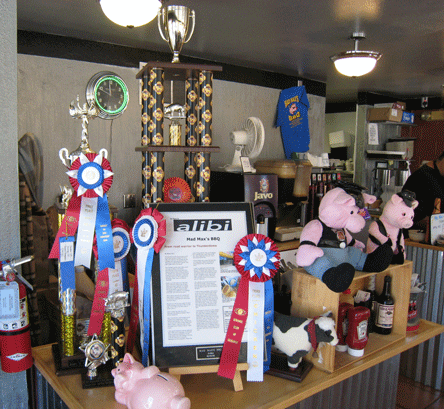
NOTE:  In March, 2010, Max and Fran Montano entered into a lease to buy agreement with an enthusiastic owner who continued to use the recipes which made Mad Max’s the very best barbecue in the Albuquerque area.  By September, 2010 the restaurant was closed.  Max and Fran will continue competing in competitions throughout the region and will also cater events.  They will be missed as much for their warmth and great humor as for their outstanding barbecue. Since the discovery of fire, man has viewed his domain as the great outdoors. The outdoors is from where man brought home the day’s victuals for early woman to prepare.  As the centuries progressed, descendents of troglodytic man (many of whom haven’t evolved much) have perceived cooking as a feminine affectation, taunting any other man who deigned to acquire culinary skills. In 1952, George Stephen invented the original Weber kettle grill and with his innovative design, sparked a backyard revolution that transformed man. As a result of the Weber grill, the XY chromosome complement was no longer a handicap (or more accurately, an excuse) for men throughout the world when it came to preparing meals for their families. With Stephen’s invention, grilling outdoors…