The Cajun Kitchen – Albuquerque, New Mexico (CLOSED)

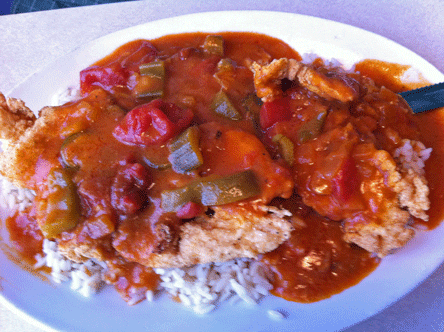
Note:  After 24 years of serving Albuquerque in two locations, the Cajun Kitchen closed its doors on Friday, March 11, 2011.  On a notice in the menu, the Hebert family wrote, “It has been a privilege serving the Albuquerque community and have been equally blessed by the support of those who have graced our tables making the restaurant the institution it has become.” When we moved back to Albuquerque in 1995 after eight years of living in the Mississippi Gulf Coast, we begrudgingly accepted the fact that in New Mexico, we would never experience the type and quality of  Cajun and Creole cuisine with which we had fallen head-over-heels in love.  Our taste buds, we thought, would be deprived of  the very lively, very colorful and very varied rustic cuisine characterized by the use of the “holy trinity” (bell pepper, onion and celery), just-off-the-boat seafood, spicy sausage and perfectly prepared rice.  Where, we wondered would we receive our meals with the “laissez bon temps rouler” (let the good times roll) attitude so prevalent in the Deep South? Obviously we didn’t know about the Cajun Kitchen, where Duke City diners have been getting their Cajun and Creole cooking fix for nearly a…

Chama River Brewing Co. – Albuquerque, New Mexico (CLOSED)

We were mellowing out to the haunting three-part harmony of the Bee Gees as they crooned “How Can You Mend a Broken Heart” when we drove into the Chama River Brewing Company’s parking lot during one unseasonably warm January day. How appropriate. At that moment my answer to the Bee Gee’s poignant question would have been “with an order of mango chutney chicken egg rolls served with a pickled ginger and an orange-chile dipping sauce followed by seared Ahi tuna and seaweed Timbale.” These were two of the wonderful appetizers masterfully crafted by Robert Griego, erstwhile chef and proprietor of the tragically now defunct Nouveau Noodles. While Nouveau Noodles no longer exists (a March 31, 2005 casualty of unadventurous diners not venturing to Tijeras to partake of incomparably wonderful and innovative Asian fusion cuisine), the immensely talented and contagiously affable Mr. Griego now serves as general manager for the Chama River Brewing Company, a brewpub restaurant which has impressed us more with every visit.  Our  inventive friend has continued to elevate the restaurant to greater heights even though he’s not in the kitchen crafting his inspired culinary masterpieces. The Chama River Brewing Company is a sister restaurant to Santa Fe…

Bumble Bee’s Baja Grill & Burgers – Santa Fe, New Mexico (CLOSED)

The economic malaise of recent years has prompted Americans to become more judicious on how they spend their disposable income (the little that’s left after all the usual bills, expenses and taxes are paid off).  Instead of splurging on gourmet meals at high-end restaurants, Americans are going to those same high-end restaurants for a reliable old favorite that in years past would not have graced their menus.  More than ever, Americans are turning to an American original,  our ultimate comfort food and favorite sandwich–the hamburger–and not the “gobble and go” burgers proffered by the bastions of fast food. American consumers have made it known through their wallets and purses that despite the current economic environment, the one luxury they are not willing to cut back on is a premium burger.  Technomic, a food service industry consultant, confirms that “consumers are willing to pay more for a specialty burger, especially a premium burger, than they are for a standard burger, regardless of restaurant segment.”  That’s why even high-end restaurants and classically trained chefs make sure there’s a premium burger on their menu. In recent years, when restaurant traffic has consistently experienced quarter-after-quarter declines, the  NPD Group, a market research expert, reports…

Antonio’s Cafe & Cantina – Albuquerque, New Mexico (CLOSED)

A veritable melting pot of cultures from throughout the world, the Duke City has a laid-back attitude toward diversity, a live and let live realization that our differences aren’t as important as all we have in common. Perhaps nowhere is that  acceptance better practiced than at Kirtland Air Force Base, appropriately bordered by Albuquerque’s International District.  Back in the early 1980s, I had the privilege of being stationed at the largest military installation in New Mexico where my closest friends and colleagues were from New York, Trinidad, Barbados, Georgia, California and Indiana.  Not only were our backgrounds vastly different, so were many of our opinions and ideologies. Aside from our common patriotic values, what most brought us together was our love of culinary diversity.  We not only broke bread together, we broke tortilla, pita, croissants, arepas, Challah, chapati, naan, lavosh, injera and every other variation of the staff of life we could find.  Ever the proud New Mexican, it pleased me to no end to see how quickly and how deeply a love for New Mexican food became ingrained in my colleagues, some of whom have retired in New Mexico where they continue to enjoy the Land of Enchantment’s  incomparable…

Japanese Kitchen – Albuquerque, New Mexico

For generations, traditional New Mexican food as it had been served for generations by Hispanic families in Northern New Mexico was surprisingly rare in restaurants throughout the Land of Enchantment.  Many restaurants throughout the state served “Mexican” style food similar to what our neighbors in Arizona and Texas offered.  That meant insipid chile lacking the flavor and piquancy which has become a hallmark of New Mexican cuisine.  Once restaurants such as Rancho de Chimayo began serving traditional New Mexican food, the genre immediately made tremendous inroads, quickly usurping the popularity of the interlopers. Though tradition has certainly not gone by the wayside, New Mexican food has both grown and evolved over the years largely through the influence of “Santa Fe style” whose genesis may be rooted in the confluence of Pueblo adobe style and Spanish territorial architecture, but whose influences have branched to other aspects of the city’s laid-back culture of joie de vivre and self-expression.  Mark Miller, the high priest of Southwestern cuisine and other inventive chefs recognized the potential for chile, the centerpiece of New Mexican cooking, to be used in ways heretofore unexplored.  They have revolutionized the use of New Mexico’s official state “vegetable” and in the…

Desert Fish – Albuquerque, New Mexico (CLOSED)

If you were entertaining a visitor from Seattle or Portland, would you take them to Long John Silver’s, Captain D’s or even  Pelican’s to show them how the seafood in land-locked Albuquerque measures up to the seafood in those two bastions of fresh, succulent seafood?  Not likely!  You’d probably want to take them to a restaurant which showcases New Mexico’s red and green chile.  For some reason, however, during business trips to Seattle and Portland, my well-intentioned colleagues insist on taking me to Mexican restaurants.  Perhaps they assume that with my Spanish surname and place of residence, I would want to try their Mexican food.  That makes as much sense as expecting me to stay at La Quinta and drive a Ford Fiesta rental car. As a consequence of such faulty (albeit well-meaning) assumptions, I’ve been subjected to such chains as Chevy’s and other restaurants of that ilk where instead of “red or green,” a gloppy brown “sauce” absolutely reeking of the accursed demon spice cumin is ladled on liberally over the overly cheesy entrees.  Perhaps discerning my disdain for chains, my colleagues have also entertained me at such independent, but no less offensive Americanized Mexican restaurants as Macheezmo Mouse (you read…

Outlook Cafe – Rio Rancho, New Mexico (CLOSED)

Some would argue that the city of Rio Rancho was spawned as a dubious marketing ploy designed to bilk gullible New Yorkers out of their savings by enticing them to a vast wasteland under the pretext  that their  “lucrative investment” would  ensure a comfortable retirement in “among the greenest, most fertile valleys in the world.”  Others see those pioneers who sought to civilize the wilderness on the plateaus west of Albuquerque as visionaries possessing a clarity and prescience that escapes most of us. Frankly, on our inaugural trek to the Outlook Cafe, we began to question our own sanity as we traversed what seemed to be an endlessly empty enormity of sage and sand beyond any vestige of civilization save for the two-lane Unser Boulevard on which we drove.  Any restaurant this far out in Rio Rancho’s vast outskirts would have to be a veritable oasis in a high desert expanse untouched and unsullied by modernity.   It would have to be a true destination restaurant, an  exclusive enclave far away from the bustling well-beaten and well-eaten path that defines the City of Vision’s dining scene. In truth, from the intersection of Rio Rancho’s Unser and Southern Boulevards, the Outlook…

Pupuseria Y Restaurante Salvadoreño – Albuquerque, New Mexico

In the 1980s, several hundred thousand Salvadorans fled their civil war ravaged nation (courtesy, many would say of America’s attempting to turn El Salvador into the Western hemisphere’s version of Vietnam).  Many migrated to large metropolitan areas in the United States where their culture has quietly flourished.  Those immigrants introduced and hooked Californians on their national snack, a modest street food called the pupusa.  If you’ve never had a pupusa, there’s a chance you may have learned of them on the Food Network’s Diners Drive-Ins and Dives program.  In 2009, host Guy Fieri visited Santa Fe’s Tune-Up Cafe where the garrulous wayfarer was first introduced to pupusas himself. A pupusa is a thick, hand-made corn tortilla stuffed with sundry ingredients, the only limitation as to what each is engorged with being the imagination of the chef preparing them.  Unlike New Mexican tortillas, Salvadorian tortillas are made with no baking powder and very little (if any) salt.  They’re roughly four-inches in diameter and made with a maize masa.  In recent decades, pupuserias have sprung up in many large American cities.  Generally small and family run, pupuserias have been developing a very popular following among college students and adventurous diners. Pupuseria Y Restaurante…

‘O Eating House – Pojoaque, New Mexico (CLOSED)

Until the 1990s, Poeh (also known as the Pueblo of Pojoaque) lived up to its name. In Tewa, the traditional language of six of New Mexico’s eight northern Pueblos, “Poeh” means pathway. That’s all Poeh seemed to be–a pathway to somewhere else.  Located fifteen miles north of Santa Fe on U.S. 84/285, Poeh didn’t seem to draw a second glance from speeding motorists on their way to Taos.  That was the case until the 1990s when the late Poeh governor Jake Viarrial and other tribal visionaries led an economic renaissance that established thriving Pueblo businesses, including flourishing gaming operations. Today Poeh’s numerous tribal enterprises make it a model of prosperity and self-sufficiency. Its empire now includes the Cities of Gold casino, the Buffalo Thunder resort (New Mexico’s largest and most expensive resort), two hotels, two golf courses, a shopping center, a wellness center and a Santa Fe caliber fine-dining restaurant called Ó (pronounced “oh”) Eating House. The restaurant is named for the traditional corn grinding stone, perhaps the most essential of prehistoric cooking implements, at the center of traditional Pueblo kitchens.  Located just east of the Poeh Cultural Center and Museum, the Ó Eating House launched its new dining concept…

Pelican’s Restaurant – Albuquerque, New Mexico

The remonstrance from a group of my foodie friends was vocal and animated when I contended that good seafood in the Duke City dining establishments not only exists, some of it borders on greatness.  One ardent detractor asserted that good seafood in our landlocked community is as rare as a good steak was on Gilligan’s Island.  Another argued that only at Pappadeaux, a national chain, could good seafood be found while a third reminisced that in the 1990s there were actually three restaurants–Cafe Oceana, the Rio Grande Yacht Club and Pelican’s–vying perennially for “best seafood” honors. My rejoinder was to remind them of the half-dozen or so mariscos (Mexican seafood) restaurants in the Duke City, most of which serve very good to excellent seafood.  “Duplicity,” they cried, “when we think of seafood, we’re thinking of King crab, Ahi tuna, lobster and halibut.”  I then reminded them that Pelican’s continues to thrive in two Duke City locations–the original on the Heights (9800 Montgomery, N.E.) and a newer location on the burgeoning Northwest side (10022 Coors, N.W.).  They unanimously found merit in the case for Pelican’s, a popular seafood emporium that has served Albuquerque since 1975. That’s more than three and a…

GoNuts Donuts – Albuquerque, New Mexico (CLOSED)

Their Points of View. ‘Twixt optimist and pessimist The difference is droll; The optimist the doughnut sees – The pessimist the hole. – New York Sun, 1904 It’s almost deliciously ironic that the “Optimist’s Creed” references the oft-maligned donut. In recent years, donuts and their high-carb brethren have been damned and all but banned by the “nutritionally correct” who believe America should supplant these decadent orbs of sugary deliciousness with tofu, celery sticks, carrots and beef juice.  Donuts went through a period in which they were nearly as popular as terrorist extremists at a New York City fire department party.  Even the once sanctified Krispy Kreme saw its stock prices plummet. In such a climate of adversity, it is donut purveyors who have to be eternal optimists even as their product is assailed and vilified. Albuquerque has in recent years seen the demise, departure or diminished numbers of Krispy Kreme, Shipley’s Donuts, Winchell’s Donuts and even Dunkin’ Donuts. Whether it was an onslaught of health-crazed fanatics, reduced ranks in the police force or a combination of other factors, the Duke City can hardly be called the Donut City. In an article for Saveur, writer extraordinaire John T. Edge, who spent…