Marcello’s Chophouse – Albuquerque, New Mexico (CLOSED)

Steak–even the word conjures stereotypes of power brokers in suits and ties. There’s just something about sizzling, flame-kissed beef that seems to appeal to the wheelers and dealers and movers and shakers among us. Steak may just be the ultimate power food!  That power is also wielded in the ultimate thumbing of the nose at vegetarians when carnivores emphasize that they didn’t claw their way to the top of the food ladder only to eat vegetables. Vegetarians may retort that steak is antithetical to a healthful lifestyle. To carnivores, however, it’s not as important that steak may not be good for you as it is that steak is oh so good. Meat lovers emphasize that there is nothing like a perfectly prepared steak! As a 1995 episode of Seinfeld illustrated, steak is also not just a guy thing anymore. When Jerry took a blind date to the Old Homestead Steakhouse, he admitted “I’m not really that much of a meat eater” to which his date replied “You don’t eat meat? Are you one of those…” Questions about his masculinity persisted when she ordered a porterhouse medium rare and Jerry had a salad. Some of our neighbors take their steak more…

Cafe Bleu – Albuquerque, New Mexico (CLOSED)

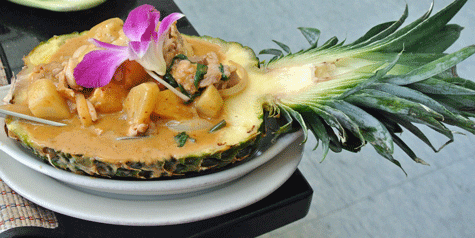
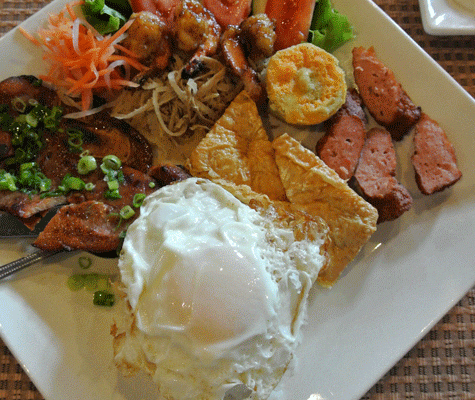
Today Huyen Wylie might smile a little when she describes herself as having been one of the Vietnamese “boat people,” but it’s not because she finds anything evenly mildly amusing about the term.  She was but ten years old when her family braved the choppy waters of the South China Sea in their quest for freedom.  It was their third attempt.  As with many families, fleeing their homeland was an act of desperation undertaken by people persecuted by an oppressive communist government.  It was a perilous journey fraught with uncertainty and danger.  Still, risking death on the open seas was preferable to the certain imprisonment or execution many citizens  faced at the hands of a retaliatory government.  Many of the boats used to flee Vietnam were crude and makeshift watercraft–often converted fishing boats–not built for the open waters.  Dangerously overcrowded, many sunk shortly after leaving the shore.  Making it out to the open sea was no guarantee of freedom, but  often the beginning of other dangers such as unfriendly neighboring countries who turned the refugees away and pirates who murdered many and sold others into prostitution or slavery. Huyen’s family made it to Hong Kong where they remained in a…

Dudley’s Barbecue – Albuquerque, New Mexico

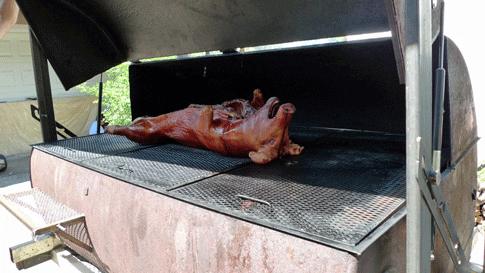
The United States Department of Agriculture defines barbecue as “any meat cooked by the direct action of heat resulting from the burning of hardwood or the hot coals therefrom for a sufficient period to assume the usual characteristics” including the formation of a brown crust and a weight loss of at least thirty percent.” To the citizens of the great state of North Carolina, that definition is heresy, an example of government ineptitude and maybe even reason enough to secede from the union. Everyone in the Tar Heel state knows barbecue is all about pork. In fact, the words “barbecue” and “pork” are synonymous…and don’t ever call pork “the other white meat.” Doing so would be to utter fighting words (similar to suggesting to a Norteño that a little bit of cumin will improve chile) and to disparage centuries of tradition. You can get away with saying that in North Carolina tobacco is a vegetable, but to suggest beef as a viable barbecue option is blasphemy. North Carolinians go especially hog wild for pulled pork that’s been slow roasted for hours over low heat rendering it so tender that it’s “pulled” from the roast with one’s fingers or forks. In…

Mamba’s Kitchen – Albuquerque, New Mexico (CLOSED)

When my friend Ryan “Break the Chain” Scott and I first visited Mamba’s Kitchen, we deliberated the genesis of the restaurant’s name. The possibilities were intriguing. The restaurant must be named for the black mamba, one of the world’s most venomous snakes, I thought. Ryan surmised then quickly dismissed the notion that the restaurant’s name honors Kobe Bryant, the Los Angeles Lakers star who calls himself the “Mamba” because he wants to have the type of basketball precision the snake has (it can strike with 99 percent accuracy at maximum speed, in rapid succession). Could it share the Mamba sobriquet with Beatrix Kiddo, the protagonist of the brilliant Quentin Tarantino movie Kill Bill, we wondered. Perhaps it’s named for Mambo Italiano, the 1954 hit song by Rosemary Clooney. Because the edifice which is now home to Mamba’s Kitchen twice previously housed two soul food restaurants, we finally reasoned Mamba’s Kitchen must be a sort of hybrid Soul food-Mexican food fusion restaurant.  Clever though our conjecture was, the reason for the restaurant’s name is far more down-to-earth and beautifully innocent.  Mamba is actually named for the grandmother of restaurant founder and owner Rebecca Sandoval.  When a grandchild couldn’t pronounce “grandma,” he…

Jamon’s Frybread Cabana – Albuquerque, New Mexico (CLOSED)

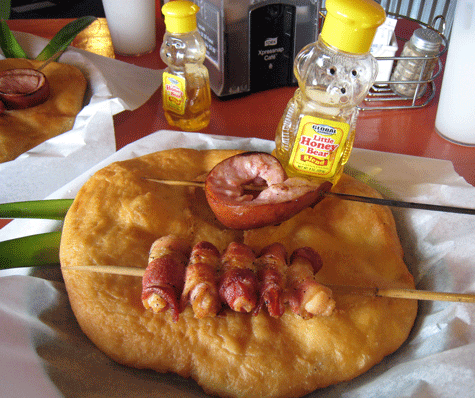
Several years ago when dinosaurs roamed the earth, multi-player gaming meant sitting at a table and playing board and card games with friends actually sitting across the table from you as opposed to the disembodied online kind of ‘friends.” My compadre Brad and I had been trounced several times by our pop culture savvy spouses at Trivial Pursuit, a primitive game contemporaneous with throwing rocks at mastodons.  After four games, we finally had a chance to win one, but it came down to the toughest question Kim and Vicki could muster in a pop culture category which had been our downfall all night.  The question was “Who is called the Marilyn Monroe of South America?”   You could hear a pin drop when I calmly answered “Sonia Braga.” Shockingly (for me), no one else at the table had even heard of Sonia Braga, a sultry seductress from Brazil…and tragically none of them had seen Gabriela and Flor and Her Two Husbands, two wonderfully spicy movies showcasing the raw voluptuousness of the sexy siren.  As if Sonia’s erotic qualities weren’t sufficiently alluring, in both movies her cooking was as integral to the plot lines as her lovemaking.  A stunning woman who…

Just A Bite! – Albuquerque, New Mexico (CLOSED)

An April, 2009 article in the Taos News reveals just how much cultural attitudes have changed in the county in which I grew up toward men in the kitchen.  The article profiled a Taos High School culinary arts team–comprised of three boys and one young lady–which triumphed over 16 other New Mexico schools in a state-wide cooking competition to earn a berth on the national stage. In the dark ages when I attended high school, any male student deigning to admit to enjoy cooking would have been dismissed as a (select your own pejorative) and might even have incurred physical harm.  When I enrolled in Home Economics as a senior, I spared myself merciless taunting and possibly painful beatings by telling my friends it was solely so I could eat the food prepared by the female students (not surprisingly my pals thought it was a good idea, too).  As if by malevolent design, the first semester of the class was dedicated to sewing, a torturous ordeal for which my profound lack of interest proved an early undoing. I quit well before semester’s end. My next flirtation with participating in the culinary arts came when I enlisted in the Air Force.  With vocational aptitude scores…

El Sarape – Albuquerque, New Mexico (CLOSED)

Before the advent of political correctness, the unchecked use of controversial stereotypes was rampant throughout America.  Starting in the 1930s, for example,  ethnic caricatures in the guise of tchotchkes (salt shakers, cookie jars, plant pots and the like) could be seen in households throughout the fruited plain. Neon-spangled roadside five-and-tens  dotting the motorways and byways were primary culprits in the sale of kitschy, tacky knickknacks propagating such stereotypes as mammies, cigar-store Indians and the Mexican peasant taking a siesta while reclining against a saguaro.  The sleeping Mexican, often called Pancho, was particularly prominent throughout the Southwest.  Generally attired in huaraches, pantaloons, a sash which doubled as a belt, a massive sombrero that hid his face and a colorful sarape, that image perpetuated the stereotype of the lazy Mexican. While politically conscious Americans of all ethnicities found the sleeping Mexican offensive, in the border towns and in the barrios, the image was often used in front yards by families of Mexican descent as a symbol of home.  According to Maribel Alvarez, an associate professor at the University of Arizona, Mexican workers viewed the sleeping Mexican not as a laughable stereotype or curio, but as a symbol of honor–a hard-working Mexican resting…

Dagmar’s Restaurant & Strudel Haus – Albuquerque, New Mexico (CLOSED)

According to the 2000 United States Census, there are 47 million Americans of German ancestry, making them the largest self-reporting ethnic group in the country. German Americans represent 16 percent of the total U.S. population.  With such a large ancestry group, you might wonder why German cuisine isn’t as popular as the cuisine of its European neighbors Italy and France.  It’s a question which also seems to baffle the National Restaurant Association which posits that Americans characterize German food as “rich, indulgent foods; good, hearty portions; and irresistible desserts.”  With reasons like those, you might expect that there would be more German restaurants across the fruited plain (and more than one German restaurant in the Land of Enchantment).  Bon Appetit‘s restaurant and drink editor Andrew Knowlton gives hope that this will change, “In a refreshing departure from the Italian comfort food craze, America is enjoying a Germanic cuisine boom.  I chalk it up to the perfect storm of craft beer and charcuterie and the overall pork-obsessed times we live in.” If you grew up in the Midwest where German is the most reported ancestry, chances are you’re well acquainted with German food. My Kim grew up in Chicago where she…

Sengdao Bar-B-Q Asian Cuisine – Albuquerque, New Mexico (CLOSED)

Despite my (then) near eidetic memory and a sesquipedalian lexicon, it was my bumpkinly naivete my friends in Boston found most surprising (and amusing) about me.  By having absorbed Encyclopedia Britannica (before the internet and Wikipedia were a twinkle in Al Gore’s eyes), I had as much or more “book knowledge” about Boston as any of them did, but became wide-eyed and mesmerized at seeing all those sights and cultures which heretofore existed for me only on the printed page.  My friends delighted in introducing me to things you’d just never see in bucolic Peñasco, New Mexico.  They also did their best to shock me (though for sheer shock and Wes Craven movie fear-inducing value, nothing was as shocking as the catch-as-catch-can driving style of Bostonians).  By taking me to Boston’s notorious “Combat Zone,” a name given to the red light district (which no encyclopedia could have prepared me for), they sought to tear down the enceinte built up by my conservative Catholic upbringing.  It certainly did shock and awe me.   Not at all as shocking as my friends would have enjoyed were the cuisines of the world to which they introduced me.   Rather than shock me, they…

Mariscos Altamar – Albuquerque, New Mexico

“Forget what you thought you knew about Mexican food!” That should be a cardinal rule for unacculturated diners when traveling to Mexico–or visiting Mariscos Altamar–for the first time. Many of the dishes some Americans commonly believe typify Mexican cooking are either not Mexican at all (chimichangas and fajitas, for example), or are prepared using inauthentic techniques and ingredients (such as “nachos” crafted from melted Velveeta heaped over a dish of corn chips, a recipe I’ve actually seen on a cookbook published by a charity for which I almost withdrew support based on such recipes). Because Mexico spans several climatic zones and a diverse topography, its cuisine varies from region to region.  The favorite foods of the Mexican coast may not even be available further inland.  Inland foods may not be as commonly served on the coasts.  Ah, those coasts!  Mexico’s beautiful and varied coastal waters are not only pristine in their azure purity, they yield an abundant and unsurpassed assortment of deliciously prepared delicacies from the sea. When Hector Hernandez moved to Albuquerque from Ronald Reagan country (Orange County, California), it didn’t take him long to determine that the Duke City restaurant scene lacked traditional Mexican seafood (mariscos) restaurants–the type…

Silvano’s New Mexican Restaurant – Albuquerque, New Mexico (CLOSED)

My friend Carrie Seidman, the elegant and erstwhile restaurant critic for the Albuquerque Tribune prefaced one restaurant review by saying “sometimes pleasure comes with a price tag.” That pithy aphorism should probably be appended by paraphrasing Luke 12:48: “from those who charge a lot, much will be expected.”   Expensive meals come with  expectations of intoxicating aromas and tastes, impeccable service and a classy, relaxed milieu in which to bask in the glory of a decadent, memorable meal.  Such meals are worth it only if afterwards you consider every dollar well spent.  Any regrets and the experience will leave you (and your wallet or purse) empty. Fortunately for the most penurious and parsimonious among us, there is no absolute correlation of price tag to enjoyment.  There is no guarantee that an expensive meal will be a good one…but there is most certainly a correlation between spending a lot of money and the pain and regret you feel afterwards if the meal didn’t achieve lofty expectations.  Conversely, some of the very best restaurant meals to be enjoyed are often those that not only provide great value for the money, they serve genuinely good food and provide simple, but very pleasant and rewarding…